
The short version
Build in public by turning real product work into useful evidence: the problem, the decision, the result, the lesson, and one focused invitation. Share enough context to help the right people, but protect customers, credentials, contracts, and thinking that is not ready for reaction. Measure feedback, relevant conversations, testers, signups, and revenue beside reach. The goal is not to perform productivity. It is to make better decisions, earn trust, and create distribution while the product improves.
Building in public is often reduced to screenshots, revenue charts, and daily shipping logs. That is the visible surface, not the method. A good public update makes a piece of work legible to someone who cares about the underlying problem. It can attract feedback, preserve a decision, reveal demand, or invite the next user.
I started using X while building ClimbX and reached 6,900 followers in 81 days. The useful result was not the follower number by itself. Public posts created conversations, forced clearer explanations, and gave the product an audience connected to the work. This guide explains how to build that loop without turning your company or life into content.
What building in public is, and what it is not
Building in public is a deliberate practice of sharing selected work before the entire story is finished. The useful unit is not an announcement. It is evidence plus context. Readers should understand what changed, why it mattered, and what you learned.
- It is documentation: decisions, experiments, customer observations, tradeoffs, and outcomes.
- It is conversation: questions that a relevant reader can answer from experience.
- It is distribution: repeated proof that makes the problem and your point of view recognizable.
- It is not surveillance: the audience is not entitled to private data, exact revenue, or every unfinished thought.
- It is not a commit log: shipped activity without a reader-level lesson is usually interesting only to the builder.
Choose the business reason before the content format
“Grow an audience” is too vague to guide a post. Pick one reason for the next 30 days. A pre-product founder may need problem interviews. A working product may need testers. A founder with users may need clearer positioning, stronger proof, or distribution for a launch.
| Business need | Useful public artifact | Measure |
|---|---|---|
| Understand the problem | Observed pain, assumption, focused question | Relevant replies and interviews |
| Recruit early users | Specific workflow, current limitation, tester invitation | Qualified testers |
| Improve the product | Decision, before and after, result | Useful feedback and adoption |
| Build trust | Evidence-backed lesson or honest postmortem | Repeat readers and qualified profile visits |
| Launch | Problem, product, proof, who it is for, one action | Trials, demos, or sales |
The five-part public update
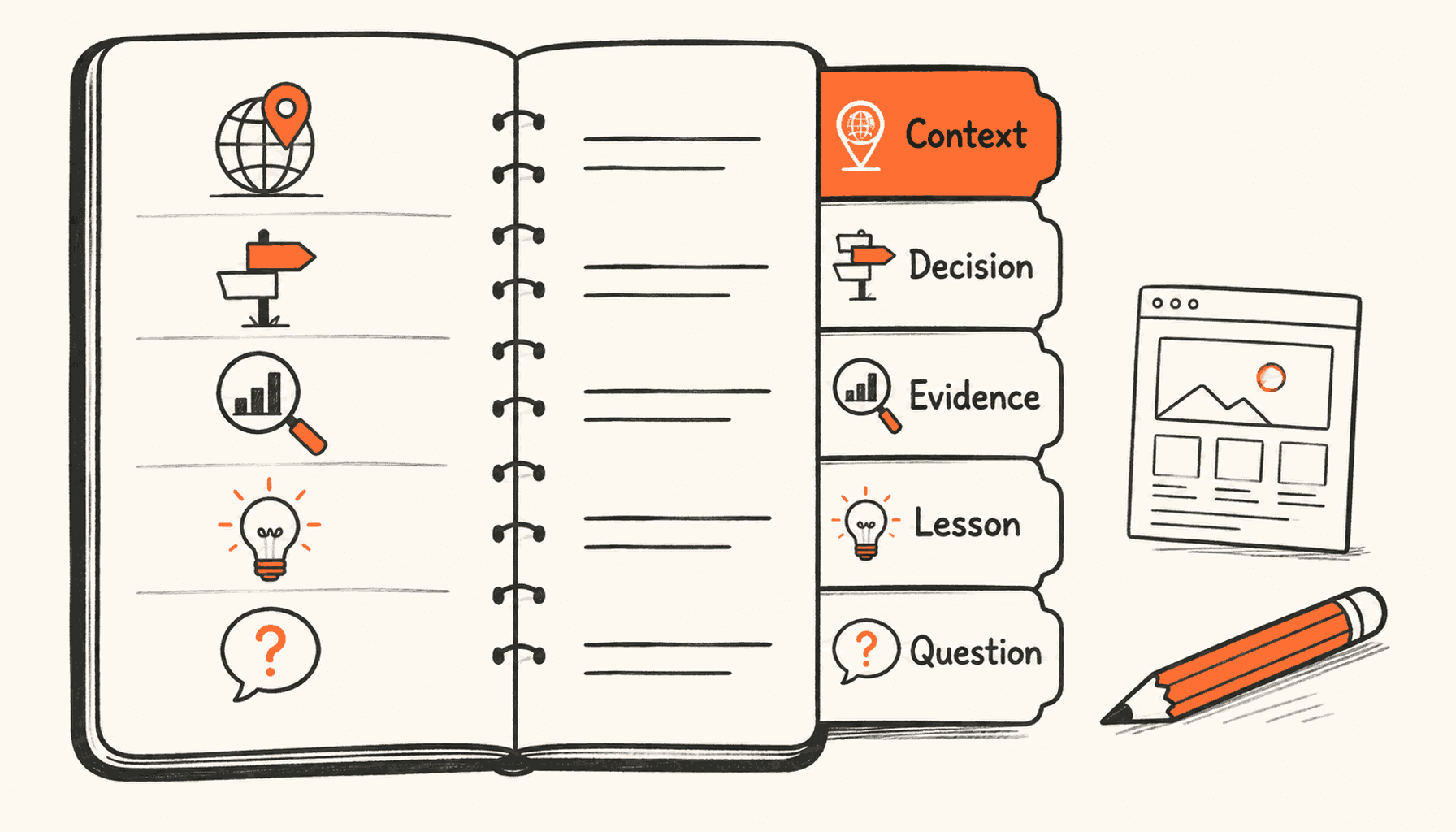
The strongest build-in-public posts usually climb an evidence ladder. You do not need all five parts every time, but a post becomes more useful as it moves beyond activity.
| Level | Question answered | Example |
|---|---|---|
| Activity | What you did | Shipped a new onboarding screen |
| Decision | Why you chose it | Removed two fields after watching setup failures |
| Evidence | What changed | More testers reached the first useful result |
| Lesson | What another founder can reuse | Ask only for information needed before value |
| Invitation | Who should respond | Looking for three founders with multi-account workflows |
Start with the assumption, explain what you observed, and name the decision it changed. Include the limitation before inviting a relevant reader to respond. These are editorial formats to try, not a measured ranking of which format produces the most customers.
Seven formats that give the audience a reason to care
- 1
The decision post
Explain two plausible options, the constraint that mattered, the choice, and what would make you reverse it. This demonstrates judgment rather than activity. - 2
The customer-language post
Describe a recurring problem in anonymized customer language, then explain how it changed the product or positioning. Never expose a private conversation. - 3
The experiment post
State the hypothesis, one changed variable, the observation window, the result, and the caveat. Small honest tests are more credible than universal claims. - 4
The proof artifact
Use a screenshot, chart, short demo, or before-and-after comparison only when it proves the claim. Decorative art is not evidence. - 5
The mistake and repair
Name the specific decision that failed, what it cost, the signal you missed, and what changed. Avoid vulnerability performed only for engagement. - 6
The weekly operating note
Summarize what shipped, what changed your mind, what remains uncertain, and the next outcome. This is stronger than a list of completed tasks. - 7
The focused invitation
Ask for a specific type of user, use case, or experience. “Thoughts?” creates noise. A clear eligibility condition creates useful replies.
What to keep private
Public does not mean exposed. Boundaries make the practice sustainable. Review every screenshot for browser tabs, notifications, email addresses, tokens, customer names, private URLs, and image metadata. When the lesson comes from a customer, separate the lesson from the identity.
- API keys, tokens, cookies, recovery codes, private repositories, and exploitable security details.
- Customer names, emails, analytics identifiers, payment details, and support conversations without explicit permission.
- Partner agreements, unreleased integrations, contracts, and information owned by an employer or collaborator.
- Personal routines, locations, family details, or health information that do not serve the lesson.
- Unfinished decisions where public reaction would distort the work before you have enough evidence.
A delayed retrospective is still building in public. Write privately during the experiment, make the decision, then publish the evidence and tradeoff once the lesson is clear.
Build with customers, not only in front of founders
The most common strategic mistake is attracting people who enjoy the founder journey but will never buy the product. If your SaaS serves other founders, the overlap may be useful. If it serves accountants, recruiters, clinics, or tradespeople, a founder-heavy audience can deliver applause without demand.
Keep some founder-story posts, but anchor the account in the customer problem. Use the phrases buyers use, show the workflow they recognize, and spend time in the conversations where they already appear. My analysis of 926 posts found that broad questions could produce enormous discussion. That is useful for distribution, but reach is not proof of purchase intent. The next article in this cluster explains why build-in-public posts can get likes without customers.
A sustainable weekly system
- 1
Capture while working
Keep one note with decisions, customer questions, surprising data, bugs, tradeoffs, and screenshots that are safe to share. - 2
Select by business value
Choose the artifact most likely to clarify the problem, earn feedback, prove progress, or invite a relevant person. - 3
Add the missing context
Explain the prior assumption, the constraint, and the evidence. Do not expect a stranger to understand an internal changelog. - 4
Publish in one clear format
Use a concise post for one idea, a thread for a real sequence, and a screenshot or demo only when it carries proof. - 5
Stay for the conversation
Answer relevant replies, ask follow-up questions, and record the language people use. The response often contains the next product or content idea. - 6
Review the business outcome
Track relevant replies, profile visits, site clicks, tester conversations, signups, and revenue. A post can be useful without going viral.
A practical weekly mix
- One customer-problem observation.
- One decision or tradeoff from the product.
- One proof-backed result or honest failed experiment.
- One useful reply session inside customer conversations.
- One weekly recap with a focused invitation.
How to measure whether building in public is working
Use a ladder of outcomes. Impressions show distribution. Profile visits show curiosity. Relevant follows show positioning. Qualified replies and DMs show problem recognition. Trials and sales show commercial movement. Measure every level so you can find the broken handoff.
| Signal | What it suggests | If it is weak |
|---|---|---|
| Impressions | The idea earned feed distribution | Improve topic relevance and opening |
| Profile visits | Readers wanted more context | Make the post more specific or distinctive |
| Relevant follows | The profile promise matched | Clarify bio, proof, and pinned post |
| Qualified conversations | The audience recognizes the problem | Write closer to customer language |
| Trials or demos | The next step is credible | Show product proof and reduce CTA friction |
| Paid customers | Problem, audience, offer, and trust align | Interview non-buyers before posting more |
Common build-in-public mistakes
- Publishing a task log with no reader-level lesson.
- Turning every setback into theatrical vulnerability.
- Sharing customer information because a screenshot looks persuasive.
- Optimizing for other founders when the buyers are somewhere else.
- Asking broad questions that produce engagement but no decision-quality feedback.
- Letting content consume the hours needed to build and support the product.
- Treating one viral result as a repeatable acquisition channel.
- Hiding the product so completely that interested readers cannot understand or try it.
Your first 30 days
| Week | Focus | Output |
|---|---|---|
| 1 | Positioning and customer language | Profile promise, 10 relevant conversations, 3 problem posts |
| 2 | Decisions and evidence | 2 decision posts, 1 experiment, 1 proof artifact |
| 3 | Feedback loop | Focused tester invitation, interviews, public lesson from feedback |
| 4 | Repeat and connect | Weekly recap, product proof, clear next step, outcome review |
At the end of the month, keep the formats that created relevant conversations and product movement. Retire the formats that created only shallow attention. The best build-in-public system becomes quieter and more precise over time because you learn what the audience and business actually need.
Frequently asked questions
What does building in public mean?
Building in public means sharing useful evidence from the process of creating a product, including decisions, experiments, lessons, progress, and selected setbacks. It does not require sharing every detail, live revenue, customer data, or unfinished private thinking.
Does building in public work with no followers?
Yes, but the first goal is not broad reach. Use early posts to create ten relevant conversations, recruit testers, clarify the problem, and build a public record. Replies and direct conversations usually matter more than broadcasting when the account is small.
How often should a SaaS founder post build-in-public updates?
Start with one useful original post on most working days or one substantial weekly recap, plus relevant replies. Capture notes while working so publishing does not replace product work. Increase frequency only when the quality and business value remain intact.
Should founders share revenue publicly?
Only when the number teaches something and you accept the consequences of making it permanent. You can often share a conversion lesson, a pricing decision, or a directional change without publishing exact revenue.
What should never be shared while building in public?
Never expose customer identities, private messages without consent, credentials, security details, private contracts, unreleased partner information, or personal information that creates safety risk. Screenshots need the same review as code.
Can build-in-public content attract SaaS customers?
It can when the people enjoying the content also experience the problem your product solves. Product evidence, customer language, useful problem education, and a clear next step connect the public story to buying intent. Founder entertainment alone rarely does.
Turn real product work into useful founder content.
ClimbX helps you study relevant outliers, organize ideas from your own work, draft in your voice, schedule consistently, and learn from what your audience actually responds to.
Read next
- What to Post on X as a Startup Founder: 50 Practical Ideas - Fifty useful X post ideas for startup and SaaS founders, organized by proof, customer insight, product decisions, lessons, launches, and conversation goals.
- How to Get Your First SaaS Customers From X - Find real buying signals on X, start useful founder conversations, validate the problem, and turn relevant attention into your first paying SaaS customers.
- Why Your Build-in-Public Posts Get Likes but No Customers - Diagnose why X followers and build-in-public likes are not producing SaaS customers, then repair the audience, message, proof, offer, and conversion path.
Sources
- SaaS Ranger: Building a Micro-SaaS in public - a practical founder guide to sharing progress, learning from feedback, and building an audience around a small SaaS product
- Mercury: Build in public or private - a founder-focused discussion of when public building helps, when privacy is useful, and why the choice is a spectrum