
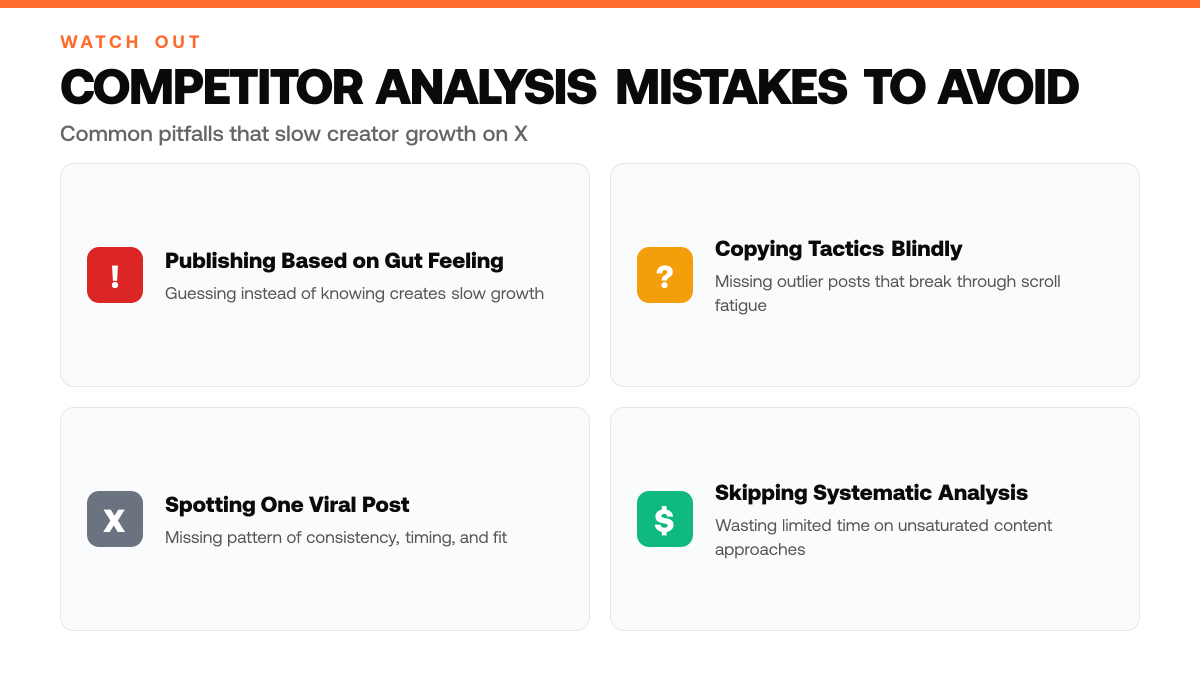
Every successful creator on X has a pattern, certain post formats, topics, and timing that consistently outperform the rest. Yet most solo builders never study these patterns. Instead, they publish based on gut feeling, hoping something lands. The difference between guessing and knowing is the difference between slow growth and momentum.
Competitor analysis on Twitter reveals the content strategies and engagement patterns that already work in your niche. By examining what resonates with audiences similar to yours, you can adapt proven approaches to your own voice and audience. Research shows that creators who study what breaks out in their space gain a measurable edge over those who rely on intuition alone.[2] For a deeper look, see Why Your Twitter Posts Plateau (And How to Fix It). For a deeper look, see Why Top Creators Tweet at Different Times (Data Analysis).
This article walks you through how to analyze competitor posts for actionable content ideas, what to look for, which metrics matter, and how to extract strategies you can apply immediately to grow your own following and engagement. Most creators copy competitor tactics blindly, missing the outlier posts that actually broke through their audience's scroll fatigue, ClimbX scans accounts ahead of you to surface the 2-3x overperforming posts your niche is sleeping on, then drafts your response in your authentic voice.
TL;DR
- Competitor Twitter analysis means tracking their top-performing posts, engagement metrics, posting frequency, and how their audience interacts with their content to shape your own strategy.
- This approach works because it reveals what resonates with your shared audience without requiring you to guess, you learn directly from real engagement data.
- Most creators skip the systematic part: they spot one viral post and copy it, missing the pattern of consistency, timing, and audience fit that actually drives growth.
Understanding Competitor Twitter Post Analysis
What Is Competitor Twitter Post Analysis?
Competitor Twitter post analysis is the process of systematically reviewing what your competitors are sharing on X, their topics, posting frequency, engagement patterns, and messaging style, to identify gaps and opportunities in your own content strategy. Rather than creating in a vacuum, you examine the posts that resonate in your niche, study which formats and angles generate discussion, and note the timing patterns that drive visibility. This research reveals which content approaches are already saturated and which audience needs remain underserved, giving you a roadmap for differentiation.
Why Competitor Analysis Matters for Solo Creators
For solo creators and solopreneurs, competitor analysis uncovers audience gaps, content timing patterns, and messaging angles that competitors haven't fully exploited. By understanding what your competitors do well and where they fall short, you can position your unique voice and avoid duplicating saturated content approaches. This intelligence helps you spend your limited time and energy on posts that fill real demand rather than guessing which topics will resonate. The result is faster audience growth, higher impressions, and a clearer path to monetization, because you're building content around proven audience interests, not hoping something sticks.[3]
The Competitive Landscape on X
X has become a primary platform where creators, entrepreneurs, and thought leaders compete for attention and influence. The platform rewards consistency, authenticity, and relevance, but only if your content speaks to what your audience actually wants to hear. Competitors in your niche are already running this experiment; they're posting daily, testing different angles, and learning what works. By analyzing their moves, you skip months of trial and error and adopt strategies grounded in real engagement data from your actual market. This competitive intelligence transforms content creation from guesswork into a strategic, audience-first process.
Step-by-Step Process
1. Select 5 - 10 competitor accounts to monitor
Identify creators in your niche who post regularly and have engaged audiences, accounts slightly ahead of your current size often offer the most actionable insights. Follow them and add their profiles to a dedicated list or monitoring tool so you can track their activity consistently without getting lost in your main feed.
2. Track engagement metrics on their top posts
For each competitor's posts over the past several weeks, note which ones generate the most replies, retweets, likes, and bookmarks. Look for patterns: Do threads outperform single tweets? Do certain topics or posting times attract more interaction? Record these observations in a simple spreadsheet to spot trends that emerge across multiple posts.[1]
3. Identify recurring themes and content formats
Review the high-performing posts to uncover what subjects, angles, or storytelling structures resonate with their audience. Note whether they rely on lists, personal stories, contrarian takes, or data-backed claims. This reveals the content DNA that works in your space, not to copy, but to understand what your audience values.
4. Test and adapt insights into your own posts
Take the patterns you've identified and create original posts using similar formats or themes but with your unique voice and perspective. Track how your audience responds to these experiments. Over time, you'll learn which competitor insights translate to your own growth, refining your strategy based on real performance data rather than guesswork.
How This Works in Practice
Example 1: The Solo Creator Spotting Engagement Hooks
Picture a solo creator who's been posting inconsistently and watching her follower count plateau. She decides to spend 30 minutes analyzing the top 10 posts from three competitors in her niche over the past month. She notices a pattern: competitors consistently ask direct questions in their opening line, tag relevant communities, and post between 8 and 10 a.m. She also sees which hooks, personal vulnerability, contrarian takes, or behind-the-scenes breakdowns, generate the most replies and retweets. Armed with this insight, she redesigns her own content calendar to mirror the posting times, adopts the question-first structure, and rotates through the same engagement hooks she observed. Within 3 weeks, her average impressions climb noticeably, and her reply rate doubles. She's not copying content; she's reverse-engineered the *format* that works for her audience.
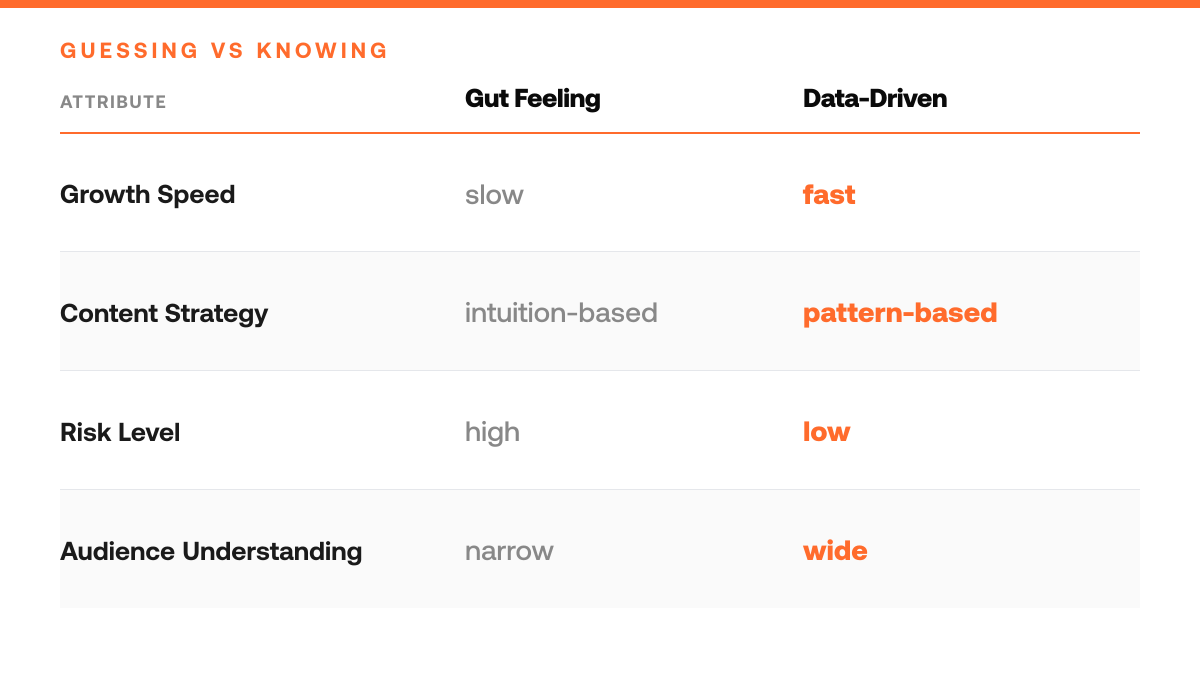
Guessing vs. Data-Driven Content Strategy
| Approach | Process | Result |
|---|---|---|
| Guessing (Traditional) | Publish based on gut feeling without studying patterns | Slow growth, inconsistent engagement, months of trial and error |
| Data-Driven (Competitor Analysis) | Study competitor posts, engagement metrics, and timing patterns | Measurable edge, faster audience growth, higher impressions, clearer path to monetization |
| Blind Copying (Common Mistake) | Spot one viral post and replicate it without understanding context | Miss the pattern of consistency, timing, and audience fit that drives real growth |
Example 2: The Solopreneur Identifying Content Gaps
Consider a solopreneur who offers freelance writing services and wants to position himself as an authority. He audits five established voices in his space and maps out what topics they cover: productivity hacks, writing tools, client horror stories. He notices none of them consistently address the *business side*, pricing strategies, contract negotiation, raising rates. He sees an opening. Over the next 4 weeks, he publishes 8 posts on contract red flags, rate-setting frameworks, and client management. Because he's filling a gap his competitors left empty, his posts attract a different subset of the audience, people actively seeking business advice, not just writing tips. His engagement from potential clients increases, and several reach out about his services. His competitor analysis revealed not what to copy, but what to own.
Why Observation Beats Guessing
Both examples share a core truth: analyzing competitor content isn't about theft, it's about pattern recognition. Solo creators who study what resonates in their niche (posting cadence, hook style, topic selection) can make intentional choices instead of posting randomly and hoping. The data lives in plain sight on X; the creators who extract it systematically are the ones who grow.
Competitor Twitter Analysis Checklist
- Document competitor posts that generate high engagement and note the specific format, hook, and call-to-action used
- Track which post types (threads, polls, quotes, replies) your competitors use most frequently and measure their performance
- Record the posting times and frequency of top-performing competitors to identify patterns in audience activity
- Analyze the language, tone, and topics in competitor posts that resonate with your shared audience
- Translate competitor insights into your content calendar by scheduling similar formats and themes for your own posts
Common Mistakes to Avoid
Mistake: Copying competitor tweets verbatim instead of adapting them to your voice
Plagiarizing competitor content damages your credibility and fails to differentiate you in a crowded feed. Instead, use competitor tweets as inspiration for topics and angles, then rewrite entirely in your own voice, perspective, and style. This builds authentic audience connection and avoids the appearance of copying.[4]
What to Track vs. What to Skip
| Track This | Why It Matters | Skip This |
|---|---|---|
| Top-performing posts and engagement metrics | Reveals what resonates with your shared audience | Random posts without engagement context |
| Posting frequency and timing patterns | Uncovers visibility windows and consistency strategies | Sporadic posting data that shows no pattern |
| Audience interaction and messaging style | Shows which formats and angles generate discussion | Surface-level observation without systematic review |
| Content gaps and underserved audience needs | Identifies opportunities competitors haven't exploited | Copying saturated content approaches |
Mistake: Analyzing competitors in different niches or audience segments than yours
Studying creators who target a different audience or operate in an unrelated niche wastes analysis time and produces irrelevant insights. Focus competitor research on accounts that serve the same audience, solve the same problems, or operate in your exact niche. This ensures the content patterns you identify actually resonate with your followers.[4]
Mistake: Collecting competitor data but never testing insights with your own audience
Competitor analysis only works when you validate findings through experimentation. After identifying a high-performing tweet format or topic from competitors, test it with your audience, track engagement, refine based on results, and iterate. Skipping this step leaves you guessing whether competitor success will translate to your followers.[4]
Frequently Asked Questions
How often should I analyze competitor Twitter posts?
Analyze competitor posts weekly or bi-weekly to stay current with trending formats and audience preferences without over-analyzing. Regular cadence helps you spot emerging patterns in what resonates, engagement spikes, hook types, and topic shifts, while keeping your own content fresh and responsive. Consistent monitoring beats sporadic deep dives.[5]
Which metrics matter most when reviewing competitor posts?
Engagement rate, reply count, and retweet volume reveal what genuinely resonates with your shared audience, far more than follower count alone. Focus on posts that outperform their baseline (2-3x their typical engagement), as these signal format, topic, or hook patterns worth adapting. Impressions and save counts also indicate content that drives lasting value.[5]
How do I adapt competitor insights without plagiarizing?
Adapt the format, hook structure, or topic angle, not the exact wording or premise. If a competitor's thread on audience psychology performs well, write your own thread on the same topic using your unique examples, voice, and perspective. The goal is learning what works structurally, then making it authentically yours through original research and lived experience.
Sources
Try the loop on your own cohort.
Pick three accounts you would like to be at in 12 months. ClimbX pulls their recent outliers, tags them, and drafts in your voice off what is currently working. Edit, ship, watch the loop tighten.
Read next
- X Posts in Google Search Console: The New SEO Opportunity - Google Search Console can now track the queries, impressions, clicks, CTR, and position of your X posts. Here is how creators can turn social posts into a measurable SEO and AI-search research loop.
- X Algorithm Labels Explained: How Visibility Filtering Works - X can label accounts and posts before deciding where they may appear. See the real DoNotAmplify, SpamHighRecall, abuse, NSFW, and post-level labels in X’s open-source algorithm.