
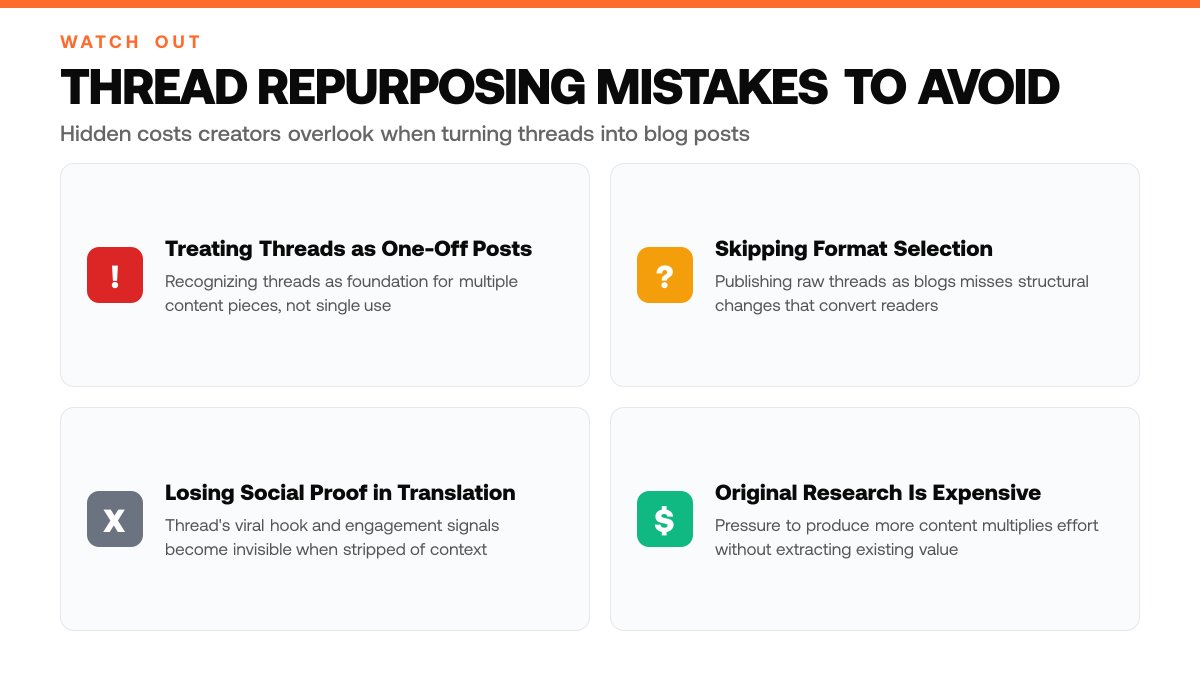
A Twitter thread that lands with your audience contains something most blog posts don't: real narrative momentum, genuine insight, and built-in engagement signals from replies and retweets. That thread already proved it resonates. The problem is treating it as a one-off social post instead of recognizing it as the foundation for multiple content pieces.
Content creators and solopreneurs face constant pressure to produce more, more posts, more formats, more platforms. But original research and ideation are expensive. The smarter move is to extract maximum value from content that's already working. Repurposing a single strong thread into multiple blog formats multiplies your output without doubling your effort, and it keeps your messaging consistent across channels. For a deeper look, see 7 Twitter Post Formats That Outperform Your Niche. For a deeper look, see How to Repurpose Blog Content for X (5 Formats).
This article walks through five proven formats for transforming your best Twitter threads into blog-ready content. Each format serves a different reader intent and search pattern, so a single thread can become a how-to guide, a case study, a checklist, an explainer, or a narrative essay, each one standing alone as complete, valuable content. Twitter threads often underperform as blog posts because the thread's viral hook, designed for scroll-stopping, becomes invisible when stripped of context and social proof, ClimbX identifies your highest-performing formats across your last 100 posts, then mirrors those winning patterns into new blog-ready content that compounds your reach across platforms.
TL;DR
- Five proven blog formats, how-to guides, case studies, listicles, tutorials, and narrative essays, transform Twitter threads into SEO-friendly, monetizable content that drives sustained audience growth.
- Each format repurposes thread material by expanding core insights into long-form content that search engines reward and readers trust, turning fleeting social posts into lasting assets.
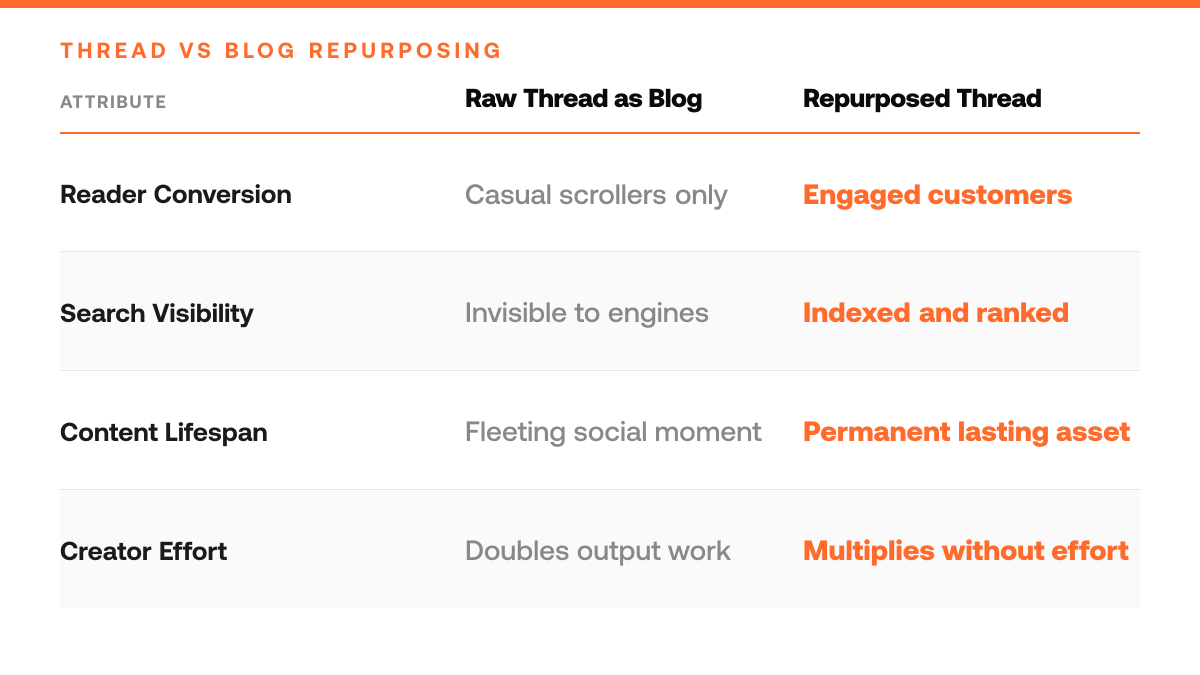
- Most creators skip format selection and publish raw threads as blogs, missing the structural changes that convert casual scrollers into engaged readers and customers.[1]
Understanding How to Repurpose Twitter Threads Into Blog Posts
What Is Thread Repurposing?
Thread repurposing is the practice of taking a Twitter thread, a connected series of posts built around a single insight or narrative, and reformatting it into a blog post or other long-form content. This isn't copying; it's translating the same core idea into a different medium with a different reader expectation. A Twitter thread uses hooks, evidence, transitions, and conclusions structured to hold attention in a feed. When you repurpose that thread into a blog post, you're mapping those same structural elements onto a longer, more detailed architecture. The insight stays intact, but the format, depth, and presentation adapt to how blog readers consume information, scanning headlines, jumping to sections, and expecting comprehensive coverage in one place.[2]
Why Repurposing Matters for Solo Creators
For solo creators and solopreneurs building an audience on X, repurposing threads into blog posts multiplies the value of every piece of original thinking you produce. You've already done the hard work of distilling an idea into a thread; extending that work into a blog post means reaching readers who prefer long-form content, improving your search visibility, and creating an asset that drives traffic back to your profile. A single thread might spark engagement in the moment, but a blog post lives permanently, gets indexed by search engines, and can be shared across multiple channels. This approach lets you grow followers and increase impressions without starting from scratch each time, you're leveraging the same insight across different audience segments and platforms.
The Structural Connection Between Threads and Blog Posts
Twitter threads and blog posts share the same foundational architecture: a hook that captures attention, evidence or examples that support your claim, transitions that guide the reader forward, and a conclusion that reinforces the takeaway. The difference is scale and depth. A thread condenses these elements into separate tweets; a blog post expands them into sections, paragraphs, and supporting details. Understanding this structural parallel makes repurposing straightforward, you're not inventing new content, you're unpacking what's already there. Each tweet becomes a section or subsection, each transition becomes a bridge paragraph, and each piece of evidence gets room to breathe. This alignment means repurposing isn't a creative burden; it's a natural extension of the thinking you've already done.[2]
Step-by-Step Process
1. Audit Your Thread's Core Performance
Review your Twitter thread's engagement metrics, likes, retweets, replies, and impressions, to identify which threads resonated most with your audience. Threads with higher engagement contain proven ideas worth expanding. Note the main claim or insight that drove that engagement; this becomes your blog post's anchor. Document the thread's original structure so you can see how the narrative flowed and what made readers stop to interact.
2. Extract and Clarify the Core Claim
Pull out the single strongest idea or argument from your thread and state it plainly in one sentence. This claim becomes your blog post's thesis. Strip away Twitter's character limits and casual tone; reframe the idea in formal, searchable language. Ask yourself: if someone searched for this problem or topic on Google, would my core claim answer their question? This step ensures your repurposed content targets reader intent, not just your followers.[3]
3. Choose a Blog Format That Fits Your Claim
Select one of five formats, how-to guide, listicle, case study, explainer, or opinion piece, based on what your claim demands. A how-to works best for actionable advice; a listicle suits multiple related tips; an explainer breaks down a concept; a case study shows real-world results; an opinion piece deepens a perspective. Match format to claim so the expanded post feels natural, not forced. This choice shapes how you'll add examples and citations in the next step.[3]
How This Works in Practice
Example 1: The Growth Marketer's Repurposing Workflow
Picture a growth marketer who publishes a Twitter thread on audience-building tactics, sharing 8 tweets over a few days on how to identify and engage micro-communities. Instead of letting that thread fade into the feed, she extracts the core insight and transforms it into a how-to guide for her blog, complete with step-by-step instructions and screenshots. The same thread then becomes the skeleton for a narrative essay exploring why community-first growth outperforms spray-and-pray tactics. Within weeks, she's created three distinct pieces targeting different search intents: readers hunting "how to build an audience" land on the guide; those asking "why does community matter" find the essay; and those seeking quick wins discover a listicle version titled "5 Micro-Community Tactics That Drive Real Engagement." Each format ranks independently, multiplying her organic traffic without requiring new research or original insights, just strategic repackaging of a single thread's value.
Twitter Thread vs Blog Post: Structural Differences
| Element | Twitter Thread | Blog Post |
|---|---|---|
| Reader Expectation | Scroll-stopping hooks and viral momentum | Comprehensive coverage in one place |
| Navigation | Sequential feed consumption | Scanning headlines and jumping to sections |
| Lifespan | Fleeting social engagement | Permanent asset indexed by search engines |
| Depth | Concise evidence and transitions | Expanded core insights with detailed architecture |
Example 2: The Creator's Monetization Strategy Expansion
Imagine a solopreneur who threads out a detailed breakdown of her creator monetization stack, sponsorships, affiliate programs, digital products, and ad revenue. That thread becomes a case study blog post documenting her exact revenue mix and the tools she uses to manage it. She then repurposes the same content into a tutorial-style post ("How to Set Up Your First Sponsorship Deal") and a longer narrative essay ("Why Diversification Saved My Creator Business"). A fourth format, a comparison listicle, tackles "5 Creator Monetization Models Ranked by Effort vs. Payoff." Each piece serves a different reader: the case study appeals to those wanting real-world proof; the tutorial attracts action-takers ready to implement; the essay resonates with skeptics; the listicle helps undecided creators choose their path. One thread, five formats, five different audience segments discovering her expertise across search and social.
Why Format Multiplication Wins
The core insight is simple: a Twitter thread contains multiple stories waiting to be told. A single thread on audience-building, monetization, or creator tools holds the DNA of a how-to guide, a case study, a listicle, a tutorial, and a narrative essay. By repurposing one thread into all five formats, you're not duplicating effort, you're multiplying discoverability. Each format attracts a different search query and reader intent, turning a single moment of insight into a long-term traffic engine that compounds over time.
Pre-Repurposing Thread Quality Checklist
- Review your thread for a clear central idea or narrative arc before converting it into blog format.
- Verify each tweet in the thread contains actionable insight, data, or storytelling that adds value to blog readers.
- Check that the thread's tone and voice align with your target audience's expectations for long-form content.
- Assess whether the thread has sufficient depth and supporting examples to sustain a full blog post without padding.
Common Mistakes to Avoid
Mistake: Copying thread text verbatim into a blog post without restructuring for SEO
Pasting a Twitter thread directly into a blog post ignores the structural demands of search engines and reader behavior. Threads lack the hierarchy, keyword placement, and scannable formatting that blog posts require. Fix this by rewriting each tweet as a full paragraph or section, adding an H2 or H3 subheading, and weaving in target keywords naturally. This transforms casual social copy into SEO-optimized content that ranks and holds reader attention.[4]
Do's and Don'ts When Repurposing Threads to Blog Posts
| Practice | Do This | Don't Do This |
|---|---|---|
| Format Selection | Choose a format matching reader intent and search patterns | Publish raw threads as blogs without structural changes |
| Core Content | Keep the original insight and narrative intact | Strip away context and social proof signals |
| Expansion | Map thread elements onto longer, more detailed architecture | Treat repurposing as simple copying to a new medium |
| Value Extraction | Leverage the same insight across different audience segments | Treat strong threads as one-off social posts |
Mistake: Failing to expand thread points with new examples, data, or deeper context
A Twitter thread's brevity is a feature on X but a liability on a blog. Readers expect longer-form content to deliver more value than the original post. If you simply expand spacing without adding fresh examples, case studies, or supporting evidence, the post feels thin and unfinished. Strengthen each claim from your thread by including a concrete example, a statistic, or a step-by-step breakdown that didn't fit in 280 characters.[4]
Mistake: Ignoring format-specific optimization for the target medium
A thread repurposed as a blog post, video script, or infographic requires different optimization for each format. Skipping this step wastes the repurposing effort, your blog post won't rank, your video won't hold viewers, and your infographic won't convert. Audit each format's best practices: blogs need keyword-rich headers and internal links; videos need captions and timestamps; infographics need clear hierarchy and readable fonts. Tailor the content to the medium, not just copy it across.[4]
Frequently Asked Questions
Why doesn't the same blog post work across all platforms?
Each platform has distinct reader expectations, search behavior, and content norms. A Twitter thread thrives on brevity and real-time engagement; a blog post demands depth, structure, and SEO optimization. Repurposed content performs best when tailored to these differences, adapting tone, format, and keyword strategy, rather than treating it as a one-size-fits-all asset. Research shows that platform-specific content strategies drive measurable audience growth and engagement.[5]
How often should I repurpose content to see real growth?
Frequency and consistency are key drivers of audience growth and monetization success. Rather than sporadic repurposing, establish a regular cadence, weekly or biweekly, and vary your formats (blog posts, newsletters, video scripts, lead magnets). This approach compounds over time, building authority and giving your audience multiple entry points to your ideas. Solo creators who maintain consistent repurposing schedules typically see measurable growth in followers and impressions.[5]
What's the fastest way to turn a thread into a blog post?
Use the step-by-step process: extract your thread's core claim, expand each point with examples or data, add an introduction and conclusion, optimize for search intent, and format for readability (headers, lists, short paragraphs). Most creators complete this in under an hour once they develop a rhythm. The key is working from a quality thread, weak source material slows you down regardless of method.
Start your 7-day trial
Grow on X without sounding like everyone else. The right tool learns from your top posts and the leading voices in your niche, then drafts content in your voice. You edit, approve, and ship.
Start free trialSources
Read next
- How to Research Social Media Content Without Spreading Bad Information - A practical source-first research workflow for social posts: find useful ideas, evaluate evidence, use AI without inventing claims, and publish content you can defend.
- X Posts in Google Search Console: The New SEO Opportunity - Google Search Console can now track the queries, impressions, clicks, CTR, and position of your X posts. Here is how creators can turn social posts into a measurable SEO and AI-search research loop.