Many creators write posts in the moment, a thought strikes, they compose, and they hit publish immediately. But the best performers on X often work differently. They maintain a library of half-finished ideas, sketches, and variations waiting in drafts, ready to deploy when timing and audience momentum align. This practice separates creators who post reactively from those who post strategically.
For solo creators and solopreneurs, the challenge is real: how do you build content velocity, the consistent flow of ideas, without sacrificing the precision needed to maximize reach and engagement? Research shows that creators who plan and batch their content see measurable improvements in performance. Drafts solve this tension. They let you capture ideas when inspiration strikes, then publish when your audience is most receptive, without the pressure to go live immediately.[1] For a deeper look, see Why Your Twitter Posts Plateau (And How to Fix It). For a deeper look, see How to Turn Twitter Followers Into Email Subscribers.
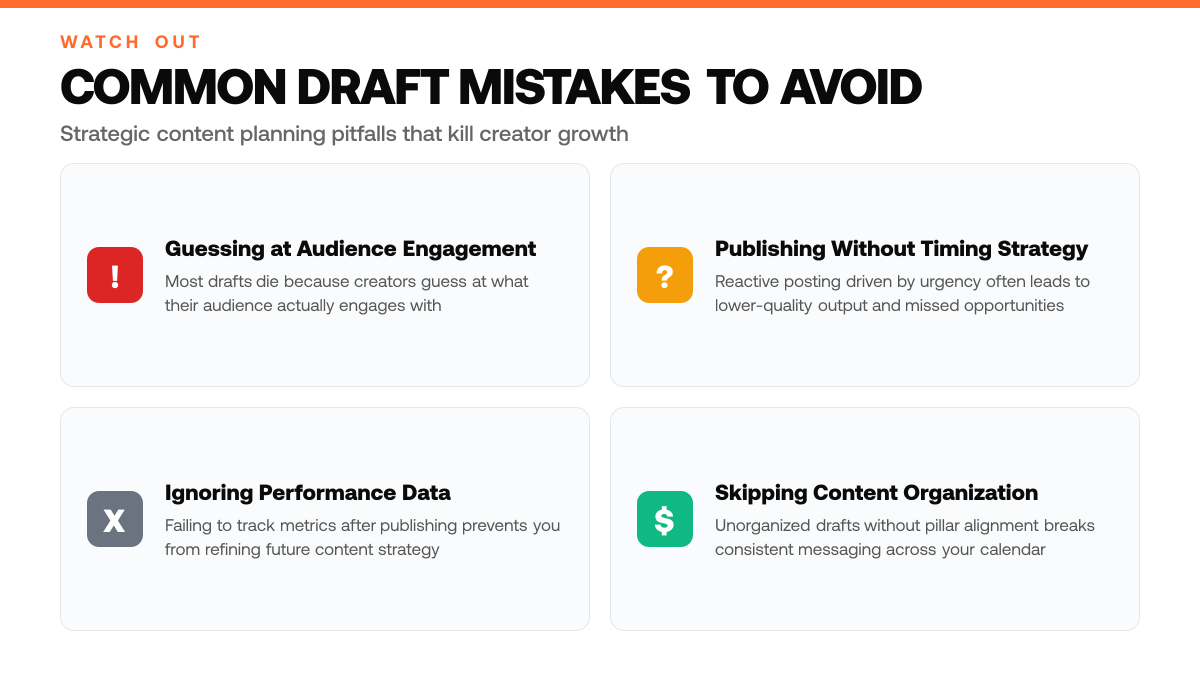
This article walks through how to use X drafts as a strategic asset: how to build a draft system that works for your schedule, when to move drafts to published posts, and how to refine ideas in drafts before they reach your audience. By the end, you'll have a repeatable workflow that turns scattered ideas into intentional, well-timed content. Most drafts die because creators guess at what their audience actually engages with, spinning content in the dark, ClimbX analyzes your highest-performing formats and scans outlier posts in your niche to surface what works, so Cliff drafts posts in your voice that compound growth over time.
TL;DR
- Organize X drafts by content pillar to ensure consistent messaging and strategic alignment across your publishing calendar.
- Schedule posts for peak audience activity times to maximize impressions and engagement when your followers are most active.
- Track performance metrics after publishing to identify what resonates and refine your content strategy for future posts.[4]
Understanding X Drafts and Strategic Content Planning
What Are X Drafts?
X Drafts is a native feature that allows creators to write, edit, and refine posts before publishing them to their audience. Rather than composing and immediately sharing content, drafts function as a staging area where you can batch-write multiple posts, test different messaging angles, and polish your ideas without the pressure of live publication. This workspace separates the creative process from the distribution process, giving you control over when and how your content reaches your followers.[2]
Why Draft Management Matters for Creator Growth
Strategic draft management is a hallmark of creators who consistently grow their audience and engagement. By preparing content in advance, you avoid reactive posting driven by urgency or trending moments, which often leads to lower-quality output and missed opportunities. Drafts let you schedule publication during optimal posting windows when your audience is most active, ensuring your best work reaches the right people at the right time. This deliberate approach enables you to make data-driven decisions about what resonates with your followers, refine your voice across multiple posts, and maintain momentum without burning out.
The Competitive Advantage of Batch Content Creation
Creators who batch-write and schedule content using drafts operate at a different scale than those publishing ad-hoc. The ability to prepare a week or month of posts in a single session eliminates the daily pressure to create and allows you to think strategically about narrative arcs, audience growth, and message consistency. This approach also protects you from publishing regrettable content in moments of emotion or fatigue. As social media trends continue to reward consistency and authenticity, the separation between reactive creators and strategic ones increasingly determines who builds sustainable influence and who plateaus.
Step-by-Step Process
1. Audit your existing drafts by theme and readiness
Review all saved drafts across your X account and sort them by topic, format (thread, quote, single post), and completion stage. Identify which drafts are nearly ready to publish versus those still needing refinement. This inventory step prevents duplication, reveals content gaps, and ensures you're not sitting on high-potential posts that could drive engagement. A structured audit transforms scattered ideas into a visible pipeline.[5]
2. Optimize copy, visuals, and hooks for your audience
Polish each draft's opening line to grab attention within the first few words, this is where X users decide to stop scrolling or engage. Refine visuals to match your brand aesthetic and ensure they load quickly. Verify that your core claim is clear and your call-to-action (follow, reply, retweet) aligns with your growth goal. Small tweaks to clarity and visual consistency compound into higher click-through and conversion rates over time.
3. Schedule posts based on audience activity and timing
Analyze when your followers are most active on X, typically during morning commutes, lunch breaks, or evening hours, and schedule drafts to post during those windows. Spacing posts strategically prevents audience fatigue and maximizes impressions per post. Consistent timing builds anticipation and trains your audience to check for your content at predictable intervals, directly supporting follower growth and monetization readiness.[5]
4. Measure engagement and refine your publishing rhythm
Track metrics like impressions, engagement rate, and follower growth for each published post. Note which topics, formats, and posting times generate the strongest response. Use these patterns to inform your next batch of drafts, double down on what works and adjust what doesn't. This feedback loop turns publishing from guesswork into a repeatable, data-driven system that compounds your reach and authority over weeks.
How This Works in Practice
Example 1: The Thought Leader's Weekly Cadence
Picture a thought leader who publishes insights on creator economics and audience growth, but struggles to maintain a consistent posting rhythm without burning out. She drafts 5 posts at the start of each week, mixing original observations, curated takes, and engagement hooks, then schedules them across the next 7 days. By batching her creative work upfront, she avoids the daily pressure to ideate and write, which often led to skipped days or rushed, lower-quality posts. Over a month, her followers notice the predictable rhythm: they return at the same times expecting fresh content, and her reply rates climb as she's no longer scrambling to catch up. The draft workflow transforms her from reactive to intentional, turning sporadic bursts into reliable presence that builds audience trust.
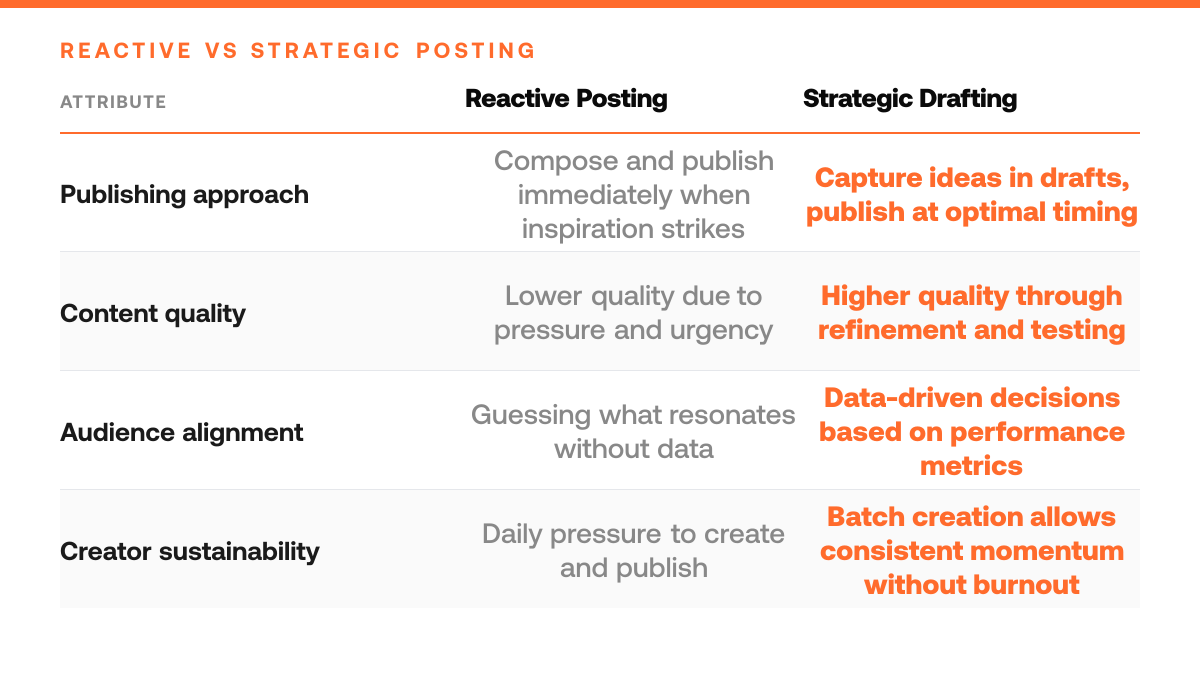
Reactive vs Strategic Creator Posting Approach
| Reactive Creator | Strategic Creator |
|---|---|
| Composes and publishes immediately when inspiration strikes | Captures ideas in drafts, then publishes when timing aligns |
| Posts without considering audience activity patterns | Schedules posts for peak audience activity windows |
| Guesses at what content resonates with followers | Tracks performance metrics to refine strategy |
| Creates daily under pressure and urgency | Batch-writes multiple posts in single sessions |
| Risks publishing regrettable content in emotional moments | Reviews and refines ideas before live publication |
Example 2: The Educator Scaling Reach During Peak Seasons
Consider an educator who teaches online courses and uses X to drive enrollments. She knows that back-to-school season and New Year's resolutions create spikes in search interest, but she also knows that during those windows she's swamped with student support and course delivery. Three weeks before peak season, she drafts a library of 20+ posts, lesson previews, student wins, objection-handling threads, and calls-to-action, then spaces them strategically across the high-opportunity weeks. When September arrives, her content is already queued and publishing on schedule, while competitors scramble to create in real time. Her reach amplifies precisely when her audience is most receptive, and she captures enrollments without sacrificing course quality or her own sanity. The draft buffer lets her compete at scale without doubling her workload.
Why Timing and Consistency Compound
Both examples reveal the same principle: draft workflows decouple content creation from publication, freeing creators to publish on strategy rather than impulse. A thought leader stays visible without daily ideation; an educator captures seasonal demand without chaos. The result is audience growth that feels effortless because the heavy lifting, writing, happens in batches, leaving only the lightweight task of hitting publish at the right moment.
Pre-Publish Checklist for X Drafts
- Review your draft against your core messaging pillars to ensure it aligns with your audience's growth and monetization goals.
- Verify all claims, links, and calls-to-action are accurate and functional before scheduling publication.
- Check posting time and frequency against your content calendar to avoid overlap and maximize reach.
- Confirm the post meets your brand voice and tone standards, then flag it as ready for live conversion.
- Test the post preview on mobile and desktop to catch formatting issues that could reduce engagement.
Common Mistakes to Avoid
Mistake: Ignoring audience timezone and peak activity windows when scheduling posts
Posting when your audience is offline dramatically reduces impressions and engagement, leaving reach on the table. Research your follower demographics and posting patterns using X analytics, then schedule content for times when your specific audience is most active, not when it's convenient for you. This directly impacts monetization potential since algorithms reward engagement velocity.[3]
Draft Management Process: From Capture to Publication
| Phase | Action | Outcome |
|---|---|---|
| Capture | Write ideas in drafts when inspiration strikes | Build library of half-finished sketches and variations |
| Organize | Sort drafts by content pillar and theme | Ensure consistent messaging and strategic alignment |
| Refine | Test messaging angles and polish before publishing | Separate creative process from distribution |
| Schedule | Move drafts to publication during optimal posting windows | Maximize impressions when audience is most receptive |
| Analyze | Track performance metrics after publishing | Identify what resonates and inform future content |
Mistake: Over-scheduling without reviewing performance data between posts
Batch-drafting content and publishing on autopilot without checking what resonates wastes your posting calendar. After each batch, pause to analyze which drafts drove engagement, clicks, or conversions. Use those insights to refine your next batch, topic, tone, format, or call-to-action. Skipping this step means repeating what doesn't work and missing patterns that could accelerate growth.
Mistake: Treating all draft content equally instead of prioritizing based on engagement trends
Not all drafts deserve equal airtime. If your audience consistently engages more with threads than single tweets, or prefers data-driven posts over opinion, prioritize those formats in your publishing queue. Adapt your draft mix based on what engagement data shows works, thread length, hashtag use, media type, posting frequency. Neglecting this optimization leaves significant monetization potential untapped.
Frequently Asked Questions
How often should I post X drafts to maximize audience growth?
Posting frequency depends on your audience's activity patterns and your content capacity. Rather than a fixed schedule, test different frequencies over several weeks and monitor which cadence drives the most consistent engagement and follower growth. Track metrics like impressions and reply rates to identify your optimal rhythm. Most successful creators find a sustainable schedule they can maintain without sacrificing draft quality.
What's the best way to organize X drafts before publishing?
Use a content calendar to map drafts by topic, timing, and audience segment. Group related posts into threads or sequences, then schedule them strategically across your week. This prevents topic overlap and ensures variety. A visual system, whether spreadsheet, dedicated tool, or calendar app, helps you see gaps, spot patterns, and maintain consistency without scrambling at publish time.
Should I post at different times for different audience segments?
Yes. Your audience spans multiple time zones and activity windows. Review your X analytics to identify when different segments are most active, morning scrollers, lunch-break readers, evening engagers. Draft posts targeting each window and schedule them accordingly. This approach captures attention across your full audience rather than optimizing for a single peak hour.
Sources
Try the loop on your own cohort.
Pick three accounts you would like to be at in 12 months. ClimbX pulls their recent outliers, tags them, and drafts in your voice off what is currently working. Edit, ship, watch the loop tighten.
Read next
- How to Research Social Media Content Without Spreading Bad Information - A practical source-first research workflow for social posts: find useful ideas, evaluate evidence, use AI without inventing claims, and publish content you can defend.
- X Posts in Google Search Console: The New SEO Opportunity - Google Search Console can now track the queries, impressions, clicks, CTR, and position of your X posts. Here is how creators can turn social posts into a measurable SEO and AI-search research loop.