
You launched your X account in a niche that felt right at the time. Your early posts gained traction, your audience grew, and you committed to the topic. But six months later, your engagement has flatlined, your replies feel hollow, and the posts you're most proud of barely move the needle. The niche that once felt foundational now feels like a cage.
Niche selection is critical to creator success on X, it shapes your audience, your content strategy, and your monetization potential. Yet the right niche at launch often isn't the right niche as your audience evolves, market trends shift, and you discover what you actually enjoy writing about. The challenge is knowing the difference between a temporary slump and a genuine misalignment that demands a pivot.[1]
This article walks through five warning signs that your niche has stopped serving you, and how to distinguish between sunk-cost thinking that keeps you trapped and premature pivoting that wastes momentum. By the end, you'll have a framework to decide whether to double down or move on. Most creators abandon their niche because they can't tell whether their content is genuinely exhausted or just poorly positioned against what's actually winning, ClimbX scans top-performing outlier posts in your niche to reveal format and hook patterns you're missing, so you pivot with evidence instead of intuition.
TL;DR
- Stagnant follower growth over consecutive months signals your current niche isn't resonating with your audience or the market has become oversaturated.
- Declining engagement rates, audience misalignment feedback, and difficulty securing brand partnerships indicate your content strategy needs a fundamental reset.
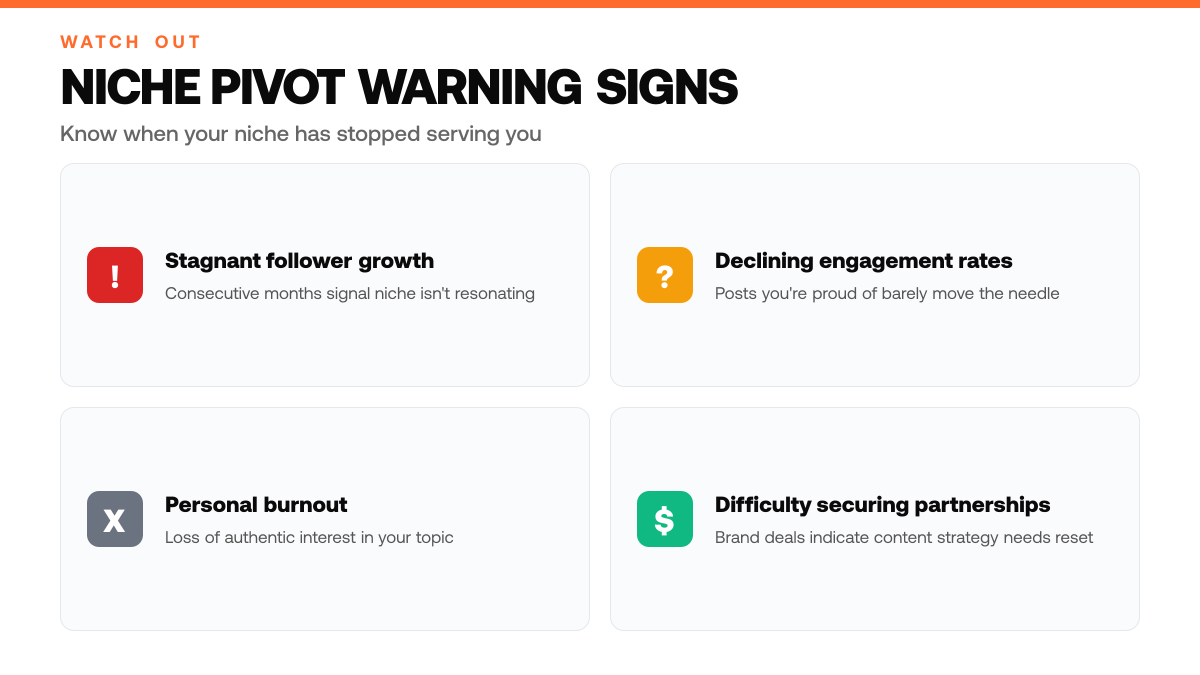
- Personal burnout or loss of authentic interest in your topic is a clear sign that pivoting to a fresh niche will restore both your energy and audience trust.
Understanding Niche Pivots for X Creators
What Is a Niche Pivot?
A niche pivot is a deliberate shift in the content focus, audience segment, or positioning strategy that a creator pursues on X. Rather than abandoning the platform or starting from zero, a pivot leverages existing audience trust and platform experience while redirecting energy toward a different market, topic, or angle. This might mean moving from general productivity advice to deep-dive systems thinking, or from B2B SaaS commentary to founder mental health, the creator stays on X, but the niche changes. A pivot is not failure; it's a strategic response to market saturation, audience evolution, or personal misalignment that successful creators use to unlock new growth phases.[2]
Why Niche Pivots Matter for Solo Creators
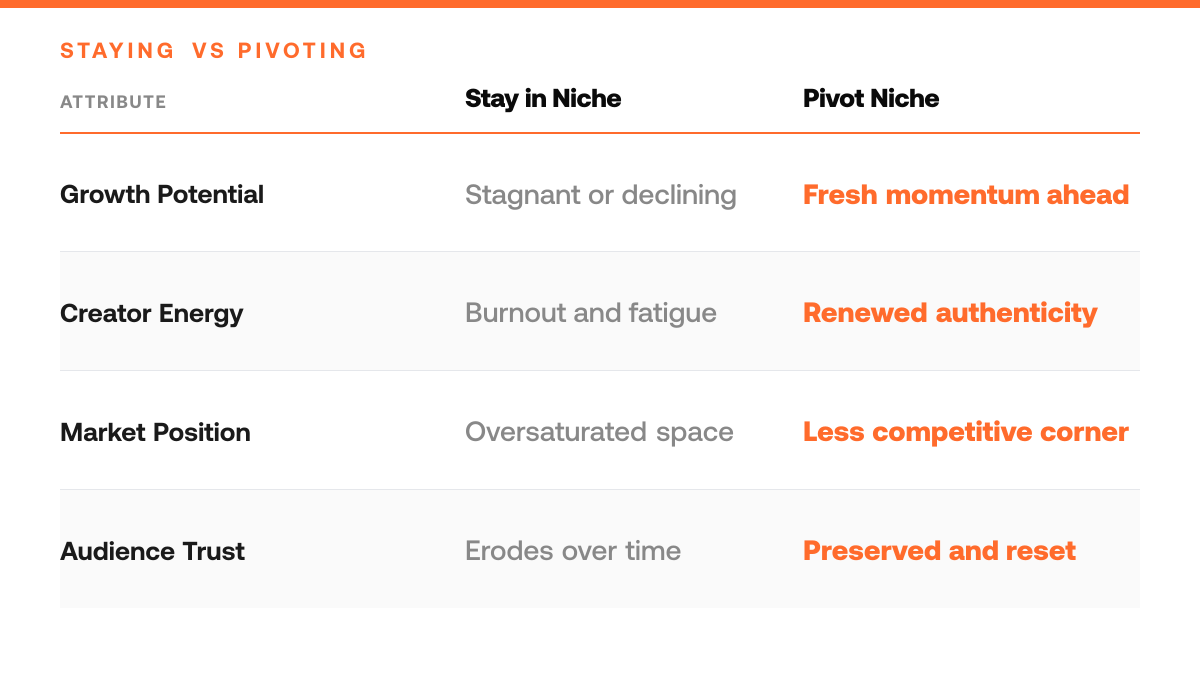
Understanding when to pivot is critical because the cost of staying in a declining niche is often higher than the cost of moving. Creators who recognize the difference between temporary engagement dips (normal seasonal or algorithmic noise) and structural niche decline (a warning sign of market exhaustion or audience drift) avoid premature pivots that waste momentum and credibility. A well-timed pivot preserves your follower base, resets your content calendar around genuine interest, and positions you to monetize faster in a less-saturated corner of X. Conversely, pivoting too early or without a clear signal leaves you chasing trends rather than building authority.[2]
The Creator Economy and Niche Evolution
The X creator landscape is dynamic. Niches that attracted audiences several years ago may now face oversupply, algorithm changes, or shifting audience priorities. Solo creators and solopreneurs building influence on X are uniquely exposed to niche risk because their entire income stream often depends on a single audience segment. Unlike larger media companies that diversify across multiple topics, a solo creator's growth, impressions, and monetization are tethered to niche health. Recognizing when your niche is maturing, fragmenting, or losing relevance, versus when you're simply in a plateau, separates creators who scale from those who stall.
Step-by-Step Process
1. Track Your Content Performance Over 60 - 90 Days
Monitor which posts drive the most impressions, engagement, and follower growth. Use X's built-in analytics to log metrics on your top performers and underperformers. Document patterns, do certain topics, formats, or posting times consistently outperform others? This baseline data reveals whether your current niche is genuinely resonating or stalling. A sustained decline across multiple metrics signals that your audience may be losing interest in your existing angle.
2. Survey Your Audience Directly
Ask your followers what content they want to see next. Use X polls, replies to your posts, or direct messages to gather feedback on potential new niches or angles. Questions like 'What problem do you want me to solve?' or 'Which topic interests you most?' uncover unmet demand within your existing audience. This qualitative input prevents you from pivoting based on assumption alone and validates whether your followers will follow you into a new direction.
3. Research Adjacent Niches for Demand and Saturation
Before pivoting, verify that your target niche has real audience demand and isn't oversaturated. Search X for related keywords and hashtags to see how many creators are already dominating that space. Assess whether the niche aligns with your existing skills and credibility, or if you'll need to build authority from scratch. Lower saturation combined with genuine audience interest makes a niche a stronger pivot candidate than a crowded, competitive one.[3]
How This Works in Practice
Example 1: The Creator Stuck in Generic Productivity
Picture a creator who spent 6 months posting generic productivity tips, time-blocking, task batching, morning routines, the kind of advice that fills thousands of feeds. Growth was steady but slow, and engagement felt hollow. After recognizing the niche was oversaturated and her audience wasn't converting, she noticed a pattern in her replies: followers with ADHD kept asking how her methods applied to their scattered focus and hyperfocus cycles. She pivoted to productivity specifically for ADHD creators, reframing her entire archive and centering future posts on dopamine-driven workflows, body doubling, and rejection-sensitive dysphoria. Within weeks, her engagement multiplied, her community felt tighter, and brands interested in neurodivergent audiences began reaching out. The specificity that felt risky, narrowing down from "all creators" to "ADHD creators", became her competitive moat.
Temporary Slump vs. Structural Niche Decline
| Signal | Temporary Engagement Dip | Structural Niche Problem |
|---|---|---|
| Follower Growth | Pauses briefly but resumes within weeks | Stagnant across consecutive months |
| Engagement Quality | Replies remain substantive and audience-aligned | Replies feel hollow and disconnected |
| Content Performance | Top posts still move the needle | Posts you're proud of barely gain traction |
| Root Cause | Seasonal or algorithmic noise | Market oversaturation or audience drift |
Example 2: The Creator Who Quit Too Soon
Consider a creator who launched a niche around "AI tools for small-business owners" but abandoned it after 2 months of slower growth compared to his first few weeks. He switched to a broader topic, "general AI trends", thinking the wider audience would accelerate his numbers. Instead, he found himself competing against established voices in an already-crowded space, and his follower growth stalled entirely. Looking back, he realized those first 2 months weren't a sign of failure; they were the natural plateau that comes after the initial novelty wears off. Audience building requires consistency over time. Had he stayed the course, posted regularly for at least several more months, and refined his angle based on which small-business pain points resonated most, he likely would have built genuine authority. His premature pivot taught him that the urge to jump ship often arrives just when compounding should begin.
Why Timing Matters
Both examples point to the same truth: the right pivot emerges when you've exhausted your current niche's potential and have concrete evidence, audience feedback, engagement patterns, market saturation, that a shift will serve your growth. Quitting early out of impatience costs you the compounding benefit of consistency; pivoting too late wastes months in a dead-end. The key is distinguishing between a niche that's genuinely oversaturated and one that's simply in its early, slower-growth phase.
Pre-Pivot Niche Optimization Checklist
- Audit your top-performing posts from the past three months to identify which topics and formats drive the most engagement within your current niche.
- Test at least three new content angles or formats in your existing niche before concluding the audience has lost interest.
- Survey your most engaged followers to understand what problems they still want solved in your current niche.
- Review your posting frequency and consistency, gaps in publishing often feel like niche fatigue when the real issue is visibility.
Common Mistakes to Avoid
Mistake: Pivoting after a single bad month of engagement
One weak month doesn't signal a niche failure, it reflects a temporary dip in algorithm performance, posting consistency, or external factors. Abandoning your niche prematurely wastes the audience trust and topical authority you've already built. Instead, analyze multiple months of data before deciding to pivot. Look for sustained decline in impressions and engagement across a rolling quarter, not isolated weeks.[4]
Do / Don't: Deciding to Pivot Your Niche
| Situation | Do This | Don't Do This |
|---|---|---|
| Engagement has flatlined | Analyze format and hook patterns in top-performing posts to pivot with evidence | Abandon your niche based on intuition or a few slow weeks |
| You've lost authentic interest | Pivot to a fresh niche that restores your energy and audience trust | Force content creation in a topic that burns you out |
| Audience feedback shows misalignment | Reset your content strategy and positioning fundamentally | Tweak surface-level tactics while ignoring structural problems |
| Considering a move | Recognize that pivoting preserves follower base and unlocks new growth phases | Chase trends without building authority in your new direction |
Mistake: Chasing trending niches without genuine expertise or audience demand
Profitable niches require both market opportunity and creator authenticity. Pivoting to a hot topic you don't genuinely care about will show in your content quality and consistency, stalling growth faster than staying in a smaller but authentic niche. Before pivoting, validate that your target audience actually exists on X and that you have real knowledge to share, not just surface-level interest in the trend.[4]
Mistake: Failing to communicate the pivot clearly to existing followers
Abruptly shifting your content without explanation confuses your audience and damages trust. Followers subscribed to you for a specific value proposition; sudden topic changes feel like betrayal. Announce your pivot explicitly, explain why you're moving, what your new focus solves, and how it serves your audience. Give followers time to adjust and decide whether to stay, rather than letting them discover the change through inconsistent posts.
Frequently Asked Questions
How do I know if it's too early or too late to pivot my X niche?
Timing depends on your engagement trajectory and audience saturation. It's too early to pivot if you haven't tested at least a handful of content angles within your current niche, you may simply need optimization, not a full shift. It's too late when your engagement has plateaued for weeks despite consistent posting and niche-specific optimization attempts. The sweet spot is when you've exhausted reasonable optimization efforts but see an adjacent niche where your skills or perspective offer genuine differentiation.
How do I bring my followers along when I pivot to a new niche?
Frame your pivot as an evolution, not abandonment. Start by publishing content that bridges both niches, show how your old expertise informs your new direction. Be transparent in a few posts about why you're shifting, then gradually increase new-niche content while maintaining a thread of familiar value. Your most engaged followers will adapt; others may unfollow, but that's normal. Quality followers in the new niche will outweigh the loss over time.
What tools help me track engagement metrics and validate a new niche before fully pivoting?
Analytics tools let you test content angles without manual spreadsheet tracking, reducing friction in the validation process. The right tool analyzes your last 100 posts to identify your highest-performing formats, hooks, and topics, then scans accounts ahead of you in your niche to surface outlier posts doing 2-3x their baseline engagement. This data helps you spot whether a new niche direction genuinely resonates or requires further refinement before you commit to a full pivot.
Start your 7-day trial
Grow on X without sounding like everyone else. A purpose-built platform learns from your top posts and the leading voices in your niche, then drafts content in your voice. You edit, approve, and ship.
Start free trialSources
Read next
- X Posts in Google Search Console: The New SEO Opportunity - Google Search Console can now track the queries, impressions, clicks, CTR, and position of your X posts. Here is how creators can turn social posts into a measurable SEO and AI-search research loop.
- X Algorithm Labels Explained: How Visibility Filtering Works - X can label accounts and posts before deciding where they may appear. See the real DoNotAmplify, SpamHighRecall, abuse, NSFW, and post-level labels in X’s open-source algorithm.