The short version
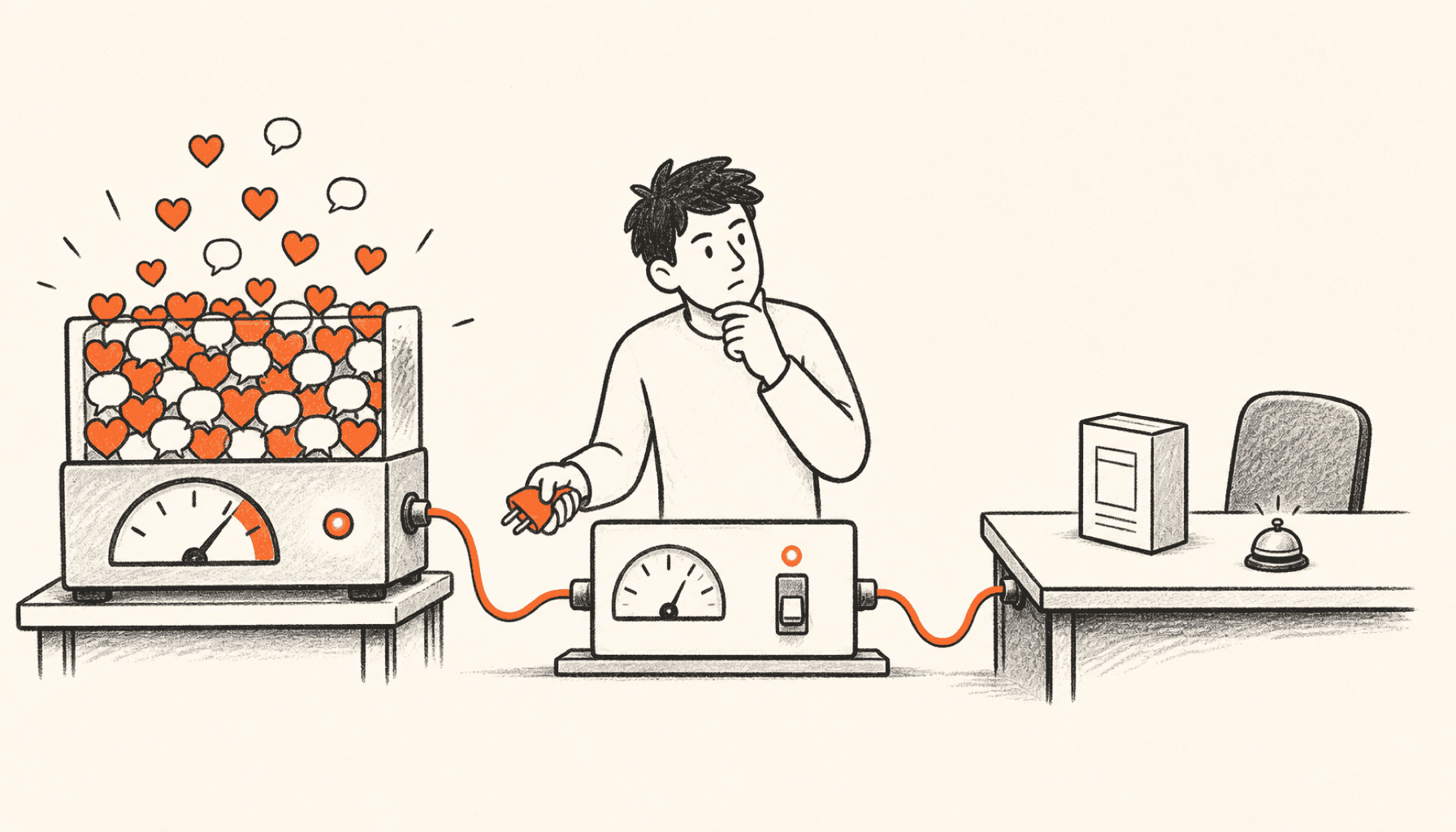
Build-in-public likes do not become customers automatically. A post can win attention from people who enjoy founder stories but never experience the product problem. Repair the system in order: audience fit, problem recognition, product relevance, proof, offer, next step, activation, and follow-up. Track each handoff from impression to retained customer. Keep broad posts for discovery, but publish enough customer-language content and product evidence that a buyer can recognize themselves and act.
The post reaches 20,000 people. Founders congratulate you. The like count climbs. Then the analytics page shows almost no qualified visits, trials, or sales. This is not mysterious. The post succeeded at one job and failed at another.
I ranked 926 of my X posts and found that the 10 largest generated 2,067,969 impressions and 11,052 replies. That analysis was valuable, but it also made the distinction obvious: a post can be excellent at creating discussion without proving that the readers are potential ClimbX customers. Distribution is an asset. It is not revenue by itself.
The applause-to-customer gap
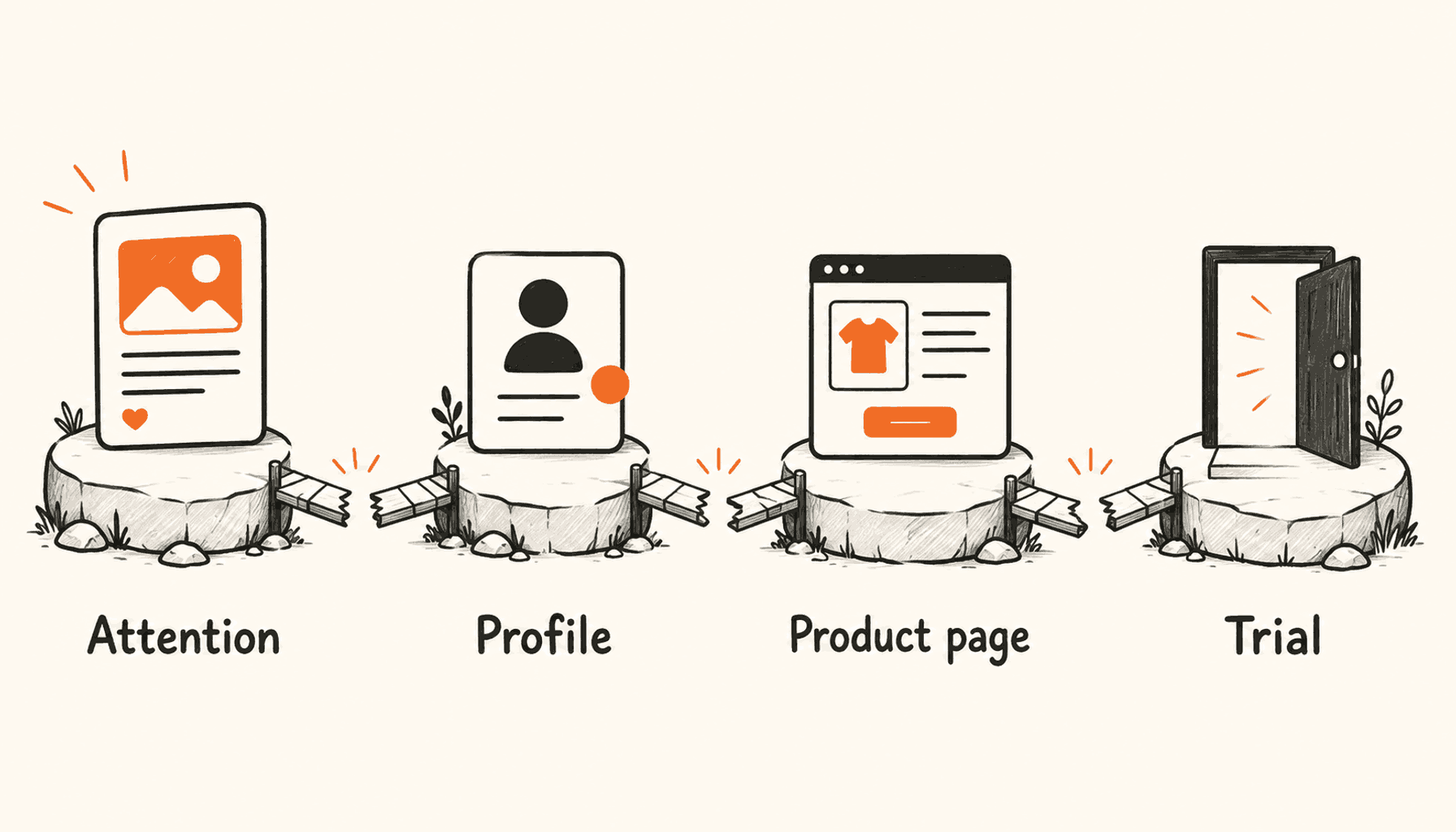
A person can like your founder milestone because it is impressive, reply to a broad question because it is easy, and follow because the journey is entertaining. Buying asks for something different: a recognized problem, sufficient urgency, trust in the solution, a credible offer, and a low-friction next step.
| Attention action | Buyer action | Missing bridge |
|---|---|---|
| Views the post | Recognizes a costly problem | Customer-specific language |
| Likes or replies | Understands why the product is relevant | Problem-to-product connection |
| Visits the profile | Trusts the founder and proof | Clear positioning and evidence |
| Clicks the link | Starts and reaches first value | Focused landing page and onboarding |
| Tries the product | Pays and keeps using it | Recurring value, offer, support, retention |
Diagnosis 1: the audience enjoys founders, but your buyers are elsewhere
Build-in-public content naturally attracts builders. That is powerful if your SaaS serves founders, developers, creators, or startup teams. It is weaker when your customer is a clinic manager, accountant, recruiter, property operator, or local service business that rarely joins founder conversations.
- Open the profiles behind meaningful replies, not only the largest accounts.
- Sample recent followers and classify likely customer, peer, student, investor, bot, or unclear.
- Compare the vocabulary in your posts with the vocabulary in customer calls and support.
- Check whether buyers in this market actively use X for professional decisions.
- If the channel fit is weak, move customer acquisition to search, communities, partnerships, outbound, or another platform.
Do not abandon a useful founder audience automatically. It may create partnerships, referrals, hiring, learning, or future distribution. Just do not label it a customer channel without evidence.
Diagnosis 2: the content teaches the founder journey, not the customer problem
“Shipped three features this week” tells the audience that you are working. It does not explain why the features matter. Translate activity into customer consequence.
| Founder-centered | Customer-centered |
|---|---|
| Shipped a dashboard redesign | Users can now find the failing account before opening five reports |
| Hit 1,000 users | The workflow is now used across 1,000 accounts, and this is what broke at scale |
| Added AI | Drafting now starts from the user’s own winning posts instead of a generic prompt |
| Worked all weekend | A billing failure exposed this trust problem, so we changed the recovery flow |
| Launched version 2 | Teams with this exact limitation can now complete the job in one place |
Diagnosis 3: the high-reach topic has no commercial adjacency
Broad technology debates, geography questions, jokes, and universal founder observations can generate large numbers because many people can respond. They may still help discovery, but the account needs a bridge back to the problem you solve.
Do not force a product pitch into a broad post. Instead, make the profile convert curiosity, pin a strong product explanation, and follow broad reach with narrower useful posts. The content portfolio should contain discovery, trust, product, and conversion assets.
Diagnosis 4: readers cannot understand the product in one pass
Curiosity dies quickly when the bio says “building the future of growth,” the pinned post tells a life story, and the landing page lists features without a clear outcome. Run the five-second test with someone outside the company.
- Who is this for?
- What painful or valuable job does it address?
- What is the first result?
- Why should I trust it?
- What should I do next?
- Name the audience and the job you help them complete.
- Add the product name and one relevant proof point or honest limitation.
- Give interested readers one clear next step.
Diagnosis 5: there is no proof at the moment of doubt
Founders often post milestones as proof of themselves, while buyers need proof of the outcome. A revenue screenshot may show that a business exists. It does not necessarily show that the product will solve this reader’s problem.
| Claim | Useful proof |
|---|---|
| The product is easy | A short first-use demo or measured setup time |
| It improves results | Before and after with method and limitation |
| It works for my role | Relevant case, workflow, or customer quote with permission |
| The founder understands the problem | Specific diagnosis, tradeoff, and customer language |
| It is safe to try | Clear data handling, limitations, pricing, support, and cancellation |
Diagnosis 6: the offer asks for too much or says too little
“Try my SaaS” leaves the reader to calculate fit, effort, risk, and expected value. A good early offer names the customer, first outcome, setup requirement, support, price or trial, and limitation.
- State who qualifies and the workflow they need help with.
- Explain the first useful result and what setup requires.
- Describe the support available and who the product does not fit.
- End with one action that delivers the promised next step.
Diagnosis 7: the path breaks after the click
Content may be doing its job while the landing page, signup, onboarding, billing, or first session loses the user. Track the complete path. Watch real people use it. A stronger hook cannot repair a product that hides its first value behind ten setup steps.
For an appointment-led business, the first value is often a confirmed booking. If a barber, salon, tradesperson, or personal trainer earns a click from X and then asks the visitor to message back and forth about availability, the conversion path is still doing too much work. A focused booking system such as Bookrightly gives the business its own booking page with live availability, deposit payments, and a management dashboard. That lets the call to action say “Book an appointment” and lead directly to that outcome rather than another conversation.
- 1
Check message continuity
The landing page should continue the problem and promise that earned the click, not introduce a different category story. - 2
Remove unnecessary commitment
Ask only for the information required to reach the first result. Explain card requirements and trials clearly. - 3
Measure activation
Define the first action that demonstrates value and track how many qualified signups reach it. - 4
Support early users manually
A founder-led setup or short call reveals confusion that event analytics cannot explain. - 5
Follow up on intent
Ask non-activating users what stopped them. Use the answer to improve the path, not to pressure them.
The content mix that connects attention to demand
| Content role | Example | Suggested share |
|---|---|---|
| Discovery | Broad but relevant insight, story, or question | 30% |
| Problem education | Diagnosis, cost, workflow, comparison | 25% |
| Trust | Decision, mistake, experiment, original evidence | 20% |
| Product proof | Demo, use case, customer result, limitation | 15% |
| Conversion | Tester invitation, launch, offer, direct CTA | 10% |
These percentages are a diagnostic starting point, not a rigid schedule. If readers know the problem but not the product, increase proof. If reach is tiny but buyers convert, improve discovery. If engagement is broad and clicks are irrelevant, narrow the audience and language.
Measure the handoffs, not only the totals
| Handoff | Calculation | What a weak result may mean |
|---|---|---|
| Post to profile | Profile visits divided by impressions | The idea did not create relevant curiosity |
| Profile to site | Site clicks divided by profile visits | Positioning or pinned proof is unclear |
| Site to signup | Qualified signups divided by visits | Offer, trust, fit, or friction problem |
| Signup to activation | Activated users divided by signups | Onboarding or product-value problem |
| Activation to paid | Paid customers divided by activated users | Recurring value, price, urgency, or trust problem |
| Paid to retained | Retained customers divided by paid cohort | Product is not sustaining the promised job |
Use counts beside rates when the sample is small. One customer out of two trials is not a stable 50 percent funnel. The goal is to locate the next conversation and experiment, not decorate a dashboard.
A 30-day repair plan
| Week | Action | Evidence to collect |
|---|---|---|
| 1 | Audit followers, buyers, profile, pinned post, and funnel | One clearly broken handoff |
| 2 | Interview customers and non-buyers, rewrite problem language | Repeated triggers, objections, and phrases |
| 3 | Publish customer-focused content and product proof | Qualified replies, clicks, and activation |
| 4 | Test one clearer offer and support users manually | Paid decisions and reasons for yes or no |
Change one major bottleneck at a time. If you replace the audience, profile, landing page, price, product, and CTA together, you will not know what repaired the path.
When likes are still useful
Likes are not worthless. They help indicate whether an idea is legible and socially resonant. High-reach posts can introduce the founder, improve distribution, and create a pool of future readers. The mistake is assigning them a business meaning they do not have.
My first X payout came after 81 days, about 6,900 followers, roughly 480 posts, 23,300 replies, and about 6 million impressions. The $828.77 payout was real, but the more durable value was the audience and learning around the product. Read the full 81-day X growth and payout case study for the context behind those numbers.
Frequently asked questions
Why do my X posts get likes but no customers?
Likes can come from people who enjoy the story but do not experience the problem, cannot buy, or do not understand the product and next step. Diagnose audience fit, problem recognition, product proof, offer clarity, and conversion friction separately.
Does building in public actually get customers?
It can when the people following the build overlap with the buyers and the content connects product decisions to customer outcomes. If the audience is mostly other builders who enjoy milestones, build-in-public posts may create reach without demand.
What metrics should founders track instead of likes?
Track relevant profile visits, qualified follows, site clicks, demo requests, activated trials, paid customers, retention, and the reasons prospects decline. Likes are useful distribution feedback, but they are not a sales metric.
Should every founder post include a product link?
No. Constant promotion weakens the account. Make the profile and pinned post explain the product, then use links when the post creates genuine product interest or asks for a specific action. The path should be available without dominating every idea.
How do I attract buyers instead of only other founders?
Use the customer’s problem language, participate in their conversations, teach their workflow, show relevant proof, and publish where that profession already gathers. If the buyer is not active on X, use another acquisition channel rather than forcing the fit.
How long should I test a content-to-customer strategy?
Use a 30-day diagnostic cycle with enough relevant posts and direct conversations to observe each handoff. Do not wait months to inspect a completely broken path. Review weekly and change the clearest bottleneck one at a time.
Grow the audience that fits the product.
ClimbX helps founders learn from relevant outliers, create content in their own voice, schedule a balanced mix, and review the signals that matter beyond likes.
Read next
- How to Get Your First SaaS Customers From X - Find real buying signals on X, start useful founder conversations, validate the problem, and turn relevant attention into your first paying SaaS customers.
- How to Build in Public on X: The SaaS Founder Playbook - A complete build-in-public system for SaaS founders: what to share, what to keep private, how to earn feedback, and how to connect posts to customers.
- My 10 Biggest X Posts, and What They Taught Me - I ranked all 926 of my X posts in ClimbX. The top 10 generated 2,067,969 impressions and 11,052 replies. Here are the posts and the patterns I'd reuse.
Sources
- SaaSRanger: Does building in public get customers? - a practical discussion of customer overlap, vanity metrics, audience fit, and why public revenue alone rarely creates demand
- Kerix: Twitter Lead Generation for B2B SaaS - a conversion-oriented baseline for recognizing intent, qualifying prospects, and moving from public context to sales conversations