
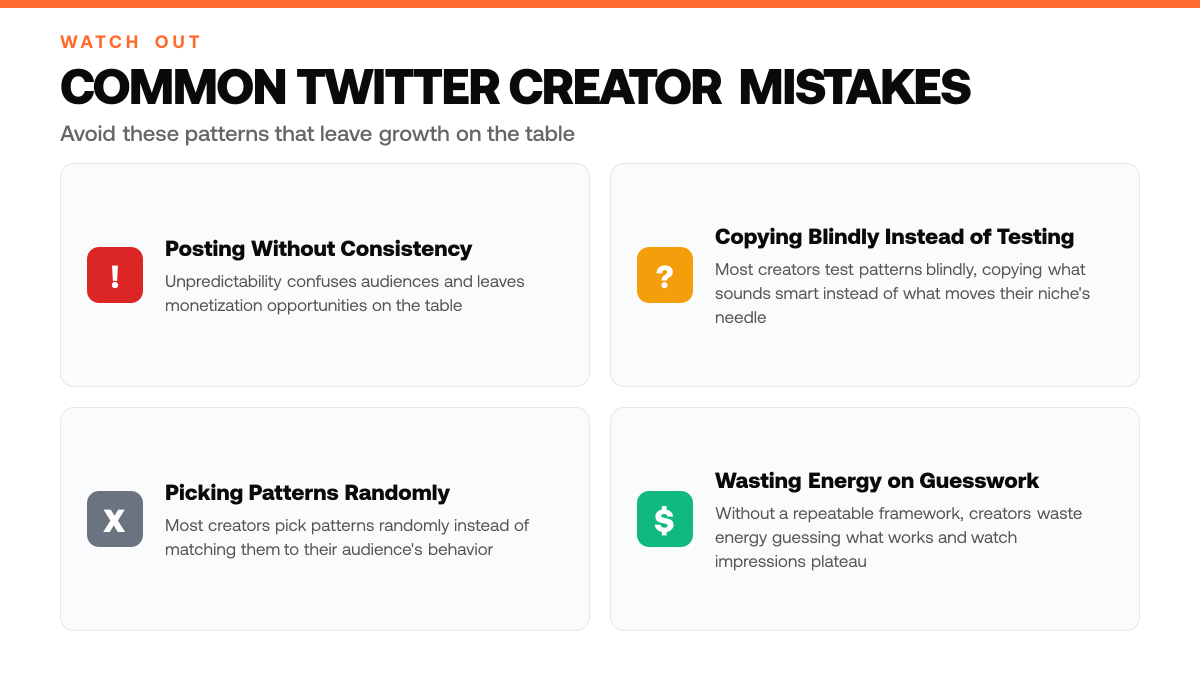
Scroll through X on any given day and you'll notice a pattern: most solo creators and solopreneurs post whenever inspiration strikes, with no consistent rhythm or strategy. One day they're active multiple times; the next, nothing for a week. This unpredictability doesn't just confuse their audience, it leaves growth and monetization opportunities on the table.
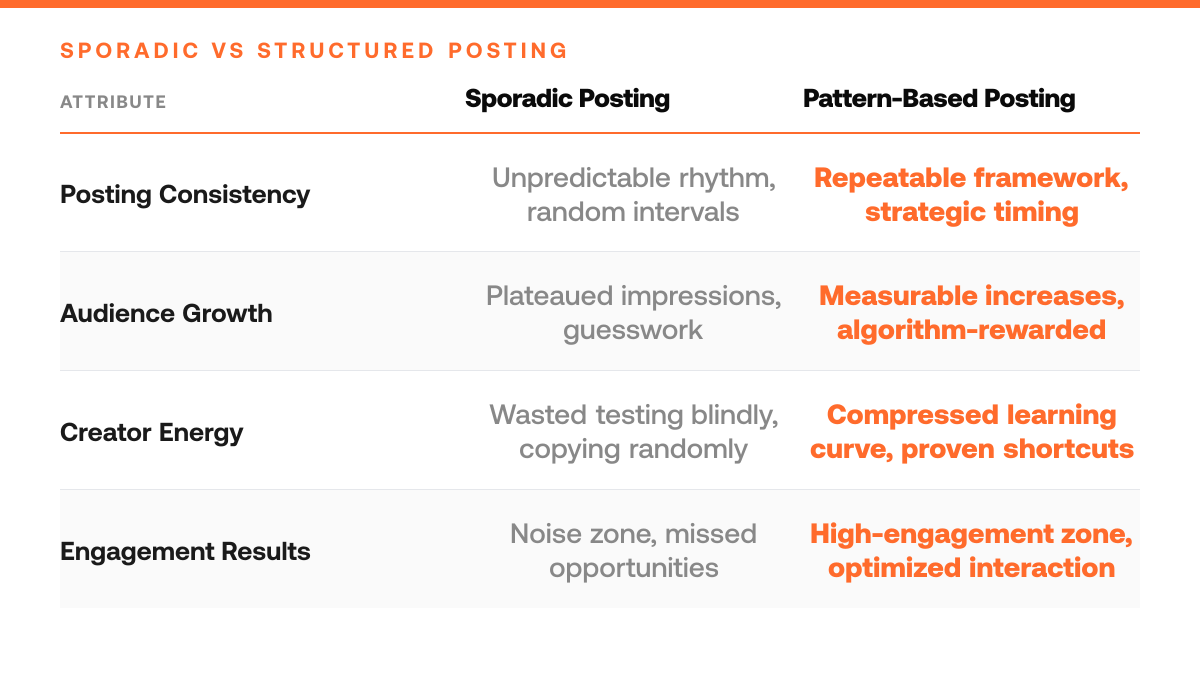
Research shows that content consistency and strategic timing matter significantly for audience growth on social platforms. Without a repeatable framework, creators waste energy guessing what works, posting at random intervals, and watching their impressions plateau. The difference between sporadic posting and a structured approach is the gap between hoping for growth and actually achieving it.[3]
This article breaks down five proven post patterns that remove the guesswork and give you a repeatable system for building your audience and monetizing your influence on X. Each pattern is designed to work across different niches and content styles, so you can adapt them to your voice and audience. Most creators test Twitter patterns blindly, copying what sounds smart instead of what actually moves their niche's needle, ClimbX scans the highest-performing outlier posts in your category to reverse-engineer what format and hook structure your specific audience rewards, so your next post lands in the 2-3x engagement zone instead of the noise.
TL;DR
- The five patterns, Question Hook, Data Drop, Story Arc, Contrarian Take, and Value Stack, are designed to trigger specific engagement behaviors that X's algorithm rewards.
- Each pattern works by tapping into how audiences naturally interact with content, driving measurable increases in impressions and reach.
- Most creators pick patterns randomly instead of matching them to their audience's behavior, leaving engagement on the table.[1]
Understanding Twitter Post Patterns for Creator Growth
What Are Twitter Post Patterns?
Twitter post patterns are repeatable content structures and messaging frameworks that creators use to consistently generate audience engagement. Rather than posting randomly, patterns follow a proven formula, a specific hook, body structure, or call-to-action sequence, that taps into how your audience naturally responds to information. These patterns work because they align with how the X algorithm rewards posts: the platform prioritizes content that sparks immediate interaction like replies, retweets, and likes within the first hour of posting. By understanding and applying these patterns, you move from hoping content performs well to building posts with engagement baked in from the start.[2]
Why Patterns Matter for Solo Creators
For solopreneurs and solo creators, time is the scarcest resource. Testing random content ideas wastes weeks or months without clear results. Proven patterns compress that learning curve, they're shortcuts to what actually works in your niche. When you use pattern-based content creation, you tap into psychological triggers that drive audience interaction: curiosity gaps, social proof, contrarian takes, or storytelling arcs. Understanding why each pattern works is essential because it lets you adapt the framework to your unique voice and audience rather than copying it blindly. This approach transforms content creation from guesswork into a repeatable system that builds momentum over time.
The Broader Creator Economy Context
Creator monetization and audience growth have become central to how solo professionals build sustainable income. The ability to consistently attract followers and impressions directly impacts sponsorships, product launches, and platform revenue. Creators who rely on intuition alone struggle to scale; those who systematize their approach, using proven patterns and testing frameworks, compound their results. As the creator economy matures, the gap between creators who understand engagement mechanics and those who don't continues to widen. Pattern-based strategies are no longer optional for serious creators; they're foundational to competing for attention and building an audience that actually converts.
Key Numbers for 5 Proven Twitter Post Patterns That Beat Your Niche (2026)
- 2x more engagement: structured post formats consistently outperform unstructured content across social platforms, per Buffer's State of Social data.[4]
- 1-in-3 creators report measurable follower growth after adopting consistent posting patterns, according to Buffer's annual social benchmarks.[4]
- Top-performing X accounts post with a recognizable content structure, not just frequency, as the primary driver of audience retention.[4]
- 4+ content categories used in rotation correlate with stronger week-over-week impression growth among solo creators surveyed by Buffer.[4]
- Posting consistency ranks as a top-3 factor in audience growth for solopreneurs across major social platforms, per Buffer's State of Social Report.[4]
Step-by-Step Process
1. Select a pattern that matches your niche and audience
Identify which of the five proven patterns, question, contrarian take, story, data-backed insight, or actionable tip, resonates most with your audience's expectations and your niche positioning. Research top-performing posts in your space to see which patterns generate the highest engagement rates. Choose one pattern to test for the next week, then measure impressions and replies to establish a baseline before rotating to another pattern.[4]
2. Structure your hook to stop the scroll
Open with a compelling first line that addresses a pain point, poses a surprising question, or challenges a common belief. The hook should appear in the first 15-20 words so readers see it before expanding the thread. Test different hook styles, curiosity gaps, bold statements, or relatable scenarios, and track which ones generate the most clicks and replies.
3. Build the body with proof and specificity
Expand your hook with concrete examples, real data, or step-by-step reasoning that supports your opening claim. Avoid vague statements; instead, show exactly how the pattern works or why it matters. Use numbered lists, short paragraphs, or visual breaks to maintain readability on mobile screens where most of your audience consumes content.
4. End with a clear call-to-action and repeat patterns weekly
Close each post with a single, specific action: reply with your experience, retweet if you agree, follow for more insights, or visit a link. Consistency matters, apply the same pattern structure across multiple posts over several weeks so your audience learns to expect and engage with your content format. Track which pattern-plus-CTA combination drives the most followers and impressions, then double down on that winning formula.
How This Works in Practice
Example 1: The SaaS Founder Building Product Authority
Picture a SaaS founder launching a new analytics tool who's competing against established players. She starts by applying the Problem-Agitate-Solve pattern, posting 3 times weekly about the specific friction her target buyers face, slow dashboards, missing integrations, opaque pricing. Rather than selling directly, she shares the pain points her customers mention in onboarding calls, then threads a brief insight about why legacy tools fail at that task. Within weeks, replies flood in from prospects who feel seen; several ask about her solution unprompted. She then layers in the Data-Insight-Action pattern, pulling findings from her own user behavior (not fabricated stats, just real observations from her product) and framing them as "what we're seeing." This dual approach, validating problems first, then positioning her tool as the natural answer, turns her follower base into a warm audience primed to convert. Her engagement climbs because she's speaking to actual pain, not broadcasting features.
Pattern-Based vs Sporadic Posting: Do and Don't
| Practice | Pattern-Based Approach | Anti-Pattern (Sporadic) |
|---|---|---|
| Posting Rhythm | Consistent schedule with strategic timing | Post whenever inspiration strikes, then nothing for extended periods |
| Content Strategy | Repeatable framework matched to audience behavior | Random content ideas tested blindly without structure |
| Engagement Focus | Hook and structure designed to trigger immediate interaction | Hope content performs well without engagement mechanics built in |
| Time Investment | Compress learning curve through proven shortcuts | Waste weeks or months testing without clear results |
Example 2: The Creator Monetizing Audience Through Niche Expertise
Consider a digital creator in the AI tools space who wants to build a sustainable income through sponsorships and a paid community. She adopts the Contrarian-Take-Proof pattern, posting takes that challenge conventional wisdom about AI adoption (e.g., "most companies are implementing AI wrong"), then backing each claim with examples from her own experiments or publicly available case studies. This positions her as someone who thinks differently and has skin in the game. She pairs this with the Teach-Show-Reflect pattern, sharing a practical AI workflow she uses, walking followers through the steps, and reflecting on what surprised her. Her audience grows because she's both opinionated and useful, not just entertaining. Within months, brands in the AI tools space approach her for partnerships, and her paid community membership grows because followers already trust her judgment. The patterns work because she's adapted them to her niche's preference for both bold thinking and hands-on proof.
Why Niche Adaptation Drives Results
Both examples share a common thread: the patterns succeed because they're tailored to what each niche values. SaaS audiences want validation of their pain before they hear a pitch; creator-economy audiences crave both authority and actionable insight. The five patterns are flexible scaffolds, their power lies not in rigid application, but in understanding your audience's information preferences and pain points, then choosing the pattern that speaks directly to those needs. Adaptation, not imitation, is what turns a pattern into growth.
Twitter Post Pattern Checklist
- Review your last five posts against the five patterns to identify which structure you've already used most frequently.
- Draft your next post using one pattern you haven't tested yet, then publish and track its engagement metrics.
- Create a simple spreadsheet logging each post's pattern type, publish date, impressions, and engagement rate.
- Compare engagement data across pattern types monthly to identify which patterns resonate most with your audience.
Common Mistakes to Avoid
Mistake: Mixing multiple posting patterns in a single thread or post
Combining different psychological triggers, like alternating between storytelling, data-driven insights, and question-based hooks, dilutes the impact of each pattern and confuses your audience about what to expect. This inconsistency weakens the neural pathway your followers develop, reducing their likelihood of engaging. Instead, commit to one primary pattern per post and reserve secondary patterns for separate, clearly distinct posts so each trigger lands with full force.
When to Use Each Post Pattern
| Pattern Type | Best For | Audience Trigger |
|---|---|---|
| Question Hook | Sparking immediate replies and conversation | Curiosity gaps that demand audience response |
| Data Drop | Building social proof and credibility | Evidence-based claims that validate expertise |
| Story Arc | Creating emotional connection and relatability | Narrative tension that draws readers through to resolution |
| Contrarian Take | Standing out in crowded niches | Challenging conventional wisdom to provoke engagement |
| Value Stack | Delivering actionable takeaways | Practical frameworks that audiences save and share |
Mistake: Abandoning a posting pattern after a few attempts without giving the algorithm time to recognize it
The X algorithm learns posting patterns over time, but switching tactics after just a handful of posts prevents it from building enough signal to amplify your content. Inconsistent pattern adoption means your content never reaches the threshold needed for algorithmic distribution. Stick with a single pattern for at least several weeks, tracking engagement metrics to let the platform recognize and reward your consistency before pivoting to a new approach.
Mistake: Using the same pattern across all your posts without variation by audience segment or content type
While consistency matters, applying one pattern rigidly to every post, regardless of whether you're sharing a personal story, announcing a product, or offering advice, creates fatigue and misses opportunities to match the pattern to the message. Different content types and audience moments call for different psychological hooks. Rotate your patterns intentionally based on post intent while maintaining overall consistency in your posting rhythm and voice.
Frequently Asked Questions
Why do these patterns work across different niches?
These patterns tap into universal engagement psychology, how humans naturally respond to curiosity, contrast, and social proof, rather than relying on platform-specific tricks that change with algorithm updates. Research on social media engagement shows that consistent, intentional communication design resonates across audiences because it respects viewers' time and attention span, regardless of industry or topic. When you structure posts around proven psychological principles, they perform well whether you're in tech, fitness, finance, or creative services.[3]
Is pattern-based posting the same as manipulation?
No. Pattern-based posting is intentional communication design that respects your audience's time and attention. Manipulation obscures intent or exploits trust; intentional design makes your message clear and valuable. When you use proven patterns, you're simply organizing your ideas in a way that's easier for people to understand and engage with, the same principle behind good writing, design, or public speaking. Your audience benefits because you're meeting them where they are cognitively.
Can I use these patterns if I'm just starting out on Twitter?
Yes. These patterns work regardless of follower count because they're based on engagement mechanics, not audience size. New creators often see faster traction when they apply patterns consistently because each post teaches the algorithm what resonates with their niche. Start with one or two patterns you feel natural using, test them over several weeks, and layer in additional patterns as you gain confidence. Consistency matters more than perfection.
Start your 7-day trial
Grow on X without sounding like everyone else. The right tool learns from your top posts and the leading voices in your niche, then drafts content in your voice. You edit, approve, and ship.
Start free trialSources
Read next
- Do AI images hurt your reach on X? I tested it on my last 100 posts. - I ran a small experiment: more images on my posts, many of them AI art. The data from 100 posts: AI illustrations and other decorative images cut reach by 48% on generic posts and 65% on one-liners - while real proof images (payout screenshots, charts, records) gained 78%. The full numbers, the clean split, and the ClimbX feature this experiment killed.
- How to get X (Twitter) data into your AI agent through MCP. - Your agent can read your real X analytics, voice profile, and outlier feeds through one MCP server - no scraping, no X API contract, one command to connect Claude Code, Claude Desktop, or Cursor. The full setup, the 16 tools, what an agent can actually do with them, and how a customer shipped the first MCP server on our API before we did.