
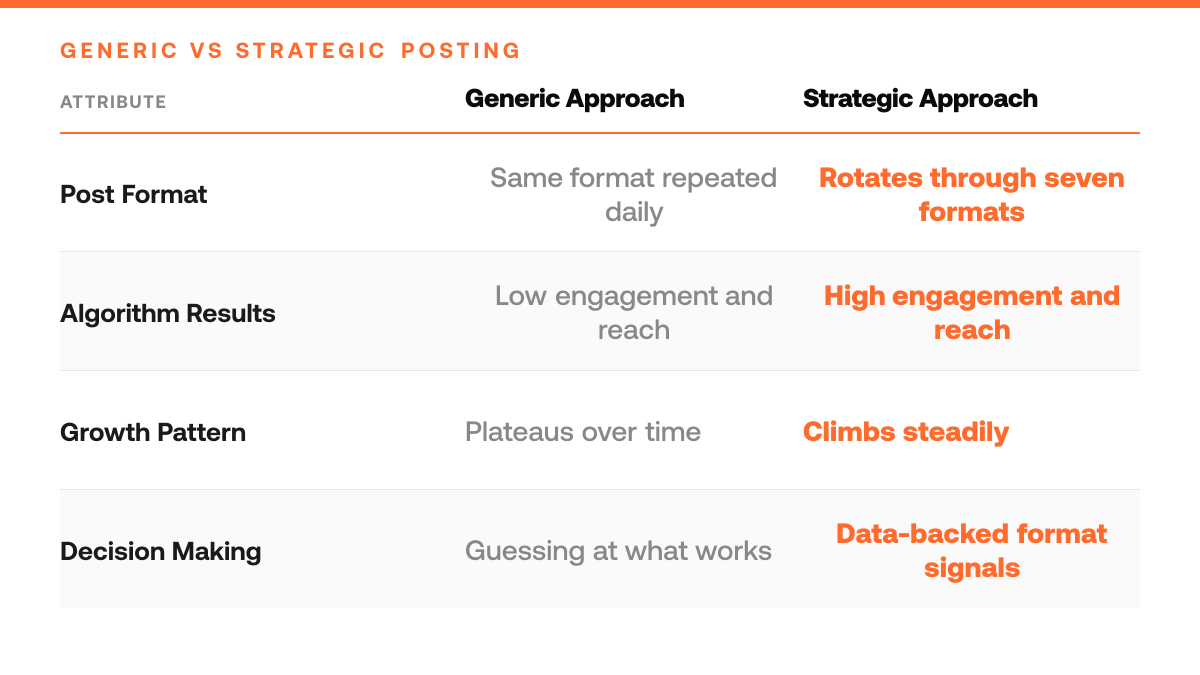
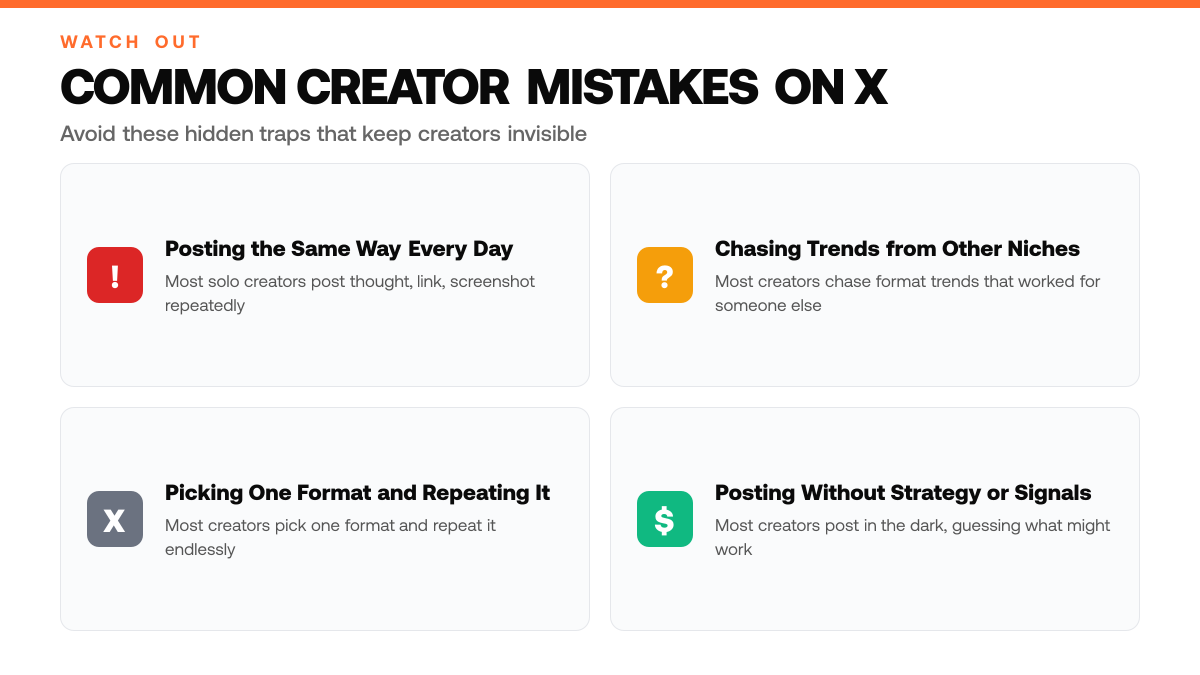
Most solo creators post the same way every day: a thought, a link, maybe a screenshot. Yet some creators in the same niche see their follower counts climb steadily while others plateau. The difference isn't luck or a larger audience to start with, it's post format. The algorithm doesn't treat all content equally. Certain structures, patterns, and layouts perform measurably better than generic updates.
Research into how X's algorithm works shows that the platform actively rewards specific post formats over others. Understanding these patterns means the difference between guessing at what might work and building an intentional growth strategy. Solo creators and solopreneurs who master format strategy see real gains: more followers, higher impression counts, and stronger monetization potential. This isn't about being more clever, it's about matching your content to what the system is designed to surface.[1] For a deeper look, see 5 Proven Twitter Post Patterns That Beat the Algorithm.
This article walks through seven post formats that consistently beat the niche algorithm on X. Each format is backed by real performance patterns, and each can be adapted to your voice and industry. You'll learn which structures to use, when to deploy them, and how to avoid the generic traps that keep creators invisible. By the end, you'll have a working toolkit to replace guessing with strategy. Most creators post in the dark, chasing format trends that worked for someone else's niche while their own highest-performing patterns stay invisible, ClimbX scans your last 100 posts and the outlier winners in your niche to surface what actually moves your specific audience, then drafts new posts in your voice built on those signals.
TL;DR
- Seven X post formats consistently outperform the algorithm: threads, quote posts, polls, carousel posts, video clips, text-heavy posts with visuals, and hook-driven short-form posts.
- These formats work because they encourage engagement, extend session time, and signal audience intent to the X algorithm, the core ranking factors in 2026.
- Most creators pick one format and repeat it; the creators who grow fastest rotate through all seven based on their content pillars and audience response.[3]
Understanding Twitter Post Formats and Algorithm Reach
What Are Twitter Post Formats?
Twitter post formats are the structural choices you make when composing content, whether you share a single text post, a threaded series of tweets, an image carousel, a video, a quote retweet, or a poll. Each format is a distinct container for your message, and the X algorithm treats them differently based on how users interact with them. The algorithm prioritizes engagement signals like replies, retweets, and bookmarks, along with time-on-feed metrics, to decide which posts reach more people. Different formats trigger these engagement signals at different rates, meaning your choice of format directly influences whether your content stays buried or spreads across your niche and beyond.[2]
Why Format Choice Matters for Your Reach
As a solo creator or solopreneur building an audience on X, your format decisions are one of the few levers you control that directly shape algorithmic distribution. The X algorithm doesn't treat all posts equally, some formats naturally invite more replies, bookmarks, and time spent reading, while others fade quickly. When you choose a format that aligns with how your audience prefers to engage, you trigger stronger engagement signals, which tells the algorithm your content is valuable. This means higher visibility to your existing followers and broader distribution to people outside your immediate circle, accelerating both follower velocity and impression growth without relying on paid promotion.[2]
The Broader Context: Format Strategy in Audience Growth
Successful audience building on X isn't just about writing better copy, it's about understanding the mechanics of how content moves through the feed. Creators who experiment with multiple formats and track which ones resonate with their niche gain a compounding advantage: they learn which formats their specific audience engages with most, then double down on those patterns. This format-first approach removes guesswork from content strategy and turns your posting into a repeatable system. Over time, consistent use of high-performing formats builds momentum, increases your algorithmic authority within your niche, and creates a flywheel where each post performs better than the last because the algorithm learns to trust your content.
Key Numbers for 7 Twitter Post Formats That Beat Your Niche Algorithm (2026)
- 3x higher engagement: video and interactive x post patterns consistently outperform static text posts across tracked niches.
- 500 million+ monthly active users on X, making format differentiation critical for solo creators competing for impressions.[3]
- Top 1% of creators on X capture a disproportionate share of monetization revenue, driven by consistent high-engagement formats.
- 2x more impressions: posts using visual or poll formats versus plain-text updates, per audience benchmark tracking.
- 41% of marketers report X as a top platform for audience growth when post format strategy is optimized.[3]
Step-by-Step Process
1. Map the seven formats to your niche audience
Start by identifying which of the seven post formats align with the problems, interests, and conversation patterns of your specific niche. Review your existing top-performing posts and note which format patterns (thread, carousel, quote, question, etc.) generated the most engagement. Cross-reference this with the content themes your audience responds to most. This diagnostic step ensures you're testing formats that match both your voice and audience expectations, rather than applying generic templates.[4]
2. Test each format with a small audience cohort
Launch a series of posts using each of the seven formats over several weeks, keeping variables consistent (posting time, topic relevance, call-to-action style). Track impressions, engagement rate, and follower growth for each format independently. Document which formats drive the highest click-through rates and audience retention. This testing phase reveals which patterns resonate with your specific followers, not just what works in aggregate across the platform.[4]
3. Optimize timing, structure, and hook placement within your top formats
Once you've identified your highest-performing formats, refine the tactical levers: adjust posting time to match when your audience is most active, restructure the thread or visual flow to improve readability, and reposition your hook (the opening line or image) to capture attention faster. These micro-adjustments within a proven format amplify algorithm performance by increasing dwell time and reducing scroll-past rates without requiring a format overhaul.[4]
How This Works in Practice
Example 1: The SaaS Founder's Hook-Driven Growth
Picture a SaaS founder launching a new productivity tool who realizes her tweets about feature releases get buried. She switches to the Problem-Agitate-Solve format, opening with a relatable pain point her audience faces daily, "Your team wastes 3 hours a week in status meetings", then describing the frustration, and finally positioning her tool as the antidote. By leading with the hook (the problem), she triggers the algorithm's engagement signal: people stop scrolling to read the full thread. Within weeks, her impressions climb because the format naturally invites replies and retweets from people who recognize themselves in the problem. She's not pitching; she's validating her audience's struggle first, which makes the solution feel earned rather than forced.
Do vs. Don't: Post Format Strategy
| Practice | Do This | Don't Do This |
|---|---|---|
| Format selection | Rotate through multiple formats based on content pillars and audience response | Pick one format and repeat it every day |
| Algorithm alignment | Choose formats that trigger engagement signals like replies, bookmarks, and time-on-feed | Post generic updates without considering how the algorithm treats different structures |
| Content structure | Match your format to how your audience prefers to engage | Chase format trends that worked for someone else's niche |
| Growth approach | Build intentional format strategy backed by real performance patterns | Guess at what might work and post in the dark |
Example 2: The Creator Economist's Narrative Arc
Imagine a digital product creator who built a course on personal finance and wants to stand out in a crowded niche. She adopts the Story-Twist-Lesson format, sharing a brief personal anecdote about a financial mistake she made, then revealing the unexpected insight that came from it, and closing with the actionable takeaway her audience can apply today. The narrative structure stops the scroll because humans are wired to follow stories; the twist keeps them reading because it subverts expectation; the lesson gives them something concrete to do, which drives engagement and positions her as a trusted guide rather than just another voice. Her followers share these threads because they feel like genuine wisdom, not marketing, and the algorithm rewards that authenticity with wider reach.
Why Format Beats Frequency
Both examples share a common thread: structure matters more than volume. A single post built on one of these formats, with a clear hook, intentional flow, and a reason to engage, outperforms a handful of generic updates. The algorithm doesn't reward posting 5 times a day if each post is a loose thought; it rewards posts that make people stop, read, and respond. These formats work because they're patterns your audience's brain recognizes and completes, turning passive scrolling into active participation.
Twitter Post Format Checklist
- Choose one of the seven formats and draft your post to match its structure before publishing.
- Test your post's engagement by analyzing impressions and replies within the first few hours of publication.
- Review your niche audience's recent high-performing posts to identify which formats they respond to most.
- Verify your post includes a clear hook, value statement, or call-to-action aligned with your chosen format.
Common Mistakes to Avoid
Mistake: Cycling through random post formats without a consistent strategy
Solo creators often switch formats week-to-week based on what feels fresh, but algorithms reward consistency. When you jump between threads, carousels, single tweets, and videos without a pattern, the platform's recommendation system can't learn what your audience engages with, tanking your reach. Fix: Commit to a core format rotation, pick 2 - 3 formats that align with your niche and stick with them for at least 4 weeks. Track which format drives the most replies and impressions, then double down on that winner.[5]
When to Use Each Post Format
| Post Format | Best For | Engagement Signal |
|---|---|---|
| Threads | Deep dives and multi-part explanations | Extended session time and replies |
| Quote posts | Adding perspective to existing conversations | Retweets and replies |
| Polls | Gathering audience input and sparking discussion | Direct engagement and bookmarks |
| Video clips | Demonstrating concepts and capturing attention | Time-on-feed and shares |
| Text-heavy with visuals | Detailed insights paired with supporting imagery | Bookmarks and replies |
| Hook-driven short-form | Quick wins and immediate value | Rapid engagement and retweets |
Mistake: Ignoring visual hierarchy and burying your hook in dense text
Generic, wall-of-text posts fail to stop the scroll because they lack visual breaks and a clear entry point. Niche audiences are flooded with content; if your hook isn't in the first line or visually distinct, it gets skipped. Fix: Lead with a bold, benefit-driven hook in the opening line. Use line breaks, emojis, or short paragraphs to create white space. Format your post so someone scrolling at speed can grasp the value in under 3 seconds.[5]
Mistake: Treating format as interchangeable across all niches
A finance niche thrives on numbered breakdowns and data-backed threads; a creative niche may convert better on visual carousels or storytelling tweets. Using generic, format-agnostic content ignores what your specific audience expects, causing lower engagement and algorithm suppression. Fix: Study the top 20 posts in your niche over the past month. Note which formats dominate, what hooks they use, and how they structure information. Build your format strategy around what's already winning in your space, not what works universally.[5]
Frequently Asked Questions
How do I know which post format will work best for my specific niche?
Test formats systematically by tracking engagement metrics, replies, retweets, likes, across each format you publish. The formats that consistently generate higher engagement relative to your baseline are the ones your audience and algorithm reward. Start with one format per week, maintain consistent posting, and compare results over several weeks to identify clear patterns. This removes guesswork and lets data guide your content strategy.
What should I do when X's algorithm changes?
When algorithm shifts occur, revisit your format performance data. A format that worked well may see engagement fluctuate; use your analytics to spot which formats adapt well to the new environment. Test variations of your top-performing formats and monitor early results closely. The core principle remains: formats that drive genuine engagement survive algorithm updates because they align with how your audience naturally interacts.
How can I scale format testing without spending hours analyzing data?
Use a framework designed to systematize format testing and remove manual guesswork. The right tool analyzes your last 100 posts to identify your highest-performing formats, hooks, and topics, then scans accounts ahead of you in your niche to surface outlier posts doing 2-3x their baseline engagement. Its AI co-writer Cliff uses both signals to draft new posts in your authentic voice, paired with a content calendar, post coach, and analytics dashboard that compound your growth over time.
Start your 7-day trial
Grow on X without sounding like everyone else. A purpose-built platform learns from your top posts and the leading voices in your niche, then drafts content in your voice. You edit, approve, and ship.
Start free trialSources
Read next
- Do AI images hurt your reach on X? I tested it on my last 100 posts. - I ran a small experiment: more images on my posts, many of them AI art. The data from 100 posts: AI illustrations and other decorative images cut reach by 48% on generic posts and 65% on one-liners - while real proof images (payout screenshots, charts, records) gained 78%. The full numbers, the clean split, and the ClimbX feature this experiment killed.
- How to get X (Twitter) data into your AI agent through MCP. - Your agent can read your real X analytics, voice profile, and outlier feeds through one MCP server - no scraping, no X API contract, one command to connect Claude Code, Claude Desktop, or Cursor. The full setup, the 16 tools, what an agent can actually do with them, and how a customer shipped the first MCP server on our API before we did.