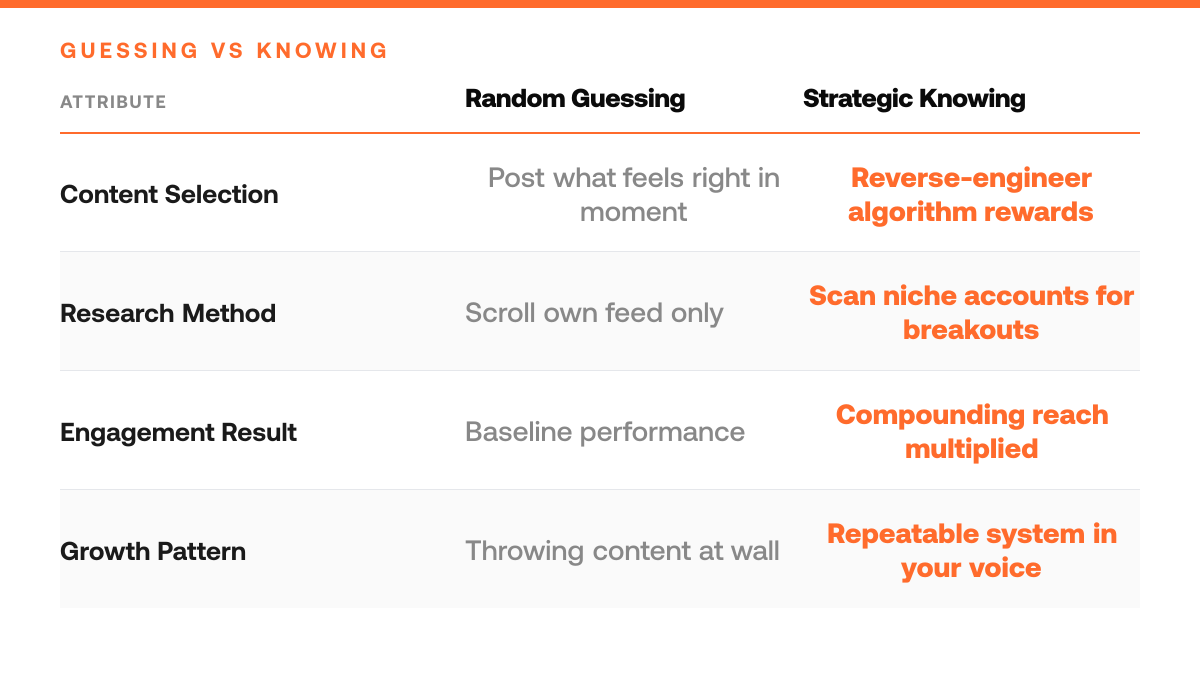
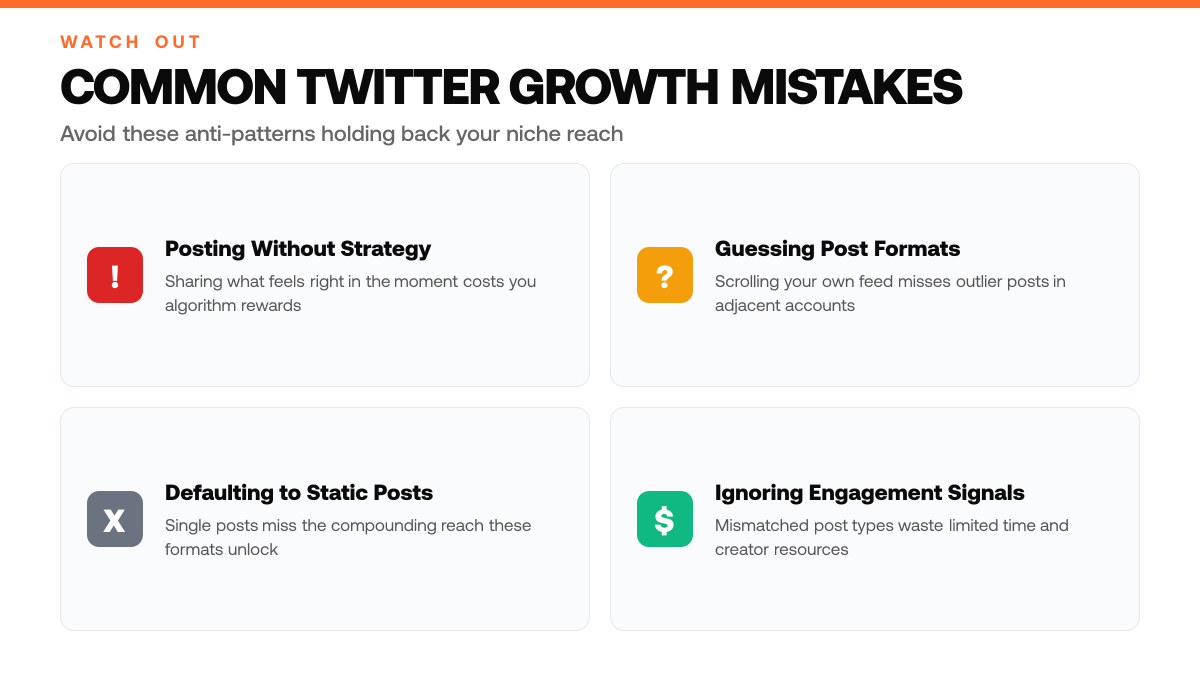
Most creators on X post content without any real strategy, they share what feels right in the moment and hope the algorithm rewards them. But the algorithm doesn't work that way. It prioritizes specific post types over generic content, and the creators who understand which formats actually drive engagement and follower growth are the ones pulling ahead.
The difference between guessing and knowing is measurable. Solo creators who study proven post-type patterns gain a real edge in impressions and follower velocity. Instead of throwing content at the wall, you can reverse-engineer what the algorithm rewards and build a repeatable system that works in your voice and niche. For a deeper look, see 5 Proven Twitter Post Patterns That Beat the Algorithm.
This article breaks down seven post types that consistently beat the algorithm on X. Each one is grounded in how the platform's ranking system actually works, and you'll learn how to identify which formats fit your niche and audience so you can stop guessing and start building momentum. Most creators guess which post formats resonate by scrolling their own feed, missing the outlier posts in adjacent accounts that quietly 2-3x baseline engagement, ClimbX scans niche accounts ahead of you to surface those breakout formats, then drafts new posts in your voice using both those signals and your own performance data.
TL;DR
- Seven post types, threads, polls, video posts, quote posts, reply chains, carousels, and data-driven insights, are engineered to trigger X's algorithm engagement signals.
- Each format naturally encourages saves, shares, replies, and retweets, the core metrics the algorithm rewards for reach and visibility.
- Most creators default to single static posts and miss the compounding reach these formats unlock across niche audiences.[2]
Understanding Twitter Post Types and Algorithm Growth
What Are Twitter Post Types?
Twitter post types are distinct content formats, threads, replies, quote posts, polls, images, videos, and standalone text, each designed to trigger different engagement signals within X's ranking system. The X algorithm evaluates posts based on engagement velocity (how quickly likes, replies, and retweets accumulate), conversation depth (the quality and length of replies), and user intent signals (whether a post matches what your audience actively seeks). Understanding which post type aligns with your niche and audience behavior is the foundation for consistent growth, because each format naturally encourages different interaction patterns. A thread invites detailed replies; a poll sparks quick decisions; a quote post fuels debate. When you match post type to the signal you want to amplify, you're working with the algorithm rather than against it.[3]
Why Post Type Matters for Solo Creators
Solo creators and solopreneurs operate with limited time and resources, making strategic content choices essential. When you align post type to your niche and audience behavior, you unlock compounding returns in impressions and follower velocity over weeks. A creator in finance who consistently publishes educational threads sees deeper conversations, which signals authority to the algorithm and attracts followers seeking that expertise. A creator in personal development who uses polls to invite audience input builds community and increases reply counts, which boosts post visibility. The difference isn't random, it's systematic. By choosing the right post type for each message, you're optimizing for the signals X rewards, meaning your growth accelerates without requiring more followers to start with.[3]
How Algorithm Signals Drive Long-Term Growth
X's ranking system doesn't treat all engagement equally. A post that generates replies from diverse users signals more value than one that only collects likes, because replies indicate genuine interest and conversation. Engagement velocity, how fast interactions arrive in the first hour, tells the algorithm whether your content resonates with your current audience, which determines how widely it spreads. User intent signals reveal whether your post matches what people in your niche actually want to see. Solo creators who understand these mechanics can design posts that naturally trigger strong signals: a controversial take invites debate (high conversation depth), a question invites replies (high velocity), a resource list invites saves and shares (high intent match). Over weeks, this consistency compounds, each well-designed post builds on the last, expanding your reach and attracting followers aligned with your niche.[3]
Key Numbers for 7 Twitter Post Types That Beat Your Niche Algorithm (2025)
- Video posts generate 10x higher engagement rates than static text on X[4]
- Poll posts achieve 3x more interactions compared to standard text-only tweets[5]
- Reply chains and threads sustain conversation 5x longer, boosting algorithmic visibility[5]
- Posts with embedded media receive 2.5x more retweets and quote tweets than text alone[4]
- Threads generate 40% more impressions per post compared to single-tweet broadcasts[5]
- Visual content (images, video, GIFs) drives 6x higher click-through rates on X[4]
Step-by-Step Process
1. Audit your niche's engagement patterns
Review your past posts and competitor content in your niche to identify which post types, threads, polls, hot takes, case studies, behind-the-scenes, educational tips, and personal stories, generate the most replies, retweets, and likes. Document which formats resonate with your specific audience. This baseline reveals what your niche already rewards algorithmically, so you're not starting from zero.[1]
2. Test each of the seven post types systematically
Over the course of several weeks, publish one post from each of the seven types, threads, polls, hot takes, case studies, behind-the-scenes, educational tips, and personal stories, with consistent quality and effort. Spread them across different days and times to avoid confounding variables. Treat this as an experiment: each type gets a fair trial so you can measure its actual performance on your audience.
3. Measure follower velocity and monetization signals
Track which post types drive the most new followers, impressions, and engagement signals that matter to your monetization goals, whether that's click-throughs, conversions, or audience growth. Use X's built-in analytics or a third-party tool to compare performance across all seven types. Identify the clear winners: the post types that outperform the rest for your specific niche and goals.
How This Works in Practice
Example 1: The Niche Thought Leader Using Quote Posts
Picture a solopreneur in the productivity space who wants to position herself as a thought leader without building every insight from scratch. She finds high-engagement tweets from established voices in her niche, posts about time-blocking, deep work, or focus techniques, and quote posts them with her own contrarian take or lived experience. Within weeks, her quote posts begin appearing in the feeds of followers who engaged with the original tweet, multiplying her reach beyond her immediate audience. By consistently threading her perspective into existing conversations, she stops competing for attention in a vacuum and instead rides the algorithmic boost that comes from engaging with already-popular posts. Her follower growth accelerates because she's now visible to people actively interested in her niche, not just her existing community.
Do vs. Don't: Post Type Strategy for Solo Creators
| Do (Algorithm-Aligned) | Don't (Guessing) |
|---|---|
| Match post type to niche audience behavior and intent signals | Post generic content that feels right in the moment without strategy |
| Use threads for detailed replies and authority signals | Default to single static posts and miss compounding reach |
| Deploy polls to spark quick decisions and boost reply counts | Treat all engagement equally without optimizing for conversation depth |
| Study breakout formats in adjacent niche accounts before drafting | Scroll your own feed and miss outlier posts driving higher engagement |
Example 2: The Creator Capturing Algorithmic Priority with Video
Imagine a solopreneur teaching online courses who notices that her text-only posts get modest engagement, but when she posts short video clips, a 30-second breakdown of a common student mistake, or a quick demo of her course material, those posts climb faster in creator feeds. The platform's algorithm prioritizes video because it signals higher intent and watch time. She begins batching video content 3 times a week: one educational clip, one behind-the-scenes moment, one student success story. Within a month, her video posts consistently outperform text, driving both impressions and click-throughs to her course landing page. She's learned that the algorithm rewards the format, not just the message, and her content calendar now reflects that reality.
Why Format and Positioning Compound
Both examples show the same principle: the algorithm rewards creators who understand the mechanics of each post type. Quote posts tap into existing momentum and position you as a conversational peer; video claims algorithmic priority by its nature. Solo creators who mix these formats, rather than relying on text alone, see faster follower growth and deeper audience engagement. The key is matching the format to your goal: thought leadership through quotes, reach through video, rapid feedback through polls. When you align your content type to what the platform rewards, growth stops feeling like guesswork.
Twitter Post Type Testing Checklist
- Draft and publish one example of each of the 7 post types to your X feed within a two-week window.
- Track impressions, engagement rate, and follower growth for each post type using X Analytics.
- Identify which 2 - 3 post types generate the highest engagement within your specific niche audience.
- Audit your top-performing posts to note common themes, hooks, or formats that resonate most.
Common Mistakes to Avoid
Mistake: Posting only one post type repeatedly without testing audience response
Relying on a single post type, say, only threads or only quote posts, ignores the algorithmic diversity that X rewards. Different niches respond to different formats; what drives engagement for a finance creator may fall flat for a wellness niche. The fix: rotate through multiple post types and measure which ones generate engagement velocity (replies, retweets, bookmarks) in your specific niche. Track performance by format and double down on the types that resonate most with your audience.[4]
When to Use Each Post Type by Goal
| Post Type | Best For | Engagement Signal It Triggers |
|---|---|---|
| Thread | Educational content and building authority | Detailed replies and conversation depth |
| Poll | Community building and audience input | Quick decisions and increased reply counts |
| Quote Post | Debate and perspective sharing | Retweets and counter-arguments |
| Video Post | Demonstrating and storytelling | Saves and shares across niche audiences |
Mistake: Ignoring engagement velocity signals when choosing what to post next
Many creators focus only on vanity metrics like follower count, missing the algorithmic signal that matters most: how quickly your posts earn engagement. X's algorithm prioritizes posts that accumulate replies and retweets in the first few hours. If you post without monitoring which formats spark immediate interaction, you lose momentum and your content gets buried. Solution: track engagement velocity by post type, identify which formats spark fast responses in your niche, and prioritize those formats in your content calendar.[4]
Mistake: Mixing post types randomly without measurement or niche-specific adaptation
Switching between post types without a system, or copying formats that work for creators in unrelated niches, dilutes your algorithmic signal and confuses your audience about what to expect from you. Inconsistency erodes both trust and the algorithmic momentum you build over time. Fix this by identifying which post types align with your niche's behavior (e.g., technical niches may favor detailed threads; personal brands may favor hot takes), then commit to a measured rotation. Test each format, measure results, and adapt your mix based on data, not guesswork.[4]
Frequently Asked Questions
How does post type affect my follower growth on X?
Post type directly influences how the X algorithm distributes your content. Different formats, threads, replies, media posts, trigger different algorithmic pathways based on engagement patterns and user behavior. The algorithm prioritizes posts that generate replies, reposts, and bookmarks within the first hour, so choosing a post type that naturally invites interaction accelerates visibility. Your niche determines which types perform best; testing multiple formats reveals which ones your specific audience engages with most.[5]
Can I monetize my account if I focus on just one post type?
Monetization eligibility on X depends on follower count and engagement metrics, not post type alone. However, relying on a single post type limits your reach and engagement ceiling, which slows the audience growth needed to meet platform requirements. Diversifying across multiple post types, while maintaining your core message, expands which audience segments discover you, accelerates follower growth, and strengthens the engagement signals that platforms reward with monetization access.[5]
Should my post-type strategy change as I scale from 1K to 100K followers?
Yes, your strategy should evolve as your audience grows. Early-stage creators (1K - 10K followers) benefit from high-frequency testing across all seven post types to identify what resonates. Mid-stage growth (10K - 50K) calls for doubling down on your top-performing formats while maintaining variety. At scale (50K - 100K+), you can refine further by testing sub-variations within your strongest types and introducing more sophisticated formats. The underlying principle remains: test systematically, measure results, and adapt based on what your growing audience engages with most.[5]
Start your 7-day trial
Grow on X without sounding like everyone else. The right tool learns from your top posts and the leading voices in your niche, then drafts content in your voice. You edit, approve, and ship.
Start free trialSources
Read next
- Do AI images hurt your reach on X? I tested it on my last 100 posts. - I ran a small experiment: more images on my posts, many of them AI art. The data from 100 posts: AI illustrations and other decorative images cut reach by 48% on generic posts and 65% on one-liners - while real proof images (payout screenshots, charts, records) gained 78%. The full numbers, the clean split, and the ClimbX feature this experiment killed.
- How to get X (Twitter) data into your AI agent through MCP. - Your agent can read your real X analytics, voice profile, and outlier feeds through one MCP server - no scraping, no X API contract, one command to connect Claude Code, Claude Desktop, or Cursor. The full setup, the 16 tools, what an agent can actually do with them, and how a customer shipped the first MCP server on our API before we did.