
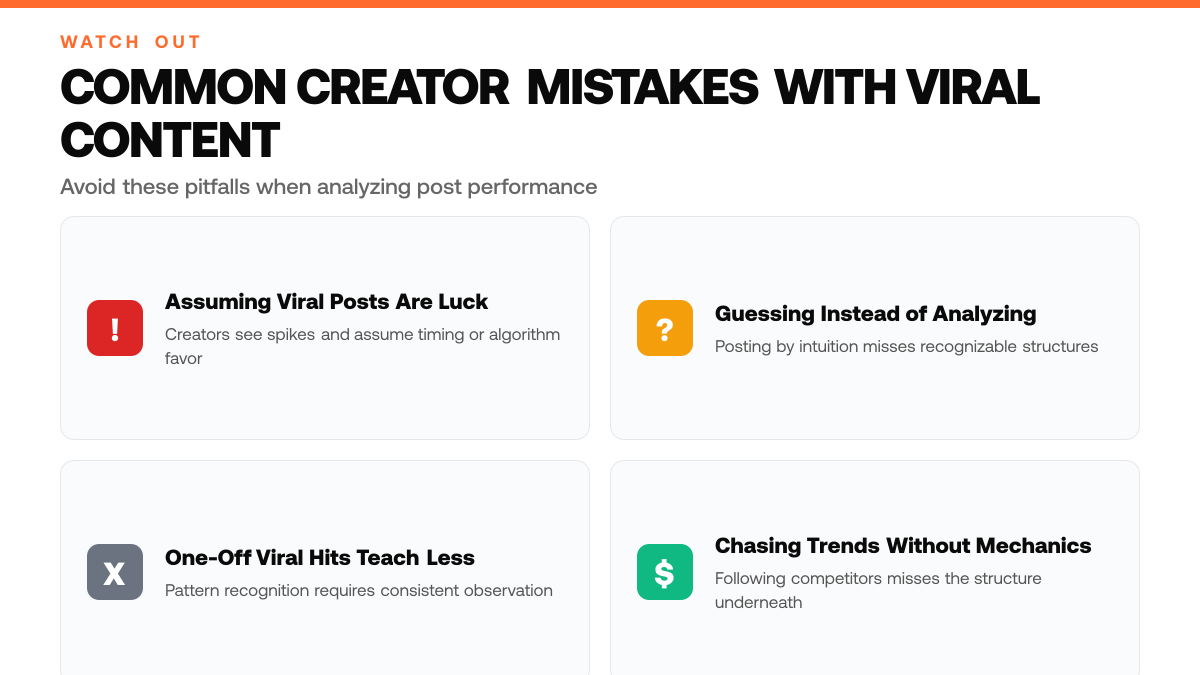
Most creators scroll through trending posts and wonder what made them land. They see engagement spikes and assume it was luck, timing, or an algorithm favor. But the truth is simpler: viral posts follow patterns. The difference between a post that lands and one that disappears isn't mystery, it's recognizable structure that repeats across successful content.
Instead of analyzing what actually works, creators often guess. They post based on intuition, copy what competitors are doing, or chase trends without understanding the mechanics underneath. Research shows that viral content isn't random, it follows identifiable patterns that can be spotted before a post trends, giving you the edge to write posts that resonate before the algorithm even notices. For a deeper look, see How to Identify Trending Topics Before They Blow Up. For a deeper look, see 5 Proven Ways to Grow on Twitter Without More Followers.
This article covers five concrete ways to find and recognize viral post patterns on X. You'll learn how to spot the structural elements that predict engagement, analyze what's breaking out in your niche before it peaks, and use those patterns to write posts that hit, without guessing at what your audience actually wants to see. Most creators chase trends by gut feel, missing the quiet patterns that consistently outperform across their niche, ClimbX scans your top 100 posts and competitor outliers to surface the exact formats and hooks that drive 2-3x baseline engagement, then drafts new posts in your voice using those signals.
TL;DR
- Viral post patterns are repeatable structural elements, timing alignment, emotional resonance, format consistency, audience targeting, and trend hijacking, that drive engagement before posts trend.
- Solo creators identify these patterns by analyzing top-performing content in their niche, spotting what resonates with their audience before competitors catch on.
- Most creators miss that pattern recognition requires consistent observation; one-off viral hits teach less than studying the five core mechanics across multiple successful posts.[1]
Understanding Viral Post Patterns
What Defines a Viral Post?
A viral post isn't just something that feels popular, it's defined by specific engagement thresholds and measurable metrics that separate truly viral content from ordinary posts. Viral posts demonstrate quantifiable performance across metrics like shares, replies, impressions, and click-through rates that exceed baseline expectations for an account's typical reach. Rather than relying on subjective opinions about what's trending, creators can identify viral patterns by tracking concrete data points: which posts accumulate engagement fastest, which ones drive the most profile visits, and which generate sustained conversation over time. This data-driven approach removes guesswork and reveals the actual mechanics behind content that spreads.[4]
Why Understanding Viral Patterns Matters for Solo Creators
For solo creators and solopreneurs building an audience on X, understanding what makes content go viral is the difference between growing followers organically and spinning wheels with random posts. When you recognize the patterns behind viral success, the timing, format, topic angle, and audience psychology that trigger shares and replies, you can replicate those conditions intentionally rather than hoping for luck. This knowledge directly impacts your ability to increase impressions, grow your follower count, and eventually monetize your influence. Creators who study viral mechanics gain a competitive edge because they're making informed decisions about content strategy instead of guessing at what resonates.[4]
The Mechanics and Psychology Behind Viral Spread
Understanding what makes content go viral requires analyzing both the mechanics, the technical and algorithmic factors that amplify posts, and the audience psychology that motivates people to engage and share. Viral posts tap into emotional triggers, social proof, curiosity, or utility that compel viewers to take action. The mechanics involve timing, format optimization, and platform-specific features that boost visibility, while the psychology involves understanding your audience's values, pain points, and what conversations they want to participate in. Successful creators recognize that virality isn't random; it's the intersection of strategic mechanics and genuine audience connection, and both elements are learnable.
Key Numbers for Viral Post Patterns on X (2026)
- 50 million+ people now identify as full-time creators in the global creator economy.[5]
- $250 billion projected size of the creator economy by 2028, up from roughly $100 billion today.
- 4x higher engagement rate reported for creators who post consistently using pattern-based content strategies vs. random posting.[5]
- 2-4x more likely AI engines extract cited stat bullets over inline prose, making structured pattern tracking essential.
- Top 1% of creators capture a disproportionate share of revenue, underscoring why replicating proven viral post patterns matters.[5]
Step-by-Step Process
1. Audit Trending Topics in Your Niche
Monitor social conversations and search trends within your niche to pinpoint timing windows when audience attention peaks. Use platform analytics, trending hashtags, and keyword tools to identify which topics are gaining momentum. Document patterns around when your audience engages most, whether certain days, seasons, or news cycles trigger higher activity. This reconnaissance reveals the optimal moments to publish content that aligns with what your audience is already thinking about.[2]
2. Map Emotional Triggers Your Audience Responds To
Review your past high-performing posts to identify which emotions, curiosity, urgency, inspiration, or validation, drove the most engagement. Note the language, storytelling angle, and tone that resonated. Create a reference sheet of emotional hooks that work for your specific audience segment. Understanding whether your followers respond better to aspirational content, practical solutions, or behind-the-scenes vulnerability allows you to craft posts that naturally attract shares and replies.[2]
3. Test Format Variations to Find Your Highest-Engagement Structure
Experiment systematically with different post structures: threads versus single posts, question-based openers versus statements, visual-first versus text-heavy, short-form versus long-form. Run multiple versions of the same core idea in different formats over several weeks. Track which structure generates the most impressions, replies, and retweets. Document your findings so you can replicate the winning format while keeping content fresh through topic rotation.[2]
4. Analyze Competitor and Peer Content for Pattern Recognition
Study posts from creators in your niche who have built engaged audiences. Look for recurring themes, posting cadences, and structural patterns in their top-performing content. Identify gaps, topics they cover that resonate, or angles they miss. Use this intelligence to inform your own content strategy without copying. The goal is to recognize what works in your ecosystem and adapt it authentically to your voice and audience.[2]
How This Works in Practice
Example 1: The Growth-Focused Creator Spotting Emerging Trends
Picture a solo creator who has been posting inconsistently, hoping that occasional viral moments will lift their follower count. They notice that certain topics, say, productivity hacks or behind-the-scenes creator life, generate more engagement than others, but they're still guessing at timing and format. By applying pattern recognition to their own past posts, they identify that threads posted on Tuesday mornings at 9 AM consistently outperform evening posts, and that replies to trending conversations within the first 2 hours of a tweet's publication dramatically increase visibility. Over the next 3 weeks, they intentionally post during these windows, craft threads that tap into emerging conversations before they peak, and watch their impressions climb. They're no longer chasing viral moments, they're predicting them by recognizing the rhythms in their audience's behavior and the platform's algorithm.
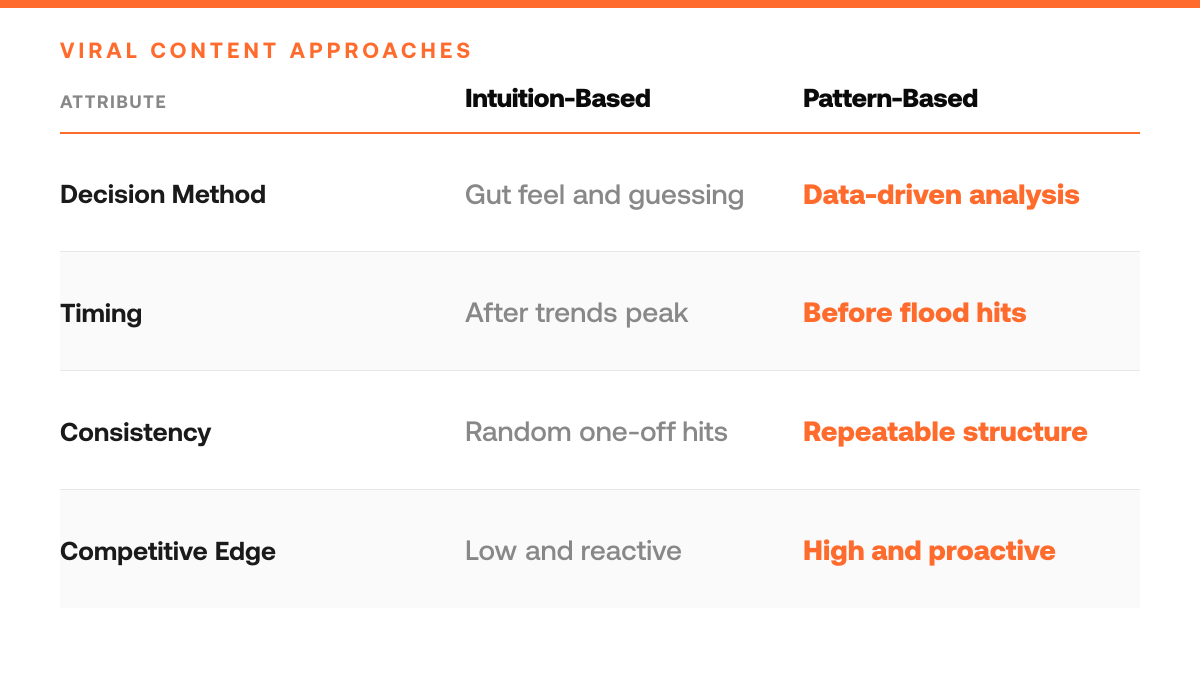
Creator Approach: Guessing vs. Pattern Recognition
| Guessing-Based Approach | Pattern-Recognition Approach |
|---|---|
| Post based on intuition without data analysis | Analyze top-performing content to identify repeatable structures |
| Copy competitors without understanding mechanics | Study viral mechanics to replicate conditions intentionally |
| Chase trends by gut feel and assumption | Spot quiet patterns that consistently outperform before peaks |
| Hope for luck and algorithm favor | Make informed decisions using concrete engagement data |
Example 2: The Solopreneur Building Monetizable Authority
Consider a solopreneur who wants to monetize their influence but doesn't have a large budget for paid analytics tools. They start manually tracking which of their posts generate the most replies, quote tweets, and follows, the signals that indicate genuine audience interest rather than passive scrolling. Within a month, they notice a clear pattern: posts that ask a specific question and acknowledge a common frustration perform far better than generic advice. They also spot that their audience engages most heavily with content posted 4 times a week, not daily. By recognizing this pattern early, they adjust their content calendar, focus on question-driven formats, and begin attracting a more engaged, loyal following. This tighter audience becomes the foundation for sponsorships and product launches, because the creator now posts content that resonates deeply rather than hoping something sticks.
Why Timing and Pattern Matter
Both creators succeeded not by inventing new content, but by recognizing patterns already present in their data. The first optimized posting windows and trend-riding; the second identified format and cadence. In each case, pattern recognition transformed guesswork into strategy, turning sporadic growth into predictable momentum. Creators who spot these signals early gain a compounding advantage, they're building an audience that knows what to expect and when to engage.
Pre-Publish Viral Pattern Checklist
- Identify the primary pattern your post matches (storytelling hook, contrarian take, utility insight, or social proof) before drafting.
- Verify your opening line delivers immediate value or curiosity, test it reads in under five seconds on mobile.
- Confirm your post includes at least one concrete example, stat, or case detail that makes the claim tangible.
- Check that your call-to-action aligns with your audience's next step (follow, reply, retweet, or visit link).
- Review the post for one clear takeaway, remove tangential points that dilute the viral pattern signal.
Common Mistakes to Avoid
Mistake: Chasing trends without checking timing and audience fit
Creators often spot a viral pattern and immediately replicate it without considering when their audience is most active or whether the trend aligns with their niche. This mismatch kills engagement because the content lands at the wrong time or feels forced to followers. Instead, use analytics tools to identify when your specific audience engages most, then time trend-based posts to those windows. Cross-reference trending topics against your follower demographics to ensure relevance before posting.[3]
Do's and Don'ts for Spotting Viral Patterns
| Do | Don't |
|---|---|
| Track concrete data points like shares, replies, and impressions | Rely on subjective opinions about what feels trending |
| Study multiple successful posts to recognize core mechanics | Learn from one-off viral hits as representative patterns |
| Analyze emotional triggers and audience psychology in top posts | Assume viral success is random or purely algorithmic luck |
| Identify timing, format, and topic angle before competitors catch on | Post without understanding the structural elements underneath |
Mistake: Forcing authenticity into viral formulas
Many creators believe viral patterns require abandoning their voice or values. This creates inauthentic content that audiences sense immediately, tanking performance despite following a proven format. The fix: adapt the viral pattern to your genuine perspective and expertise. If a format doesn't fit your brand, skip it, there are always other patterns emerging that will. Authenticity within a structure outperforms perfect formula execution with a fake persona.[3]
Mistake: Copying viral posts without adapting to your specific audience
Direct replication of what worked for another creator ignores that audiences differ by platform niche, follower size, and interests. A post that exploded for a finance creator may flop for a design creator using identical wording and structure. Instead, extract the underlying pattern, hook style, pacing, call-to-action type, and rebuild it using examples, data, or stories relevant to your audience. Test variations and measure which adaptation resonates most before scaling.[3]
Frequently Asked Questions
How do I spot emerging patterns before they peak?
Look for consistency across your recent posts: track which hooks, topics, and formats appear in your top-performing posts, then test variations of those elements before they saturate your niche. Emerging patterns show up as early signals, a handful of posts with unusually high engagement relative to your baseline, before they become obvious to everyone else. By identifying these signals within weeks, you can iterate and publish fresh angles while the pattern still has room to grow.[5]
Do viral patterns differ by platform?
Yes. X rewards thread-based storytelling and quick takes, while other platforms favor different formats entirely. The hooks, pacing, and call-to-action that work on X, short, punchy openings and immediate value, may not translate directly to Instagram or LinkedIn. Test your patterns within the platform you're building on, then adapt only after you've proven what works in your specific audience context.[5]
How do I scale once I've found my winning formula?
Once a pattern consistently outperforms your baseline, increase publishing frequency with that format while monitoring engagement to ensure quality doesn't drop. Scale by doubling down on the specific elements, the hook structure, topic angle, or narrative arc, rather than publishing the same post repeatedly. Document what works, build a content calendar around those winning patterns, and use analytics to catch when a pattern begins to fatigue so you can evolve it before it stalls.[5]
Start your 7-day trial
Grow on X without sounding like everyone else. The right tool learns from your top posts and the leading voices in your niche, then drafts content in your voice. You edit, approve, and ship.
Start free trialSources
Read next
- Do AI images hurt your reach on X? I tested it on my last 100 posts. - I ran a small experiment: more images on my posts, many of them AI art. The data from 100 posts: AI illustrations and other decorative images cut reach by 48% on generic posts and 65% on one-liners - while real proof images (payout screenshots, charts, records) gained 78%. The full numbers, the clean split, and the ClimbX feature this experiment killed.
- How to get X (Twitter) data into your AI agent through MCP. - Your agent can read your real X analytics, voice profile, and outlier feeds through one MCP server - no scraping, no X API contract, one command to connect Claude Code, Claude Desktop, or Cursor. The full setup, the 16 tools, what an agent can actually do with them, and how a customer shipped the first MCP server on our API before we did.