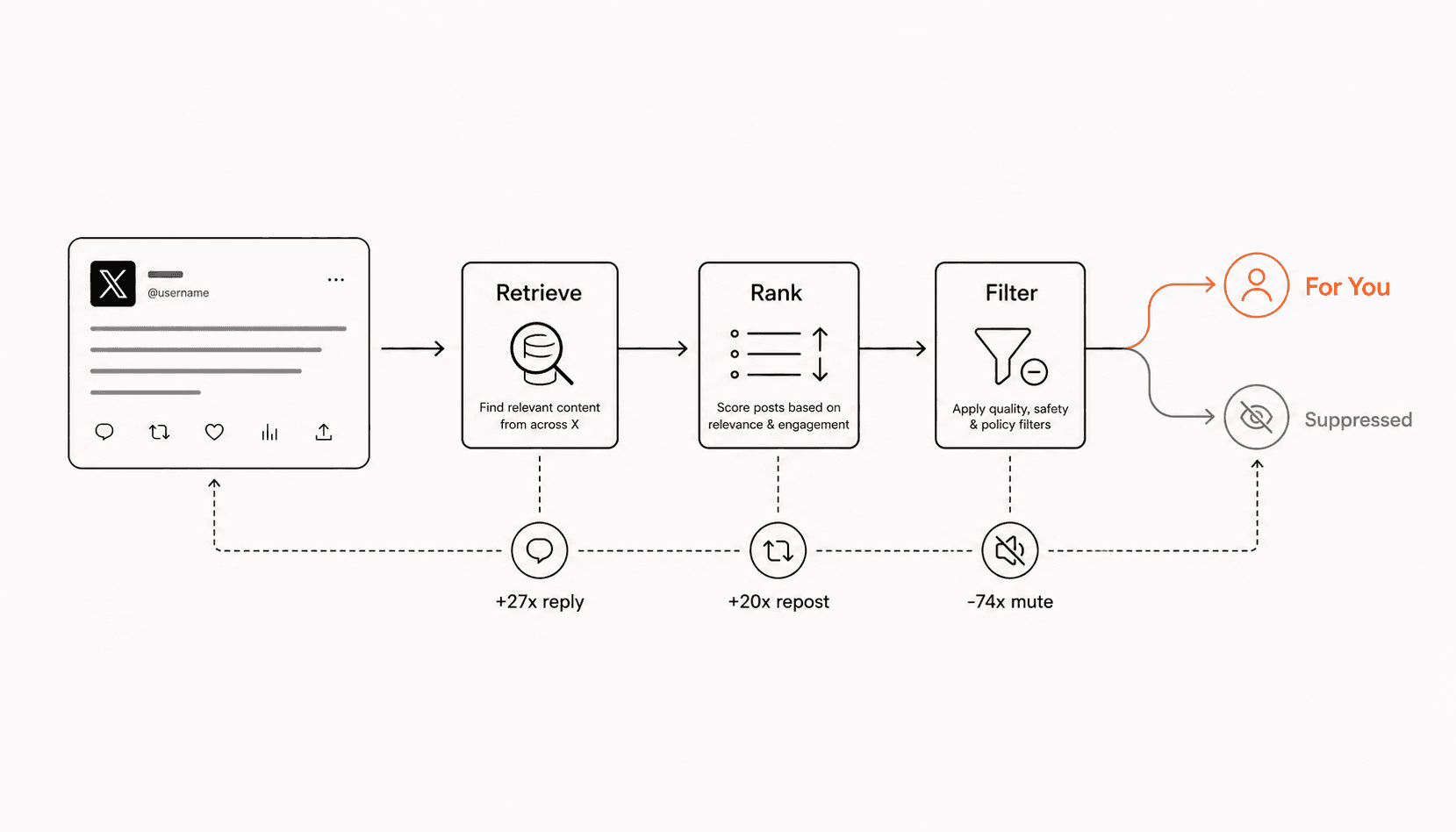
The For You feed decides who reads your posts. The follower-only Following feed is the minority case for most accounts now, and almost all reach comes from algorithmic recommendations to people who don't follow you yet. Understanding the ranking model is no longer optional if you want to grow.
X open-sourced the original ranking code in 2023 and just refreshed the release this week as xai-org/x-algorithm - a runnable, end-to-end For You pipeline built around a Grok-based transformer. The weights and the model have shifted, but the architecture is still the same retrieval plus ranking sandwich. Reading the actual code is the cleanest way to ground yourself in how reach is calculated. This post walks through what the algorithm measures, ranked by impact, and what it quietly demotes. Where a public number exists, I cite it. Where my read is based on operating an account through the changes, I say so.
The first 30 minutes decide everything
A post's score is calculated continuously, but the curve is heavily front-loaded. Engagement velocity in the first 15 to 30 minutes is the single largest signal for whether a post breaks out. After about 90 minutes, the ranker has mostly decided. After 24 hours, your post is effectively dead unless someone with a much larger account quotes or replies to it.
Three operational consequences fall out of this.
- Post when your audience is actually online. A post that gets 50 replies in the first 30 minutes outperforms an identical post that gets 200 replies over 12 hours.
- Reply to your own post within the first few minutes. Adding context, a follow-up thought, or a question keeps engagement velocity high while the ranker is still deciding.
- Don't post and walk away. The first hour is when your presence in the replies matters most. Engaging with early commenters multiplies their incentive to engage back.
How predicted actions shape ranking
The current For You system predicts how likely each viewer is to take actions such as liking, replying, sharing, dwelling, visiting a profile, blocking, or reporting. It then combines those predictions with weights before applying additional scoring and filtering. The implementation and configuration are published in xai-org/x-algorithm.
| Predicted action | What it suggests |
|---|---|
| Reply | The viewer may join the conversation |
| Repost | The viewer may distribute the post to others |
| Profile visit after seeing post | The post may create interest in the author |
| Video played at least half | The viewer may spend meaningful time with the media |
| Like | The viewer may respond positively |
| Negative feedback | The viewer may block, report, mute, or ask for less |
X clarified on August 14, 2026 that these weights scale predicted probabilities for an individual viewer. They do not scale raw engagement counts. It is incorrect to convert one reply, report, or block into a fixed number of likes. That clarification matters because a points-based reading encourages bait instead of useful posts.
The useful writing lesson is not to maximize one raw action. Create posts that the right viewer is likely to read, discuss, share, and value without producing blocks, reports, or other negative feedback. A healthy mix of qualified responses says more than a fabricated exchange rate between engagement types.
What X actively demotes
The visible signals get attention. The quiet demotions matter just as much. These are the categories the ranker is known to suppress, in rough order of how much they cost you.
External links
A post containing a URL to a domain X doesn't own gets a meaningful reach penalty. Founders who post studies, articles, or product links eat this every day. The workaround that actually works is to post the content as a thread or screenshot in the post itself, and put the link in the first reply. Reach on the original stays clean; people who care will scroll for the link.
AI-generated content
X has been tightening detection of fully-AI-written posts since 2025. Posts that read like a model wrote them get throttled. The signals X uses are not public, but operators observe demotion on posts that fit common LLM patterns: long sentences, hedged claims, em-dashes, tricolons, and stock openers like "the truth is" or "here's the thing." Posts that get heavily edited by a human, or that include personal specifics no model would invent, don't see the same throttle.
"Show less often" feedback
The three-dot menu on every post has a "Not interested" and a "Show less from this account" option. Each tap is a strong negative signal, and the ranker treats it as a long-term penalty against your account, not just that post. The most reliable way to earn these is to bait engagement without delivering value. A post that goes viral on outrage will frequently underperform on the next ten posts that follow it.
New accounts and low-trust accounts
Accounts under a few months old, with low follower-to-following ratios, or with a history of being reported, sit in a cold-start penalty box. The fix is mechanical: consistent posting, a real profile, a verified email and phone, and earning real replies from established accounts. The penalty thaws over weeks, not days.
The author features the ranker scores
Each post is also scored by who wrote it. The ranker reads a feature vector for the author and uses it as a multiplier on the engagement score. The features that matter most.
- Premium subscriber. X Premium accounts get a documented boost in For You ranking. The boost is largest in the replies-to-large-accounts case, which is why Premium replies tend to surface above non-Premium replies on a popular post.
- Follower-to-following ratio.A high ratio signals that the account earned its followers. Following back everyone who follows you suppresses this feature and is one of the easier mistakes to fix.
- Recent engagement rate.The ratio of engagement to impressions on your last 30 days of posts. A run of weak posts drags this down for weeks. One outlier doesn't fix it; consistency does.
- Reciprocal engagement graph.The accounts you reply to, and that reply to you, form a private graph the ranker uses to seed early distribution. Posts get shown first to accounts in your graph, and those accounts' reactions drive whether the post breaks out beyond it.
The reply window is where most accounts actually grow
The reciprocal engagement graph point deserves its own section because it explains the single largest mistake small accounts make. Posts from accounts under 5,000 followers rarely break out of the author's own network on their own. Posts that earn an early reply from an account with 50,000+ followers regularly do.
The leverage is in being in the replies of large accounts during the first 15 to 30 minutes after they post. A sharp reply that gets liked by the original author exposes your account to that author's full reader pool for the duration of the post's lifecycle. One good reply can produce more impressions than a week of your own posts.
This is also the mechanic that AI-generated reply tools poison. Bulk AI replies get flagged, suppressed, and increasingly reported, and the accounts running them get throttled at the profile level. The reply-window mechanic only works when the reply is actually good. There's no shortcut.
What this means if you're trying to grow
The ranker is not a black box. It rewards specific behavior and penalizes specific behavior, and the patterns are stable across the last two years of updates. If you want one short list to operate by.
- 1Post when your audience is awake. Reply velocity in the first 30 minutes is worth more than total engagement over a day.
- 2Write posts that earn a reply, not just a like. A specific claim, a contradiction, a question someone has a real answer to.
- 3Keep links out of the post. Put them in the first reply.
- 4Reply early on posts from accounts 2 to 5 times your size. That's where your reach ceiling actually moves.
- 5Don't bulk-post AI text. Heavy human editing is the difference between a post that ships and a post the ranker quietly buries.
- 6Watch your "show less often" rate. One bait post that earns mutes hurts the next ten posts you ship.
The algorithm rewards specific, replyable, human posts written by accounts with a real reciprocal graph. That's also what readers actually want. Most of the time, the algo rewards the right thing for the right reason. The mistake is treating "what works on X" as a separate question from "what's worth posting." It usually isn't.
ClimbX builds around these rules.
The wedge is a 30-day calendar of posts in your voice, drafted from what worked for 3 to 5 accounts ahead of you in your niche. Reply-friendly hooks, no links in the post, edit-before-publish on every draft. The system is the rules above, automated.
Read next
- Outliers as training data: how ClimbX learns what works at your size. - Why we draft from posts that broke out for accounts 2 to 5x your size, how the cohort data refreshes, and how the learning loop tightens with every draft you ship - all framed by what the X algorithm actually rewards.
Sources
- github.com/xai-org/x-algorithm - the May 2026 refresh of the For You pipeline (retrieval + Grok-based ranking)
- X Engineering: Twitter's Recommendation Algorithm - 2023 open-source announcement with the original Heavy Ranker weights
- X Premium help center - the documented ranking boost for Premium subscribers