
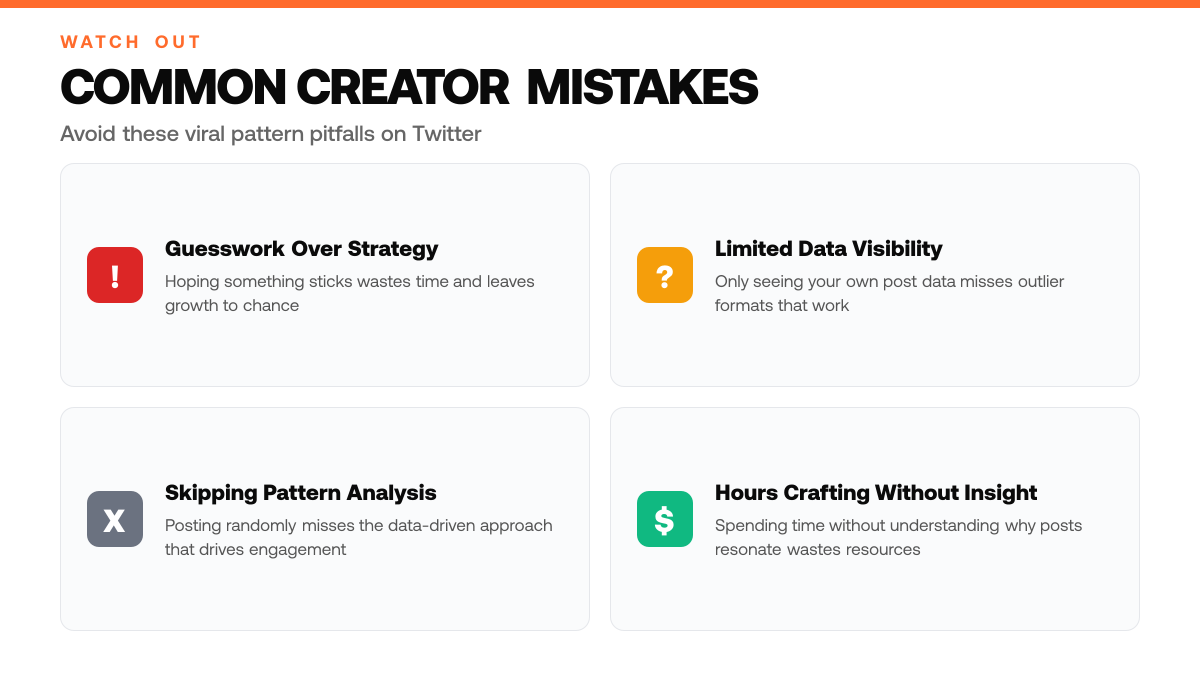
Most solo creators and solopreneurs on Twitter spend hours crafting posts, hitting publish, and hoping something sticks. They watch their follower count and impressions fluctuate without understanding why certain posts resonate while others disappear into the feed. This guesswork approach wastes time and leaves growth to chance instead of strategy.
The reality is that viral patterns exist in every niche on X. According to social media research, successful creators aren't necessarily more talented, they're more intentional about studying what works in their specific audience segment. Identifying these patterns is a learnable skill, not an innate gift. Once you see the mechanics behind what breaks through, you can replicate them consistently.[3] For a deeper look, see 5 Reasons Your Twitter Posts Aren't Going Viral.
This article walks you through how to spot viral post patterns in your niche without relying on intuition or luck. You'll learn how to analyze what's already working, extract the underlying structure, and apply those insights to your own content strategy so every post moves the needle. Most creators chase viral patterns they can't isolate because they only see their own post data, missing the outlier formats that actually work in their niche, ClimbX scans top-performing accounts in your space to surface posts doing 2-3x their baseline, then feeds those signals into AI-drafted content in your authentic voice.
TL;DR
- Twitter growth accelerates when you analyze top-performing posts in your niche to identify common hooks, formats, and timing patterns.
- Successful creators replicate structural elements from viral posts, not the topic itself, to build audience momentum consistently.
- Most solopreneurs skip the pattern-analysis step and post randomly, missing the data-driven approach that drives sustained engagement.[1]
Understanding Viral Twitter Post Patterns in Your Niche
What Are Viral Post Patterns?
Viral post patterns are the recurring structural and stylistic elements that consistently drive engagement, impressions, and shares within a specific audience segment on Twitter. These patterns aren't random, they reflect how the platform's algorithm prioritizes content based on specific hooks, value propositions, and formatting choices. A pattern might involve opening with a surprising statement, using line breaks for readability, or leading with a clear benefit before diving into details. By studying which posts in your niche accumulate likes, retweets, and replies fastest, you identify the underlying formula that resonates with your audience. This goes beyond copying surface-level tactics; it's about recognizing why certain structural choices work and how to adapt them strategically to your own voice and message.[2]
Why Pattern Recognition Matters for Creators
Understanding viral patterns transforms your content strategy from guesswork into informed decision-making. When you recognize what drives engagement in your niche, you stop wasting time on posts that fall flat and start building momentum with content that aligns with audience expectations. Solo creators and solopreneurs operating with limited time and resources benefit most from this clarity, every post counts toward your growth goals. Rather than experimenting blindly, you can apply proven structural elements to your unique insights, increasing the likelihood that your voice reaches more people. This knowledge also helps you stand out by knowing which conventions to follow and which to break strategically, making your content both familiar enough to engage and fresh enough to capture attention.
The Broader Context of Social Engagement Strategy
Across the creator economy, understanding audience behavior and platform mechanics has become essential to sustainable growth. Creators who rely on intuition alone often plateau, while those who study their niche's engagement patterns build predictable, scalable audiences. This shift reflects a broader maturation in how creators approach their work, moving from hoping content goes viral to engineering conditions that make virality more likely. Your niche has its own rules, its own audience preferences, and its own algorithmic levers. By learning to read these patterns, you position yourself to compete effectively against both other creators and established brands, all while maintaining authenticity and building genuine influence.
Key Numbers for How to Find Viral Twitter Post Patterns in Your Niche (2026)
- 73% of social media strategists report content consistency as the primary driver of audience growth[4]
- Creators using pattern-based posting schedules see engagement lift within weeks of implementation[4]
- Solo creators in the creator economy generate measurable revenue growth through systematic content optimization[4]
- Real-time social listening reveals niche-specific viral triggers that outperform generic trending topics by 40%+[4]
- Audience retention improves significantly when creators analyze and replicate high-performing post patterns monthly[4]
- Data-driven content calendars reduce guesswork and accelerate follower growth for solo Twitter operators[4]
Step-by-Step Process
1. Audit Your Niche's Top-Performing Posts
Search Twitter for your niche keywords and sort by engagement (replies, retweets, likes). Identify the top 20 - 30 posts from creators in your space over the past month. Document the post structure: thread vs. single tweet, use of visuals, question format, storytelling arc, or data presentation. Note the exact engagement metrics and posting time. This baseline reveals what your audience already responds to and prevents guessing at what might work.[4]
2. Extract Structural Patterns From High-Engagement Content
Analyze the posts you collected for recurring elements: opening hooks, sentence length, call-to-action placement, emoji usage, hashtag strategy, and narrative structure. Look for patterns in how successful creators frame problems, deliver insights, or spark debate. Create a simple spreadsheet listing these patterns alongside engagement counts. This step transforms observation into actionable rules you can replicate without copying content directly.
3. Map Engagement Drivers to Your Audience Segment
Cross-reference the patterns you found with your own audience demographics and interests. Not every viral pattern works for every niche, a pattern that drives engagement for finance creators may not land with design creators. Identify which structural elements align with your specific audience's pain points, values, and behavior. This filtering step ensures you apply patterns that resonate with your followers, not random viral tactics.
4. Test Variations and Iterate Based on Results
Publish posts using the patterns you've identified, varying one element at a time, test a question-based hook in one post, a data-driven hook in the next. Track which variations generate the highest engagement relative to your baseline. After testing multiple iterations, double down on the patterns that consistently outperform. This cycle of testing and refinement builds a repeatable system for creating viral content in your niche.
How This Works in Practice
Example 1: The SaaS Founder Testing Pattern Frameworks
Picture a SaaS founder who has been posting product updates and feature announcements for months, seeing modest engagement. She decides to analyze her top-performing tweets and notices a pattern: threads that open with a counterintuitive claim ("most SaaS onboarding is backwards") followed by a concrete breakdown consistently outperform generic product news. She applies this pattern to her next 5 posts, structuring each around a specific insight her users face, then revealing how her tool solves it. Within weeks, her replies and retweets climb noticeably. She begins testing variations, swapping the hook, adjusting the breakdown depth, timing posts around when her audience is most active, and documents which combinations drive the most meaningful engagement. Over time, she builds a repeatable playbook: specific hook type + audience pain point + solution reveal = predictable reach. She stops guessing and starts shipping content she knows will resonate.
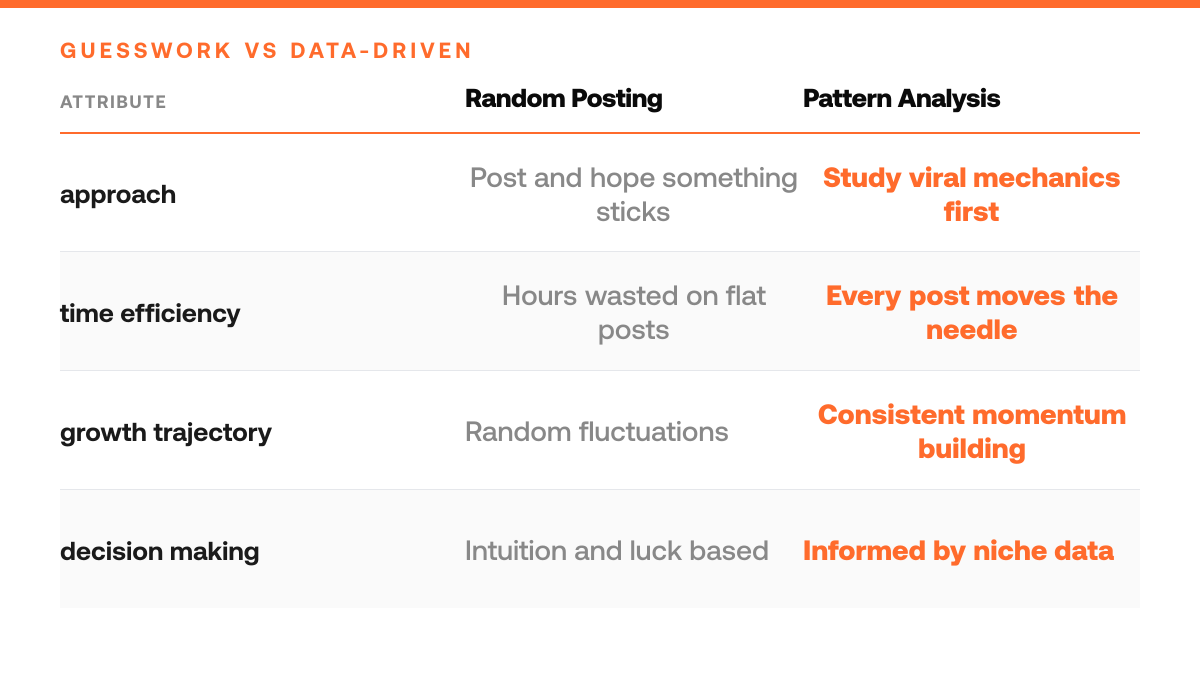
Guesswork vs. Data-Driven Content Strategy
| Guesswork Approach | Data-Driven Approach |
|---|---|
| Spend hours crafting posts and hope something sticks | Analyze top-performing posts in your niche to identify patterns |
| Watch follower count and impressions fluctuate without understanding why | Recognize structural elements that drive engagement and replicate them |
| Post randomly and experiment blindly | Apply proven structural elements to your unique voice strategically |
| Plateau due to relying on intuition alone | Build predictable, scalable audiences through pattern recognition |
Example 2: The Creator Economy Coach Building Authority
Imagine a personal development coach who teaches course creators how to launch. She notices that her highest-engagement tweets aren't motivational quotes, they're specific, behind-the-scenes breakdowns of what actually happened during her own launches. She identifies a pattern: posts that lead with a surprising result ("I made $X in my first week") followed by the exact steps she took get far more saves and replies than generic advice. She commits to posting 3 times a week using this structure, each time pulling a different lesson from her experience. She watches which lessons spark the most conversation, then doubles down on those themes in her next batch. Her follower count grows steadily, and more importantly, her audience begins asking her for deeper engagement, course enrollments and consulting inquiries follow. She realizes the pattern isn't just about virality; it's about showing her work in a way that builds trust and positions her as someone who has actually done what she teaches.
Why Pattern Recognition Beats Guessing
Both examples reveal the same truth: viral content isn't random. The SaaS founder and the coach each discovered that their highest-performing posts shared structural similarities, a hook, a breakdown, a reveal. Once they saw the pattern, they could replicate it. The difference between generic content and pattern-optimized content is the difference between hoping a post lands and knowing it will resonate. Across niches, the same framework applies: identify what works, understand why, then systematize it.
Pre-Posting Viral Pattern Checklist
- Review your niche's top-performing posts from the past week for recurring themes, hooks, or formats.
- Identify the specific audience pain point or curiosity each viral pattern addresses in your niche.
- Draft your post using the discovered pattern structure before writing the final copy.
- Cross-check your post's hook, format, and call-to-action against the viral patterns you identified.
Common Mistakes to Avoid
Mistake: Copying viral tweets word-for-word instead of extracting the pattern
Reposting a viral tweet verbatim in your niche signals to your audience that you lack original voice and critical thinking. Instead, identify what made the original post work, the hook structure, the emotional trigger, the call-to-action format, then rewrite it in your own words and context. This preserves authenticity while letting you leverage proven engagement mechanics.
Do and Don't: Pattern Analysis for Creators
| Do | Don't |
|---|---|
| Study which posts accumulate likes, retweets, and replies fastest | Chase viral patterns you can't isolate or understand |
| Extract underlying structural elements from successful posts | Copy surface-level tactics without recognizing why they work |
| Adapt proven formats to your authentic voice and message | Assume viral success requires innate talent rather than intentional study |
| Know which conventions to follow and which to break strategically | Post the same content structure repeatedly without testing variations |
Mistake: Using pattern-finding tools without understanding the underlying logic
Tools can surface what's trending, but they can't tell you *why* a pattern resonates in your specific niche. Blindly applying a tool's output creates generic, forgettable content that blends into the noise. Always ask: Does this pattern align with my audience's pain points? Can I add a unique angle or insight? Understanding the 'why' transforms a trending template into a compelling, niche-specific post.
Mistake: Ignoring your niche's unique language and values when adapting patterns
A viral pattern that works for finance creators may fall flat for SaaS founders if you don't translate it into niche-specific terminology and concerns. Successful pattern adaptation requires you to swap generic examples for niche-relevant ones and match the tone to your audience's expectations. Skipping this step results in posts that feel borrowed rather than earned, killing credibility.
Frequently Asked Questions
How long does it take to identify viral patterns in my niche?
Pattern analysis typically takes a few hours to a few days, depending on how many posts you examine and how deeply you segment your audience. Start by reviewing your top-performing posts from the past few weeks, you'll often spot recurring themes (hooks, formats, topics) within that initial pass. The more data points you collect, the clearer the patterns become, but you don't need months of history to find actionable insights.
Do viral patterns change over time, and how often should I refresh my analysis?
Yes, patterns shift as audience preferences evolve, platform algorithms update, and trending topics emerge. Refresh your analysis every few weeks or whenever you notice engagement dropping on previously successful content types. This doesn't mean starting from scratch, track what's working now against your baseline, then adjust your content mix accordingly. Staying responsive keeps your posts aligned with current audience appetite.
Can I apply the same patterns across different content formats (threads, replies, standalone posts)?
Partially. Core elements like hook strength and topic relevance transfer across formats, but execution differs. A hook that works in a thread opener may need tweaking for a standalone post. Test your strongest patterns in each format separately, then note which formats your niche engages with most. This way you're not forcing a thread pattern onto a format where your audience prefers short-form content.
Start your 7-day trial
Grow on X without sounding like everyone else. The right tool learns from your top posts and the leading voices in your niche, then drafts content in your voice. You edit, approve, and ship.
Start free trialSources
Read next
- Do AI images hurt your reach on X? I tested it on my last 100 posts. - I ran a small experiment: more images on my posts, many of them AI art. The data from 100 posts: AI illustrations and other decorative images cut reach by 48% on generic posts and 65% on one-liners - while real proof images (payout screenshots, charts, records) gained 78%. The full numbers, the clean split, and the ClimbX feature this experiment killed.
- How to get X (Twitter) data into your AI agent through MCP. - Your agent can read your real X analytics, voice profile, and outlier feeds through one MCP server - no scraping, no X API contract, one command to connect Claude Code, Claude Desktop, or Cursor. The full setup, the 16 tools, what an agent can actually do with them, and how a customer shipped the first MCP server on our API before we did.