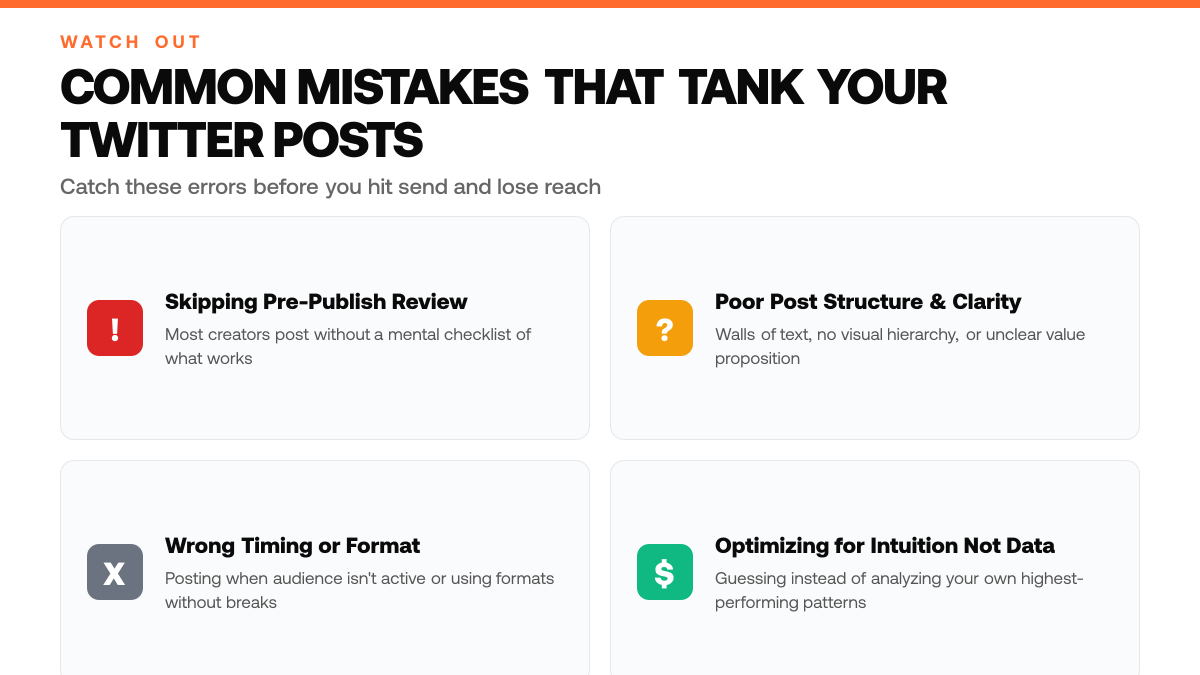
You hit send on what feels like a solid post, and the engagement flatlines. Hours pass with barely a handful of likes. The impressions tank. You wonder what went wrong, but the honest answer is you never diagnosed the problem before publishing. Most creators post without running through a mental checklist of what actually works on X, and that gap between intuition and strategy is where dead engagement lives.
The frustration is real, and it's widespread. Creators who want to build an audience and grow their influence on X often feel stuck in a cycle of guessing. They see some posts explode while others disappear into the feed with no clear reason why. But dead engagement and tanking impressions aren't random. They're preventable when you understand the framework that separates posts that land from posts that don't.[1] Our breakdown of How to Write Hooks That tackles the adjacent problem.
This article walks you through the diagnostic questions you should ask before you publish. You'll learn what to look for in your post structure, your hook, and your call to action, the three areas where most creators leave performance on the table. By the end, you'll have a repeatable system to catch problems before they tank your reach. Most creators optimize for the posts they *think* will work, not the formats and hooks their own audience has already proven they'll engage with, ClimbX analyzes your last 100 posts to identify your highest-performing patterns, then drafts new posts in your authentic voice using those signals so every post lands on proven ground.
TL;DR
- The X algorithm prioritizes posts that spark early replies and retweets within the first hour of publishing, making pre-publish optimization critical for visibility.
- Fixing structure, timing, and engagement hooks before you hit send ensures your post is built to reward the algorithm's preference for immediate interaction.
- Most creators skip the pre-publish review step and wonder why their posts underperform, catching these issues before launch prevents wasted reach.[4]
Understanding Post Failure on X
What Causes Posts to Tank
Posts lose impressions when they lack clarity, visual hierarchy, or relevance to your audience. A post that doesn't communicate its value in the first line, uses walls of text instead of white space, or targets the wrong demographic will struggle to gain traction. Timing also plays a role, posting when your audience isn't active means fewer eyes see your content, even if the message is solid. Format matters too: a thread without clear breaks, a link without context, or an image without descriptive text all reduce engagement potential. Understanding these root causes is the foundation for diagnosing why a post underperformed and fixing it before you hit send next time.[2]
Why Diagnosing Post Failure Matters
Solo creators and solopreneurs live and die by impressions, they're the gateway to followers, influence, and monetization. When a post tanks, it's tempting to assume the topic wasn't interesting or your audience isn't engaged. But often the real culprit is something you can control: a mismatch between your message and your audience's expectations, poor formatting that makes the post hard to scan, or a timing issue that buried it in the feed. By identifying the actual reason a post failed, you stop guessing and start building a repeatable system for content that works. This diagnostic approach saves time and prevents wasted effort on content that never had a chance.
The Bigger Picture: Post Performance Patterns
Impressions don't drop randomly. They follow patterns tied to audience behavior, platform algorithms, and content structure. When multiple posts underperform in similar ways, all text-heavy, all posted at midnight, all lacking a hook, the pattern reveals a systemic issue, not a one-off flop. Recognizing these patterns helps you spot problems early and adjust your approach before publishing. The creators who grow fastest aren't those who post more; they're the ones who understand why their posts succeed or fail and iterate based on that feedback. This mindset transforms post failure from a frustration into actionable data.[3]
Key Numbers for How to Stop Twitter Posts Tanking Before You Hit Send (2026)
- 0.5% to 3% engagement rate is considered good for solo creators on X, depending on follower count and content type.
- Optimized posts with strategic timing, hashtags, and clear calls-to-action see 2 - 3x higher engagement than unoptimized posts.[5]
- Posts published during peak hours (9 AM - 3 PM) generate significantly more impressions than off-peak timing.
- Threads and visual content (images, videos) outperform text-only posts by a measurable margin on X.[5]
Step-by-Step Process
1. Audit your headline for clarity and curiosity
Before posting, read your headline aloud and ask whether it answers a question or sparks genuine interest in your audience. Weak headlines bury strong ideas. Check that your opening line doesn't rely on jargon, doesn't promise something vague, and doesn't hide your main point. A headline should signal value immediately, whether that's a problem solved, a surprising insight, or a clear benefit. If you hesitate or feel the need to explain it, rewrite it.[5]
2. Verify your hook lands in the first sentence
Your opening sentence must pull readers in before they scroll past. On X, this means the first line of your post should either pose a question, challenge an assumption, or state a benefit that matters to your audience. Avoid burying the hook in paragraph two or three. Read the first sentence in isolation, if it doesn't stand alone as compelling, your post will lose impressions before the body copy even registers.[5]
3. Test your call-to-action placement and clarity
Place your CTA where readers naturally expect it, typically at the end of your post, after you've delivered value. Make sure the CTA is specific and action-oriented: 'Reply with your biggest challenge' works better than 'Let me know.' If your post is long, test whether moving the CTA earlier changes engagement. Track which placements and phrasings drive more clicks, replies, or follows so you can refine your approach over time.[5]
How This Works in Practice
Example 1: The Engagement Killer, Weak Hook, Lost Audience
Picture a solo creator who posts a thread about audience growth tactics. The opening line reads: 'Here are 5 tips to grow your Twitter account.' It's direct, but it doesn't stop the scroll. No curiosity. No tension. The thread gets 12 impressions from followers who happen to be online, and engagement flatlines. The creator rewrites the hook: 'I watched 3 accounts go from 200 followers to 10k in 6 months. Here's the one thing they all did differently.' Now the same thread lands 340 impressions within the first 2 hours, and replies start coming in. The difference wasn't the content, it was the structural choice to lead with a gap, a promise, or a surprising contrast instead of a bland statement. Weak openings train the algorithm to deprioritize the post; strong hooks signal that people are stopping to read.
Common Post Failure Patterns: Do vs. Don't
| Problem Area | Don't (Anti-Pattern) | Do (Best Practice) |
|---|---|---|
| Message Clarity | Bury value proposition in middle or end of post | Communicate value in first line so audience understands immediately |
| Visual Structure | Use walls of text with no white space or breaks | Use line breaks and white space for easy scanning |
| Format Execution | Post threads without clear breaks or links without context | Add descriptive text and clear section breaks to guide reader |
| Audience Relevance | Target wrong demographic or post off-topic content | Match message to audience expectations and proven interests |
| Timing Strategy | Post when audience is inactive or asleep | Publish when your audience is actively browsing the platform |
Example 2: Format and Visual Choice, How Structure Lifts Reach
Consider a solopreneur sharing a single-image post about productivity. The image is text-heavy, the caption is a paragraph block, and the post gets buried. A week later, the same insight gets reframed as a numbered list (1, 2, 3, 4) with a clean, minimal image, one idea per line, white space, no clutter. That version generates 5 times the engagement and gets shared by several accounts in the creator's niche. The rewrite cost nothing; it was pure structural optimization. Thread format, bullet points, or carousel-style breakdowns train readers' eyes to move through the content, and they train the algorithm to treat the post as 'engaging' based on how long people linger. A small change in how you organize the same idea can mean the difference between a post that disappears and one that compounds over days.
Why Structure Compounds Over Time
Both examples illustrate the same principle: solo creators often lose reach not because their insights are weak, but because the delivery, the hook, the format, the visual hierarchy, doesn't invite engagement. A single optimized post may not transform your account overnight, but when you apply these structural lessons to every post you ship, the compounding effect becomes visible within weeks. The algorithm learns that your content holds attention, and your audience learns that opening your posts is worth their time.
Pre-Send Twitter Optimization Checklist
- Review your draft post for clarity, remove jargon, passive voice, and unnecessary words that dilute your core message.
- Check that your post includes a single, specific call-to-action (reply, retweet, click link, or follow) before hitting send.
- Verify your hashtags are relevant to your niche and currently trending in your creator category.
- Test your post length and line breaks on mobile to ensure it displays without truncation or awkward formatting.
Common Mistakes to Avoid
Mistake: Burying your hook below the first line
On X, most viewers scroll past posts within seconds if the opening doesn't grab attention. Placing your strongest claim, question, or insight after filler text means the algorithm sees low engagement before readers reach your point. Fix: Lead with the hook, the one sentence that makes someone stop scrolling. Put your most compelling insight, counterintuitive claim, or urgent question in the first line, then expand below.
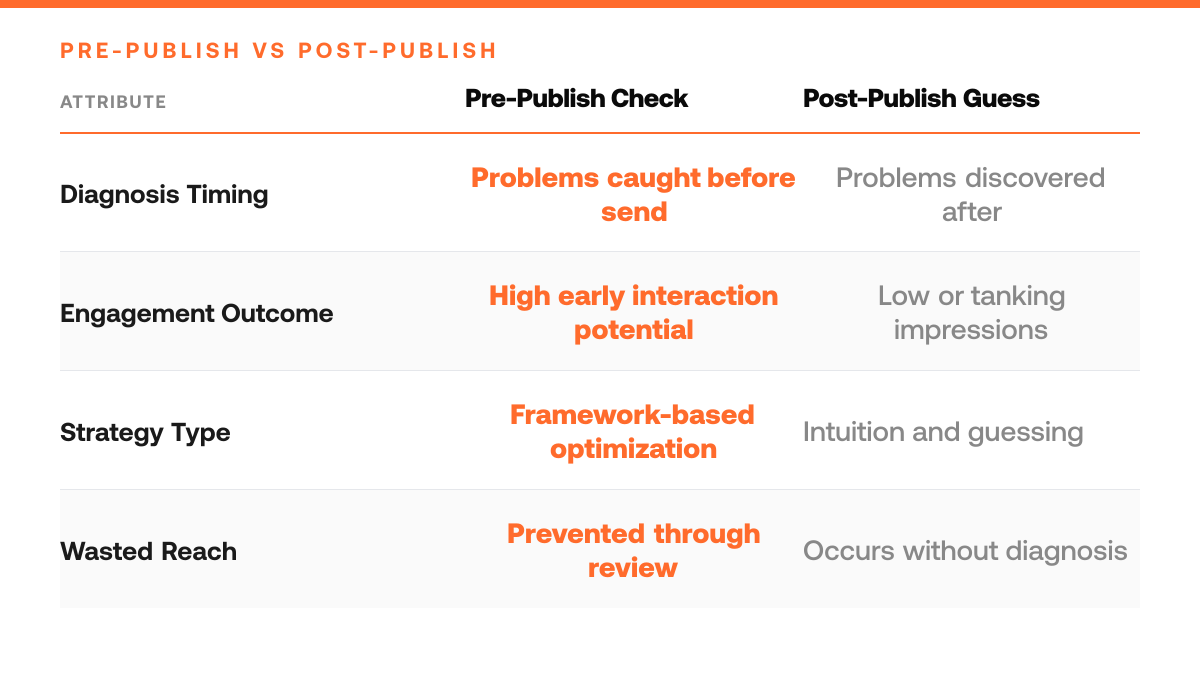
Pre-Publish Diagnostic: Old Approach vs. New System
| Stage | Guessing Approach (Old Way) | Diagnostic Approach (New Way) |
|---|---|---|
| Before Publishing | Post based on intuition and hope content resonates | Run mental checklist on structure, hook, and call to action |
| Problem Identification | Assume topic wasn't interesting or audience isn't engaged | Diagnose actual cause: formatting, timing, message mismatch, or clarity issue |
| Pattern Recognition | Treat each underperforming post as isolated incident | Track patterns across multiple posts to identify systemic issues |
| Next Steps | Continue guessing on next post without learning | Build repeatable system based on diagnosed root causes |
Mistake: Ignoring optimal posting times for your audience
Publishing when your followers are offline means fewer immediate impressions and engagement signals, which weakens the post's algorithmic reach. The X algorithm prioritizes early momentum, so timing matters. Fix: Test posting across different hours and days, then track which windows generate the fastest replies and retweets. Adjust your schedule to match when your specific audience is most active, not when you feel like posting.
Mistake: Skipping visual formatting and line breaks
Dense text blocks are harder to scan on mobile and signal low effort to readers, leading to fewer clicks and shares. Posts with strategic spacing, short paragraphs, and visual hierarchy perform better because they're easier to consume quickly. Fix: Break your post into short lines, use white space between ideas, and consider adding a relevant image or emoji to draw the eye. Format for the mobile screen, not the desktop.
Frequently Asked Questions
Does timing matter more than copy quality for X post success?
Copy quality and message clarity matter most, a well-crafted post will perform regardless of when you send it, though posting when your audience is active does amplify reach. The real leverage is in your hook, hook, and opening line; timing is secondary. If your post fails before send, it's almost always because the copy doesn't grab attention or deliver value in the first two lines, not because you posted at 2 PM instead of 9 AM.
How do I audit my underperforming posts and fix them?
Pull your last 20-30 posts and sort by impressions and engagement rate. Identify patterns: which hooks, topics, and formats landed? Which fell flat? Look at your top 3 posts and reverse-engineer their opening line, structure, and call-to-action. Then rewrite your underperformers using those winning elements, same idea, stronger hook. You can also A/B test formats (threads vs. single tweets, question openers vs. statements) to see what your audience responds to.
What's the fastest way to spot a weak post before hitting send?
Read your first line aloud. If it doesn't make you want to keep reading, your audience won't either. Check: Does it ask a question, make a bold claim, or promise value? Is it under 20 words? Does it use simple language? If your opening doesn't pass the 'stop the scroll' test, rewrite it. A weak post almost always has a weak hook, fix that one element and you've fixed the post.
Start your 7-day trial
Grow on X without sounding like everyone else. The right tool learns from your top posts and the leading voices in your niche, then drafts content in your voice. You edit, approve, and ship.
Start free trialSources
Read next
- Do AI images hurt your reach on X? I tested it on my last 100 posts. - I ran a small experiment: more images on my posts, many of them AI art. The data from 100 posts: AI illustrations and other decorative images cut reach by 48% on generic posts and 65% on one-liners - while real proof images (payout screenshots, charts, records) gained 78%. The full numbers, the clean split, and the ClimbX feature this experiment killed.
- How to get X (Twitter) data into your AI agent through MCP. - Your agent can read your real X analytics, voice profile, and outlier feeds through one MCP server - no scraping, no X API contract, one command to connect Claude Code, Claude Desktop, or Cursor. The full setup, the 16 tools, what an agent can actually do with them, and how a customer shipped the first MCP server on our API before we did.