
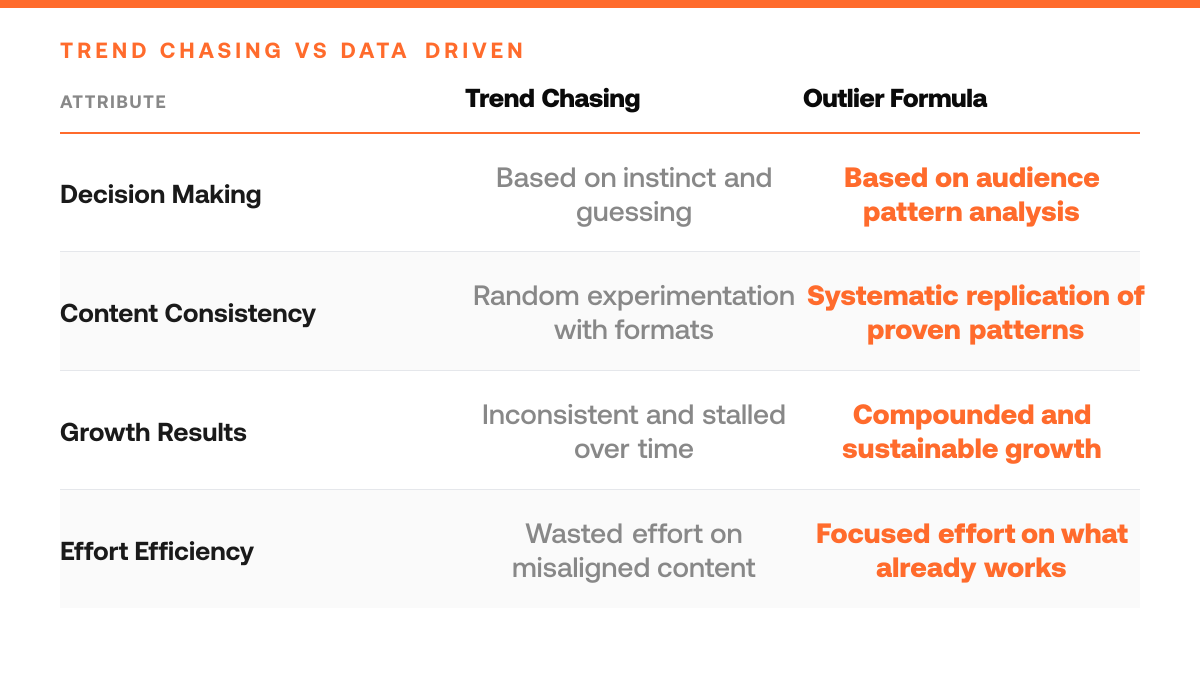
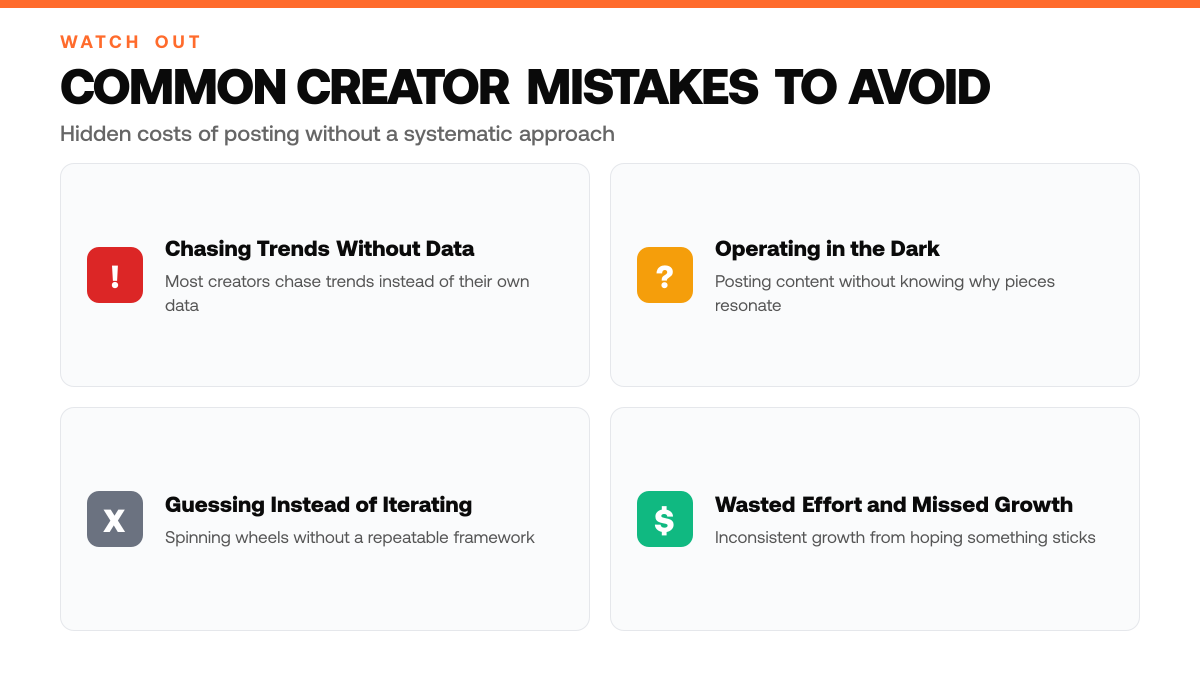
Most solo creators on X post without a systematic approach to understanding what resonates with their audience. They chase trends, experiment with different formats, and hope something sticks, then wonder why their growth stalls or feels inconsistent. The result is wasted effort, missed opportunities, and the frustration of watching other creators pull ahead with seemingly less work.
The problem isn't a lack of effort or talent. Research shows that content consistency and audience understanding are the primary drivers of social media growth, yet most creators operate on instinct rather than pattern recognition. Without a repeatable framework for identifying which content patterns drive disproportionate engagement and follower growth, even skilled creators end up spinning their wheels.[1]
This article walks through the Outlier Post Formula, a structured method for analyzing what works in your niche, reverse-engineering the patterns that generate outsized results, and applying those insights to your own posts. By the end, you'll have a repeatable system to identify high-performing content patterns and write posts that consistently drive growth. Most creators chase trending formats without realizing their audience has already rewired itself to their unique voice, ClimbX scans outlier posts outperforming baseline engagement in your niche and drafts new content in your authentic style, so you compound growth from what's already working.
TL;DR
- The Outlier Post Formula analyzes your highest-performing tweets to identify the patterns, topic, tone, structure, timing, that drive outsized engagement and reach.
- It works by extracting what made those posts succeed, then systematically replicating those patterns across future content to compound results over time.
- Most creators skip this step and chase trends instead of their own data, missing the consistent growth that comes from doubling down on what already works for their audience.
Understanding the Outlier Post Formula
What Is the Outlier Post Formula?
The Outlier Post Formula is a data-driven method for identifying and reverse-engineering your highest-performing content. Instead of creating posts randomly and hoping for engagement, you analyze your existing content library to find the posts that significantly outperform your average engagement rate. Once you've pinpointed these outliers, you systematically examine what made them work, the topic you chose, the format you used (thread, carousel, single tweet), the time you posted, and the hook style that grabbed attention. By understanding these specific elements, you can replicate the conditions that led to success rather than guessing what your audience wants to see.
Why Understanding Your Outliers Matters
Most creators operate in the dark, posting content without knowing why certain pieces resonate while others fall flat. The Outlier Post Formula shifts you from guessing to strategic iteration by revealing patterns in what your specific audience engages with most. This foundation is critical because audience preferences vary widely, what works for one creator may not work for another. When you understand why your outliers succeeded, you can confidently scale your growth by doubling down on the elements that actually drive engagement for your followers, rather than chasing trends or copying strategies that don't align with your audience's interests.[3]
How This Approach Fits Modern Creator Growth
In today's social media landscape, data-informed content strategy separates creators who grow consistently from those who plateau. The Outlier Post Formula acknowledges that sustainable audience growth isn't about viral luck, it's about understanding the mechanics of what your audience values and then building on that foundation repeatedly. By treating your past performance as a learning tool, you develop a repeatable system that compounds over time, turning occasional wins into predictable results and transforming your content calendar from a guessing game into a strategic roadmap.
Step-by-Step Process
1. Audit your last 50-100 posts for engagement outliers
Pull your last 50 to 100 posts from X and calculate the engagement rate for each by combining likes, retweets, and replies. Rank them by total engagement. Identify the top 10%, these are your outlier posts, the ones that resonated most with your audience. This data-driven approach removes guesswork and reveals what actually works for your specific followers, not what generic advice suggests should work.[2]
2. Document patterns across your top-performing posts
For each outlier post, document the common elements: the topic or theme, the format (single tweet, thread, quote tweet, or reply), the hook type (question, stat, story, contrarian take), and the time of day it was posted. Look for repeating patterns across the group. You'll likely notice that certain topics, formats, or hook styles appear more frequently in your high-engagement set than in your overall feed. These patterns are the DNA of your winning content.
3. Create and test a content template on 5-10 new posts
Build a reusable template based on the patterns you identified, for example, a specific hook format paired with a topic and posting time. Apply this template to 5 to 10 new posts over the next week or two. Track the engagement on these test posts. This validation step confirms whether the formula works consistently or if the outliers were one-off successes. Real-world testing beats theory every time.
4. Refine your formula and scale it across your calendar
Review the results from your test posts. If engagement remains strong, you've found your winning formula, now scale it. Integrate this template into your regular content calendar so you're publishing high-probability content consistently, not randomly. If results dipped, adjust one variable at a time (hook, topic, or timing) and test again. This iterative refinement turns a one-time win into a repeatable system that compounds your growth.
How This Works in Practice
Example 1: The Productivity Creator's Contrarian Discovery
Picture a creator focused on productivity tips who posts regularly but notices most of their content receives modest engagement. They decide to audit their top-performing posts and spot a pattern: the outliers all challenge conventional wisdom. Posts titled "Stop Using [Popular Tool]" paired with a specific, actionable alternative consistently outperform polished, how-to content. They realize their audience doesn't want confirmation of what they already know, they want permission to question it, plus a concrete next step. The creator shifts their content strategy to intentionally surface contrarian angles backed by personal experience. Within weeks, they notice higher reply counts, more shares, and followers explicitly thanking them for the permission to rethink their workflow. The formula works because it taps into what their particular audience values: fresh perspective over repetition.
Traditional Creator Approach vs Outlier Post Formula
| Traditional Approach | Outlier Post Formula |
|---|---|
| Post content randomly and hope for engagement | Analyze existing content to identify highest-performing posts |
| Chase trending formats without audience data | Reverse-engineer patterns from your own outliers |
| Operate on instinct rather than pattern recognition | Use data-driven method to replicate success conditions |
| Wonder why growth stalls or feels inconsistent | Compound results by doubling down on what works |
Example 2: The SaaS Solopreneur's Vulnerability Win
Consider a solopreneur building a SaaS product who initially posts polished success stories and feature announcements. Their engagement stays flat. After analyzing their outlier posts, they notice the highest-engagement content isn't about wins at all, it's behind-the-scenes insights and honest mistakes. A post about a failed marketing experiment that cost them time and money generates far more replies and retweets than a launch announcement. They begin sharing the messy middle: product pivots that didn't work, customer feedback that stung, and lessons learned. This vulnerability resonates because it's rare and authentic. Their audience starts engaging not to celebrate a win, but to learn from real failure. The formula reveals that their community values transparency over perfection, and that insight becomes the foundation for all future content decisions.
Why Your Niche Needs Your Insight
Both examples share a core truth: the outlier post formula isn't a template to copy. It's a diagnostic tool that reveals what your specific audience actually craves. A productivity creator and a SaaS founder will never have identical content formulas, but both can use the same method to uncover their own. By analyzing what already works in your feed, you skip the guesswork and build on authentic patterns your followers have already shown you they value.
Outlier Post Formula Implementation Checklist
- Audit your top-performing posts from the past month to identify which topics, formats, and posting times generated the most engagement.
- Document the common patterns across your best posts, headline style, content structure, call-to-action type, and audience response patterns.
- Create content templates based on your highest-performing patterns so you can replicate success consistently without starting from scratch.
- Test new variations of your template formula on a small batch of posts to measure whether the pattern holds across different topics.
- Measure results after each test cycle and refine your template based on what moved the needle for followers, impressions, and engagement.
Common Mistakes to Avoid
Mistake: Copying viral post formats without analyzing your own audience's engagement patterns
Many creators replicate the structure of trending posts (thread length, hook style, call-to-action) without understanding why those posts resonated with THEIR specific followers. This leads to wasted effort and low engagement because the format doesn't match audience preferences. Fix: Before copying any format, analyze your own top 20 - 30 posts to identify which structures, topics, and tones drive the most replies, retweets, and followers for your niche. Let your data guide format choices, not viral trends.[4]
Elements to Analyze in Your Outlier Posts
| Content Element | What to Examine |
|---|---|
| Topic | Which subjects significantly outperform your baseline engagement |
| Format | Whether threads, carousels, or single tweets drive outsized results |
| Timing | When you posted content that resonated most with your audience |
| Hook Style | What attention-grabbing opening grabbed followers and kept them engaged |
Mistake: Drawing conclusions from fewer than 20 - 30 posts analyzed
A small sample size creates false patterns. Analyzing only 5 - 10 viral posts can lead you to spot coincidences rather than genuine trends, causing you to chase phantom formulas. You'll invest time in tactics that don't actually work for your audience. Fix: Commit to analyzing a meaningful sample, at least 20 - 30 of your own top-performing posts, to identify reliable patterns in structure, timing, and messaging before applying them to new content.
Mistake: Ignoring audience-specific context when applying the formula
The Outlier Post Formula works differently across niches. A thread that drives engagement for a fintech creator may flop for a lifestyle creator, even if the structure is identical. Applying the formula blindly without considering your audience's interests, pain points, and platform behavior wastes the formula's potential. Fix: Test formula elements on a small batch of posts first, measure results within your niche, and adjust hook style, depth, and tone to match what your specific followers respond to before scaling.
Frequently Asked Questions
How often should I audit my posts using the Outlier Post Formula?
Audit your posts monthly to track patterns and refine your approach. Monthly reviews give you enough data to spot trends in what resonates with your audience without overwhelming you with micro-adjustments. Consistent auditing helps you stay aligned with what actually works rather than guessing based on a handful of posts.
Can I use the Outlier Post Formula on platforms other than X?
Yes, the core principles adapt to other platforms. The formula works wherever you have audience engagement data, LinkedIn, Threads, Bluesky, or others. The mechanics shift slightly (algorithm signals differ), but identifying your highest-performing formats and topics, then scaling what works, remains universally applicable across social networks.
How long until I see results from applying this formula?
You'll begin seeing measurable results within weeks of consistent application. Growth compounds over time as you publish more outlier posts and refine your understanding of what resonates. Early momentum depends on how frequently you post and how closely you follow the formula, patience and consistency matter more than perfection.
Start your 7-day trial
Grow on X without sounding like everyone else. The right tool learns from your top posts and the leading voices in your niche, then drafts content in your voice. You edit, approve, and ship.
Start free trialSources
Read next
- Do AI images hurt your reach on X? I tested it on my last 100 posts. - I ran a small experiment: more images on my posts, many of them AI art. The data from 100 posts: AI illustrations and other decorative images cut reach by 48% on generic posts and 65% on one-liners - while real proof images (payout screenshots, charts, records) gained 78%. The full numbers, the clean split, and the ClimbX feature this experiment killed.
- How to get X (Twitter) data into your AI agent through MCP. - Your agent can read your real X analytics, voice profile, and outlier feeds through one MCP server - no scraping, no X API contract, one command to connect Claude Code, Claude Desktop, or Cursor. The full setup, the 16 tools, what an agent can actually do with them, and how a customer shipped the first MCP server on our API before we did.