
You post consistently, your writing is solid, but engagement stays flat. The frustration is real: you're creating content, yet your audience isn't growing and your monetization efforts stall. Most solo creators face this exact wall because they rely on intuition and guesswork to decide what to post, rather than grounding their strategy in what actually resonates with their audience.
Content marketing is a core driver of both audience growth and monetization for creators on social platforms. Yet the gap between posting and converting is where most creators get stuck. Research shows that many creators struggle to find ideas that actually move the needle because they lack a systematic way to identify what their audience wants to see and what will drive real engagement.[1]
This guide walks you through a data-driven approach to finding content ideas that convert. You'll learn how to move beyond intuition, identify patterns in what works, and build a repeatable system for generating posts that grow your following and strengthen your monetization potential.
TL;DR
- Analyze what your audience already engages with, comments, shares, replies, to identify patterns in high-performing content.
- Systematize those patterns into repeatable templates you can apply across future posts to reliably generate converting ideas.
- Most creators skip this step and guess at content instead of letting their audience data do the work for them.[2]
Understanding Converting Content Ideas
What Is Converting Content?
Converting content is material designed to move your audience from passive consumption to measurable action. Unlike viral content that spreads for entertainment or shock value, converting content drives followers to click a link, reply to a post, follow your account, or make a purchase. The distinction matters because reach and conversion are different goals. A post with thousands of impressions means nothing if nobody acts on it. Converting content solves a specific problem your audience faces right now, their current pain point, and includes a clear call-to-action that tells them exactly what to do next. This structural pattern is consistent across successful converting posts: problem identification, audience relevance, and a defined next step.[3]
Why Converting Content Matters for Solo Creators
For solopreneurs building an audience on X, the difference between viral and converting content directly impacts your ability to monetize influence. Followers who engage with converting content become customers, subscribers, or collaborators. They're not just scrolling past, they're taking an action you can track and measure. This measurable response tells you what resonates with your specific audience, which lets you refine your strategy instead of guessing. Solo creators with limited time and resources can't afford to chase vanity metrics. Every post should move the needle toward a business goal: growing followers who are genuinely interested, increasing impressions among the right people, or converting attention into revenue.
The Market Reality of Content Strategy
Most creators produce content without a clear conversion framework, which is why so many struggle to grow and monetize simultaneously. The gap between content volume and content effectiveness is where opportunity lives. Creators who understand the structural patterns of converting content, addressing pain points, speaking directly to their audience's needs, and including a clear call-to-action, consistently outperform those who post reactively. This isn't about posting more; it's about posting smarter. The solopreneurs who win are those who reverse-engineer what works by studying their own data and applying proven patterns to every piece of content they create.
Key Numbers for The Complete Guide to Finding Content Ideas That Actually Convert (2026)
- $7.65 ROI for every $1 spent on content marketing in 2025, proving measurable returns justify creator effort.[4]
- 73% of creators struggle with sustainable posting schedules while maintaining quality, highlighting the need for strategic ideation.[3]
- 278% higher engagement on LinkedIn carousels versus single images, demonstrating format-specific performance measurement.[3]
Step-by-Step Process
1. Audit Your Past Content Performance
Pull analytics from your X account and identify which posts generated the most engagement, impressions, and clicks. Note the themes, formats, and posting times of your top performers. Document what resonated, whether it was educational threads, personal stories, quick tips, or controversial takes. This baseline data removes emotion from content decisions and grounds your strategy in what your specific audience actually engaged with, not what you assume they want.[4]
2. Analyze Audience Gaps and Competitor Moves
Study the conversations happening in your niche, what questions do people ask repeatedly? What problems go unsolved in existing content? Review creators you admire (not to copy, but to identify white space). Look for topics they skip, angles they miss, or formats they underuse. Cross-reference these gaps with your audit findings. This analysis step ensures your next ideas fill real demand rather than chase trends that don't align with your audience's actual needs.
3. Ideate Content Variations on Proven Themes
Take your top-performing topics and generate multiple angles: the contrarian take, the step-by-step breakdown, the behind-the-scenes story, the common mistake, the data-backed argument. Brainstorm at least three variations per theme. Write them down without filtering. This ideation phase feeds your content calendar with multiple versions of what already works, reducing the risk of one-off flops and building momentum around themes your audience has proven they'll engage with.
4. Validate and Iterate Based on Results
Post your ideated content and measure performance against your original audit baseline. Which variations outperformed? Which underperformed? Document the patterns, specific words, story structures, lengths, or hooks that moved the needle. Use these results to refine your next batch of ideas. This feedback loop transforms your process into a compounding system: each cycle teaches you more about what converts, so your content improves predictably over time rather than by accident.
How This Works in Practice
Example 1: The SaaS Founder Documenting Product Development
Picture a SaaS founder who launches a new feature but struggles to explain its value to her audience. Instead of writing a polished announcement, she shares a behind-the-scenes thread: the problem her users faced, the sketches her team debated, the failed prototypes, and finally the working solution. She answers follow-up questions in replies, turning the thread into a conversation rather than a broadcast. Within weeks, that thread drives more signups than her previous month of promotional posts combined. The key wasn't the feature itself, it was the transparent process that made her audience feel like collaborators rather than customers.
Example 2: The Creator Answering Audience Questions Live
Imagine a content creator in the creator economy space who notices the same questions appearing repeatedly in her DMs: 'How do you edit videos so fast?' 'What gear do you actually use?' 'How much did you earn in month one?' Instead of ignoring them, she turns each question into a dedicated post or thread, walking through her exact process step by step. She doesn't hide the messy parts, failed experiments, tools she abandoned, income breakdowns. Her followers share these posts because they answer real problems, and new followers arrive specifically because they're searching for those honest answers. Her engagement doesn't just grow; it compounds because her content becomes the reference people bookmark and return to.
Viral Content vs Converting Content: Key Differences
| Content Type | Primary Goal | Audience Action | Business Impact |
|---|---|---|---|
| Viral Content | Spread for entertainment or shock value | Passive scrolling and shares | High reach but no measurable conversion |
| Converting Content | Move audience to specific action | Click, reply, follow, or purchase | Drives followers, impressions, and revenue |
Why Process Beats Perfection
Both examples share a common thread: the creators who convert aren't the ones with the slickest production or the biggest claims. They're the ones who document their thinking, answer what their audience actually wants to know, and show the work behind the result. This framework applies across niches, whether you're building a SaaS tool, monetizing as a creator, or promoting an AI product. The content that sticks is the content that feels like a conversation with someone who's already solved the problem you're facing.
Pre-Posting Content Checklist
- Verify your content idea addresses a specific pain point your target audience faces when building influence on X.
- Test the core claim or insight against your own recent posts that drove the highest engagement and follower growth.
- Confirm the content idea includes a concrete takeaway your audience can apply within their next content creation session.
- Check that your idea stands apart from generic advice by referencing a real example, case study, or data point you've observed.
- Assess whether the idea aligns with your monetization goal and attracts the audience segment most likely to convert.
Common Mistakes to Avoid
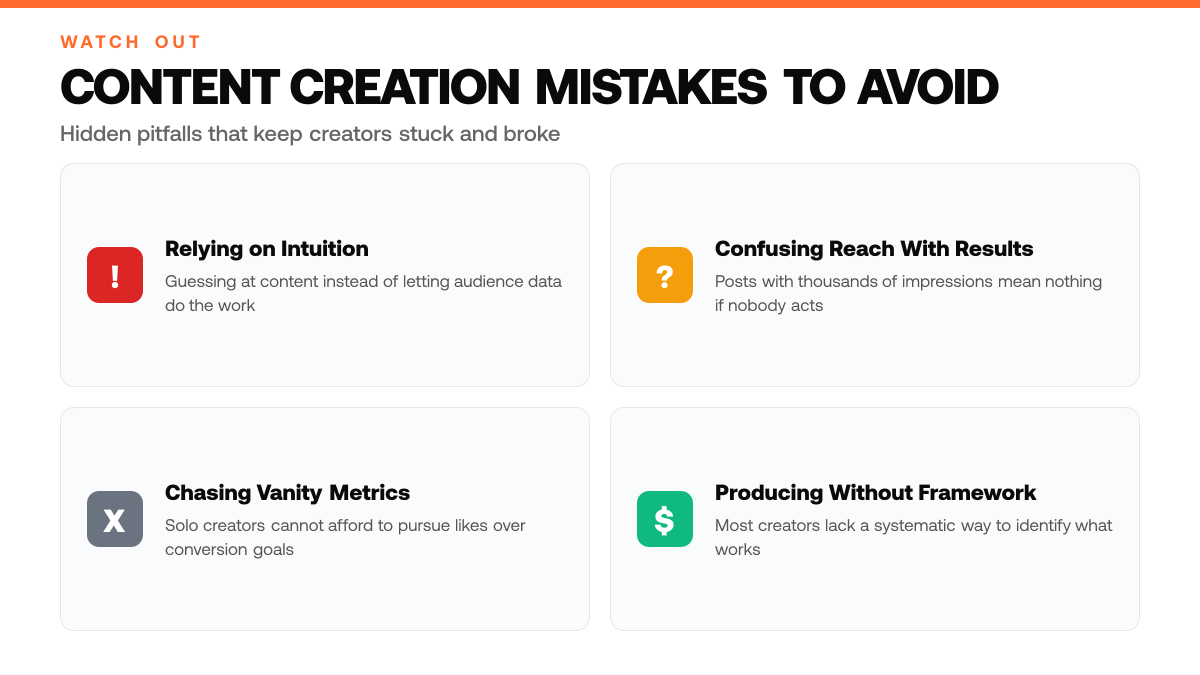
Mistake: Chasing viral trends instead of testing what your specific audience converts on
Following every trending topic sounds smart, but it dilutes your message and wastes energy on content that doesn't align with your audience's actual interests. The fix: Run small experiments with 3 - 5 content variations, measure which ones drive engagement and conversions specific to your niche, then double down on winners. Skip the trend treadmill and own your lane.[5]
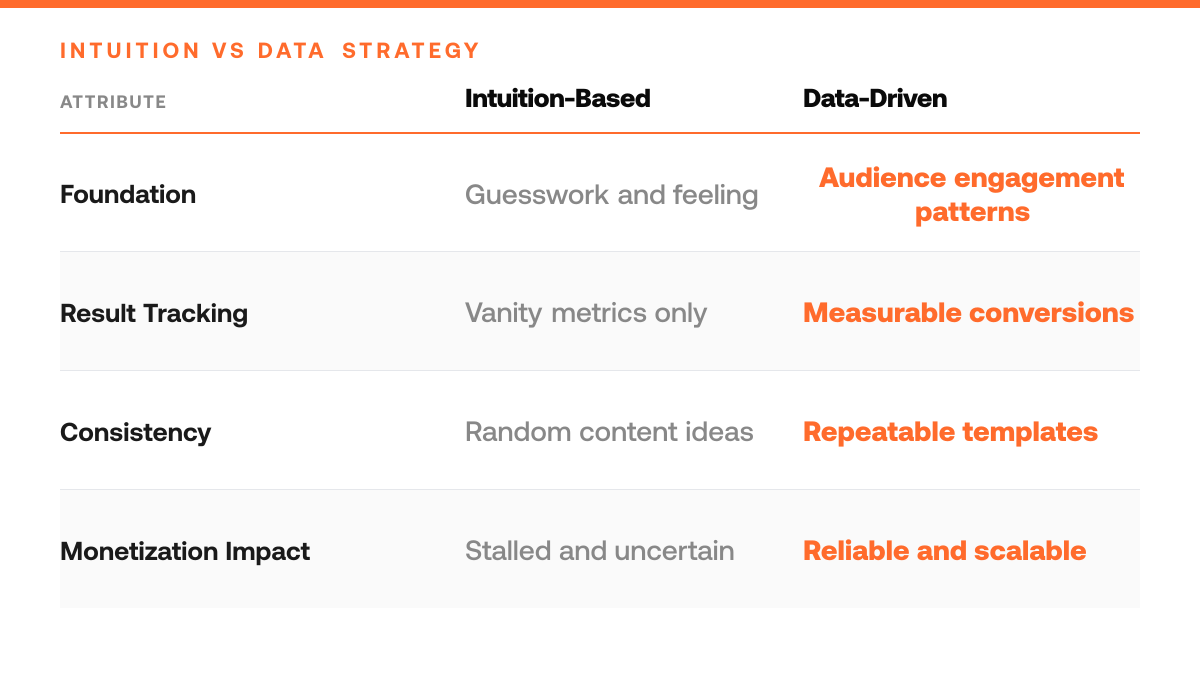
Guessing vs Data-Driven Content Strategy
| Approach | Method | Result |
|---|---|---|
| Guessing (Reactive) | Post based on intuition without analyzing audience data | Flat engagement and stalled monetization |
| Data-Driven (Systematic) | Analyze comments, shares, replies to identify patterns and apply templates | Reliable converting posts that grow followers and revenue |
Mistake: Publishing content without tracking which ideas actually converted
Many creators post consistently but never measure results, no click-through rates, no conversion data, no audience feedback loops. This makes it impossible to know what works. Set up basic tracking: note which posts drove sales, signups, or meaningful engagement. Review weekly. This single habit transforms guessing into strategy.[5]
Mistake: Assuming one content format works for all audience segments
Not every follower consumes the same way. Some prefer threads, others short takes, others links to long-form. Without testing different formats and measuring which segments respond to each, you're leaving conversions on the table. Test format variety, track which resonates with which part of your audience, and allocate more effort to high-converting combinations.
Frequently Asked Questions
How often should I be searching for new content ideas?
Finding converting content ideas is an ongoing practice, not a one-time task. The best creators treat idea discovery and validation as a core part of their weekly workflow, continuously testing what resonates with their audience rather than relying on a single brainstorm session. This consistent approach compounds over time, revealing patterns in what actually drives engagement and conversions.
Do I really need tools to find converting content ideas?
Tools and platforms designed for creators can accelerate the idea-discovery and validation process by surfacing data faster and identifying patterns you might miss manually. However, the framework itself, how you think about audience needs, test ideas, and measure results, is what truly matters. A strong process beats any single tool; the right tool simply makes that process more efficient and scalable.
What's the difference between a popular post and a converting post?
A popular post gets views and likes; a converting post drives the specific action you want, whether that's newsletter signups, product sales, course enrollments, or audience growth. Converting content aligns with your monetization goal and moves followers toward that outcome. Tracking conversions, not just vanity metrics, reveals which ideas actually build your business.
Sources
Try the loop on your own cohort.
Pick three accounts you would like to be at in 12 months. ClimbX pulls their recent outliers, tags them, and drafts in your voice off what is currently working. Edit, ship, watch the loop tighten.
Read next
- X Posts in Google Search Console: The New SEO Opportunity - Google Search Console can now track the queries, impressions, clicks, CTR, and position of your X posts. Here is how creators can turn social posts into a measurable SEO and AI-search research loop.
- X Algorithm Labels Explained: How Visibility Filtering Works - X can label accounts and posts before deciding where they may appear. See the real DoNotAmplify, SpamHighRecall, abuse, NSFW, and post-level labels in X’s open-source algorithm.