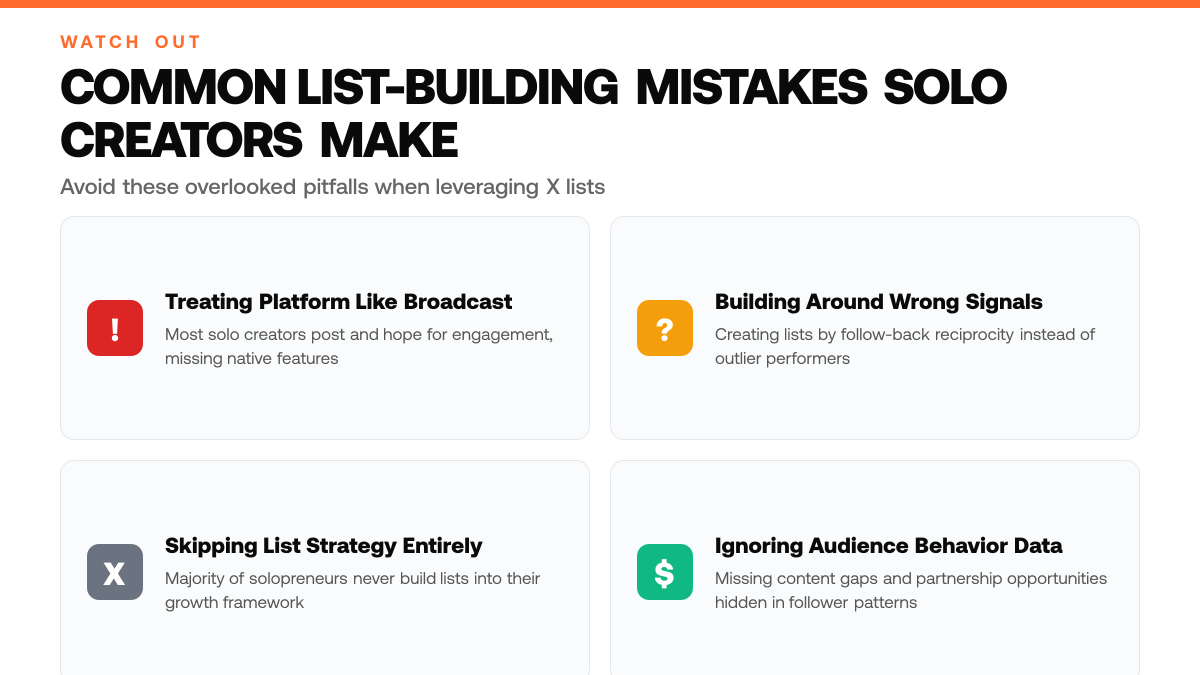
Scroll through X and you'll notice something: most solo creators treat the platform like a broadcast channel. They post, hope for engagement, and move on. But beneath the surface, a native feature sits almost entirely unused by the creators who need it most. Lists, the simple organizational tool in X's sidebar, are quietly one of the most direct levers for visibility and follower growth on the platform, yet the vast majority of solo creators never build them into their strategy.
The difference between creators who grow predictably and those who guess comes down to how deliberately they use the tools already in front of them. Lists aren't just for organizing accounts you follow; they directly shape who sees your content, how often your posts resurface, and which creators notice your work. Research shows that strategic list usage impacts visibility, engagement, and follower acquisition in measurable ways, yet most solopreneurs skip this step entirely.[1] For a deeper look, see How to Grow on Twitter: 5 Proven Strategies.
This article walks through five list strategies that separate intentional growth from random posting. You'll learn how to build lists that compound your reach, which lists drive the most engagement, when to add yourself to others' lists, and how to use lists as a research tool to stay ahead of what's breaking on X. By the end, you'll have a concrete framework for turning this overlooked feature into a core part of your growth system. Most creators build lists around follow-back reciprocity or topic tags, missing the posts that actually move engagement needles in their niche, ClimbX scans outlier performers ahead of you to surface what's working 2-3x harder, then drafts posts in your voice built on those signals.
TL;DR
- X lists let you curate niche authority by grouping accounts that resonate with your target audience, making your profile a discovery hub for followers seeking specific expertise.
- Adding your account to high-traffic lists amplifies visibility and impressions without requiring you to create new content, leveraging existing audience attention.
- Lists reveal audience behavior patterns, content gaps, and partnership opportunities, turning follower data into actionable strategy for growth and monetization.[3]
Understanding Twitter Lists and Their Role in Creator Growth
What Are Twitter Lists?
Twitter Lists are curated collections of accounts organized around a specific theme, interest, or niche. When you create a list, you're grouping accounts together so you, and anyone who follows that list, can see their tweets in a dedicated feed. Lists can be public, allowing other users to discover and follow them, or private for your own organizational purposes. They function as both a discovery mechanism that surfaces relevant voices to targeted audiences and a credibility signal that positions the list creator as an authority within that niche community.[2]
Why Lists Matter for Solo Creators
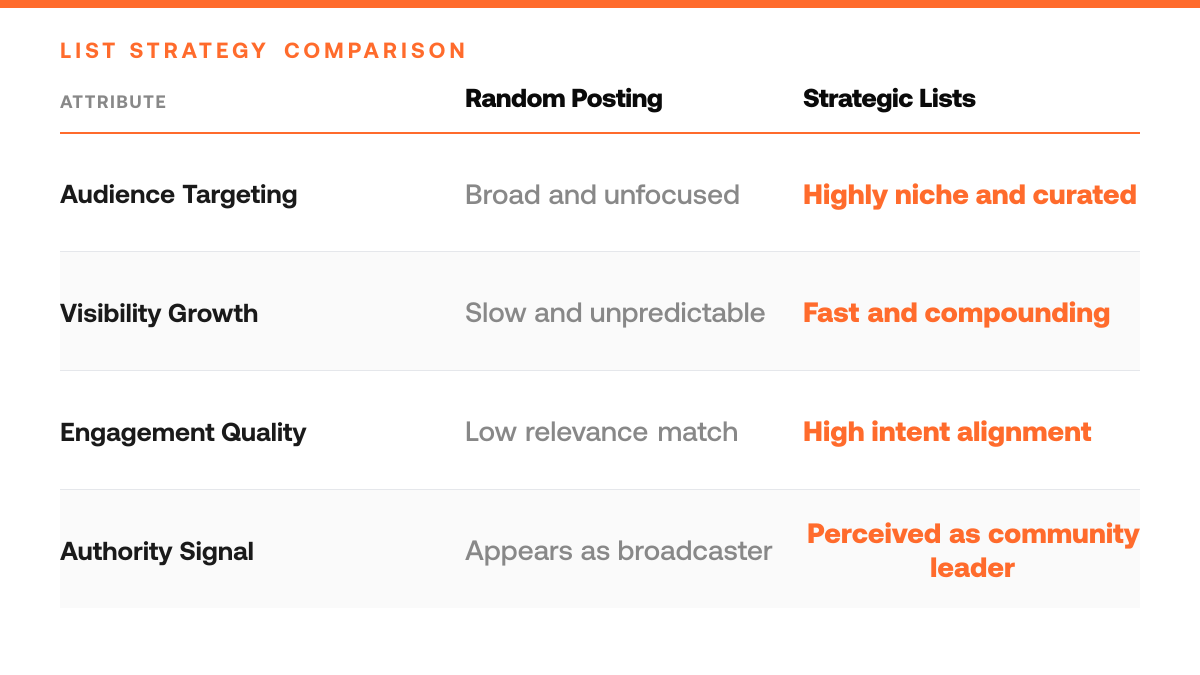
Being added to relevant, high-quality lists dramatically expands your content's reach beyond your immediate followers. When a list gains traction and attracts followers, your tweets appear in front of people actively seeking voices like yours, highly targeted audiences already primed to engage with your niche. For solo creators building authority, lists offer a unique opportunity: by curating and owning lists in your space, you establish yourself as a community builder and thought leader. This ownership of a niche community becomes a powerful asset for growing influence and credibility without relying solely on algorithmic promotion.
Lists in the Broader Creator Economy
In today's creator economy, standing out requires more than consistent posting, it demands visibility and perceived authority. Lists have emerged as an underutilized tool that bridges the gap between raw follower counts and genuine influence. They allow creators to move beyond passive content consumption and actively shape conversations within their niche. Solo creators who master list strategy gain a compounding advantage: each list you build or join amplifies your reach, strengthens your positioning as a curator and expert, and creates multiple entry points for new audiences to discover your work.
Step-by-Step Process
1. Build authority lists within your niche expertise
Create multiple curated lists around your core expertise to establish yourself as a trusted voice in your category. Start by identifying the key themes, subtopics, or audience segments you serve, then build lists that reflect your unique perspective. Include creators, resources, and voices that genuinely align with your authority. This positions you as a curator and thought leader, not just a participant. Your lists become a signal to followers that you've done the work to understand your space deeply.[1]
2. Get added to high-traffic category lists strategically
Identify the most-followed lists in your category and work to get included on them. This visibility boost happens when list owners recognize your value and add you to their curated collections. Engage authentically with list creators, share their lists, and demonstrate consistent quality in your niche. Being added to established, high-traffic lists exposes your profile to audiences already interested in your category, without relying on algorithm luck or paid promotion.[1]
3. Analyze list metrics to validate content resonance
Use list analytics to track which of your posts get the most engagement from list members, and which lists drive the most meaningful interactions. This data reveals what your target audience actually cares about, not what you assume they want. Pay attention to which topics, formats, or posting times generate the strongest response within specific lists. Let these insights guide your content strategy so you're creating what your audience proves it values.[1]
How This Works in Practice
Example 1: The SaaS Founder's Niche Authority Play
Picture a SaaS founder building a product for early-stage startups. She realizes her audience is scattered across Twitter, so she curates a 'Growth Hacking Tools' list featuring 30 - 40 resources, templates, and thought leaders her ideal customers actually follow. Over several weeks, she shares the list in her bio, mentions it in relevant threads, and watches as founders who care about scaling discover and subscribe. The list becomes a magnet, it signals that she understands the ecosystem deeply, and subscribers begin following her main account because they trust her judgment. Within a couple of months, her follower count grows meaningfully, and more importantly, the list subscribers become her warmest audience for product launches and feedback requests. The curation itself positions her as a curator and connector, not just another founder selling something.
Common List Mistakes vs. Strategic Approach
| Common Creator Mistake | Strategic List Practice |
|---|---|
| Build lists around follow-back reciprocity or topic tags | Curate lists by grouping accounts that resonate with target audience |
| Post content and hope for engagement without list leverage | Add account to high-traffic lists to amplify visibility and impressions |
| Treat lists as personal organizational tool only | Create public lists that position you as niche authority and community builder |
| Miss audience behavior patterns and content gaps | Use lists to reveal audience signals, partnership opportunities, and growth strategy |
Example 2: The Content Creator's Impression Multiplier
Consider a content creator who writes about AI writing tools and publishes threads sharing frameworks and tutorials. She pitches herself to be added to a well-maintained 'AI Writing Tools' list curated by a respected voice in her niche. Once added, her tweets get surfaced to list subscribers, people actively seeking exactly what she writes about. A single tweet she publishes reaches list subscribers multiple times through the list's visibility, and she notices her impressions climb noticeably on those posts. The list membership doesn't just add followers; it amplifies the reach of every piece of content she shares, because the audience is pre-filtered and engaged. Over time, this consistent amplification compounds, more impressions lead to more engagement, which leads to more followers discovering her work organically.
Why Curation Compounds Your Reach
Both examples share a common thread: lists turn passive followers into active subscribers who seek you out because you've demonstrated taste and expertise. Whether you're building a list to establish authority or getting added to one to amplify your voice, the mechanism is the same, you're joining or creating a trusted filter in a noisy platform. The compounding effect kicks in when subscribers return to the list repeatedly, encounter your content, and bring others along. That's where solo creators unlock growth that feels effortless because it's built on genuine curation, not constant self-promotion.
Twitter List Strategy Checklist
- Audit your current Twitter list memberships and track which lists generate the most profile visits and follower conversions.
- Create a niche-specific Twitter list relevant to your audience and actively promote it to build authority in your space.
- Identify and reach out to list creators in your niche with a personalized pitch to request inclusion on their lists.
- Review your Twitter list analytics monthly to identify which lists drive engagement and refine your list strategy accordingly.
Common Mistakes to Avoid
Mistake: Creating lists but never promoting them to your audience
Many creators build curated lists on X but treat them as one-off projects, never sharing them with followers or mentioning them in threads. This invisibility means the lists remain undiscovered, no new followers find you through list recommendations, and the engagement boost from list activity never materializes. Fix this by actively promoting your lists in pinned posts, linking them in your bio, and mentioning them when relevant in your content strategy.[4]
List Usage: Passive Broadcasting vs. Intentional Growth
| Passive Creator Approach | Intentional Growth Approach |
|---|---|
| Post and move on without platform strategy | Build lists into core growth system deliberately |
| Ignore how lists shape content visibility and reach | Recognize lists directly impact who sees content and how often posts resurface |
| Skip list curation as non-essential tactic | Use lists as discovery mechanism and credibility signal within niche community |
| Rely solely on algorithmic promotion for authority | Own niche lists to establish thought leadership and community ownership |
Mistake: Ignoring lists you've been added to instead of leveraging them for engagement
When other creators add you to their lists, it signals an opportunity to engage with that curator's audience and understand what niche or value proposition they associate with your account. Creators who skip this step miss the chance to build relationships, discover content gaps, and tap into ready-made audiences interested in their work. Regularly check which lists you're on, engage with the list creator, and use that feedback to refine your positioning.[4]
Mistake: Failing to analyze list performance data to guide content decisions
X provides analytics on which lists drive engagement and follower growth, yet many solo creators never review this data. Without examining which lists your content resonates in, you're flying blind, you can't identify your strongest audience segments or double down on the topics and formats that attract list curators. Start reviewing list analytics monthly to spot patterns in engagement, then adjust your content strategy to reinforce what's working.[4]
Frequently Asked Questions
Why are Twitter lists valuable for creator growth?
Twitter lists amplify your visibility because they're public by default, making them a powerful discovery tool for new audiences. When creators add you to their curated lists, you gain exposure to followers who trust those list owners' judgment. This credibility transfer helps you reach engaged audiences without relying on algorithms or paid promotion, growth happens organically through genuine curation.
How many lists can I be added to, and does it matter?
You can be added to unlimited lists on X, and each one expands your reach to a different audience segment. More lists mean more visibility pathways, followers of those lists discover you through curation, not guesswork. This multiplier effect compounds over time as you appear in more niche and general lists, each one introducing your content to people actively interested in your topic.
Is list-based growth sustainable without paid promotion?
Yes. List-based growth is inherently organic because it relies on creators voluntarily adding you to their curated collections. You don't need to guess at what content works or pay for visibility, the strategy works by positioning yourself where engaged audiences already gather. This makes it a low-friction, sustainable way to build momentum as a solo creator.
Start your 7-day trial
Grow on X without sounding like everyone else. The right tool learns from your top posts and the leading voices in your niche, then drafts content in your voice. You edit, approve, and ship.
Start free trialSources
Read next
- AI Social Media Tools for Solo Creators (2026) - An evidence-based comparison of AI social tools for solo creators, using current official pricing and clear best-fit criteria instead of unsupported market statistics.
- The Complete Guide to Using Engage for Community Building - The Complete Guide to Using Engage for Community Building. A practical guide to what works, what to skip, and how to get started.
- Do AI images hurt your reach on X? I tested it on my last 100 posts. - I ran a small experiment: more images on my posts, many of them AI art. The data from 100 posts: AI illustrations and other decorative images cut reach by 48% on generic posts and 65% on one-liners - while real proof images (payout screenshots, charts, records) gained 78%. The full numbers, the clean split, and the ClimbX feature this experiment killed.