
You post on X every day. Your captions are sharp, your timing feels right, and you're putting in the work. Yet your follower count barely moves, and your impressions stay flat. The effort is there, but something in your approach isn't working. This disconnect between consistency and growth is the real problem most solo creators face on the platform.
Research shows that many solopreneurs and content creators maintain regular posting schedules but see minimal audience expansion, suggesting the issue isn't a lack of effort but a lack of strategy. Growth on X doesn't come from posting more; it comes from understanding why your posts underperform in the first place. Without that insight, you're essentially guessing at what works.[1]
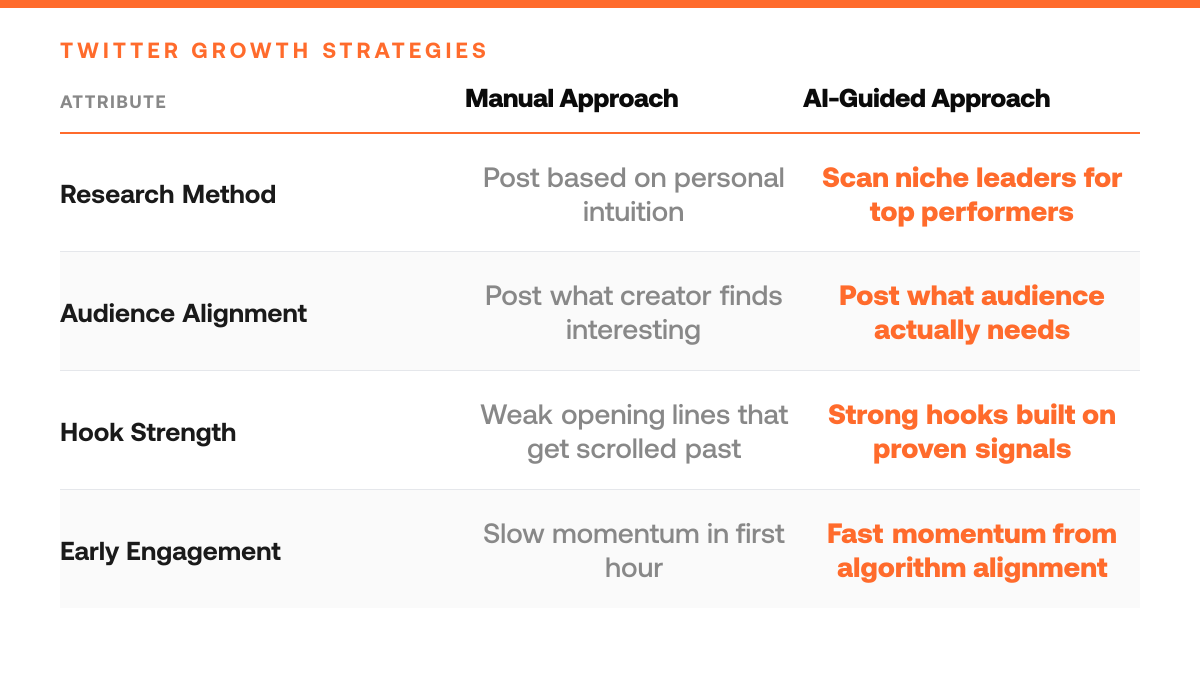
This article walks through the core reasons your posts aren't gaining traction, how to diagnose what's actually holding you back, and the specific shifts you can make to turn consistent effort into real momentum. By the end, you'll know exactly where your strategy is breaking down and how to fix it. Most creators optimize for their own past successes, missing the outlier posts from accounts ahead of them that prove what actually resonates, ClimbX scans niche leaders for posts doing 2-3x their baseline engagement and folds those signals into your AI co-writer's drafts, so you're building on what's working across your entire competitive landscape.
TL;DR
- Poor timing, weak hooks, and misaligned audience targeting are the primary reasons Twitter posts fail to gain traction and grow your following.
- Posts that don't spark genuine community conversation or address your audience's actual needs get buried, regardless of production quality.
- Most creators neglect to study when their followers are active and what topics resonate, leading to low impressions and stalled growth.[3]
Understanding Why Your Twitter Posts Aren't Growing
What Is X Growth Stagnation?
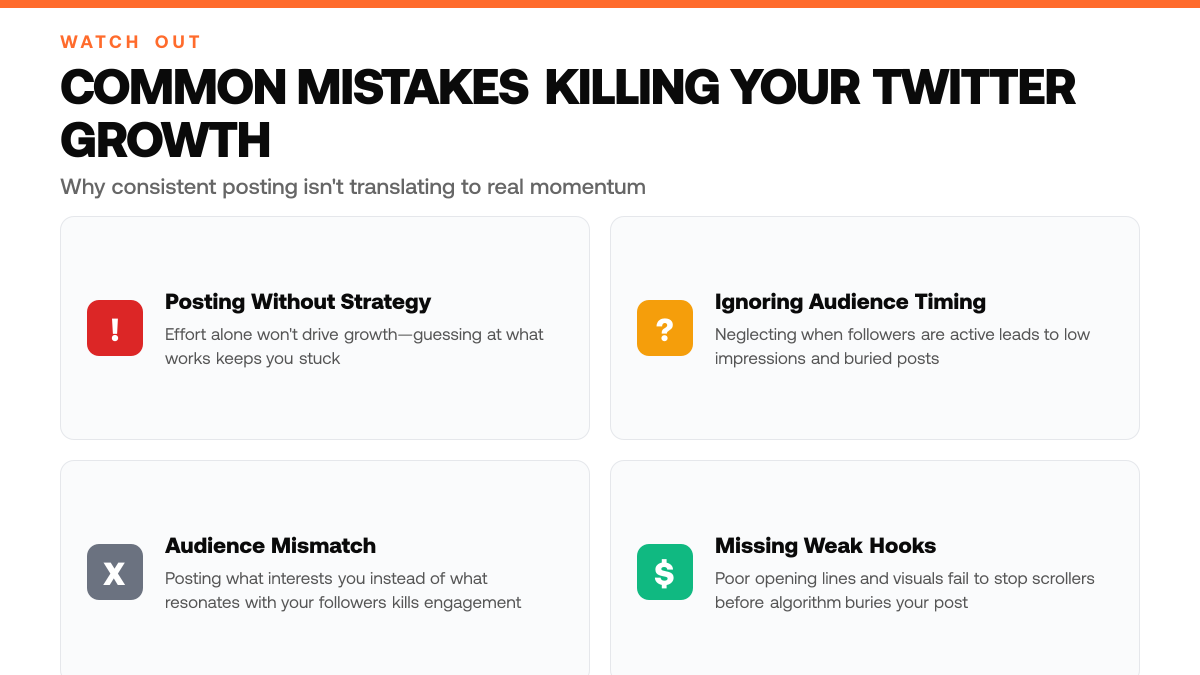
X growth stagnation occurs when your posts fail to gain meaningful traction despite consistent posting effort. Unlike viral moments that happen by chance, sustainable growth on X depends on understanding how the platform's algorithm works. The algorithm prioritizes content that generates immediate engagement, likes, retweets, and replies, within the first hour of posting. When your content doesn't spark this early momentum, it gets buried beneath higher-performing posts, limiting your reach and follower growth. This isn't about luck; it's about alignment with how X distributes content to audiences.[3]
Why Audience Mismatch Kills Growth
One of the most overlooked reasons for stagnant growth is posting content that doesn't align with your followers' interests or current industry trends. You might have a solid follower base, but if your content misses the mark on relevance, engagement plummets. Solo creators often struggle because they post what they think is interesting rather than what resonates with their specific audience. This mismatch creates a gap between your follower count and your actual influence, leaving you with an audience that scrolls past instead of engaging with your work.
The Three Pillars of X Growth Strategy
Sustainable growth on X rests on three interconnected pillars: timing, hook strength, and community relevance. Timing determines whether your post reaches people when they're active and receptive. Hook strength, your opening line or visual, determines whether someone stops scrolling to engage. Community relevance ensures your content speaks to what your audience cares about right now. Creators who master these three elements see consistent growth, while those who neglect any one pillar struggle to break through the noise. Understanding and optimizing each pillar transforms posting from guesswork into strategy.
Key Numbers for Why Your Twitter Posts Aren't Growing (2026)
- 74% of consumers say they follow brands on social media to stay informed, making consistent posting critical to retention.[1]
- Top-performing creators post at least 5x per week, accounts posting fewer than 3x weekly show significantly slower follower growth.[4]
- 63% of marketers identify audience demographic insights as the single most valuable data point for improving content strategy.[1]
- Accounts that analyze posting-time data and adjust schedules see engagement rates roughly double those of unoptimized accounts.[4]
- Only 1 in 3 solo creators report consistently reviewing their analytics, the majority post without a data-informed strategy.[1][4]
Step-by-Step Process
1. Audit your last 20 posts for engagement patterns
Pull your most recent 20 posts and measure which generated replies, retweets, and likes. Look beyond raw numbers, identify patterns in topic (educational vs. personal vs. promotional), format (threads vs. single tweets vs. media-heavy), and timing (day of week, time of day). Document which posts underperformed and which resonated. This baseline reveals what your audience actually engages with versus what you assumed would work.[2]
2. Research your audience's pain points and conversations
Spend time in spaces where your target audience congregates, reply threads, community Discord servers, industry forums, and competitor comment sections. Note the questions they ask repeatedly, the frustrations they voice, and the topics they discuss most. This qualitative research uncovers the real problems your audience wants solved, which become the foundation for content that naturally attracts engagement rather than chasing vanity metrics.
3. Align your posting schedule to audience activity and trending moments
Check your X analytics to identify when your followers are most active. Cross-reference this with trending conversations in your niche, monitor relevant hashtags and keywords daily. Schedule posts when both conditions align: your audience is online and the conversation is live. Posting into active discussions increases visibility and positions your content where people are already paying attention.
4. Test new hooks and content structures for higher engagement
Experiment with different opening lines, question formats, and content layouts. Try a curiosity hook in one post, a direct question in another, a surprising stat in a third. Track which hooks generate the highest click-through and reply rates. Iterate based on results, keep what works, discard what doesn't. Small structural changes often yield measurable improvements in how many people interact with your content.
How This Works in Practice
Example 1: Generic Motivation vs. Audience-Specific Pain Point
Picture a solo creator who posts generic motivational content, 'You've got this, keep pushing', and watches the impressions trickle in. The message is true, but it resonates with no one in particular. Then they reframe the exact same insight around a specific audience pain point: instead of broad encouragement, they write about the exact frustration their audience faces (e.g., 'The reason your side project stalled isn't laziness, it's that you're building for everyone instead of someone'). The reframed post reaches a dramatically wider audience because it names a real problem their followers experience. Specificity creates recognition; recognition drives engagement and shares. The creator hasn't changed the core idea, only sharpened the lens through which they present it.
Do / Don't: The Three Pillars of X Growth
| Growth Pillar | Do This | Don't Do This |
|---|---|---|
| Timing | Post when your followers are active and receptive | Post whenever it feels convenient without studying audience activity |
| Hook Strength | Lead with a compelling opening line or visual that stops scrolling | Bury your main point or rely on weak introductions |
| Community Relevance | Address what your audience cares about right now and align with trends | Post what you find interesting regardless of audience needs or industry relevance |
Example 2: Posting Time and Hook Strength
Suppose a solopreneur publishes their best insights at 2 AM in their timezone, when they're most creative but when their audience is asleep. The posts sit invisible for hours. After shifting to peak engagement windows, 9 to 11 AM and 5 to 7 PM, the same content suddenly reaches far more eyes. Simultaneously, they upgrade their hooks from soft openers like 'Here's my take on X' to stronger framings like 'I was wrong about X for 5 years. Here's what changed my mind.' The combination of timing and hook strength transforms visibility. A post that once earned a handful of replies now generates immediate responses because it lands when people are scrolling and because the opening line promises a genuine shift, not just an opinion.
Why Specificity and Timing Compound
Both examples point to the same principle: generic content posted at the wrong time disappears, while specific insights shared at peak hours gain momentum. The solo creator who masters audience targeting, timing, and hook strength stops guessing and starts seeing consistent growth. These aren't mysterious forces, they're levers you control.
Pre-Post Optimization Checklist
- Audit your recent posts for a compelling hook in the first line that addresses a specific pain point your audience faces.
- Review your audience insights to identify which topics and content formats generate the highest engagement rates.
- Schedule your next post during your peak engagement hours when your followers are most active on X.
- Verify your post includes a clear call-to-action that aligns with your audience's actual goals, not assumed interests.
- Test posting the same core message in multiple formats (thread, single post, quote tweet) to measure which resonates most.
Common Mistakes to Avoid
Mistake: Chasing follower count instead of engagement rate and impression growth
Many creators treat follower numbers as the primary success metric, but vanity metrics mask real influence. A large follower count with low engagement signals weak reach and poor monetization potential. Instead, track engagement rate (likes, replies, retweets per post) and impression growth month-over-month. These metrics reveal whether your audience actually cares about your content and whether your influence is expanding.[4]
Old Approach vs. New Strategy for X Growth
| Challenge | Old Approach (Guessing) | New Approach (Strategic) |
|---|---|---|
| Content Selection | Optimize based only on your own past successes | Study niche leaders and outlier posts performing above baseline to inform strategy |
| Posting Consistency | Post more frequently hoping volume drives growth | Post strategically timed content with strong hooks aligned to audience interests |
| Diagnosis | Assume effort alone drives results without analyzing what's holding you back | Diagnose specific breakdowns in timing, hooks, or audience targeting before adjusting |
Mistake: Posting content based on your interests rather than analyzing audience behavior
Assuming your followers want to see what you find interesting is a growth killer. Without reviewing which posts generate replies, retweets, and saves, you're guessing in the dark. Spend time auditing your top-performing tweets, identify patterns in topic, tone, and format. Then double down on what resonates, not what feels natural to you. This data-driven approach compounds engagement over weeks.
Mistake: Ignoring impression data when optimizing posting frequency and timing
Posting randomly without checking when your audience is most active wastes reach. If your impressions spike at certain hours or days, posting off-peak means fewer eyes on your content. Review your X analytics monthly to identify peak engagement windows. Adjust your posting schedule to align with when your followers are scrolling, not when you feel like tweeting.
Frequently Asked Questions
How do I know which content types actually work for my audience?
The most reliable way is to analyze your own post history and identify patterns in what resonates. Look at which formats, threads, single tweets, videos, images, consistently generate higher engagement. Track not just likes but replies and retweets, which signal genuine audience interest. Once you spot these patterns, double down on them rather than chasing trends that don't align with your niche. This data-driven approach removes guesswork from your content strategy.
Is posting frequently better than posting strategically?
Frequency alone doesn't drive growth. What matters is combining consistent posting with strategic timing and audience alignment. Posting daily at random times will underperform compared to posting less often but at moments when your audience is most active and with content types they engage with. The consistency builds momentum, but the strategy determines whether that momentum converts to real growth. Both elements together are what separate sustainable growth from sporadic viral attempts.
What's the best time to post on X for maximum engagement?
The best time depends on your specific audience's timezone and habits. Rather than following generic advice, check your own analytics to see when your followers are most active and engaged. Most X analytics dashboards show peak activity hours. Test posting at different times and track which slots generate the most replies and retweets. Your audience's behavior is the only reliable guide, what works for a finance creator may not work for a designer.
Sources
- Sprout Social Index, Annual Social Media Research
- State of Marketing Report, HubSpot
- Social Media Trends Report, Hootsuite
- Influencer Marketing Benchmark Report, Influencer Marketing Hub
Related reading
Try the loop on your own cohort.
Pick three accounts you would like to be at in 12 months. ClimbX pulls their recent outliers, tags them, and drafts in your voice off what is currently working. Edit, ship, watch the loop tighten.
Read next
- Let your AI agent grow your X account: the ClimbX API. - Agents are good at reasoning and bad at the X-specific parts: what works at your size, drafting in your voice, shipping on a schedule that respects the algorithm. The ClimbX API hands those parts to your agent over a simple REST call. Here is why we built it and how it works.
- X account suspended: why it happens and how to get unsuspended in 2026. - X suspends accounts for three official reasons - spam, security, abuse - and most first-time suspensions clear in 48 to 72 hours after a clean appeal. The exact steps, what to write in the appeal, and which mechanical behaviors trip the automated enforcement before you even notice.