You post something you're proud of, solid writing, genuine insight, maybe even a hook that feels sharp. But by the end of the first hour, engagement has flatlined. The post sits there with a handful of likes while other creators' similar content gains traction and compounds. You're left wondering if it's your audience size, your timing, or something else entirely.
The reality is that X's algorithm prioritizes early momentum. Posts that fail to gain traction in their opening hours rarely recover, the algorithm simply stops showing them to new people. Most solo creators post without understanding why their content underperforms relative to their follower count, chalking it up to bad luck or audience disinterest. But momentum loss isn't random; it's predictable and fixable once you identify the root causes.
This article walks you through why your posts lose momentum, what signals the algorithm reads in those critical first minutes, and the specific patterns that separate posts that compound from those that die. You'll learn to diagnose your own content's performance gaps and understand the mechanics behind why some posts break out while others disappear. Most Twitter creators copy what worked last week, but algorithmic momentum dies the moment a format saturates across your niche, ClimbX scans high-performing outlier posts ahead of you to surface what's still compounding, so you post formats others haven't yet diluted.
TL;DR
- Posts lose momentum on X when they fail to generate replies, retweets, and likes in the critical first window, causing the algorithm to deprioritize distribution for twitter growth.
- Engagement across the platform has been declining, making timing and content relevance more essential than ever for reaching your audience.
- Most creators ignore the opening hours after posting, the window when algorithmic visibility is highest and audience interaction matters most.[1]
Understanding Why Your Twitter Posts Lose Momentum
What Is Post Momentum on X?
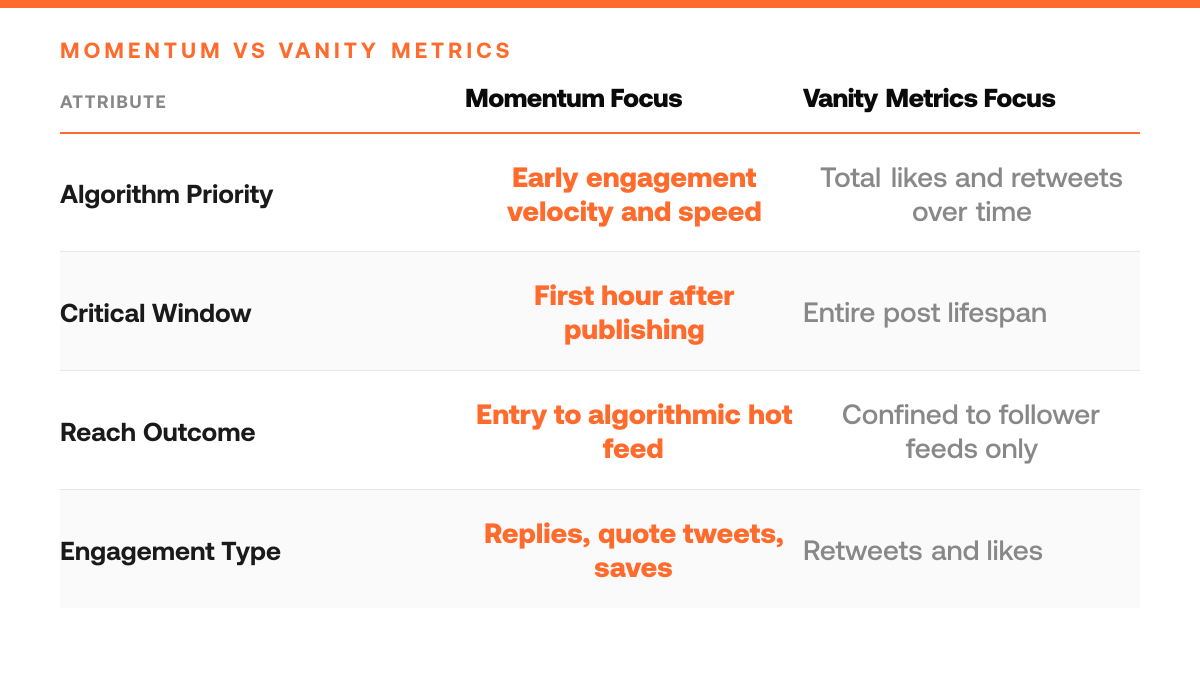
Post momentum on X refers to how quickly your content gains traction in the first moments after publishing. Unlike traditional social media metrics that measure total engagement over time, X's algorithm prioritizes engagement velocity, the speed at which your post attracts replies, quote tweets, and saves in its earliest window. This rapid engagement signals to the algorithm that your content is resonating with an audience, which then determines whether the post enters the algorithmic 'hot feed' where it reaches users beyond your immediate followers, or remains confined to your followers' feeds only. The algorithm doesn't reward posts based on how many likes or retweets they eventually accumulate; instead, it evaluates the quality and speed of initial interactions to decide amplification.
Why Momentum Matters for Solo Creators
For solo creators and solopreneurs building an audience on X, understanding momentum is critical because the first 60 minutes of a post's life are decisive. If your content fails to generate meaningful engagement velocity during this window, it effectively dies in your followers' feeds and never reaches the broader platform audience. This means that even high-quality content can fail to grow your reach if it doesn't spark immediate conversation. Relevance signals, replies, quote tweets, and saves, carry far more weight in the algorithm's decision than vanity metrics like retweets and likes. Solo creators without large teams or paid promotion need to understand this mechanism to craft content that naturally triggers these higher-value interactions, making the difference between stagnant follower growth and exponential reach expansion.
The Broader Context of Algorithm-Driven Growth
The shift toward engagement velocity as the primary ranking signal reflects how modern social platforms prioritize user experience over raw engagement counts. Platforms have learned that quality interactions, genuine replies and thoughtful saves, indicate more valuable content than passive likes or retweets, which require minimal effort. This algorithmic evolution means that creators who optimize for vanity metrics are working against the platform's actual ranking system. Understanding this context helps solo creators stop chasing surface-level engagement and instead focus on creating content that sparks real conversation, builds community, and ultimately drives the sustainable audience growth and monetization potential they're seeking.
Key Numbers for Why Your Twitter Posts Lose Momentum (2024)
- X engagement rates declined year-over-year, with early-window engagement directly correlating to post longevity and reach decay patterns.
- Posts that miss the first 1 - 2 hours of audience availability experience measurable impression drops as algorithmic visibility window closes.[2]
- Creator follower count alone does not predict reach; accounts with similar follower sizes show variance of 50%+ in impression performance.
- Engagement momentum compounds within the early window, posts gaining traction early receive algorithmic amplification; late starters face exponential decay.[2]
- Timing misalignment costs creators multiple percentage points in daily active user exposure, reducing monetization potential per post.
Step-by-Step Process
1. Post when your audience is most active
Timing is the first lever for engagement velocity. Identify when your followers are online and posting, typically during morning commutes, lunch breaks, or evening hours, and schedule your content for those windows. Early replies and retweets signal to the algorithm that your post is worth amplifying, so capturing attention in the first hour matters more than reaching people later. Track which time slots generate the most replies in your first few minutes, then cluster future posts around those high-engagement windows.[2]
2. Craft posts that invite replies, not passive scrolling
Posts that ask questions, present contrarian takes, or explicitly request input generate more conversation than statements or announcements. Instead of broadcasting information, frame your post as an invitation: "What's your biggest challenge with X?" or "Most people think Y, but I believe Z, here's why." This shift from monologue to dialogue encourages followers to reply rather than simply like or retweet, which deepens the engagement signal and keeps your post visible longer in feeds.[2]
3. Monitor real-time performance and iterate
Watch your post's first replies and engagement pattern within the opening hours. Note which post formats (threads, single tweets, images, polls) and topics drive the most replies versus passive likes. After each post, document what worked and what didn't, then apply those insights to your next batch. Over time, this feedback loop reveals your audience's genuine preferences and helps you stop guessing at what content resonates.[2]
How This Works in Practice
Example 1: The Creator Who Asks Instead of Tells
Picture a solo creator who's been posting observations about audience growth, tweets like 'Building an audience is hard' or 'Growth takes time.' These posts get a handful of likes but rarely spark conversation. One week, she shifts strategy and posts a question: 'What's your biggest blocker to growing your audience on X?' Within hours, replies flood in. Followers share their struggles, tag others, and the post gains momentum through genuine engagement. She notices the difference immediately: questions pull people into dialogue, while statements leave them passive. She doubles down on this format, asking about specific pain points each week. Over the following month, her reply counts climb, her replies get retweeted, and new followers arrive because they see her posts generating real discussion. The shift wasn't about working harder, it was about inviting her audience to participate rather than lecturing them.
Do vs. Don't: Post Momentum Tactics
| Do (High-Value Action) | Don't (Anti-Pattern) |
|---|---|
| Focus on replies, quote tweets, and saves in opening hours | Optimize for total likes and retweets accumulated over time |
| Craft content that naturally triggers immediate conversation | Copy formats that saturated weeks ago in your niche |
| Monitor and understand your content's performance gaps | Chalk up underperformance to bad luck or audience disinterest |
| Post when algorithmic visibility is highest in opening window | Ignore the critical first hours after publishing |
Example 2: The Solopreneur Who Optimizes Timing
Consider a solopreneur who posts whenever inspiration strikes, sometimes at 11 PM, sometimes mid-afternoon. Her impressions feel flat and unpredictable. She decides to test posting at 9 AM, when her audience is likely checking email and scrolling social feeds during their morning routine. That first week of 9 AM posts shows noticeably higher early engagement: more likes and replies within the first hour, which signals to X's algorithm that the content is resonating. She sticks with the 9 AM window for 2 weeks, comparing it to her evening posts from the previous month. The morning posts consistently outperform. She then experiments with 3 different post formats during the same 9 AM window, a question, a short insight, and a thread, and tracks which format drives the most replies and shares. The highest-engagement format gets repeated the following week. By month two, this compound effect of right timing plus refined format creates visible momentum: her posts reach more people, attract more engaged followers, and feel less like shouting into the void.
Why Momentum Compounds Over Time
Both examples share a common thread: small, deliberate changes, asking instead of telling, posting when your audience is present, testing formats and doubling down on what works, create compounding returns. A single well-timed question won't transform your following overnight, but a consistent pattern of engagement-driven posts builds credibility and reach week after week. The creators who see their momentum accelerate are those who treat posting as an experiment, not a broadcast.
Twitter Momentum Checklist
- Before publishing, embed a question, call-to-action, or contrarian statement to invite replies and retweets.
- Check engagement at the 15-minute mark after posting to spot early traction and adjust promotion if needed.
- Review engagement again at 30 minutes to assess whether momentum is building or stalling.
- Measure engagement once more at 60 minutes to confirm the post's trajectory and decide on amplification.
Common Mistakes to Avoid
Mistake: Posting without learning how X's algorithm works
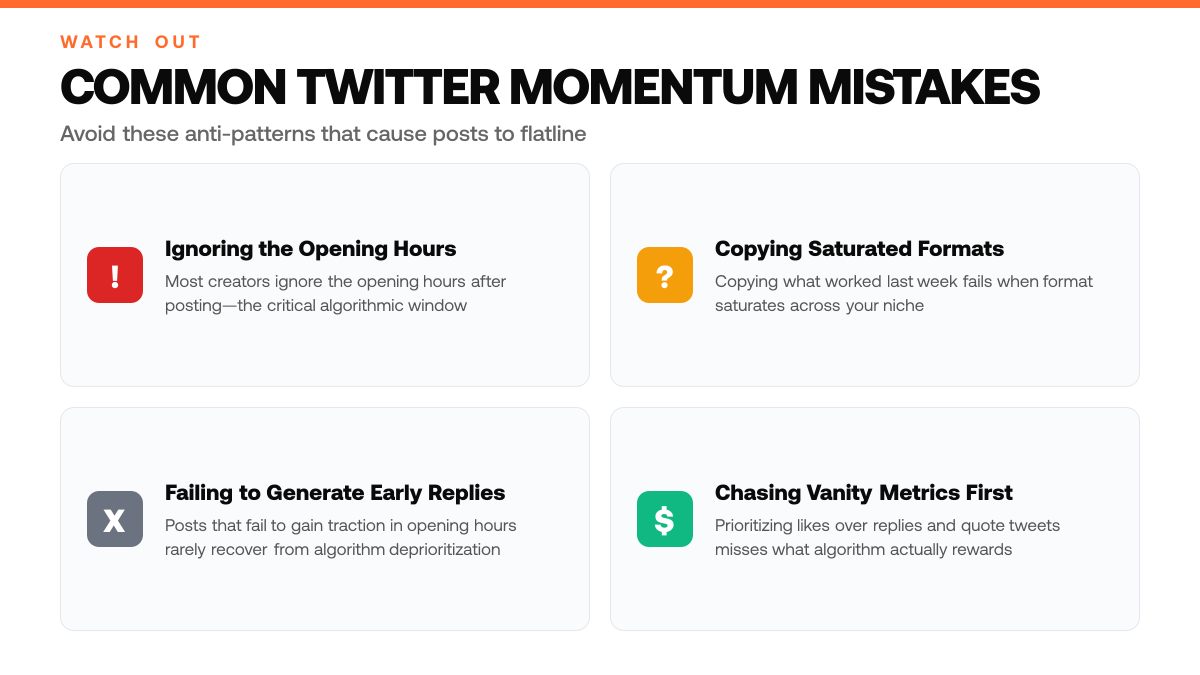
Creators who ignore algorithmic mechanics often blame a broken algorithm or low follower count for poor performance, when the real issue is misaligned content strategy. Understanding how X surfaces posts, based on engagement velocity, reply-to-like ratios, and relevance signals, is foundational. Fix: Study your platform's algorithm documentation and audit which of your past posts generated the strongest early engagement to reverse-engineer what resonates.[4]
Old Way vs. New Way: Algorithm-Driven Growth
| Old Approach (Vanity Metrics) | New Approach (Engagement Velocity) |
|---|---|
| Measure success by total engagement accumulated | Prioritize speed of early interactions in opening window |
| Copy what worked last week | Identify outlier posts still compounding before format saturates |
| Post without understanding algorithmic signals | Diagnose performance gaps and understand momentum mechanics |
Mistake: Posting at times convenient for you, not your audience
Posting when you feel like it, rather than when your audience is most active, guarantees low early engagement, the critical window that determines algorithmic reach. If your followers are active at 9 AM but you post at 6 PM, you miss the momentum-building phase. Fix: Use X's analytics or third-party tools to identify when your specific audience is online, then batch-schedule posts for those peak windows consistently.
Mistake: Chasing follower count and impressions instead of reply-to-like ratios
Vanity metrics (total followers, raw impressions) mask what actually drives growth: conversation. A post with 500 likes but zero replies signals weak resonance and won't be amplified by the algorithm. Ignoring reply-to-like ratios means you keep repeating content that looks successful but doesn't spark dialogue. Fix: Prioritize posts with high reply counts relative to likes, and analyze the themes in those replies to refine your content pillars.
Frequently Asked Questions
Why do my posts get likes but no replies?
Your post likely invites passive consumption rather than conversation. Likes require one tap; replies demand thought and effort. To fix this, ask direct questions, invite disagreement, or pose a problem that begs a response. Posts framed as statements get engagement metrics, but posts framed as invitations get the dialogue that signals quality to the algorithm.[3]
How long does a post have momentum on Twitter?
The algorithm makes its initial decision in the first 60 minutes. Early engagement, replies, retweets, and quote-tweets, signals to Twitter that your post is worth showing to more people. After that window, reach typically plateaus unless the post gains sudden viral traction. This is why the opening hour is critical: it determines whether your post gets a second wave of visibility or fades.[3]
Does posting frequency actually matter for growth?
Yes. Consistent posting trains the algorithm to expect and prioritize your content in followers' feeds. However, frequency alone doesn't work, each post must be optimized for early engagement. Posting daily with weak hooks and no call-to-action trains the algorithm to deprioritize you. Post regularly, but make every post count.[3]
Start your 7-day trial
Grow on X without sounding like everyone else. The right tool learns from your top posts and the leading voices in your niche, then drafts content in your voice. You edit, approve, and ship.
Start free trialSources
Read next
- Let your AI agent grow your X account: the ClimbX API. - Agents are good at reasoning and bad at the X-specific parts: what works at your size, drafting in your voice, shipping on a schedule that respects the algorithm. The ClimbX API hands those parts to your agent over a simple REST call. Here is why we built it and how it works.
- X account suspended: why it happens and how to get unsuspended in 2026. - X suspends accounts for three official reasons - spam, security, abuse - and most first-time suspensions clear in 48 to 72 hours after a clean appeal. The exact steps, what to write in the appeal, and which mechanical behaviors trip the automated enforcement before you even notice.