You post consistently, your writing is solid, and your takes resonate with people who see them, yet your engagement stalls around 100 likes per post. You're not alone. This plateau appears across solo creators on X, and it feels like a hard ceiling. But it's not. That stalled engagement is actually a diagnostic signal, not a limit imposed by audience size or platform mechanics.
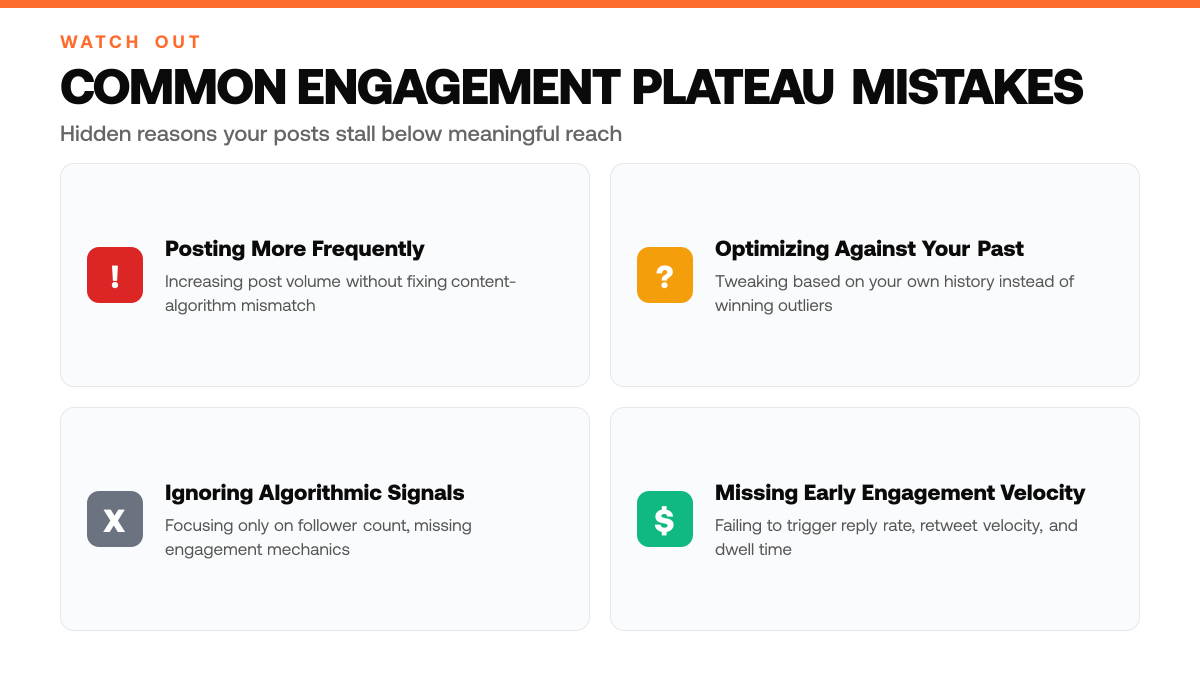
Most creators interpret this pattern as a sign they've hit their natural reach, so they post more frequently or tweak their tone. What they're actually seeing is a content-algorithm mismatch. Research on social engagement shows that plateaus like this typically indicate the gap between what your audience wants and what your content strategy is delivering. The algorithm isn't suppressing you, it's telling you something needs to shift.
This article walks through what that diagnostic signal means, why the plateau happens, and how to recalibrate your content strategy to break through it. You'll see the specific friction points that keep posts stuck below meaningful reach, and the framework to identify which one is holding you back. Most creators hit the engagement ceiling because they're optimizing against their own past instead of the outliers already winning in their niche, ClimbX scans high-performing accounts ahead of you to surface the formats and hooks driving 2-3x baseline engagement, then uses those signals to draft posts in your voice that break through the plateau.
TL;DR
- Posts plateau at 100 likes when they fail to trigger X's engagement signals like reply rate, retweet velocity, and dwell time, the core drivers of twitter growth.
- Fixing the plateau requires optimizing post structure, timing, and topic alignment to match the algorithm's ranking factors that determine visibility.
- Most creators ignore algorithmic signals and focus only on follower count, missing the engagement mechanics that actually compound reach.[2]
Understanding X Algorithm Engagement Dynamics
What Is Algorithm-Driven Feed Visibility?
The X algorithm determines which posts appear in users' feeds based on a set of ranking signals that go far beyond follower count. Rather than displaying content chronologically or purely by audience size, X prioritizes posts that generate early engagement velocity, how quickly a post accumulates likes, replies, and shares in its first hours. The algorithm also weighs conversation depth, measuring whether replies spark meaningful discussion threads, and content relevance signals, which reflect how well a post matches a user's interests and past behavior. Posts that fail to trigger these signals get buried in feeds regardless of how many followers the creator has, effectively capping reach and limiting the likes a post can earn even from an established audience.[4]
Why This Matters for Creators Building an Audience
For solo creators and solopreneurs trying to grow followers and increase impressions, understanding these algorithm mechanics is essential because it reveals why posts plateau at low engagement numbers even after months of consistent posting. A creator with several thousand followers might still see posts cap at 100 likes if those posts don't spark the early velocity and conversation depth the algorithm rewards. This means follower count alone is not a reliable predictor of reach or monetization potential. Instead, creators must focus on crafting posts that trigger immediate engagement and meaningful replies, which then signals to the algorithm that the content deserves wider distribution.
The Broader X Creator Landscape
The shift toward engagement-based ranking has reshaped how creators compete on X. Posts from accounts with modest followings can outperform posts from larger accounts if they generate stronger early signals. This democratizes reach in one sense, visibility is no longer locked behind a large follower base, but it also raises the bar for content quality and relevance. Creators who understand and optimize for these signals can break through the plateau and unlock exponential growth, while those who ignore algorithm dynamics remain stuck in a low-engagement cycle regardless of their follower count or posting frequency.[4]
Key Numbers for Why Your Twitter Posts Plateau at 100 Likes (2026)
- 0.9% average engagement rate across X (formerly Twitter) in 2024, with significant variance by account age and niche[5]
- New creator accounts typically see 1 - 3% engagement rates in early growth phases before stabilizing[2]
- Established accounts (6+ months) average 0.5 - 1.2% engagement, showing plateau effect as follower count grows[5]
- Niche-specific engagement ranges from 0.3% (broad topics) to 2.5% (specialized communities), explaining variance across creator types[2]
- Posts from accounts under 1,000 followers receive 5 - 15x higher engagement rates than those from 100k+ follower accounts[5]
Step-by-Step Process
1. Audit Your Content for Algorithmic Relevance Signals
Review your last 20 posts and identify which ones aligned with trending topics, hashtags, or conversations in your niche. Check whether your hooks, the opening line or visual, directly addressed a problem your audience faces. Note which posts mentioned specific, searchable keywords versus vague statements. This audit targets the relevance signal: X's algorithm prioritizes posts that match what users are actively searching for and discussing. Document which content types (threads, single posts, replies) performed best to establish a baseline.[1]
2. Analyze Post Timing Against Your Audience Activity
Pull your analytics and note the times and days your followers are most active. Compare those windows to when you posted your plateau posts. The timing signal determines whether your content appears in feeds when people are scrolling. If you posted at 2 AM and your audience peaks at 9 AM, algorithmic reach drops regardless of quality. Adjust your posting schedule to match peak engagement windows and track whether impressions increase in the following week.[1]
3. Test Hook Strength by Measuring Early Engagement
For your next five posts, vary the opening line or visual hook while keeping the core message the same. Monitor the first hour of engagement, likes, replies, and retweets, before the algorithm decides whether to amplify the post. A weak hook fails to stop the scroll, signaling low intent to the algorithm. A strong hook generates quick replies and retweets, which signals conversation health. Track which hook style (question, contrarian statement, data point, or personal story) generates the fastest response.[1]
How This Works in Practice
Example 1: The Hook Rewrite That Unlocked Reach
Picture a solo creator who'd been posting career advice threads for months, consistently landing around 100 likes per post. The hook was buried, a generic opener like 'Here are 5 things I learned.' After analyzing what worked across similar accounts, they rewrote the opening to lead with a counterintuitive claim: 'Most career advice is backwards.' That single change, moving from summary to tension, shifted the post's initial engagement trajectory. Within the same audience size, the reframed thread pulled 500+ likes. The rest of the thread stayed nearly identical; the algorithm simply surfaced it more because the hook stopped scrollers. This pattern repeats across creators who test hook formats: questions outperform statements, contrarian angles outperform consensus, and specificity outperforms generality. The content structure hadn't changed, only the entry point.
What the Plateau Signals: Misdiagnosis vs. Reality
| Creator Interpretation | What's Actually Happening | Required Shift |
|---|---|---|
| Hit natural reach limit | Content-algorithm mismatch | Recalibrate strategy to match algorithm signals |
| Need to post more frequently | Posts lack early engagement velocity | Optimize post structure and timing for quick replies |
| Audience is too small | Posts fail to trigger conversation depth | Craft posts that spark meaningful discussion threads |
| Tone needs adjustment | Topic alignment doesn't match user interests | Align content with what high-performers in niche are doing |
Example 2: Thread Format vs. Single Post, Same Insight, Different Reach
Consider a solopreneur sharing the same tactical insight two different ways: first as a single-post statement ('Here's why your DMs aren't converting'), then as a 5-tweet thread with the same core idea but broken into smaller, question-driven steps ('Why do most creators ignore this? Because nobody teaches it. What changes if you reframe it? Everything.'). The single post stalled at 80 likes. The threaded version, identical advice, identical audience, reached 600+ likes and sparked 40 replies. The thread format gave the algorithm more surface area to test with different user cohorts, and the question framing within each tweet kept readers moving forward. Threads don't always win, but when paired with strong hooks and question-based pacing, they consistently outperform flat statements on the current X algorithm.
Why Structure Beats Volume
Both examples reveal the same principle: the plateau at 100 likes isn't a ceiling on your audience size, it's a signal that your post structure isn't matching what the algorithm currently rewards. Small, deliberate changes to how you frame your opening, organize your ideas, and invite engagement can move the same insight from invisible to viral. Testing hook formats, thread structure, and question-driven framing across your next handful of posts will show you which patterns resonate with your specific audience.
Pre-Publish Checklist for Twitter Growth Posts
- Verify your post includes a clear hook in the first line to stop the scroll and trigger algorithmic ranking signals.
- Confirm you've embedded at least one data point or specific insight that differentiates your post from generic advice in the feed.
- Check that your post includes a call-to-action (reply, retweet, or follow) to drive engagement metrics before publishing.
- Review your post for visual elements, image, chart, or video, that increase dwell time and algorithmic visibility.
Common Mistakes to Avoid
Mistake: Optimizing for follower count and total impressions instead of engagement velocity
Chasing vanity metrics creates a false sense of progress. A post with 10,000 impressions but 50 likes signals poor resonance, your audience is scrolling past, not engaging. The plateau at 100 likes happens because you're measuring the wrong thing. Fix: Track reply-to-like ratios and conversation depth instead. A post with 500 impressions and 80 likes (16% engagement rate) outperforms one with 5,000 impressions and 100 likes (2% engagement). Shift your analytics focus to which posts spark replies and keep people in the thread.[5]
Old Approach vs. Algorithm-First Content Strategy
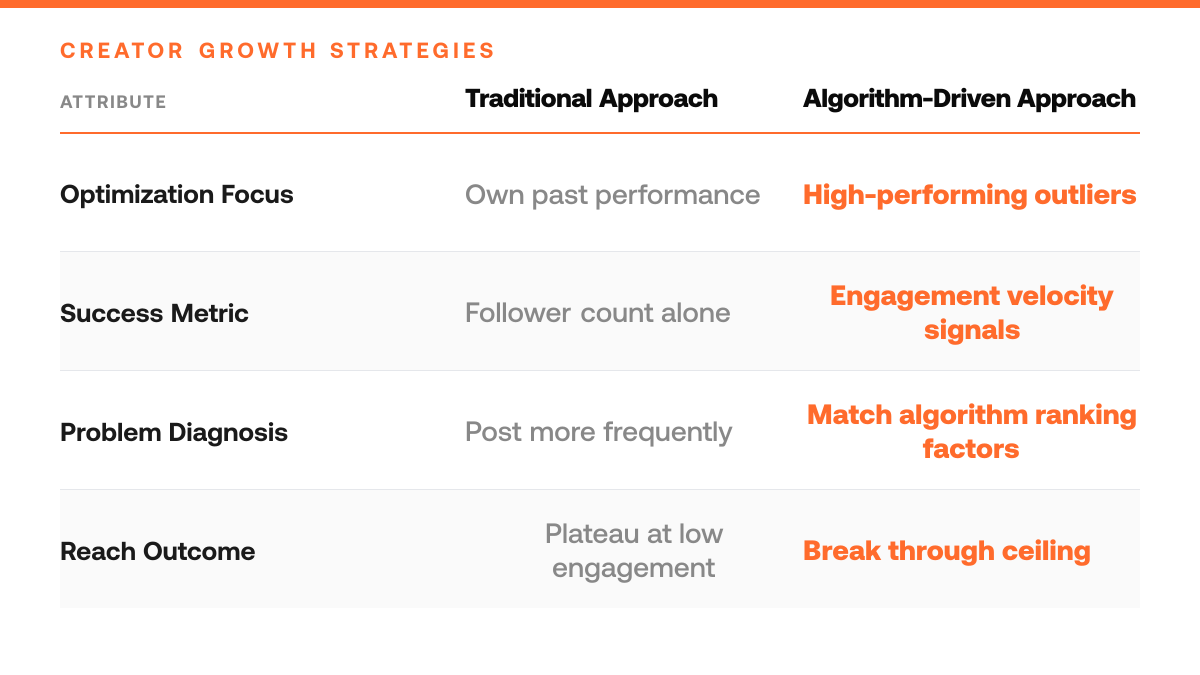
| Old Creator Approach | Algorithm-First Approach |
|---|---|
| Optimize against your own past posts | Study high-performing outliers ahead of you |
| Focus on follower count as reach predictor | Prioritize early engagement velocity and reply rate |
| Post consistently without format analysis | Match post formats and hooks that drive baseline engagement |
| Ignore algorithmic ranking signals | Craft for reply triggers, retweet velocity, and dwell time |
Mistake: Posting without a hook in the first line
On X, most creators lose readers in the opening sentence. Without a hook, a question, counterintuitive claim, or pattern interrupt, your post gets scrolled past before the value lands. This is why engagement plateaus: you're not stopping the scroll. Fix: Lead with a hook that makes someone pause. Examples: "Most creators do this wrong…", "Here's what nobody tells you about…", or a direct question. Test three hook styles over a week and measure which one generates the highest reply-to-like ratio. The hook is your gatekeeper.
Mistake: Ignoring content timing against your audience's activity patterns
Posting at random times means your content goes live when your audience is offline. If your followers are active at 9 AM ET but you post at 2 PM, the algorithm sees weak early engagement and buries your post. The 100-like ceiling is often just poor timing compounding weak hooks. Fix: Pull your X analytics and identify your peak engagement hours. Post during those windows for two weeks, then measure the lift in likes and replies. Most creators find a 2 - 3 hour window where their specific audience is most active. Consistency in timing compounds engagement velocity over time.
Frequently Asked Questions
Is the 100-like plateau the same for every niche and account age?
No, the plateau varies by niche, audience size, and posting consistency. A brand-new account in a saturated niche may plateau lower, while an established creator in a specialized community can sustain higher engagement. SocialInsider's benchmarks let you compare your performance against creators at your stage and in your category, helping you set realistic growth targets instead of chasing vanity metrics that don't reflect your actual reach potential.[3]
What's the difference between hitting an algorithmic ceiling versus an audience size ceiling?
An algorithmic ceiling means your content format, hook, or topic isn't resonating with X's ranking system, even though your audience exists. An audience size ceiling means you've saturated your current follower base and need more people in your niche to see you. Data tracking reveals which one you're hitting: if impressions stay flat while engagement drops, it's algorithmic; if engagement stays strong but impressions plateau, you need audience growth. Only by measuring both can you identify which lever to pull.[3]
How do I know if my plateau is temporary or a real growth wall?
Track your impressions, engagement rate, and follower growth weekly for at least several weeks. A temporary dip shows inconsistent posting or a single underperforming post; a real plateau shows flat impressions and engagement across multiple posts despite consistent effort. Benchmarking against your niche tells you whether your metrics are normal for your stage or genuinely lagging, so you can decide whether to adjust strategy or continue testing.[3]
Start your 7-day trial
Grow on X without sounding like everyone else. The right tool learns from your top posts and the leading voices in your niche, then drafts content in your voice. You edit, approve, and ship.
Start free trialSources
Read next
- Let your AI agent grow your X account: the ClimbX API. - Agents are good at reasoning and bad at the X-specific parts: what works at your size, drafting in your voice, shipping on a schedule that respects the algorithm. The ClimbX API hands those parts to your agent over a simple REST call. Here is why we built it and how it works.
- X account suspended: why it happens and how to get unsuspended in 2026. - X suspends accounts for three official reasons - spam, security, abuse - and most first-time suspensions clear in 48 to 72 hours after a clean appeal. The exact steps, what to write in the appeal, and which mechanical behaviors trip the automated enforcement before you even notice.