
You post consistently on X, your content feels solid, yet your follower count stalls and impressions plateau. You're not alone. Creators across the platform are hitting growth walls in 2026, even when they maintain active posting schedules and show up regularly in their niches.
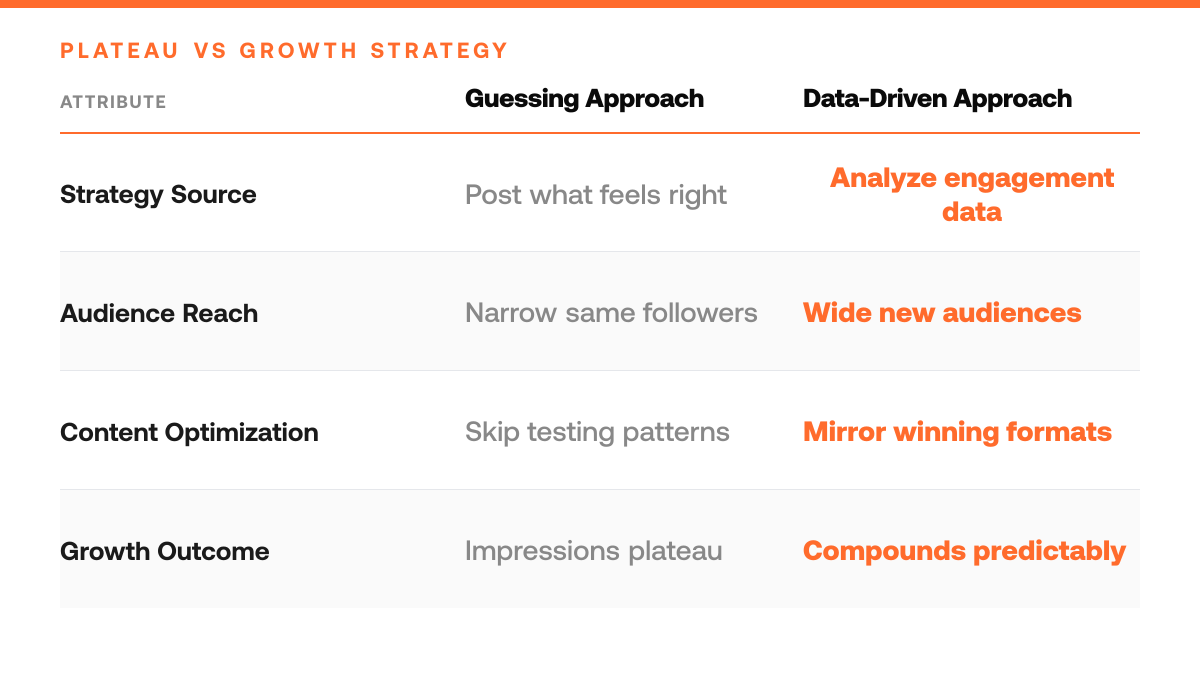
The culprit isn't effort or dedication. Many solo creators and solopreneurs plateau because they lack a data-driven strategy, they post what feels right rather than what the algorithm rewards. Without visibility into what's actually breaking out on X, you're essentially guessing at what your audience wants to see.
This article walks through why your posts plateau, shows you how to read the signals X is sending, and reveals the specific approach that helps creators move past growth ceilings by aligning their voice with what actually works on the platform right now. Most creators hit a plateau because they're chasing virality instincts instead of the specific formats and hooks their audience actually rewards, ClimbX identifies your highest-performing post patterns from your last 100 posts, then mirrors those winning structures into new drafts so growth compounds predictably.
TL;DR
- Twitter growth plateaus when your content strategy misaligns with how the X algorithm prioritizes reach and engagement across your feed.
- The fix is to analyze your engagement data, optimize your posting patterns, and refine content angles based on what actually resonates with your audience.
- Most creators skip this step and keep posting the same way, wondering why impressions stall instead of testing what their followers truly engage with.[4]
Understanding Twitter Growth Plateaus
What Is a Twitter Growth Plateau?
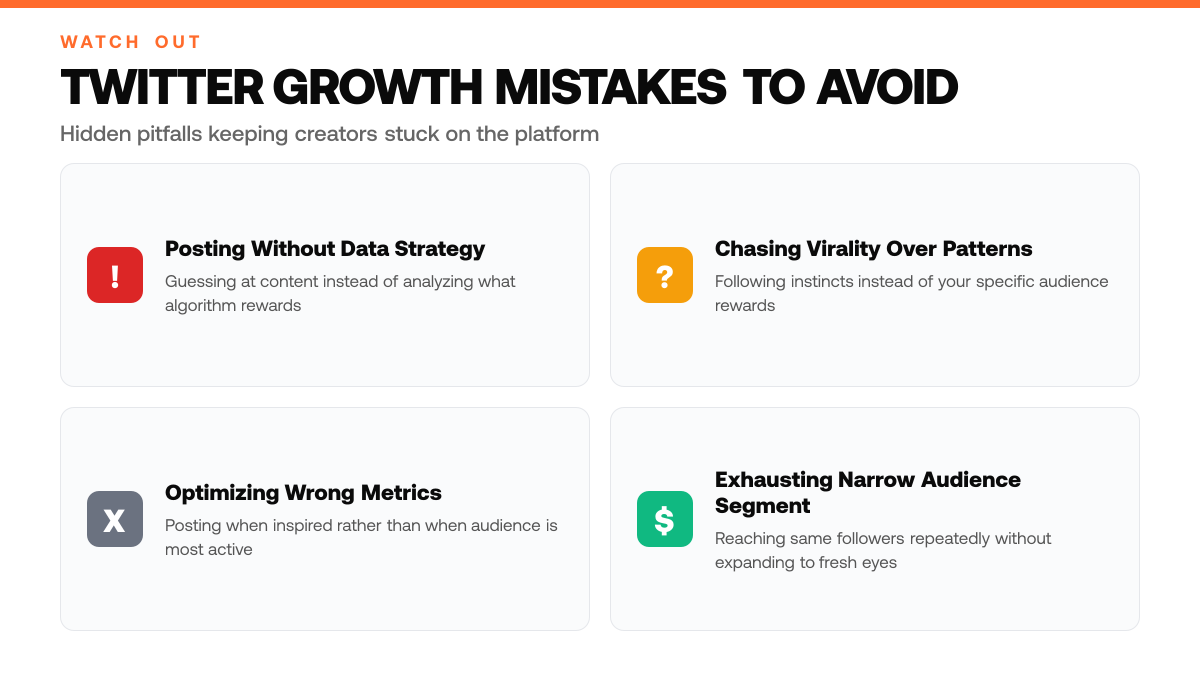
A Twitter growth plateau occurs when your follower count and engagement metrics stall despite consistent posting. This happens when you've exhausted your current audience segment, the specific group of people most likely to engage with your content, but haven't successfully expanded beyond it. You're hitting a ceiling because your content resonates with a narrow slice of the platform, and the algorithm stops amplifying your posts to new audiences. It's not that your content quality dropped; it's that you're reaching the same people repeatedly, and fresh eyes aren't discovering you. The plateau feels like you're shouting into the same room, no matter how often you post.[1]
Why Growth Plateaus Matter for Solo Creators
For solopreneurs building influence to monetize or grow a business, a plateau is a revenue ceiling. Brands sponsor creators with reach; sponsors want access to new audiences, not repeated impressions to the same followers. When your growth stalls, sponsorship opportunities dry up, and your ability to drive traffic to a product or service flatlines. The plateau also reveals a hidden gap: what you think drives engagement often differs from what actually does. Many creators optimize for the wrong metrics, posting when they feel inspired rather than when their audience is most active, or creating content they enjoy instead of content their audience craves. Without data analysis, you're guessing, and guessing keeps you stuck.
The Three Pillars of Twitter Growth
The algorithm rewards three factors equally: consistency, timing, and content-audience fit. Consistency means posting regularly so the algorithm recognizes you as an active creator. Timing means posting when your audience is online and scrolling. Content-audience fit means your posts match what your followers actually want to see. Missing even one of these three creates a plateau. A creator posting daily at the wrong time, or posting at peak hours with misaligned content, will plateau despite effort. Data analysis exposes which of your posts actually drive impressions and engagement, revealing the gap between your assumptions and reality. By analyzing your top-performing posts, you identify the specific topics, formats, and posting times that resonate, allowing you to break through the ceiling and expand into new audience segments.[1]
Key Numbers for Why Your Twitter Posts Plateau (Data Analysis + Fix) (2026)
- Engagement rates on X range from 0.5% to 3% depending on creator size and niche, with nano-influencers (under 10K followers) typically outperforming larger accounts.
- Average impressions per tweet vary significantly by account tier, with engagement rate serving as the primary indicator of content resonance and audience growth potential.
- Follower growth rate plateaus when engagement drops below niche-specific benchmarks, signaling content-audience misalignment or posting frequency issues.
- Creator accounts with consistent posting schedules and high engagement-to-follower ratios maintain steady growth, while sporadic posting correlates with stalled audience expansion.
- X analytics reveal that niche-specific engagement benchmarks vary by 2-5x across content categories, making peer comparison essential for identifying plateau causes.
Step-by-Step Process
1. Pull your X analytics to identify top performers
Access your X analytics dashboard and filter for your highest-performing posts by engagement rate and impressions over the past month or quarter. Document the top five to ten posts that generated the most interaction relative to your follower count. Note the exact metrics: likes, retweets, replies, and total impressions for each. This baseline data reveals which content resonates most with your audience and becomes the foundation for pattern discovery.[3]
2. Map posting time, format, and topic to your winners
For each top-performing post, record three variables: the time of day it was published, the content format (thread, single tweet, video, image, link), and the core topic or angle. Look across all your best performers for overlapping patterns. For example, you might notice that video posts about a specific niche topic posted between certain hours consistently outperform text-only tweets. These patterns are your content fingerprint, the formula your audience actually engages with.[3]
3. Test new angles within your niche using discovered patterns
Create fresh content that follows the patterns you identified, same posting time, similar format, related topic, but with a new angle or perspective. Publish these test posts over the next one to two weeks and track their performance against your baseline metrics. Compare engagement rates and impressions to confirm whether the pattern holds or whether your audience responds differently to the new angle. This validates whether your pattern is repeatable or audience-dependent.
4. Refine your content calendar based on data, not intuition
Update your posting schedule and content themes to prioritize the formats, times, and topics that consistently perform well. Build your monthly content calendar around these data-driven insights rather than guessing what might work. At the end of each month, repeat this entire cycle: review new top performers, identify shifts in audience preference, test fresh angles, and refine again. This monthly iteration prevents your growth from plateauing and keeps your strategy aligned with what your audience actually wants.
How This Works in Practice
Example 1: The Creator Stuck at a Plateau
Picture a solo creator who has been posting daily for months but can't push past a few thousand followers. They're consistent, sometimes posting 5 times a day, yet growth has flatlined. The problem isn't effort; it's that they've never looked at which posts actually drive engagement. Every format gets equal airtime: short takes, long threads, memes, hot takes. When they finally sit down and audit their top 20 posts by replies and reposts, a clear pattern emerges: threads diving deep into their niche consistently outperform everything else by a wide margin. Armed with that insight, they restructure their content mix so that threads make up the majority of their weekly output. Within weeks, follower growth resumes, not because they worked harder, but because they stopped guessing and let the data lead.
Common Plateau Causes vs. Data-Driven Fixes
| What Creators Do (Plateau Pattern) | What Actually Works (Data-Driven Fix) |
|---|---|
| Post when inspired, regardless of audience timing | Analyze when your audience is most active and post at peak hours |
| Create content they enjoy making | Create content your followers actually engage with based on performance data |
| Post consistently but with misaligned content | Identify top-performing formats and topics, then mirror winning structures |
| Guess at what drives engagement | Review engagement metrics to reveal gaps between assumptions and reality |
Example 2: The Creator Who Fixed Their Timing
Consider a solopreneur who writes genuinely useful content but keeps hitting a wall. Their impressions are low, replies are sparse, and growth feels stuck. A friend suggests the content just isn't good enough, but that's not the real culprit. When they check when their followers are actually online, they discover they've been publishing at 2 AM their local time, well before their audience wakes up. By the time followers log in, the post has already aged out of the feed. They shift to posting during the peak active window for their audience, mid-morning on weekdays, and run the same style of content they always have. The difference is immediate: more replies within the first hour, stronger reach, and a follower count that finally starts climbing again.
Why Data Beats Guesswork
Both plateaus had the same root cause: publishing without feedback. Audit what works, post when your audience is awake, and growth follows.
Twitter Plateau-Breaking Checklist
- Audit your last 20 posts for engagement patterns, identify which topics, formats, or posting times generated the most replies and retweets.
- Test a new content angle (thread format, niche pivot, or storytelling style) for at least one week and track impressions against your baseline.
- Experiment with posting times across different hours and days, then compare click-through and engagement rates to find your audience's peak window.
- Document your follower growth, impression counts, and reply rates before and after each test to isolate which changes moved the needle.
- Review competitor accounts in your niche for content gaps, identify topics they ignore that align with your expertise and audience needs.
Common Mistakes to Avoid
Mistake: Posting on a consistent schedule without tracking which content actually resonates
Consistency is a vanity metric, posting daily without analyzing engagement data means you're wasting effort on dead content. Solo creators often assume frequency alone builds reach, but the algorithm rewards quality signals, not volume. Fix: audit your last 20 posts by engagement rate (replies, retweets, quote-tweets), identify the top 3 patterns, and double down on those topics and formats instead of blindly maintaining a posting calendar.[2]
The Three Pillars of Twitter Growth Framework
| Growth Pillar | What It Means | Missing This Pillar Causes |
|---|---|---|
| Consistency | Posting regularly so algorithm recognizes you as active | Algorithm stops amplifying your posts |
| Timing | Posting when your audience is online and scrolling | Growth plateau despite daily posting effort |
| Content-Audience Fit | Posts match what your followers actually want to see | Reaching same people repeatedly instead of new audiences |
Mistake: Chasing viral trends instead of establishing authority in your core niche
Jumping between trending topics dilutes your positioning and confuses the algorithm about what you're an expert in. X's recommendation system rewards accounts that demonstrate consistent authority in a specific domain, not accounts that chase every viral moment. The fix: commit to your niche for a minimum period, create content that serves your core audience repeatedly, and resist the urge to pivot every time a new trend emerges.
Mistake: Posting without checking when your audience is actually online
Strong content posted when your followers are asleep gets buried before they see it, killing impressions and engagement even if the idea is solid. Timezone misalignment is a silent killer of reach. Fix: check your X analytics for peak activity times among your followers, note their geographic concentration, and schedule posts for windows when they're most active, typically early morning or evening in their primary timezone.
Frequently Asked Questions
How long does it take to break through a Twitter plateau?
Breaking a plateau typically takes weeks to months, not days. Growth acceleration depends on how quickly you identify what resonates with your audience and refine your posting strategy accordingly. According to ScheduleWave, consistent data-driven iteration compounds over time, so patience paired with systematic testing produces measurable results within a realistic timeframe.[5]
Is my niche too saturated to grow on X?
Data will show whether your niche has room to grow. Rather than assume saturation, analyze engagement on posts similar to yours, if accounts in your space are getting replies, retweets, and impressions, an audience exists. The question is not whether your niche is crowded, but whether your content format and hook stand out within it. Test and measure.
What if I'm already posting daily but still plateaued?
Daily posting without data-driven refinement is the number-one cause of plateaus. Volume alone does not break growth ceilings; posting the same format, hook, or topic repeatedly trains your audience to scroll past. Audit which posts actually drove engagement, identify the pattern, and shift your daily output toward what works.[5]
Start your 7-day trial
Grow on X without sounding like everyone else. The right tool learns from your top posts and the leading voices in your niche, then drafts content in your voice. You edit, approve, and ship.
Start free trialSources
Read next
- Let your AI agent grow your X account: the ClimbX API. - Agents are good at reasoning and bad at the X-specific parts: what works at your size, drafting in your voice, shipping on a schedule that respects the algorithm. The ClimbX API hands those parts to your agent over a simple REST call. Here is why we built it and how it works.
- X account suspended: why it happens and how to get unsuspended in 2026. - X suspends accounts for three official reasons - spam, security, abuse - and most first-time suspensions clear in 48 to 72 hours after a clean appeal. The exact steps, what to write in the appeal, and which mechanical behaviors trip the automated enforcement before you even notice.