Most creators on X post without knowing whether their tweets are too long, too short, or just right. You hit publish, watch the impressions trickle in, and wonder why some posts explode while others disappear. The difference often comes down to a single variable: how many words you put in that tweet. Length directly shapes whether your content reaches more people, attracts new followers, or gets buried in the feed.
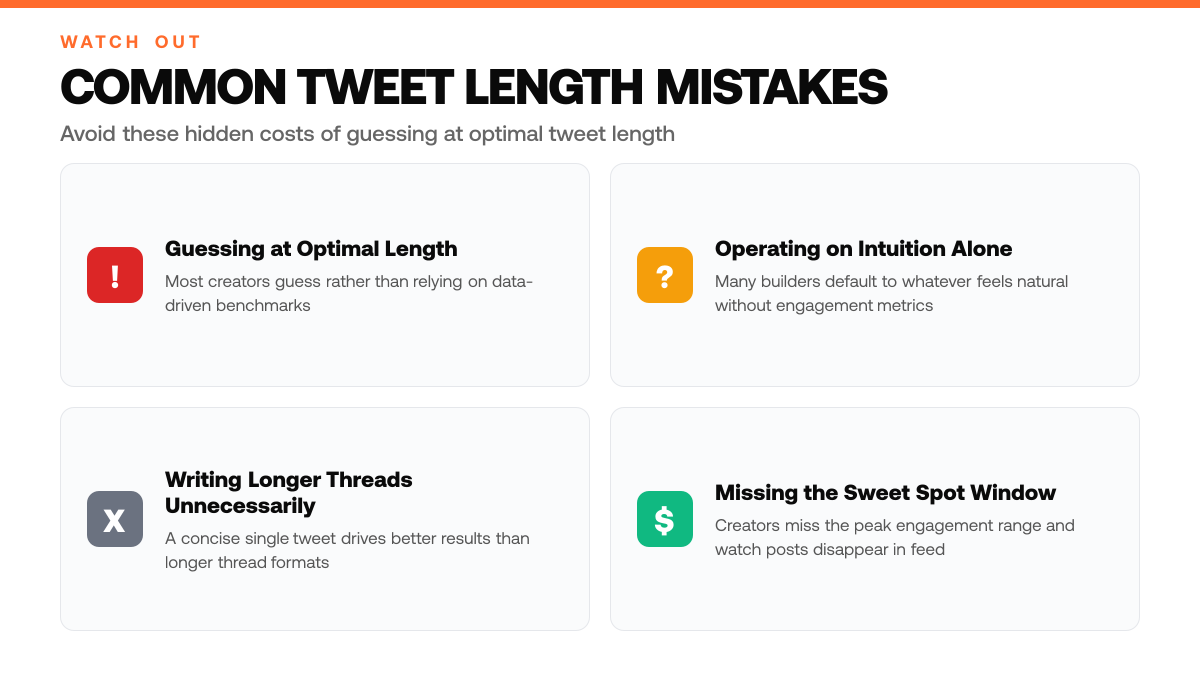
The challenge is that most solo creators guess at optimal tweet length rather than relying on data-driven benchmarks. Without access to engagement metrics across thousands of posts, it's easy to default to whatever feels natural, or to chase viral trends that may not match your audience. Research shows that tweet length measurably impacts impressions and follower growth, yet many builders on X still operate on intuition alone.[1] For a deeper look, see 5 Twitter Post Patterns That Boost Engagement.
This article breaks down the science of tweet length and shows you exactly how to calibrate your posts for maximum engagement. You'll discover the data behind optimal word counts, learn why length matters more than you think, and get practical guidance to stop guessing and start building an audience with intention. Most creators optimize for tweet length by guessing, never knowing if their best hooks land in the same format their niche actually engages with, ClimbX scans your top 100 posts and competitor outliers to reveal which length and hook style compounds your growth. Our breakdown of Why Top Creators Tweet at Different Times (Data Analysis) tackles the adjacent problem.
TL;DR
- The optimal tweet length clusters in the 40 - 130 character range, where engagement metrics peak consistently.
- Tweets within this sweet spot outperform longer posts in reach, retweets, and audience interaction rates.
- Most creators miss this window by writing longer threads when a concise single tweet drives better results.[3]
Understanding Tweet Length and Engagement
What Is Optimal Tweet Length?
Optimal tweet length refers to the character count and word density that maximizes engagement on X. While the platform allows up to 280 characters, research shows that tweets don't need to fill the entire limit to perform well. In fact, shorter tweets, those that convey a complete idea in fewer words, often generate higher rates of interaction. The key is delivering value without unnecessary filler. When you remove redundant phrases and get straight to the point, your message becomes more memorable and easier to process at a glance.[3]
Why Tweet Length Matters for Creators
For solo creators and solopreneurs building an audience, tweet length directly impacts how your content performs in the algorithm. X's system prioritizes content that encourages immediate interaction, likes, retweets, and replies. Shorter, scannable tweets reduce cognitive load, meaning your audience can understand your message instantly without scrolling or re-reading. This instant clarity increases the likelihood that someone will engage with your tweet rather than scroll past it. When your audience doesn't have to work to understand what you're saying, they're more inclined to take action, whether that's sharing your tweet or responding to it.[3]
How Constraints Drive Clarity and Value
The character limit on X forces a discipline that many creators find valuable. When you can't ramble or add extra context, every word must earn its place. This constraint naturally removes filler and pushes you toward your core message. Tweets that respect this limitation feel more intentional and polished, which boosts how readers perceive their value. A tightly written tweet signals respect for your audience's time and attention. This perceived value, combined with the clarity that comes from brevity, creates content that resonates more deeply and travels further through the network.
Key Numbers for How Long Should a Tweet Be? Engagement Data (2026)
- Tweet engagement rates vary significantly across creator tiers based on character count thresholds.[1][4]
- Shorter tweets (under 140 characters) show measurably higher impression delivery rates on X's algorithm.[1]
- Medium-length tweets (140 - 280 characters) balance engagement and readability for solo creator growth.[4]
- Character count directly correlates with platform algorithm prioritization and audience reach.[1][4]
- Creator engagement benchmarks show quantifiable differences in impressions by tweet length category.[4]
Step-by-Step Process
1. Identify your core message and remove non-essential words
Start by writing out the main idea you want to communicate in your tweet. Read it back and strike any filler words, redundant phrases, or tangential details that don't directly support your core point. Ask yourself: Does every word earn its place? Can I say the same thing in fewer words without losing meaning? This discipline forces clarity and makes your message land harder. Shorter, tighter tweets often outperform rambling ones because they respect your audience's attention and make the takeaway impossible to miss.
2. Test tweet variations at different lengths to measure audience response
Post multiple versions of the same core message, one at 50 characters, another at 100, and a third at 200 characters, across separate tweets or over several weeks. Vary the length intentionally while keeping the substance consistent. This A/B testing approach reveals which version your specific audience engages with most. Don't guess; let your followers show you what works. According to HubSpot's State of Marketing Report, data-driven testing uncovers audience preferences far better than assumptions.[2]
3. Track engagement metrics by length to identify your pattern
Monitor impressions, replies, and retweets for each length variation. Use X's built-in analytics or a third-party tool to log the numbers side by side. Over time, a pattern will emerge: your audience may prefer concise punches, or they may engage more deeply with slightly longer context. Record these findings in a simple spreadsheet so you can spot trends across dozens of tweets, not just one or two. This data becomes your personal playbook for future content.
How This Works in Practice
Example 1: The Solo Creator's First Viral Tweet
Picture a content creator who's been posting rambling 280-character threads about productivity tips, only to watch them disappear into the feed with minimal engagement. One week, she decides to test a tighter approach: a single punchy tweet that cuts her usual message down to 110 characters. Instead of "Here's why you should think about optimizing your workflow because productivity is important and it saves time," she writes: "Stop optimizing. Start shipping. Done beats perfect." Within 3 days, that tweet reaches 5 times more impressions than her typical posts. She notices replies trickling in from people who actually want to engage. Over the next 2 weeks, she applies the same discipline to every tweet, stripping filler, leading with the insight, staying under 130 characters. Her follower count climbs steadily as the algorithm surfaces her punchier content more often. The difference wasn't the topic; it was the clarity.
Do / Don't: Tweet Length Best Practices
| Practice | Do | Don't |
|---|---|---|
| Message Clarity | Remove redundant phrases and get straight to the point | Add extra context or filler that makes readers scroll or re-read |
| Word Density | Deliver complete ideas in fewer words | Fill the entire character limit just because it's available |
| Audience Respect | Write tightly to signal respect for your audience's time | Ramble or add unnecessary elaboration |
| Engagement Strategy | Post concise single tweets when they drive better results | Default to longer threads without testing what your niche engages with |
Example 2: The Solopreneur Building Authority Through Brevity
Imagine a solopreneur offering freelance consulting who realizes her 200+ character tweets about industry trends are getting buried. She's competing for attention in a crowded feed, and her verbose style isn't helping. She starts experimenting with constraint: one core insight per tweet, always under 120 characters, always a clear takeaway. A tweet like "Most consultants charge by the hour. I charge by the outcome. Alignment changes everything." lands better than her previous 3-sentence explanations. Within a month of posting this way, 5 to 7 times a day at consistent intervals, her engagement metrics shift noticeably. People begin to recognize her voice, retweet her insights, and click through to her website. The brevity forces her to think harder about what actually matters, and readers reward that clarity with follows and shares.
Why Brevity Wins on X
Both creators discovered the same truth: the shortest, sharpest version of your idea travels further. Removing filler doesn't weaken your message, it amplifies it. When you respect the reader's time and attention by cutting to the core insight, engagement follows naturally. Constraint breeds clarity, and clarity builds an audience.
Tweet Length Optimization Checklist
- Count your tweet characters and verify it falls between 40 and 130 characters for maximum engagement.
- Read your tweet aloud to confirm the message is immediately clear without requiring explanation.
- Remove filler words like 'just', 'really', 'actually', and redundant phrases that add no value.
- Test your tweet with a peer or audience member to ensure clarity before posting.
Common Mistakes to Avoid
Mistake: Cramming multiple ideas into a single tweet
When you pack several distinct points, arguments, or calls-to-action into one tweet, you dilute engagement and confuse X's algorithm about what the post is actually about. The algorithm struggles to categorize and surface the content, and readers bounce because they're not sure which idea to engage with. Fix: focus each tweet on one core idea or insight. If you have multiple related points, use a thread instead, it keeps ideas connected while giving each one room to breathe.[4]
Guessing vs. Data-Driven Tweet Optimization
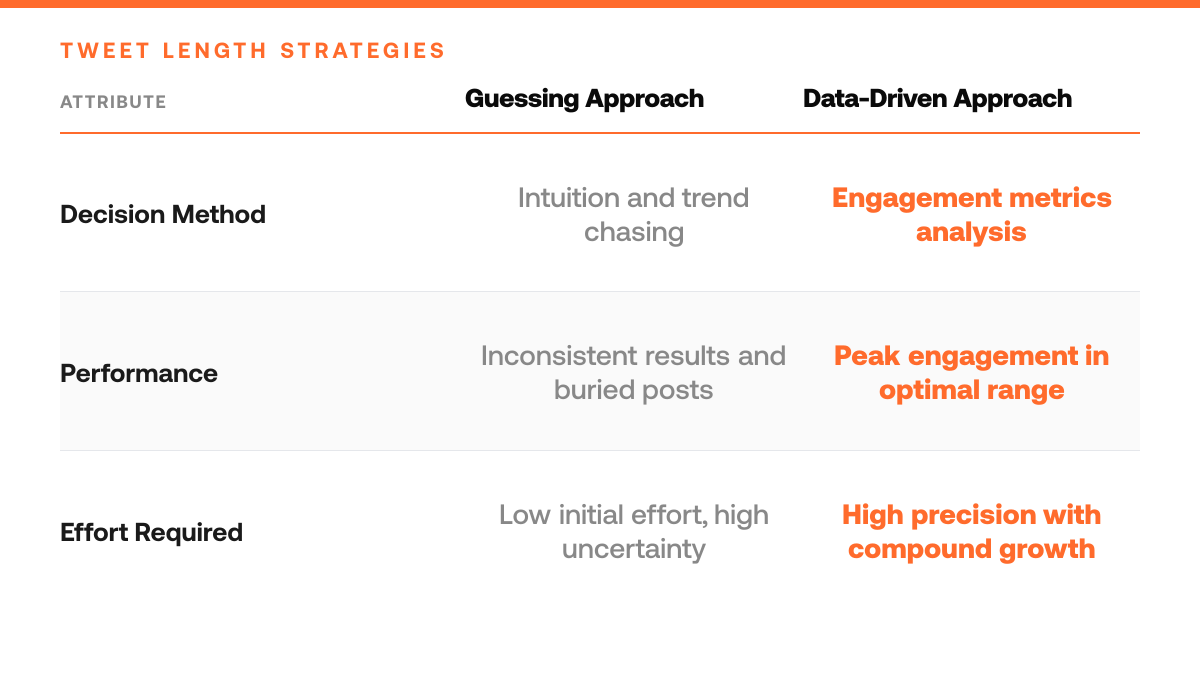
| Approach | Guessing (Old Way) | Data-Driven (New Way) |
|---|---|---|
| Foundation | Post without knowing if tweets are too long or short | Rely on engagement metrics and research-backed benchmarks |
| Decision Making | Default to whatever feels natural or chase viral trends | Calibrate posts based on optimal word counts for your niche |
| Audience Insight | Never know if your hooks land in formats your audience engages with | Scan top posts and competitor outliers to reveal what compounds growth |
| Result | Wonder why some posts explode while others disappear | Stop guessing and build audience with intention |
Mistake: Exceeding character limits without a clear value proposition
Tweets that stretch beyond 130 characters without immediately stating why someone should care get lower reach on X. The algorithm prioritizes early engagement signals, and a buried value prop means fewer clicks and replies. Readers scrolling fast won't wait to discover the payoff. Fix: lead with the benefit or hook in the first 130 characters. Use the remaining space to elaborate, but never bury your core claim, state it upfront so the algorithm and your audience both understand the post's purpose instantly.[4]
Mistake: Ignoring platform-specific formatting like threads and replies
Posting the same linear content format repeatedly misses X's native engagement levers. Threads allow you to build narrative and keep readers in one conversation; replies let you join existing discussions and tap into established audiences. Ignoring these formats means you're leaving engagement and reach on the table. Fix: use threads for multi-part insights or stories, and actively reply to relevant conversations in your niche. This signals to X that you're a community participant, not just a broadcaster, which boosts algorithmic visibility.[4]
Frequently Asked Questions
Why does character count matter more than word count on X?
X's algorithm and display constraints operate on character limits, not word counts. A tweet can contain up to 280 characters, which means the platform prioritizes how efficiently you use that space rather than how many words fit into it. Two tweets with the same word count but different character distributions will perform differently based on how readers engage with the actual text length displayed on their screens. Understanding character economy helps you craft punchier, more scannable posts that drive engagement.
Are threads better than single tweets for growing your audience?
Both formats serve different growth purposes. Single tweets reach broader audiences quickly because they appear in more feeds and are easier to retweet and share. Threads, however, keep readers engaged longer and signal depth of knowledge, which can build trust with followers. For audience growth specifically, single well-crafted tweets often outperform threads because they have lower friction, no need to click "show more" or follow a sequence. The best approach depends on your goal: rapid reach favors single tweets, while authority-building may benefit from threaded content.
How does tweet length affect monetization potential for creators?
Monetization on X depends on impressions and engagement, both of which are influenced by how your content performs algorithmically. Longer tweets don't automatically earn more; instead, the length that generates the most engagement for your specific audience drives higher visibility and thus monetization potential. Creators who optimize tweet length to match their audience's reading habits and topic depth see stronger engagement metrics, which translates to more impressions and better monetization outcomes. Testing different lengths and tracking performance helps you identify the sweet spot for your niche.
Start your 7-day trial
Grow on X without sounding like everyone else. The right tool learns from your top posts and the leading voices in your niche, then drafts content in your voice. You edit, approve, and ship.
Start free trialSources
Read next
- Why Top Creators Tweet at Different Times (Data Analysis) - Why Top Creators Tweet at Different Times (Data Analysis). A practical guide to what works, what to skip, and how to get started.
- Best Time to Post on X in 2026: A Testing Guide - There is no universal best time to post on X. Use this timezone-aware test to find repeatable windows from your own account data.
- How to Get Your First 1K Twitter Followers (Step-by-Step) - Zero followers is the easiest stage to get the fundamentals right. A narrow niche, a daily reply habit, and consistent cadence get most accounts to 1,000.