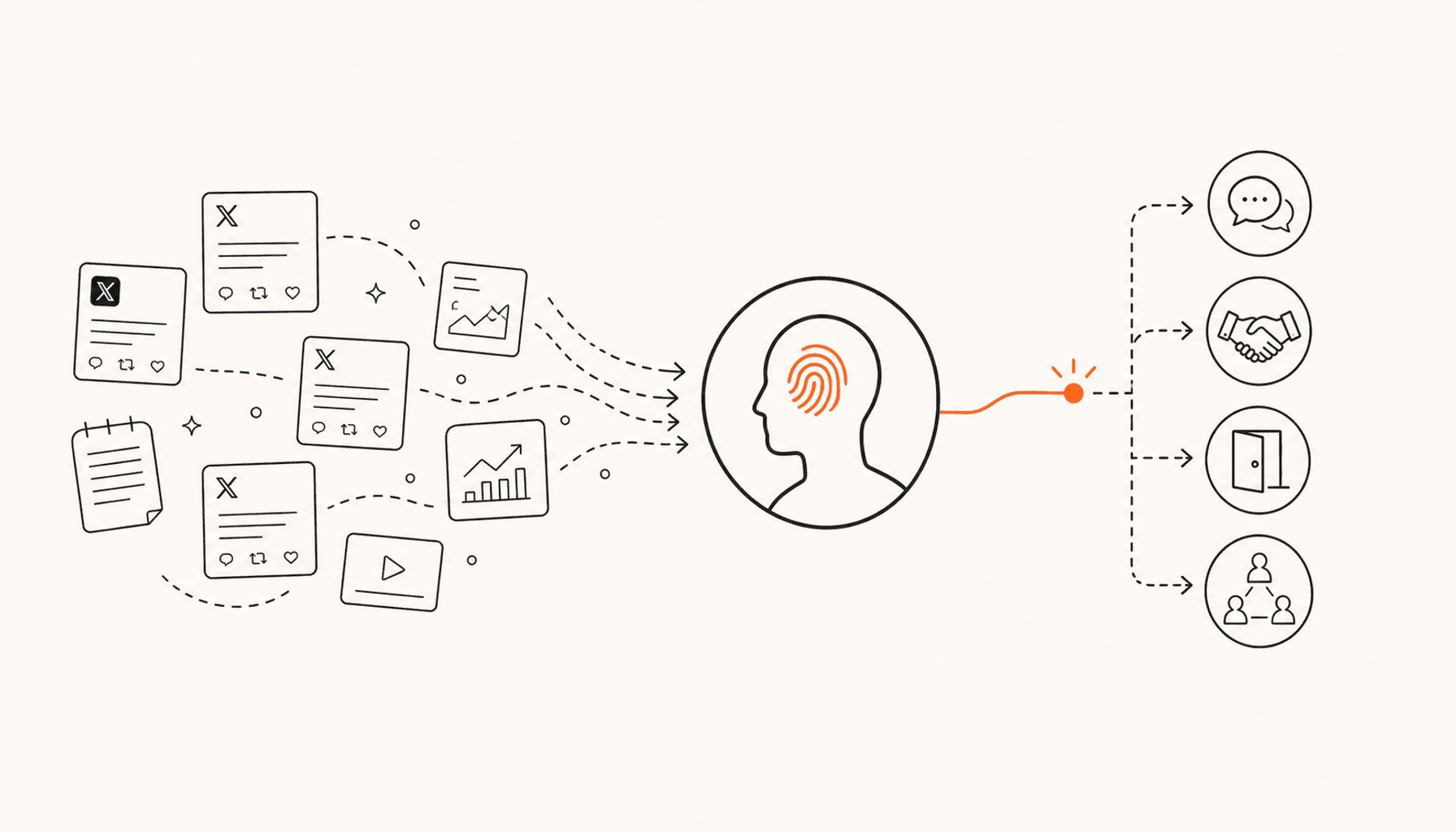
You need a personal brand when people understanding your judgment can create useful opportunities before you ever speak to them. Founders, consultants, operators, and specialists are often evaluated through their public work before the first call, job interview, product demo, or partnership conversation.
In 2026, publishing is easy. AI can produce competent-looking content in seconds. That makes content abundant, but it does not make experience, taste, or trust abundant. A consistent body of useful public work gives relevant people something real to remember and evaluate.
The short answer
A personal brand is not a costume, logo, or follower count. It is the expectation people attach to your name after seeing how you think and what you contribute. Build one if recognition and trust help your work. Skip it if public visibility has little connection to your goals or costs more energy than it returns.
What is a personal brand, really?
Your personal brand is the shorthand people use when your name comes up. They might know you as the founder who explains pricing clearly, the engineer who makes performance work practical, or the recruiter who gives unusually honest hiring advice. That shorthand is built from repeated evidence.
You already have a reputation among people who know you. Personal branding makes some of that reputation legible to people who do not. It does not require sharing your private life. Your public material can stay focused on work: decisions, experiments, useful explanations, mistakes you can discuss honestly, and informed opinions you are prepared to defend.
This is why "invent a persona" is bad personal-brand advice. A persona creates another performance to maintain. A durable brand makes your real expertise easier to recognize.
Why does personal branding matter more in 2026?
The supply of polished information has exploded. A clean thread, article, or framework no longer signals much on its own because anyone can ask an AI model to produce one. The differentiator moved upstream: Why this idea? Why now? What did you observe? Which tradeoff would you choose? What can you explain because you did the work?
Public expertise also reaches people you may never meet through a sales process. The 2025 Edelman and LinkedIn B2B Thought Leadership Impact Report found that 64% of target buyers and 63% of "hidden buyers" spend more than one hour each week consuming thought leadership. It also found that 71% of hidden buyers report little or no interaction with sales.
Thought leadership is not the same thing as a personal brand. It is one part of the evidence a brand can contain. The connection is simple: useful public expertise can reach people who would never schedule a call just to learn how you think.
Trust matters in that evaluation. In a survey of approximately 1,500 B2B marketing leaders, 94% agreed that building trust is the most important factor for B2B brand success. That is a report of marketers' priorities, not proof that posting causes revenue. Still, it explains why recognizable people increasingly appear beside company brands in marketing strategy. The same LinkedIn and Ipsos benchmark found that 55% of respondents work with creators or influencers.
Working with creators still requires more than choosing the largest audience. Teams need to evaluate whether a creator's content, audience, brand safety, and expected performance fit the campaign. An influencer discovery platform such as Influship can bring those signals into one search and evaluation workflow instead of leaving the decision to follower count and scattered spreadsheets.
What are the practical benefits of building a personal brand?
Trust before the first conversation
A useful archive answers questions that a bio cannot. It shows whether you understand the details, update your views, explain tradeoffs, and treat other people fairly. By the time someone contacts you, they may already know how you approach the problem.
That archive can also help visitors while you are unavailable. Tools such as BrainSite turn approved website knowledge into a conversational AI sales agent that can answer questions, qualify interest, and move a ready visitor toward a booking. The important boundary is that the agent answers from material you have reviewed, rather than inventing expertise on your behalf.
Repeatable distribution for useful work
Without distribution, every new idea starts at zero. A recognizable public presence gives future articles, products, research, and announcements a relevant starting audience. It does not guarantee attention. It gives good work a better chance of reaching people who have chosen to hear from you.
A link-in-bio page gives profile visitors one clear route to everything behind that work. A tool such as Linkos can collect a newsletter, product, booking page, and other channels in one profile while showing which destinations people actually use.
Visible expertise and more surface area
Private competence is easy to miss. Public work creates more ways for customers, collaborators, candidates, employers, podcast hosts, and partners to discover the part of your expertise relevant to them. One post rarely changes anything. A searchable body of work creates many small doors.
Faster feedback from the market
Publishing exposes your assumptions to real questions. Replies can show where an explanation is weak, which problem keeps recurring, or which language people use for a need. That feedback can shape a product or point of view long before a formal launch.
Recognition that can travel with you
Companies, projects, and job titles change. A reputation attached to your name can carry context into the next thing. But do not confuse portability with ownership. Followers on X, LinkedIn, or any other platform are rented distribution. Convert some attention into a direct relationship through product accounts, an email list, events, or a community you can reach without an algorithm.
Who benefits most, and who may not need a personal brand?
Personal branding tends to help when your work depends on trust in your judgment. That includes founders introducing a new product, independent professionals selling expertise, operators who want future career options, researchers trying to spread ideas, and leaders who recruit or build partnerships.
For developers, public explanations and small projects can make expertise easier to discover, but visibility is not a substitute for interview readiness. If a frontend role is the immediate goal, pair the public work with structured practice. The free FrontendGeek frontend interview preparation hub organizes JavaScript, React, machine coding, frontend system design, UI technologies, and role-specific questions in one place.
You may not need one if your goals do not depend on public discovery, your work must stay confidential, or maintaining a public presence drains energy you need elsewhere. Some excellent people prefer private networks and referrals. That is a valid strategy.
There is also a middle ground. You can publish one strong piece a month, contribute to selected conversations, and keep the rest of your life offline. Personal branding should support the work. It should not become the work unless that is what you want.
Why is follower count the wrong starting metric?
Follower count measures potential distribution on one platform. It does not tell you whether people understand your expertise, trust your judgment, remember your category, or act on anything you publish.
Start with recognition and relevance instead. Are the right people replying with informed questions? Are they repeating your framing? Do useful conversations continue in email, calls, product feedback, or collaborations? Those signals are less tidy than one public number, but they are closer to the reason for doing the work.
Discovery is also moving beyond traditional search. If your name or company should appear when buyers ask AI systems about your category, an AI visibility audit can test which questions surface your brand across major models, which competitors appear instead, and which sources those answers rely on. Treat that as a point-in-time diagnostic, not a substitute for conversations, reputation, or business results.
If your immediate goal is tactical audience growth, the separate guide to growing on X in 2026 covers cadence, replies, formats, and measurement. Those tactics are not the same as the broader decision to build a personal brand.
What do X's 2026 changes suggest about originality and relationships?
In July 2026, X announced an algorithm change intended to increase visibility among mutual followers and help interest-based clusters form. That points toward conversation and repeated relationships, not only broadcasting to strangers. It does not mean every mutual will see every post. The independent report from TechCrunch describes the change as a tweak, not a complete rewrite of the feed.
X also tightened creator-revenue enforcement around duplicated content and engagement bait. That supports a practical rule: build on work you can stand behind and contribute something of your own. It does not prove that every original post receives more organic reach, and it should not be stretched into that claim.
How do you start without turning your life into content?
- Choose a useful category. Pick a problem you know well enough to discuss for a year. It should connect to the work and people you want more of.
- Collect proof of thought. Keep notes on decisions, questions, mistakes, results, and tradeoffs from real work. You do not need to expose confidential details.
- Publish at a survivable pace. One useful post or article each week can beat a daily schedule that turns into filler and disappears after a month.
- Join the conversation. Ask and answer real questions. Recognition grows through interaction, not only output.
- Review what creates signal. Notice which topics attract relevant replies and which explanations people save or cite. Refine the category without chasing every spike.
Once you decide the effort is worthwhile, the existing seven-pillar personal-brand guide for X covers the detailed implementation. If AI is part of your workflow, read the companion guide on using AI for personal branding without losing your voice before you scale the output.
Frequently asked questions
Do I need a personal brand if I am not a creator?
Maybe. A personal brand is useful when trust in your judgment affects your work, whether you are a founder, consultant, operator, researcher, or job candidate. You do not need to call yourself a creator. If public visibility would not help your goals, you can reasonably spend the time elsewhere.
Is personal branding the same as being an influencer?
No. Influencing usually depends on access to an audience. A personal brand is the expectation attached to your name. You can build one inside a small professional category without chasing mass reach, sponsorships, or a creator identity.
How long does it take to build a personal brand?
There is no reliable fixed timeline. Recognition grows as people repeatedly encounter useful work with a consistent point of view. A few strong pieces can create early recognition, but trust usually requires sustained evidence rather than one viral post.
Can I build a personal brand without posting every day?
Yes. A sustainable weekly rhythm is better than a daily schedule you abandon. Publish when you have something useful, keep a consistent set of topics, and participate in relevant conversations between larger pieces of work.
Which platform should I use for my personal brand?
Start where the people you want to reach already spend time and where your natural format fits. X works well for short ideas and live conversation. LinkedIn fits professional context. A blog, podcast, or video channel may fit deeper work. Use one primary platform first, then create a direct relationship through an email list, product account, or community.
Build evidence, not a performance
The best reason to build a personal brand in 2026 is not to look visible. It is to make useful evidence of your judgment easy to find. That can create trust, distribution, feedback, and recognition. None of those outcomes is guaranteed, and not everyone needs them enough to justify the work.
If X is where you choose to build, ClimbX helps with the repetitive part: finding relevant ideas, drafting in your voice, and maintaining a rhythm without handing over the final judgment. The public work still has to be yours.
Build a useful body of work on X.
ClimbX helps you find relevant ideas and turn them into drafts shaped by your voice. You review, edit, and decide what earns a place under your name.
Read next
- How to Use AI for Personal Branding Without Sounding Like AI - Use AI to research, organize, and draft personal-brand content without losing your voice, judgment, or credibility.
- Outliers as training data: how ClimbX learns what works at your size. - Why we draft from posts that broke out for accounts 2 to 5x your size, how the cohort data refreshes, and how the learning loop tightens with every draft you ship - all framed by what the X algorithm actually rewards.