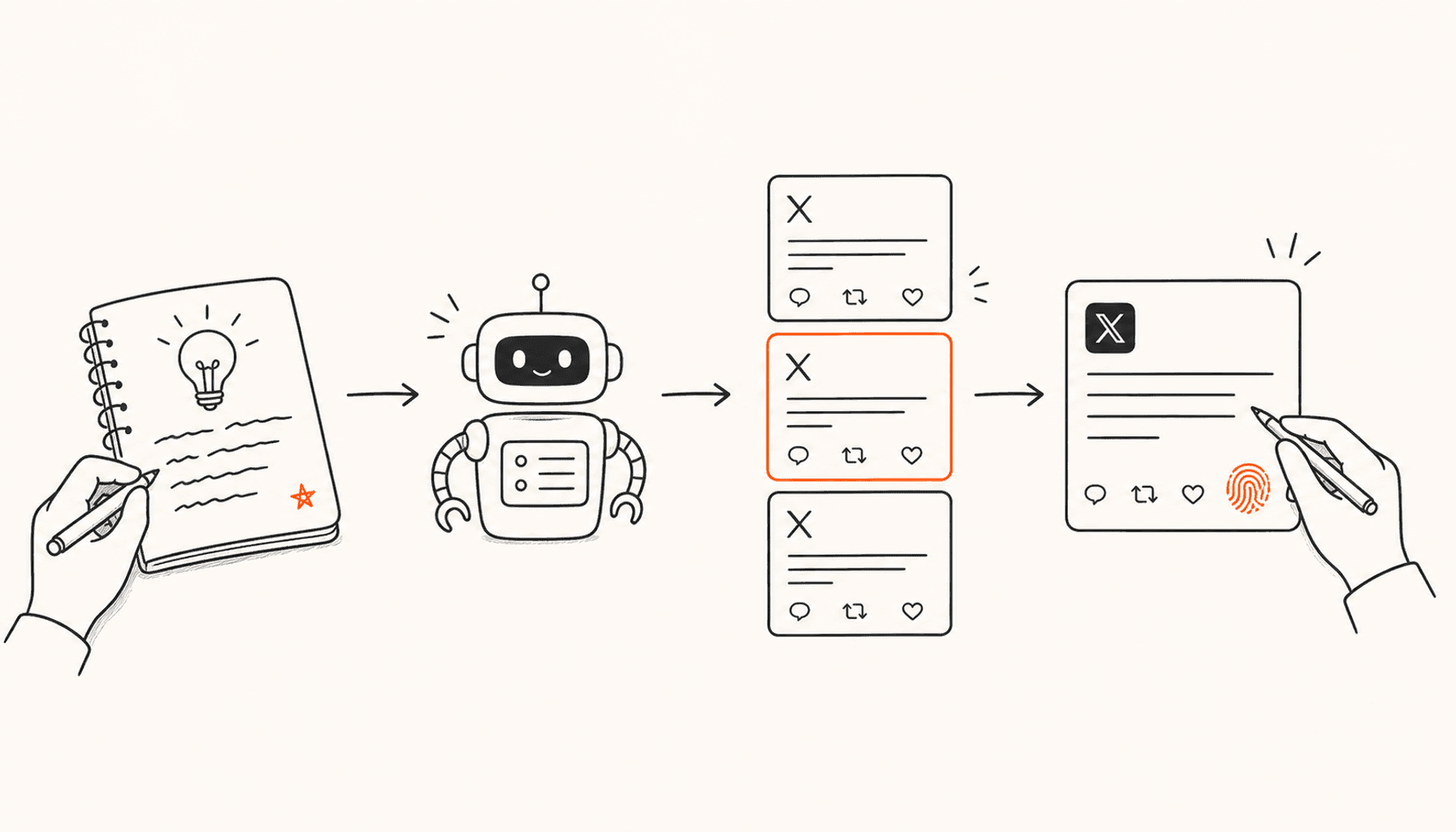
AI is useful for personal branding when it helps you express more of what you actually know. It becomes harmful when it replaces the knowledge, judgment, and specificity that gave people a reason to follow you in the first place.
The distinction is easy to miss because both workflows can produce polished text. One begins with your observations and uses AI to organize them. The other begins with an empty prompt and asks a model to manufacture something plausible. The first can make your voice clearer. The second tends to make everyone sound alike.
The short answer
Use AI as an editor, researcher, and creative partner, not as your identity. Start with a real idea or experience, give the model relevant examples, ask it to expose gaps and generate options, then make the final argument and wording your own. You should be able to explain and defend every sentence without the tool open beside you.
Why does AI-written personal-brand content sound generic?
A model predicts a useful continuation from patterns in its training and the context you provide. If the context is vague, such as “write a thought-leadership post about leadership,” the safest output is a smooth average of familiar leadership advice. It may be grammatically clean and completely forgettable.
Your recognizable voice lives in details the generic prompt leaves out: what happened, what surprised you, which tradeoff you chose, the language your customers use, what you disagree with, and what changed your mind. AI cannot recover those details from a topic alone. You have to supply them.
Generic content also comes from treating the first draft as the finished product. Common transitions, symmetrical lists, inflated certainty, and a tidy motivational conclusion can make unrelated authors feel interchangeable. The cure is not a magic “sound human” prompt. It is stronger source material and an opinionated edit.
What should AI do in your personal-brand workflow?
Turn raw notes into possible angles
Capture messy material before opening the model: voice notes after a customer call, lessons from a launch, objections you keep hearing, screenshots of your own results, or a decision that took longer than expected. Ask AI to identify tensions, recurring questions, and possible angles. Selecting the angle remains your job.
Challenge the argument before you publish it
A model can act as a skeptical reader. Ask what is unsupported, where a counterexample would weaken the claim, and which terms need definition. This is often more valuable than asking it to make the prose punchier. Personal brands are built partly through good judgment, and good judgment includes knowing the limits of a claim.
Produce alternatives at the sentence level
Ask for five openings, three structures, or a shorter explanation of one difficult point. Comparing options keeps you in the editor's seat. Asking for an entire post makes it easy to accept the model's framing before you have decided what you believe.
Adapt work you have already approved
Repurposing is a strong use case because the source already contains your thinking. AI can find short-post angles in an article, turn a transcript into an outline, or identify one chart that deserves an explanation. Review each derivative on its own; a good long-form point can become misleading when compressed.
When the source needs a sequence rather than one caption, this guide to multi-slide posts explains how to turn a single idea into a clear hook, supporting slides, and a final takeaway for LinkedIn or Instagram.
Keep a consistent editorial system
AI can tag drafts by topic, track which questions you have already answered, and notice when your queue is overloaded with one format. That supports consistency without forcing you to repeat the same idea. The system should organize your work, not decide what your reputation ought to be.
A six-step workflow that keeps the thinking yours
- Begin with evidence. Write down the event, example, number, question, or decision that makes the post worth reading. If there is no source material, do not ask AI to disguise the absence.
- State the point yourself. Complete one sentence: “I want the reader to understand that…” This prevents the model from quietly choosing a different argument because it sounds more conventional.
- Add audience and constraints. Tell the model who the reader is, what they already know, what format you need, and which claims or private details are off limits.
- Request options and criticism. Generate several structures or hooks. Ask what sounds generic and what evidence is missing. Choose deliberately instead of letting the first completion choose for you.
- Rewrite for truth and voice. Replace broad claims with exact ones, restore your natural vocabulary, vary the rhythm, and delete anything you would feel awkward saying to a colleague.
- Verify and read aloud. Check names, dates, links, quotations, and statistics against primary sources. Then read the post aloud. Your ear catches borrowed cadence and unnecessary language quickly.
What context should you give the model?
A useful voice brief is evidence, not a collection of adjectives. “Confident, authentic, and engaging” gives the model almost nothing. A small set of posts you genuinely like is better. Annotate why they work: short opening, concrete example, restrained claim, dry humor, no motivational ending, or whatever is actually characteristic of you.
For each draft, provide four kinds of context:
- Source: your notes, transcript, data, experience, or approved long-form material.
- Intent: the one thing the reader should understand, question, or do afterward.
- Audience: who the post is for and what that person already knows.
- Boundaries: facts that must remain exact, claims to avoid, privacy limits, length, and format.
Keep confidential information out of prompts unless your organization has explicitly approved the tool and its data controls for that material. A richer prompt is not worth exposing customer data, internal strategy, private messages, or someone else's work.
A practical prompt for drafting without surrendering your voice
“Act as a critical editor. Using only the source notes below, identify the strongest claim and any missing evidence. Then propose three different structures for an X post. Do not invent examples, numbers, or personal experiences. Keep the language direct and avoid generic motivational conclusions. Explain the tradeoff of each structure before drafting anything.”
Follow that with your notes, audience, constraints, and a few examples of writing you have approved. Once you pick a structure, ask for a draft and edit it. The prompt is useful because it makes uncertainty and options visible; it is not a substitute for source material.
What should you remove during the human edit?
Remove any sentence that could sit under a hundred different names. Cut claims that sound certain but are not supported. Replace abstract nouns with the event that produced the lesson. Delete throat-clearing openings, repeated conclusions, and calls to action that do not fit the relationship you have with the reader.
Also watch for false intimacy. AI can casually write “I learned,” “my clients,” or “in my experience” when no such experience appeared in the prompt. Publishing that language is not a harmless style issue. It attaches a fabricated history to your name.
A good final check is simple: if someone asks a detailed follow-up, can you answer it? If the post attracts disagreement, can you explain why you chose the claim? If the answer is no, the content is not ready merely because it reads well.
How do you scale content without scaling sameness?
Scale the collection and editing system before scaling publication. Make it easier to capture observations, search old notes, compare draft angles, and review performance. Publishing twice as much generic material only gives people twice as many reasons to stop paying attention.
Measure whether the right people understand and respond to the work, not only whether the tool increased output. Relevant replies, thoughtful follow-up questions, profile visits, qualified conversations, and ideas people repeat back to you are stronger signs of a useful personal brand than the number of drafts generated.
Keep content-led visibility and outbound sales as separate jobs. Publishing builds familiarity over time; it does not reliably put a message in front of every qualified buyer. B2B founders who also need targeted LinkedIn prospecting can use a dedicated tool such as Omentir to find and score leads, personalize outreach, and manage replies while the personal-brand system remains focused on useful public work.
If you are still deciding whether the effort makes sense, start with why a personal brand matters in 2026. If X is your primary platform, the guide to growing on X in 2026 covers cadence, conversations, and measurement.
Frequently asked questions
Can AI build my personal brand for me?
No. AI can reduce the work of researching, organizing, drafting, and repurposing content, but it cannot supply your lived experience, judgment, relationships, or reputation. Those are the parts that make a personal brand credible.
How do I make AI-written content sound like me?
Give the model examples of your real writing, describe the audience and point you want to make, and ask for options rather than a finished post. Then rewrite the opening, add specific evidence, remove phrases you would not say, and read the result aloud before publishing.
Should I disclose that I used AI to write a post?
Disclose AI use when the tool materially created media or claims that a reasonable reader could misunderstand, when a platform or client requires it, or when the process itself matters to the audience. Routine help with outlining or editing does not always need a label, but you remain responsible for everything published under your name.
What should I never give an AI writing tool?
Do not paste confidential company information, customer data, private conversations, credentials, or unpublished material you are not authorized to share. Check the tool and workspace data controls before providing sensitive context.
How much AI-generated content should I publish?
There is no useful percentage. Publish only material you have verified, edited, and are willing to defend. If AI lets you produce more drafts, use the extra capacity to select more carefully rather than filling every available slot.
Let AI increase your leverage, not replace your point of view
The useful promise of AI for personal branding is not effortless authority. It is less friction between noticing something valuable and expressing it clearly. Your experience supplies the evidence. Your judgment chooses the claim. AI helps explore and shape the draft. Your name on the finished post means the final responsibility stays with you.
ClimbX supports that division of labor on X: it helps surface relevant ideas and draft from your voice, while leaving selection, editing, and publishing in your hands.
Use AI without giving up your voice.
ClimbX helps you find relevant ideas and shape drafts around how you actually write. You keep control of the point, the edit, and what gets published under your name.
Read next
- Why You Need a Personal Brand in 2026 - A practical look at why personal branding matters in 2026, how it builds trust and distribution, and what founders and professionals should do first.
- Outliers as training data: how ClimbX learns what works at your size. - Why we draft from posts that broke out for accounts 2 to 5x your size, how the cohort data refreshes, and how the learning loop tightens with every draft you ship - all framed by what the X algorithm actually rewards.