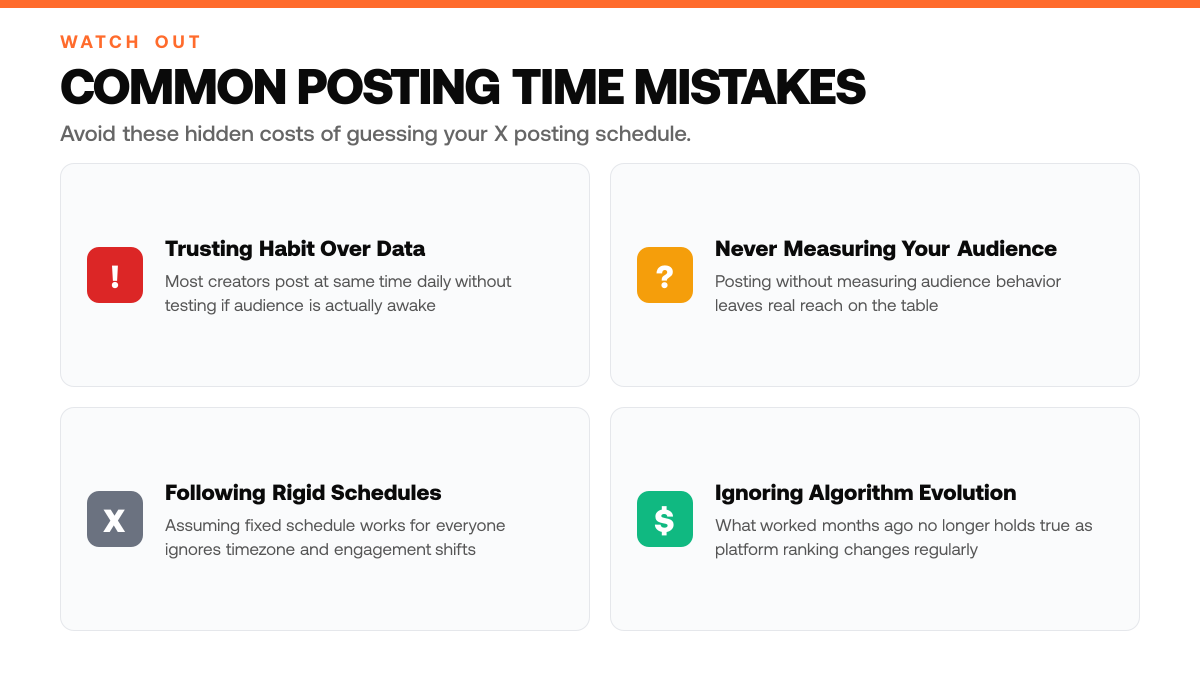
Most solo creators post on X at the same time every day, trusting habit or convenience rather than data. They assume a fixed schedule works for everyone, never testing whether their audience is actually awake and scrolling when they hit publish. This guesswork leaves real reach on the table.
The timing of a post directly shapes how many people see it, engage with it, and follow you as a result. Research shows that posting time influences impressions, reply counts, and follower growth, yet most creators never measure their own audience's behavior to find those high-impact windows.[1] For a deeper look, see Twitter Post Ideas for Solo Creators in SaaS (5 Templates), X Spaces for Solo Creators: Build Real Community (Free), and How to Analyze Competitor Twitter Posts for Content Ideas.
Top creators don't follow a rigid schedule. Instead, they adjust their posting times based on when their specific audience is most active, rotating their approach as engagement patterns shift. This article breaks down how to move beyond guessing and start using your own data to find the times that actually work for your growth. Most creators post into a void, guessing whether timing matters or if their format even resonates, ClimbX scans your last 100 posts to pinpoint which hooks and topics actually drive engagement, then surfaces outlier posts from ahead-of-you accounts so you draft in patterns that already work. The same principles drive How Long Should a Tweet Be? (Engagement Data), where this plays out in practice.
TL;DR
- Best posting times on X aren't universal, they shift based on your audience's timezone and the type of content you share.
- Engagement peaks vary significantly across weekdays and time zones depending on your creator niche and follower demographics.
- Top creators succeed by testing their own posting schedule rather than following a one-size-fits-all framework.[3]
Understanding Why Top Creators Tweet at Different Times
What Is Posting Time Strategy on X?
Posting time strategy on X refers to the deliberate choice of when to publish content based on when your audience is most likely to see, engage with, and share your tweets. Unlike a one-size-fits-all approach, successful creators recognize that the optimal time to post depends on multiple variables specific to their audience and content. Your followers may be distributed across different time zones, work schedules, and daily routines, meaning a tweet that performs well at 9 AM for one creator might fall flat for another posting at the same time. The timing decision becomes a data-driven practice rather than a guess, informed by analytics that reveal when your specific audience is most active and receptive.[2]
Why Posting Time Matters for Your Growth
Posting time directly impacts your reach, engagement, and ability to monetize your influence on X. When you publish at the moment your audience is scrolling, your content gets more immediate impressions, replies, and retweets, signals that push your tweet higher in feeds and attract new followers. Conversely, posting when your audience is offline means your content competes for visibility hours later, when the algorithm has already moved on. For solo creators and solopreneurs building an audience without paid promotion, this timing advantage is one of the few free levers you control. It affects not just vanity metrics but real business outcomes: more visibility leads to more followers, more followers lead to more monetization opportunities.
How Algorithm Changes and Content Type Shape Timing Strategy
X's algorithm evolves regularly, and what worked as optimal posting time six months ago may no longer hold true today. Platform changes in how it ranks and distributes content mean your posting strategy must adapt to stay effective. Additionally, different content types perform differently at different times. A hot take or contrarian thread might gain traction during peak work hours when people are scrolling between tasks, while educational content or long-form insights may perform better during evening hours when audiences have time to read deeply. Threads, promotional posts, and casual observations each have their own timing rhythms. Creators who ignore these shifts and content-type variations end up posting at times that no longer align with how X currently distributes content or when their specific audience engages.[4]
Key Numbers for Why Top Creators Tweet at Different Times (Data Analysis) (2026)
- 0.5% - 1% average engagement rate benchmark for most Twitter/X accounts across creator segments.[5]
- 1% - 3% engagement rate signals strong audience resonance for solo creators and solopreneurs on X.[5]
- 3%+ engagement rate marks top-tier creator performance, a threshold only a small share of accounts reach.[5]
- Peak posting windows shift measurably by niche, meaning a single universal "best time" misses most creator segments.[4]
- Impression and engagement metrics respond detectably to timing adjustments tracked across a creator's own archive data.[4]
- Engagement rate benchmarks vary significantly by follower count, larger accounts often see lower rates than smaller, tighter communities.[5]
Step-by-Step Process
1. Audit your audience analytics to identify peak activity windows
Log into your X analytics dashboard and review your follower activity data over the past several weeks. Look for patterns in when your audience is online, most analytics platforms show hourly and daily breakdowns. Note which days and times show the highest engagement rates, impressions, and click-throughs. This baseline data reveals when your followers are most receptive, not when you prefer to post. Document these patterns by content type if possible, since different audience segments may engage at different times.[5]
2. Test posting at multiple times across a 2-4 week window
Select a 2-4 week testing period and intentionally post similar content at different times each day. For example, post one thread in the morning, another at midday, and a third in the evening. Track the engagement metrics for each post independently, measure likes, retweets, replies, and impressions. Avoid changing other variables like content quality or format during this window; the goal is to isolate timing as the only variable. Record all results in a simple spreadsheet so you can compare performance across time slots.[5]
3. Measure engagement lift and identify your highest-performing slots
After your testing window closes, analyze which time slots consistently generated the most engagement relative to your baseline. Look for patterns, does morning always outperform evening, or does it vary by day of the week? Calculate the engagement lift (the percentage or absolute increase in interactions) for your top-performing times versus your lowest-performing times. This data-driven comparison removes guesswork and shows you exactly where your audience pays attention.[5]
How This Works in Practice
Example 1: The B2B Creator Capturing Lunch-Break Engagement
Picture a solo SaaS founder who builds an audience by sharing product development insights and industry analysis. She initially posts whenever content feels ready, sometimes early morning, sometimes late evening, and notices her tweets disappear into the feed without much traction. After reviewing her analytics, she spots a pattern: her audience (mostly other founders and engineering leads) engages most heavily between 9am and noon, when they're checking email and Slack before meetings kick off, and again between 3pm and 5pm when they're wrapping up tasks. She shifts her posting schedule to align with these windows, spacing out 3 - 4 tweets across these peak hours rather than dumping them all at once. Within weeks, her impressions climb noticeably, replies increase from a handful to several per post, and her follower growth accelerates. The shift costs her nothing except timing discipline, but the outcome transforms her reach without changing the content itself.
Guessing vs. Data-Driven Posting Strategy
| Approach | Posting Method | Result |
|---|---|---|
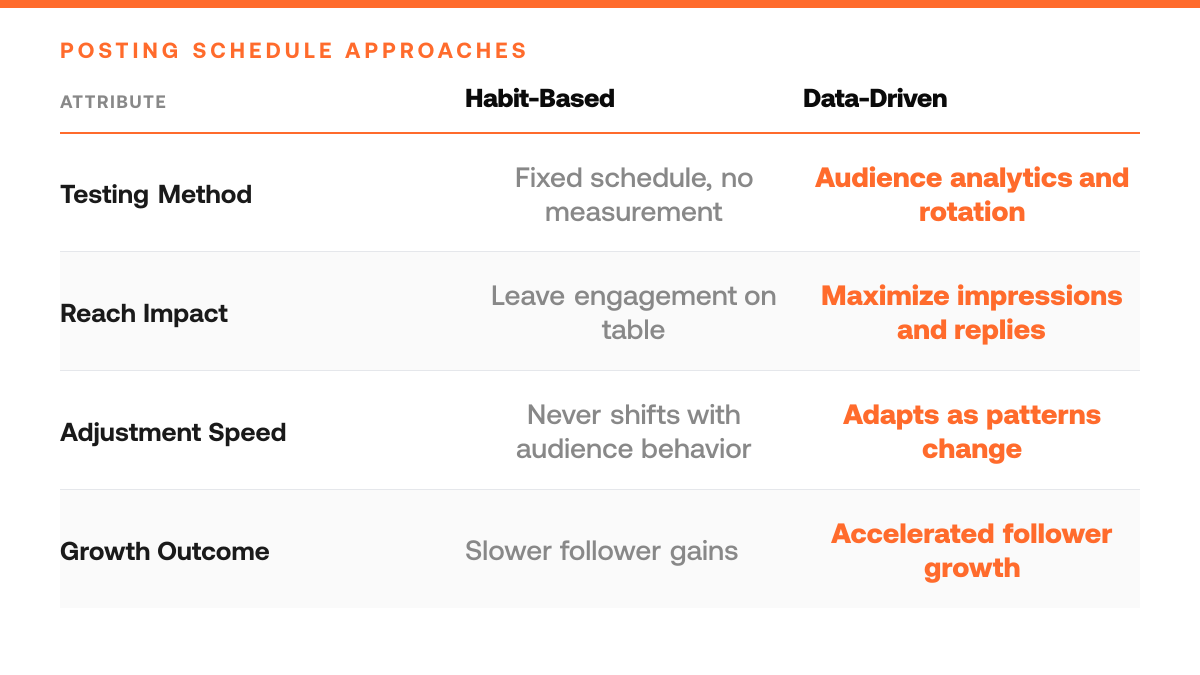
| Guessing (Most Creators) | Post at same time daily based on habit or convenience | Leave real reach on the table; miss high-impact windows |
| Data-Driven (Top Creators) | Adjust posting times based on audience activity patterns | Increase impressions, replies, and follower growth |
| Ignoring Content Type | Use fixed schedule regardless of content format | Post at times that underperform for that content type |
| Testing and Adapting | Rotate approach as engagement patterns shift | Discover optimal windows specific to your audience |
Example 2: The Lifestyle Creator Riding Weekend and Evening Spikes
Consider a creator focused on wellness and personal development content aimed at professionals seeking work-life balance. His weekday posts during typical 9-to-5 hours generate modest engagement, people are busy, distracted, heads-down in work. But when he experiments with posting on Friday evenings and Saturday mornings, the response shifts dramatically. His audience is scrolling for inspiration and relaxation when work stress is fading, not when they're in the middle of their day. He also notices that niche design and finance communities within his follower base engage most heavily during specific evening windows when they're unwinding or diving into side projects. By tailoring his posting rhythm to these leisure-time peaks rather than forcing a one-size-fits-all schedule, he sees higher save rates, more meaningful replies, and stronger community momentum.
Why Timing Unlocks Your Reach
Both creators succeeded not by posting more, but by matching their posting rhythm to when their specific audience was actually present and receptive. B2B audiences cluster during business hours; lifestyle and entertainment audiences peak in evenings and weekends; niche communities (developers, designers, finance enthusiasts) have their own distinct windows. The data is there in your analytics, you just need to read it and act on it. Guessing at timing leaves engagement on the table.
Optimizing Your X Posting Schedule Checklist
- Map your primary audience timezone and identify secondary markets where your followers are most active.
- Test posting at different times each week and record engagement metrics (likes, replies, retweets) for each slot.
- Analyze weekly engagement data to identify which posting windows consistently drive the highest interaction rates.
- Lock in your top 3 posting windows based on performance data and batch-schedule your content in advance.
Common Mistakes to Avoid
Mistake: Using a single posting time for all content types and audience segments
Assuming one optimal time works universally ignores that different content formats (threads, replies, media posts) and audience segments (early adopters vs. casual followers) have distinct engagement patterns. This flattens your reach across your audience. Instead, analyze which content types drive the most engagement at different times using tools like ClimbX, then segment your posting schedule by content format and audience behavior rather than forcing everything into one slot.
Content Type and Optimal Timing
| Content Type | Best Posting Window | Audience Behavior |
|---|---|---|
| Hot takes or contrarian threads | Peak work hours | People scroll between tasks during the workday |
| Educational content or long-form insights | Evening hours | Audiences have time to read deeply and engage |
| Threads, promotional posts, casual observations | Varies by type | Each has its own timing rhythm and performance pattern |
Mistake: Posting only during peak hours and ignoring secondary engagement windows across timezones
Focusing exclusively on peak hours misses engaged followers in other timezones and those who scroll during off-peak times. You'll leave impressions on the table and cap your potential reach. Diversify your posting schedule to include secondary windows, early morning, late evening, and weekend slots, where pockets of your audience are active but less crowded. Test these windows with Tweet Archivist analytics to find your unique secondary peaks.[4]
Mistake: Never revisiting your posting strategy after audience growth or algorithm shifts
Your optimal posting times today won't remain optimal as your audience grows, platform algorithms evolve, or your content mix changes. Stale posting schedules become a drag on growth momentum. Audit your posting performance quarterly or after major audience milestones, check which times still deliver the highest engagement, which new windows have opened, and whether your follower composition has shifted. Adapt your schedule to match the current state of your audience, not last year's data.
Frequently Asked Questions
Does posting time really matter more than how often I post?
Yes. When you post matters more for follower growth than posting frequency alone. A single well-timed tweet can reach far more of your audience than multiple posts at suboptimal hours. Research shows that timing aligns your content with when your followers are actively online and engaged, which drives impressions and follower gains more effectively than simply posting more often.[1]
Why do successful creators change their posting times throughout the year?
Optimal posting times shift seasonally and with platform algorithm updates, making static schedules stale. Your audience's behavior changes with seasons, time zones, and work patterns. Additionally, X's algorithm evolves regularly, rewarding different engagement patterns at different times. Creators who test and adjust their schedules stay ahead of these shifts and maintain consistent growth.[1][4]
I have a global audience. Should I post once a day or multiple times?
Solo creators with global audiences need multiple posting windows, not a single daily slot. A single post time reaches only the portion of your followers awake and online at that moment. Spreading posts across different hours, morning, afternoon, and evening in major time zones, exposes your content to different segments of your global audience, multiplying impressions and engagement.[1]
Start your 7-day trial
Grow on X without sounding like everyone else. The right tool learns from your top posts and the leading voices in your niche, then drafts content in your voice. You edit, approve, and ship.
Start free trialSources
Read next
- Best Time to Post on X in 2026: A Testing Guide - There is no universal best time to post on X. Use this timezone-aware test to find repeatable windows from your own account data.
- Why Your Twitter Posts Plateau (And How to Fix It) - A plateau usually means one thing went stale: the format, the reply habit, or the niche focus. How to diagnose which one, not guess.
- 5 Twitter Metrics That Predict Growth Before It Happens - 5 Twitter Metrics That Predict Growth Before It Happens. A practical guide to what works, what to skip, and how to get started.