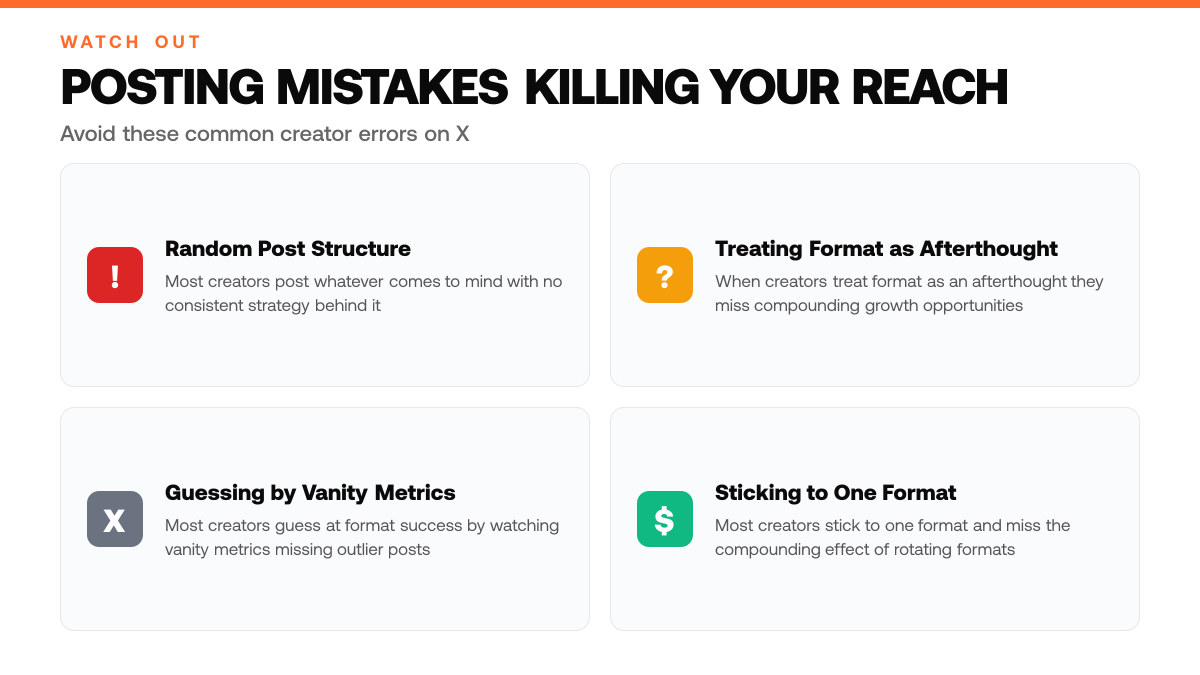
Scroll through your feed on X and you'll notice a pattern: most solo creators post whatever comes to mind, with no consistent structure or strategy behind it. A thread one day, a single line the next, a retweet with commentary after that. This randomness feels natural, but it's costing them reach. The format you choose, how you structure your words, whether you thread or stand alone, how you open and close, directly shapes whether your post gets buried or breaks through.
Research shows that post format significantly influences impressions, engagement, and follower growth on X. When creators treat format as an afterthought rather than a deliberate choice, they miss compounding growth opportunities. The difference between a post that lands with your audience and one that disappears often comes down to how you packaged the idea, not the idea itself.[1] For a deeper look, see How to Repurpose Twitter Threads Into Blog Posts (5 Formats). For a deeper look, see How to Repurpose Blog Content for X (5 Formats).
This article breaks down seven post formats that consistently outperform in competitive niches. You'll learn when to use each format, why it works, and how to adapt it to your voice and audience. By the end, you'll have a toolkit to replace guesswork with strategy, so every post you publish is built to reach the people who matter most. Most creators guess at format success by watching vanity metrics, missing the outlier posts in their niche that prove what actually moves engagement, ClimbX scans top accounts to surface high-performing formats and hooks, then generates new posts in your voice so you build on what's already working.
TL;DR
- Seven proven post formats drive consistent engagement on X: Thread, Hook-and-Payoff, Question, Stat-Driven, Contrarian Take, Case Study, and Call-to-Action.
- Each format taps into different audience behaviors, some spark replies, others drive shares, and a few build trust through storytelling or data.
- Most creators stick to one format and miss the compounding effect of rotating formats to match their content pillars and audience mood.
Understanding Twitter Post Formats for Creator Growth
What Are Twitter Post Formats?
Twitter post formats are distinct structural patterns that creators use to package ideas, insights, and calls-to-action into posts optimized for engagement and audience growth. The seven primary formats, threads, questions, statistics, contrarian takes, case studies, and direct calls-to-action, each follow a recognizable template that trains your audience to expect and interact with specific content types. A thread unfolds a narrative across multiple connected posts; a question invites direct replies; a stat presents data as proof; a contrarian take challenges conventional wisdom; a case study walks through a real-world example with results; and a CTA explicitly asks followers to take an action. These aren't arbitrary, they're psychological structures that trigger different reader behaviors and engagement patterns.[3]
Why Format Choice Matters for Your Audience
Solo creators and solopreneurs often post reactively, without considering whether their format aligns with their audience's stage in the creator journey or their content pillar. A follower discovering you for the first time may need a case study to believe your claims; an engaged community member may crave a contrarian take to spark debate and feel part of an insider conversation. Threads build authority by demonstrating depth; questions spark conversation by removing barriers to reply; statistics establish credibility by offering proof; contrarian takes generate debate by positioning you as a thought leader; case studies prove value through concrete examples; and CTAs drive measurable action. Matching format to both your pillar and your audience's readiness stage transforms passive scrolling into active participation and follow decisions.
How Format Fits Into Creator Strategy
The most successful creators rotate through multiple formats rather than defaulting to one. This variety signals that you understand your audience's needs at different moments and prevents content fatigue. A creator focused on personal finance might publish a thread on Monday to build authority, a contrarian take on Wednesday to spark debate, and a case study on Friday to prove results. Format diversity also compounds reach, questions generate reply threads that push your post into more feeds; statistics get shared by data-hungry followers; case studies attract bookmarks from people saving proof for later. Your content pillar defines the themes you cover; your format choice defines how you present them. Together, they create a rhythm that keeps followers returning and new audiences converting into followers.
Step-by-Step Process
1. Identify your content pillar and audience pain point
Start by pinpointing the core topic or problem your niche cares about most. This becomes your content pillar, the foundation for every post you create. Ask yourself: What question do my followers ask repeatedly? What transformation or insight do they need? Write this down clearly. Your pillar keeps all posts aligned and makes it easier to choose which of the seven formats fits best for each piece of content you plan to share.
2. Select the format that matches your pillar and message
Match your content pillar to one of the seven high-performing formats: educational threads, contrarian takes, personal stories, data-backed insights, quick tips, engagement questions, or case studies. Each format serves a different purpose. Educational threads build authority; contrarian takes spark debate; personal stories create connection; data-backed insights establish credibility; quick tips drive saves and shares; engagement questions boost replies; case studies show real results. Choose the format that best delivers your pillar message to your specific audience.[2]
3. Write your hook first, then layer supporting evidence
Begin with a compelling hook, a question, bold claim, or surprising stat that stops the scroll. This is the first line readers see, so make it count. Once the hook lands, add supporting evidence: examples, data, narrative details, or a step-by-step breakdown depending on your chosen format. Structure matters. The hook draws attention; the evidence keeps it and builds trust. Close with a clear next step: follow for more, reply with your take, click the link, or save the post.
4. Test format performance and iterate based on results
Track which formats generate the most engagement, saves, and replies in your niche. Not every format will outperform equally for your specific audience. Run each of the seven formats multiple times over several weeks, then review your analytics. Note which posts drove followers, which sparked conversation, and which got shared. Use these insights to double down on what works and refine or drop what doesn't. This repeatable cycle of testing and iteration is how you discover the formats that truly resonate with your audience and niche.
How This Works in Practice
Example 1: The SaaS Founder Building Product Credibility
Picture a SaaS founder launching a new tool for team collaboration. She's competing in a crowded space and needs to stand out without a massive ad budget. She starts threading educational threads using the Problem-Solution-Proof format, opening with a common pain point her customers face, walking through how her product solves it differently, and closing with a real use case. Over several weeks of consistent posting, she notices her replies shift from skeptics to prospects asking about pricing. The format works because it positions her as someone who understands the problem deeply, not just someone selling. Her engagement climbs, and within a couple of months, inbound interest from her posts alone accounts for a meaningful portion of her early signups.
When to Use Each Post Format
| Post Format | Best For | Audience Stage |
|---|---|---|
| Thread | Building authority and demonstrating depth | Engaged followers seeking insider knowledge |
| Question | Sparking conversation by removing reply barriers | Community members ready to engage |
| Case Study | Proving value through concrete examples | New followers who need proof of claims |
| Contrarian Take | Generating debate and positioning as thought leader | Engaged community seeking insider perspective |
| Stat-Driven | Establishing credibility through proof | Skeptical or discovery-stage followers |
| Hook-and-Payoff | Breaking through feed noise with compelling openings | Passive scrollers needing reason to stop |
Example 2: The Creator Coach Growing Through Contrarian Takes
Consider a content strategist who teaches personal branding to aspiring creators. The market is saturated with generic advice, so she adopts the Contrarian Hot Take format, she posts a bold claim that contradicts mainstream wisdom (e.g., 'Your engagement rate doesn't matter; your conversion rate does'), then backs it up with reasoning and a brief case example. Her posts spark debate in replies, which pushes them higher in the algorithm. She doesn't need a massive following to start; the format itself drives reach because people share takes they disagree with. Within weeks, her follower count grows, but more importantly, her audience becomes highly engaged and aligned, people who actually care about her niche perspective rather than casual browsers.
Why Format Drives Niche Growth
Both examples show the same principle: the format itself does the heavy lifting. Whether you're a SaaS founder, a creator coach, a growth marketer, or an AI tool builder, choosing a format that matches your goal, education, credibility, debate, or proof, means your content works for your niche, not against it. The structure gives your audience a reason to engage, and consistency with the right format compounds faster than random posting ever will.
Twitter Post Format Checklist
- Select one of the seven formats and draft your post using its specific structure before publishing.
- Review your post for clarity, tone match, and whether it aligns with your niche audience's expectations.
- Test the post's opening hook, verify it stops scrollers and compels them to read the full thread or reply.
- Check engagement potential by asking: does this format invite replies, retweets, or saves from your target followers?
Common Mistakes to Avoid
Mistake: Burying your hook or value proposition below the fold
When your strongest claim or question lands in the third or fourth line, casual scrollers never see it, your engagement and click-through rates plummet. Lead with your most compelling insight or benefit in the first one or two sentences. Test which opening resonates most with your niche before rolling it out across multiple posts.
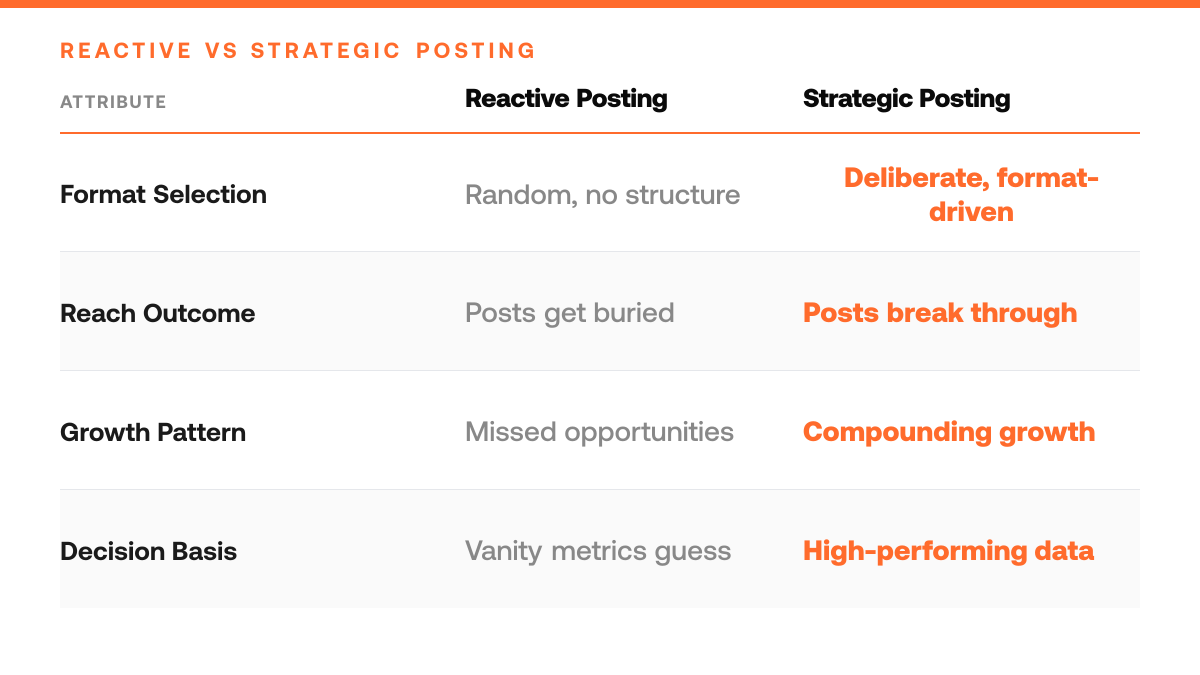
Reactive vs. Strategic Post Approach
| Approach | Format Selection | Audience Alignment | Growth Result |
|---|---|---|---|
| Reactive (Most Creators) | Whatever comes to mind, thread, single line, retweet | Misses audience readiness stage and content pillar | Posts get buried; inconsistent reach |
| Strategic (High Performers) | Rotate formats matched to pillar and audience mood | Aligns format to follower journey stage | Transforms scrolling into active participation and follows |
Mistake: Mixing formats without a deliberate testing strategy
Jumping between threads, carousels, single tweets, and video without tracking which format drives replies, retweets, and follower growth leaves you guessing. Pick one format, post it consistently over several weeks, measure performance against your baseline, then rotate to the next format. This discipline reveals which format your specific audience actually engages with.
Mistake: Abandoning format consistency after one or two posts
A single strong post doesn't prove a format works for your niche, algorithm variance and audience timing matter. Commit to testing each format across multiple posts before declaring it ineffective. Creators who stick with format discipline long enough to gather real data outperform those who chase novelty every week.
Frequently Asked Questions
How long does it take to see results from testing new Twitter post formats?
Results typically emerge within a few weeks of consistent posting with a new format. Track engagement metrics, likes, retweets, replies, on each post to identify patterns. The key is testing one format at a time across multiple posts so you gather enough data to spot genuine trends rather than anomalies. Patience and consistent measurement beat guessing.
Can I adapt these formats to different niches, or are they niche-specific?
These formats are adaptable across niches because they're based on underlying audience psychology, curiosity, relatability, and value, rather than topic-specific tactics. A thread format works in finance, fitness, and writing. The content changes; the structure that drives engagement remains consistent. Customize the examples and language to your niche, but the format skeleton transfers.
What metrics should I track to measure which formats actually work for my audience?
Focus on engagement rate (likes, retweets, replies relative to impressions), click-through rate if you link externally, and follower growth tied to specific post types. Don't chase vanity metrics alone, a format that attracts your ideal audience matters more than raw impressions. Track which formats drive meaningful conversations and conversions, not just visibility.
Start your 7-day trial
Grow on X without sounding like everyone else. The right tool learns from your top posts and the leading voices in your niche, then drafts content in your voice. You edit, approve, and ship.
Start free trialSources
Read next
- X Original Content Rewards: what changed and how to qualify in 2026. - X is shutting down Creator Revenue Sharing after September 7 and replacing it with Original Content Rewards. The new 500,000-impression threshold, qualified-view rules, final payout dates, and what existing creators need to do next.
- Do AI images hurt your reach on X? I tested it on my last 100 posts. - I ran a small experiment: more images on my posts, many of them AI art. The data from 100 posts: AI illustrations and other decorative images cut reach by 48% on generic posts and 65% on one-liners - while real proof images (payout screenshots, charts, records) gained 78%. The full numbers, the clean split, and the ClimbX feature this experiment killed.