Every blog post you publish sits on your website doing one job: attracting readers from search. But that same piece of writing contains material that could work across multiple platforms, each reaching different audiences, at different times, in different formats. A single 2,000-word article can become dozens of social posts, thread starters, quote graphics, and audience-building moments if you know how to extract and reshape the core ideas.
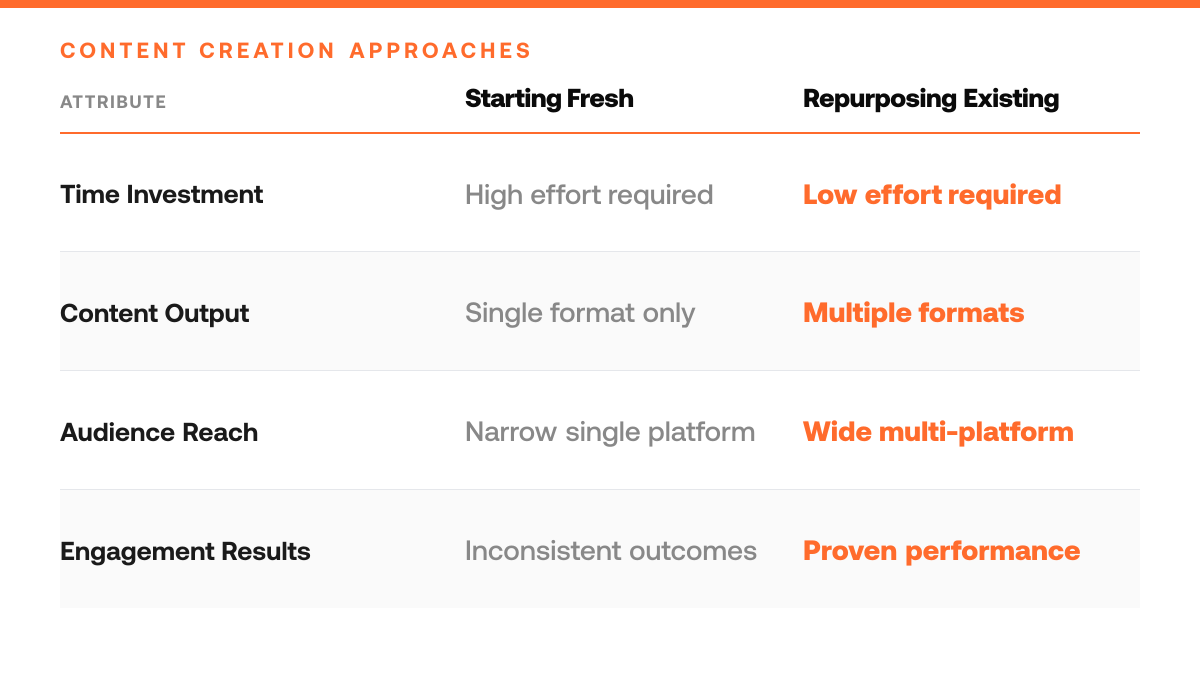
The challenge most solo creators face is that repurposing feels like extra work on top of an already full plate. In reality, content repurposing is a proven way to maximize the return on every piece you write. Rather than starting from scratch each time you want to post, you're mining existing material for angles, quotes, and insights that already resonate with your voice and your audience.[4] For a deeper look, see 7 Twitter Post Formats That Outperform Your Niche. For a deeper look, see How to Repurpose Twitter Threads Into Blog Posts (5 Formats).
This article walks through five specific formats you can repurpose from a single blog post, each one designed to drive engagement and build your following on X without requiring you to reinvent your writing process. You'll see exactly how to adapt your existing content so it lands with the right audience, at the right moment, in the format that works best. Most creators repurpose the same posts across platforms and wonder why engagement tanks, ClimbX scans your highest-performing formats and hooks against outlier posts in your niche, then surfaces the exact angles that move your audience to engagement on X.
TL;DR
- The 5 core formats for repurposing blog content on X are threads, quote posts, carousel posts, video clips, and infographics, each optimized for different audience behaviors and engagement patterns.
- Threads break long-form ideas into scannable chains, while quote posts highlight key insights; carousels, video clips, and infographics appeal to visual learners and drive higher impression rates.
- Most creators pick one format and stick with it, the real growth comes from testing all five to discover which resonates with your specific audience and maximizes reach.[1]
Understanding Content Repurposing for X
What Is Content Repurposing?
Content repurposing is the strategic practice of transforming one piece of core content into multiple formats and channels to extend reach and engagement without starting from scratch. Rather than creating entirely new material for each platform, you take the insights, data points, and narratives already embedded in a blog post and adapt them into tweets, threads, infographics, video scripts, and other formats that match how different audiences consume information. This approach multiplies the value of your research and writing effort, allowing a single blog post to fuel weeks of social content on X.[3]
Why Repurposing Matters for Solo Creators
As a solo creator building an audience on X, your time is your scarcest resource. Blog posts naturally contain multiple angles, data points, and narratives that fit different social formats and audience consumption patterns, but only if you extract and reshape them intentionally. Repurposing lets you maintain a consistent posting cadence without burning out, while ensuring your best ideas reach followers in the formats they actually engage with. This consistency builds momentum toward follower growth and monetization without the guesswork of creating content in isolation.[3]
The Broader Content Strategy Landscape
Modern audience building rewards creators who meet their followers across multiple touchpoints and formats. A single blog post represents a significant investment in research, writing, and SEO optimization, yet many solo creators publish it once and move on, leaving untapped potential. By systematically repurposing that content into X-native formats, you amplify impressions, increase the likelihood of viral moments, and create multiple entry points for new followers to discover your expertise. This layered approach transforms a one-time publishing effort into a sustained growth engine.
How This Works in Practice
Example 1: The Solo Creator Maximizing Reach Across Formats
Picture a solo creator who publishes a blog post on personal branding strategy. Rather than hoping the post drives traffic, they systematically repurpose it across X in five distinct formats over the following week. On Day 1, they extract the core thesis and post it as a thread, breaking the argument into 5-7 tweets that build on each other, each designed to stop scrolls and spark replies. On Day 2, they pull a provocative quote from the post and frame it as a standalone quote post, adding their own take to invite debate. By Day 3, they've turned the post's key steps into a carousel, visuals with minimal text, optimized for mobile viewing and saves. Day 4 brings a short video clip where they summarize the main idea in under 60 seconds, capturing viewers who prefer audio-visual content. Finally, on Day 5, they design a simple infographic that visualizes the post's framework, making it shareable and memorable. Each format reaches different audience segments: the thread attracts engaged readers, the quote post catches skimmers, the carousel appeals to visual learners, the video reaches busy professionals, and the infographic spreads among design-conscious followers. Within two weeks, the original blog post has generated dozens of new followers, hundreds of additional impressions, and multiple conversation threads, all from one core piece of content.
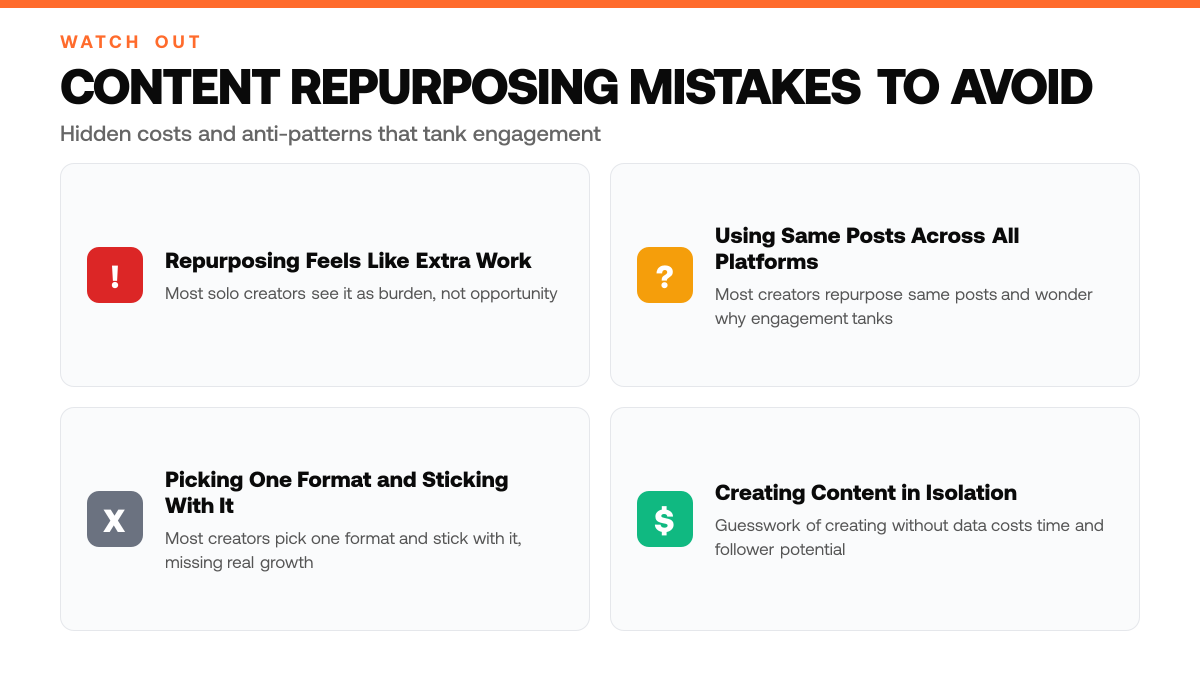
Common Repurposing Mistakes vs. Strategic Approach
| Mistake | Strategic Approach |
|---|---|
| Repurposing same posts across all platforms identically | Extract different angles and insights tailored to each platform's audience behavior |
| Creating entirely new content for each social post | Mine existing blog material for quotes, data points, and narratives already resonating with your voice |
| Picking one format and repeating it indefinitely | Test all five formats to discover which resonates with your specific audience and maximizes reach |
| Publishing blog post once and moving on | Systematically repurpose into X-native formats to create multiple entry points for new followers |
Example 2: The Solopreneur Building Authority Through Consistent Repurposing
Consider a solopreneur who publishes a detailed how-to blog post on their area of expertise. They recognize that posting the link once won't move the needle, so they adopt a repurposing rhythm: every blog post becomes a thread, a quote post, a carousel, a video, and an infographic, each tailored to a different engagement goal. The thread drives deep engagement from followers who want substance. The quote post captures attention from casual browsers. The carousel gets saved and shared by people building reference libraries. The video reaches new audiences through the algorithm's preference for video content. The infographic becomes their most-shared asset, spreading their ideas beyond their immediate network. Over the course of a month, this solopreneur notices their follower count climbing, their reply rate improving, and their most engaged followers becoming repeat engagers. The repurposing strategy also creates a content flywheel: each format generates insights about what resonates, informing the next blog post topic. Rather than guessing what works, they're building a data-backed understanding of their audience's preferences across different content types.
Why Format Diversity Compounds Reach
Both examples illustrate the same principle: a single blog post is a starting point, not an endpoint. By translating it into five distinct formats, you're not duplicating effort, you're multiplying your chances of connecting with different segments of your audience. Each format serves a different purpose: threads drive conversation, quote posts catch momentum, carousels encourage saves, videos leverage algorithmic preference, and infographics spread organically. The result is a content ecosystem where one idea reaches far more people, in far more ways, than a single post ever could.
Blog Repurposing Checklist
- Extract the core insight or data point from your original blog post before converting it into any X format.
- Identify which claims in your post are most likely to drive engagement on X based on your audience's past interactions.
- Pull direct quotes or statistics from your blog that work as standalone hooks for X threads or posts.
- List the actionable takeaways from your blog content that translate into carousel or thread-friendly steps.
Common Mistakes to Avoid
Mistake: Copying blog text verbatim into X posts without editing for platform constraints
X's fast-moving feed and character limits demand brevity and scannability that long-form blog prose lacks. Pasting entire paragraphs kills engagement because followers scroll past walls of text. Instead, extract the core insight from your blog post, distill it to one clear takeaway, and rewrite it in conversational, punchy language that fits X's native tone. Break dense concepts into short sentences or use line breaks for readability.[2]
When to Use Each Repurposing Format
| Format | Best For | Audience Behavior |
|---|---|---|
| Threads | Breaking long-form ideas into scannable chains | Readers who prefer step-by-step explanations and detailed narratives |
| Quote Posts | Highlighting key insights and memorable takeaways | Audiences seeking quick, shareable wisdom and validation |
| Carousels | Visual learners and multi-step concepts | Followers who engage more with image-based content |
| Video Clips | Demonstrating ideas and building personality connection | Audiences consuming content on mobile with sound off or on |
| Infographics | Data-heavy insights and visual summarization | Visual learners seeking impression-driven content with high shareability |
Mistake: Repurposing the same format across all five platforms instead of matching each platform's content norms
A blog post works as a blog post; a thread works as a thread. Ignoring platform-specific norms, like X's preference for opinionated takes and quick replies versus LinkedIn's professional depth, wastes the original content's reach. Audit how your audience behaves on each platform, then adapt your message structure: threads on X, carousels on Instagram, short clips on TikTok. Format fit directly correlates with algorithmic visibility and follower growth.[2]
Mistake: Treating repurposing as a one-time task rather than a systematic workflow
Lazy repurposing happens when you manually adapt content once, then move on. This approach leaves engagement on the table because you miss secondary angles, seasonal hooks, and follow-up conversations. Build a repeatable system: identify 3 - 5 distinct angles from each blog post, schedule them across platforms over weeks, and monitor which versions resonate most. Systematic repurposing compounds your content's value and reveals what your audience actually wants to hear.[2]
Frequently Asked Questions
Why is repurposing different from recycling the same post multiple times?
Repurposing means intentionally adapting your blog content to fit each platform's format, audience expectations, and native behavior. Recycling just copies the same text across channels, which ignores how X users engage with threads, polls, and visual hooks versus how blog readers consume long-form text. Effective repurposing requires rethinking your core idea for each format, a blog's detailed breakdown becomes an X thread with numbered steps, a quote becomes a standalone post with context, and data becomes a poll. This intentional adaptation is what drives engagement and growth instead of flat performance.
What parts of repurposing can tools automate?
Tools can handle format conversion, performance analysis, and draft generation, freeing you to focus on strategy and audience growth. Automation handles identifying which of your past posts performed best, analyzing competitor content in your niche, and generating post drafts in your voice. This removes the manual work of transcribing, reformatting, and brainstorming, so you spend time on what matters: refining messaging, building relationships, and scaling your influence rather than getting stuck in repetitive content tasks.
How do I know which blog topics are worth repurposing for X?
Start with your highest-traffic or highest-engagement blog posts, those already proved valuable to your audience. Then check which themes get the most saves, shares, or comments on X from accounts in your niche. Repurpose topics that solve a problem, teach a skill, or challenge an assumption, since these tend to spark conversation and sharing on X. Avoid repurposing evergreen announcements or low-stakes content unless they tie to a timely trend or personal story that adds context.
Start your 7-day trial
Grow on X without sounding like everyone else. The right tool learns from your top posts and the leading voices in your niche, then drafts content in your voice. You edit, approve, and ship.
Start free trialSources
Read next
- X Algorithm Labels Explained: How Visibility Filtering Works - X can label accounts and posts before deciding where they may appear. See the real DoNotAmplify, SpamHighRecall, abuse, NSFW, and post-level labels in X’s open-source algorithm.
- AI Content Quality: How to Improve AI Social Media Posts - A practical quality-control workflow for better AI social media content: improve the prompt, ground the draft, edit for voice, and learn from real audience response.