AI can produce a polished social post in seconds. That does not mean the post is accurate, useful, distinctive, or worth publishing. The gap between fluent text and good content is where most AI writing workflows break.
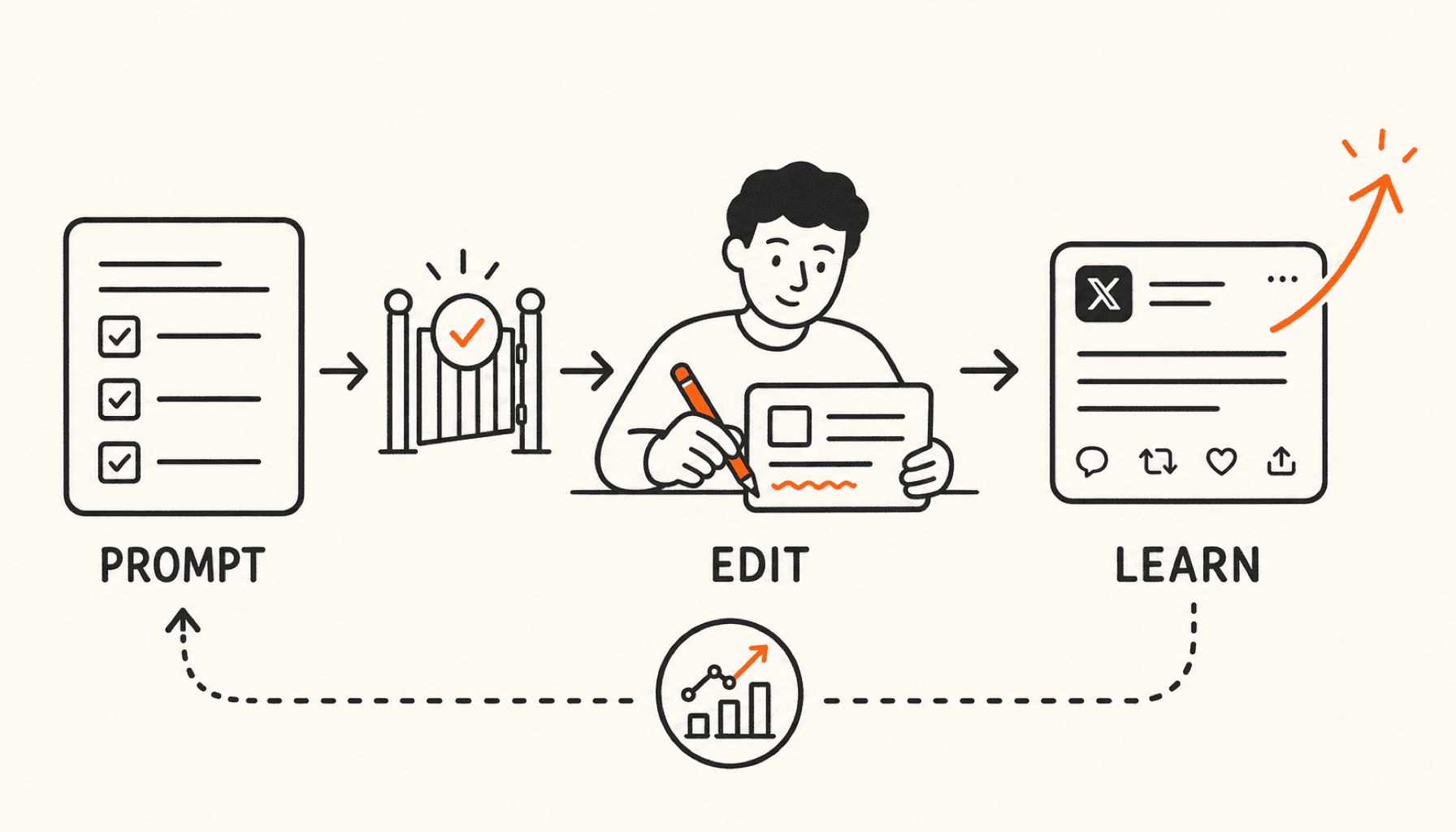
Better output begins before generation and continues after publication. You need a real source for the idea, a prompt with clear boundaries, a human edit, and a feedback loop grounded in what your audience actually responds to. Skip any layer and the system gets faster at producing content without getting better at communicating.
The short answer
High-quality AI content passes four tests: the idea is relevant, the prompt is explicit, the draft is true and sounds like its author, and the published result teaches the next draft something. Prompt quality controls the request. Editorial judgment controls the post. Audience evidence improves the system over time.
Why polished AI content still performs badly
Language models are excellent at producing plausible language. When the request is vague, plausibility pushes the answer toward familiar claims, predictable hooks, symmetrical lists, and conclusions that sound correct without saying much. The result is easy to read and easy to forget.
Social content has an additional constraint: quality depends on the relationship between the post and a specific audience. A useful explanation for a first-time founder can feel obvious to an experienced operator. A technical argument can be strong and still fail if the people who see it followed you for a different subject.
This is why “write a viral post about AI” is not merely a weak prompt. It is missing the evidence needed to make a good editorial decision. The model does not know which tension your audience cares about, what you have already repeated, or which claim you can support from experience.
The four layers of AI content quality
1. Source quality: is there a real idea underneath the draft?
Start with material the model can develop without inventing authority. Useful sources include a customer question, a decision you made, an experiment, a product constraint, a conversation, a result, or a pattern visible in your audience. Even a simple opinion gets stronger when you can name the observation that produced it.
Separate inspiration from evidence. A strong post from another creator can reveal a useful format or tension, but it does not make their experience yours. Borrow the mechanism, such as a comparison or a surprising tradeoff, while supplying your own point and support.
For a repeatable way to find, assess, and document sources before drafting, use this source-first social media research workflow. It separates topic discovery from evidence so an interesting angle cannot quietly become an unsupported factual claim.
2. Prompt quality: does the model know the job and its boundaries?
A useful prompt names the audience, purpose, source material, output shape, and claims the model must not invent. It also separates instructions from reference material so quoted text, customer language, or web research cannot quietly become new directions.
Before running an important template at scale, an AI prompt quality checker can help expose missing structure, context, grounding, trust, privacy, and security constraints. AIQualityHQ performs those checks in the browser, which makes it a practical preflight step for a reusable writing prompt. A strong score does not prove the resulting post will be interesting, but it reduces avoidable ambiguity in the request.
A stronger social-content prompt
“Using only the source notes below, propose three distinct X post angles for early-stage founders. Each angle should create a useful tension or question. Do not invent personal experience, customer results, numbers, or current events. Explain what makes each angle relevant before drafting. Keep the final draft under 220 words and mark any claim that needs verification.”
3. Editorial quality: would you put your name on every sentence?
The first draft is a proposal, not a finished post. Check whether the opening earns attention without exaggerating. Replace broad advice with the specific decision, example, or consequence. Remove phrases you would never say. Delete any ending that merely repeats the opening with more confidence.
Verify factual claims against primary sources. Watch especially for first-person language. Models can write “I learned,” “my customers,” or “we discovered” because those phrases fit the genre, even when the source includes no such experience. Publishing that wording turns a style shortcut into a false claim.
4. Outcome quality: did the right people respond in the right way?
Quality does not end at publish. Compare the post with your own baseline and with its intended job. A question should attract relevant answers. An educational post should produce saves, profile visits, or follow-up questions. A product post should create qualified curiosity, not only broad impressions.
One result should not become a universal rule. Look for repeated signals across topics, formats, and audience segments. The goal is not to make every future post resemble one winner. It is to learn which combinations of idea, structure, and voice consistently earn attention from the people you want to reach.
A practical quality-control workflow
- Capture the source. Save the note, question, screenshot, result, conversation, or observed pattern before asking for copy.
- Define the job. Decide who should care and whether the post should explain, challenge, invite replies, or introduce the product.
- Validate the prompt. Check its role, context, boundaries, output requirements, privacy, and grounding before using it repeatedly.
- Generate alternatives. Ask for different angles or structures rather than ten rewrites of the same premise.
- Edit for truth and voice. Choose the point, verify it, restore your vocabulary, and remove generated filler.
- Publish and learn. Measure the response against the purpose and feed durable patterns into future drafting.
The pre-publish AI content quality checklist
- The post begins with a real source, observation, or defensible opinion.
- The intended audience and purpose are clear.
- Names, dates, numbers, quotations, and current claims are verified.
- No personal experience, result, or customer story was invented.
- The opening creates interest without making a promise the post cannot support.
- At least one detail makes the post difficult to publish under somebody else’s name.
- The structure fits the idea instead of forcing every post into the same template.
- The final wording sounds natural when read aloud.
- The call to action fits the relationship with the reader.
- You know which audience signal will determine whether the post worked.
Prompt quality and content quality solve different problems
Prompt validation makes an instruction more complete and predictable. It can catch a missing output format, weak grounding, unsafe data handling, or contradictory directions. That is valuable, especially when a team reuses the same template hundreds of times.
Content quality requires another layer of evidence. Which topics are fresh for your audience? Which formats fit your voice? What have you repeated recently? Which posts outperformed the normal reach of comparable creators? What did you change before publishing, and did the edited version work?
This is the layer ClimbX focuses on. It studies your writing and performance, finds unusual winners from relevant accounts, turns those patterns into draft options, and learns from what you edit and publish. The prompt still matters. The advantage is that it operates inside a wider loop of audience evidence rather than treating generation as the finish line.
For a deeper explanation of that loop, read how ClimbX uses outlier posts as training data. If preserving a recognizable voice is the main challenge, the guide to using AI for personal branding without sounding generic covers the editing process in more detail.
Frequently asked questions
What does AI content quality mean?
AI content quality is the degree to which generated content is accurate, specific, relevant to its audience, recognizable in the author’s voice, and useful for the intended outcome. Clean grammar alone is not enough.
How can I improve AI-generated social media posts?
Start with a real observation or source, define the audience and purpose, make the prompt explicit, generate several angles, and edit the chosen draft for truth and voice. After publishing, use audience response and performance data to improve the next batch.
Is a prompt checker enough to guarantee good AI content?
No. A prompt checker can expose missing structure, context, privacy controls, and safety constraints. It cannot decide whether an idea is worth sharing, whether it fits your audience, or whether the final wording sounds like you.
Should I publish the first AI draft?
Usually not. Treat the first draft as material for an edit. Verify every factual claim, remove invented experience, replace generic language, and make sure you would defend the post in a real conversation.
How do I measure AI content quality after publishing?
Measure the response that matches the post’s purpose. Useful signals include relevant replies, profile visits, saves, qualified conversations, follows from the right audience, and performance against your normal baseline.
Build a loop, not a content machine
The best AI writing system does not remove the human from publishing. It removes the repetitive work around finding options, checking constraints, and remembering what has already worked. You still choose the idea, make the claim honest, and take responsibility for the result.
When prompt checks, editorial judgment, and audience learning work together, AI content becomes more useful without becoming more generic. That is the standard worth optimizing for: not the most drafts, but more posts that deserve your name.
Turn better inputs into posts your audience cares about.
ClimbX combines your voice, relevant outlier patterns, and performance feedback to generate stronger X drafts. You choose the idea, make the edit, and control what gets published.
Read next
- How to Research Social Media Content Without Spreading Bad Information - A practical source-first research workflow for social posts: find useful ideas, evaluate evidence, use AI without inventing claims, and publish content you can defend.
- How to Use AI for Personal Branding Without Sounding Like AI - Use AI to research, organize, and draft personal-brand content without losing your voice, judgment, or credibility.
- Outliers as training data: how ClimbX learns what works at your size. - Why we draft from posts that broke out for accounts 2 to 5x your size, how the cohort data refreshes, and how the learning loop tightens with every draft you ship - all framed by what the X algorithm actually rewards.
Sources
- AIQualityHQ prompt quality tools - the browser-based prompt checker and quality dimensions referenced in the prompt-validation section