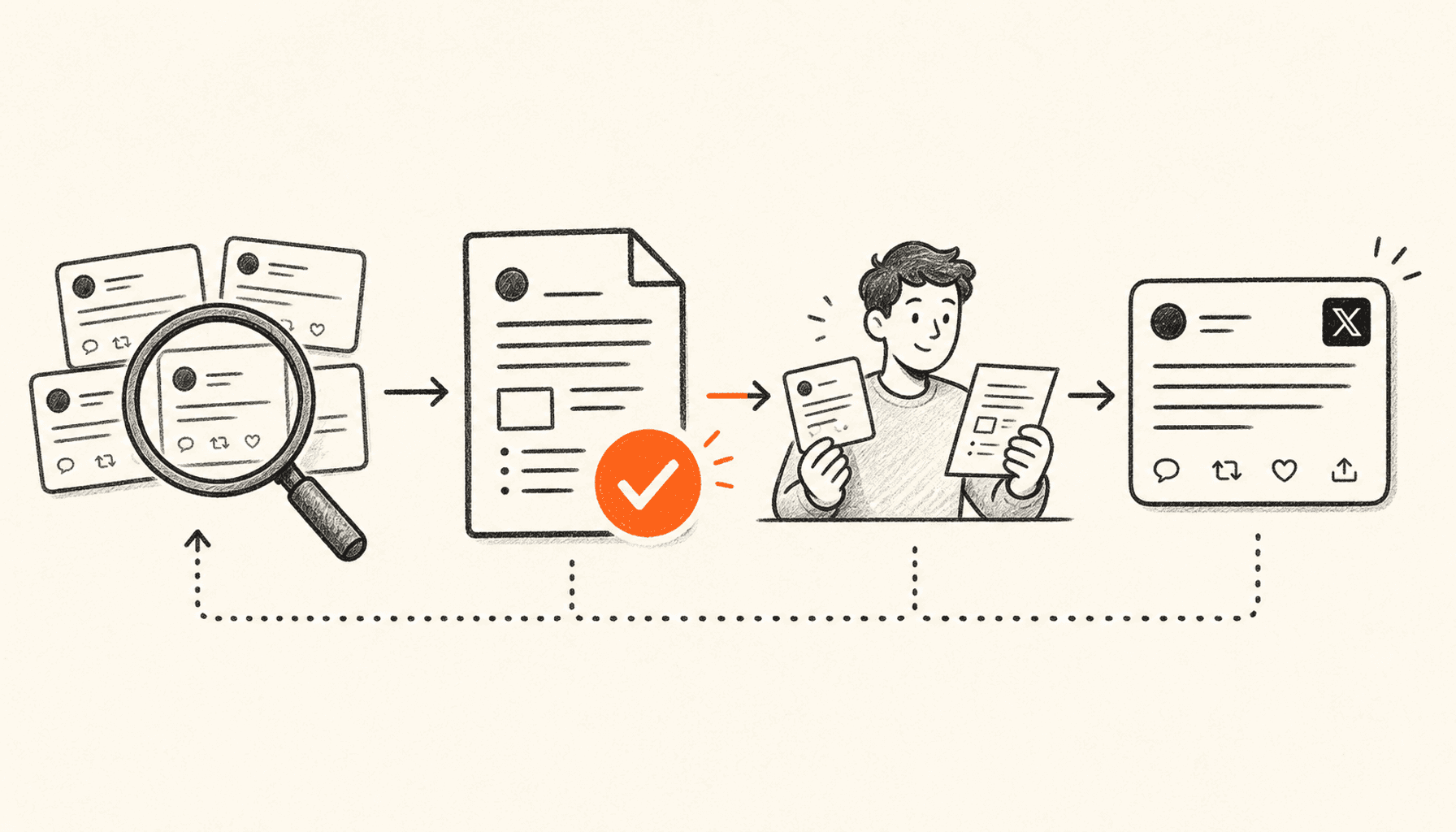
A social post can be concise without being careless. The research does not need to appear in full on the screen, but it should exist behind every factual claim. That distinction is becoming more important as AI makes polished drafts cheaper and current-sounding mistakes easier to publish.
The solution is not to turn every post into an academic paper. It is to separate four jobs that content teams often collapse into one prompt: discovering a useful question, understanding the source, verifying the claim, and translating the result for a specific audience.
The short answer
Research social content by building a small evidence packet before you draft. Write down the question, the claim, the best available source, the date checked, and what remains uncertain. Let AI organize and transform that packet, but never let the draft become the evidence for itself.
Why social media research goes wrong
Most weak research workflows begin with a format instead of a question. Someone asks for “five surprising statistics,” “a contrarian thread,” or “today's biggest story.” The system is rewarded for filling the shape, so a plausible claim can survive even when the source is old, circular, or absent.
Feeds introduce a second failure mode: repetition looks like confirmation. Ten posts can repeat the same unsupported number because they all copied one another. Search results can do the same when many pages summarize a single press release without adding independent reporting.
Finally, creators often mix fact, inference, and opinion inside one sentence. “The company changed its pricing” is a checkable fact. “The change is designed to push small customers out” is an inference. “I would not accept that tradeoff” is an opinion. Each can belong in a strong post, but readers should not be asked to treat all three as equally proven.
Four different research jobs need four different tools
Discover the question
Find the recurring language people use, the objections they repeat, and the gaps between what they search for and what existing pages explain.
Understand the material
Read enough of the original source to see its structure, limitations, and context instead of extracting one convenient sentence.
Verify the claim
Match the evidence to the precision and risk of the statement you plan to publish. Current and consequential claims require stronger support.
Translate it for the audience
Add your experience, explanation, or judgment without changing what the evidence actually establishes.
An SEO workflow can help with discovery and coverage. For example, BriefIQ combines keyword research, content briefs, grading, and Search Console data. That can reveal the questions a complete article should answer. It does not make every proposed claim true; keyword evidence describes demand, while source evidence supports the answer.
Regional reporting serves a different job. A local-language publication such as News Today Malayalam can surface Kerala stories, terminology, and local context that an English-only search may miss. For sensitive or fast-moving news, trace important details to official notices and corroborate them with other reporting before compressing the story into a post.
Comprehension tools help when the source is long or structurally difficult. Omphalis is designed to clean and structure articles, documents, podcasts, and videos while preserving the moments a reader marks. That is useful for returning to the actual argument instead of relying on a detached summary. The underlying document still carries the authority; the tool helps you work through it.
Specialist databases are valuable when a broad search hides the underlying system. AsbestosTrusts.org organizes information about U.S. asbestos bankruptcy trusts and their status. A resource like that can guide a researcher toward the relevant trust and records. Because health and compensation claims are high stakes, any publishable conclusion should still be checked against the trust's documents, court records, and qualified professional guidance.
A tool can be useful without being the final authority.
Use discovery tools to find questions, reading tools to understand material, and databases to locate records. Cite the most direct source available for the actual claim. This single rule prevents a large share of confident but weak content.
The source-first workflow, step by step
Write the audience question first
Replace a broad topic such as “AI marketing” with the question a real reader is trying to answer: “How can a founder use AI for daily posts without fabricating experience?” A precise question makes irrelevant research easier to reject.
Define the claim before collecting proof
Write the strongest sentence you may want to publish. Then label it as fact, inference, opinion, or personal experience. This prevents research from turning into an open-ended hunt for material that merely feels interesting.
Build a source ladder
Start with direct documentation, data, filings, transcripts, or your own records. Add specialist and local reporting for context. Use aggregators, summaries, and social posts to discover leads, not as automatic substitutes for the original evidence.
Save a minimal evidence packet
Keep the source URL, title, publisher, publication or update date, access date, exact supporting section, and one sentence about limitations. A screenshot can preserve a changing page, but save the URL and context as well.
Ask AI to transform, not testify
Give the model the evidence packet and ask for angles, counterarguments, or clearer explanations. Tell it to mark unsupported claims and avoid adding facts. If it proposes a new number, quotation, or current event, send that claim back through verification.
Run a claim-level edit
Highlight names, numbers, dates, causal claims, superlatives, and words such as “always,” “proves,” or “the reason.” Check each one. Then make the distinction between evidence and interpretation visible in the wording.
Publish with an update path
Current facts expire. Record when the source was checked and keep the research packet attached to the content idea. If the post later becomes a durable article, you can update the evidence instead of reconstructing the research from memory.
A compact research note you can reuse
Audience question:
Candidate claim:
Claim type: fact / inference / opinion / experience
Best direct source:
Supporting passage or record:
Published or updated:
Checked:
What this source does not establish:
Safe wording:
The “does not establish” line is the most valuable part. It makes uncertainty explicit before the copy becomes persuasive. It also gives an AI drafter a boundary it can follow.
Match research depth to risk
A post about your preferred keyboard shortcut does not need the same process as a post about election rules, medical exposure, legal compensation, or investment returns. Increase the quality and number of sources as the possible harm from being wrong increases.
For low-risk educational content, one direct source and your own clear example may be enough. For current news, confirm the event date rather than relying on the article date. For high-stakes topics, use official records, independent corroboration, careful scope, and professional review where appropriate. Sometimes the responsible editorial decision is not to compress the claim into a social post at all.
Turn research into original content
Reliable research does not require bland writing. The evidence is the floor, not the personality. Originality comes from the question you chose, the comparison you noticed, the experience you can honestly add, and the implication you are willing to defend.
This is also why copying the format of an outlier is safer than copying its authority. You can learn from a strong opening, a useful contrast, or a compact explanation while replacing the underlying claim with evidence from your own work. Read more about how ClimbX separates outlier patterns from source material.
If the final draft came from AI, use the AI content quality checklist before publishing. When a post starts earning search impressions, the X and Google Search Console workflow can help decide whether the researched idea deserves a durable page on your site.
Frequently asked questions
How do you research content for social media?
Start with one audience question, define the exact claim you may publish, gather sources suited to that claim, save the supporting evidence, and separate verified facts from your interpretation. Draft only after that evidence packet exists.
Can AI research social media posts for me?
AI can help discover angles, organize notes, compare sources, and propose drafts. It should not be treated as the source of a current fact. Open the underlying material, verify the claim, and keep a record of what supports it.
What makes a source trustworthy?
Trust depends on the claim. Prefer direct records and first-party documentation for precise facts, strong local reporting for regional context, specialist databases for discovery, and multiple independent sources when a claim is disputed or consequential.
How many sources does a social post need?
There is no useful universal number. A personal observation may need only your own record. A current factual claim may need one authoritative primary source plus corroboration. A sensitive medical, legal, financial, or political claim deserves more evidence and careful wording.
Should every social media post include external links?
No. The research should make the post reliable whether or not every source appears in the final copy. Include a link when it helps readers verify, learn more, or act; otherwise keep the source in your internal notes.
Turn trustworthy research into stronger X posts.
ClimbX helps you find useful patterns, generate distinct angles, preserve your voice, and learn from what your audience responds to. You keep control of the sources, claims, and final edit.
Read next
- AI Content Quality: How to Improve AI Social Media Posts - A practical quality-control workflow for better AI social media content: improve the prompt, ground the draft, edit for voice, and learn from real audience response.
- X Posts in Google Search Console: The New SEO Opportunity - Google Search Console can now track the queries, impressions, clicks, CTR, and position of your X posts. Here is how creators can turn social posts into a measurable SEO and AI-search research loop.
- How to Use AI for Personal Branding Without Sounding Like AI - Use AI to research, organize, and draft personal-brand content without losing your voice, judgment, or credibility.
Sources
- BriefIQ - SEO research, brief, content-grading, and Search Console workflow example
- News Today Malayalam - regional and local-language reporting example
- Omphalis - structured reading and source-comprehension workflow example
- AsbestosTrusts.org - specialist database and high-stakes verification example