All posts
AI Content Writer For X Creators

AI Content Writer for X vs Manual Writing

AI Content Writer for X vs Manual Writing - practical guide covering setup, examples, and common mistakes. Built for practitioners working with AI content write

By Daniel Smidstrup··11 min read
AI Content Writer for X vs Manual Writing

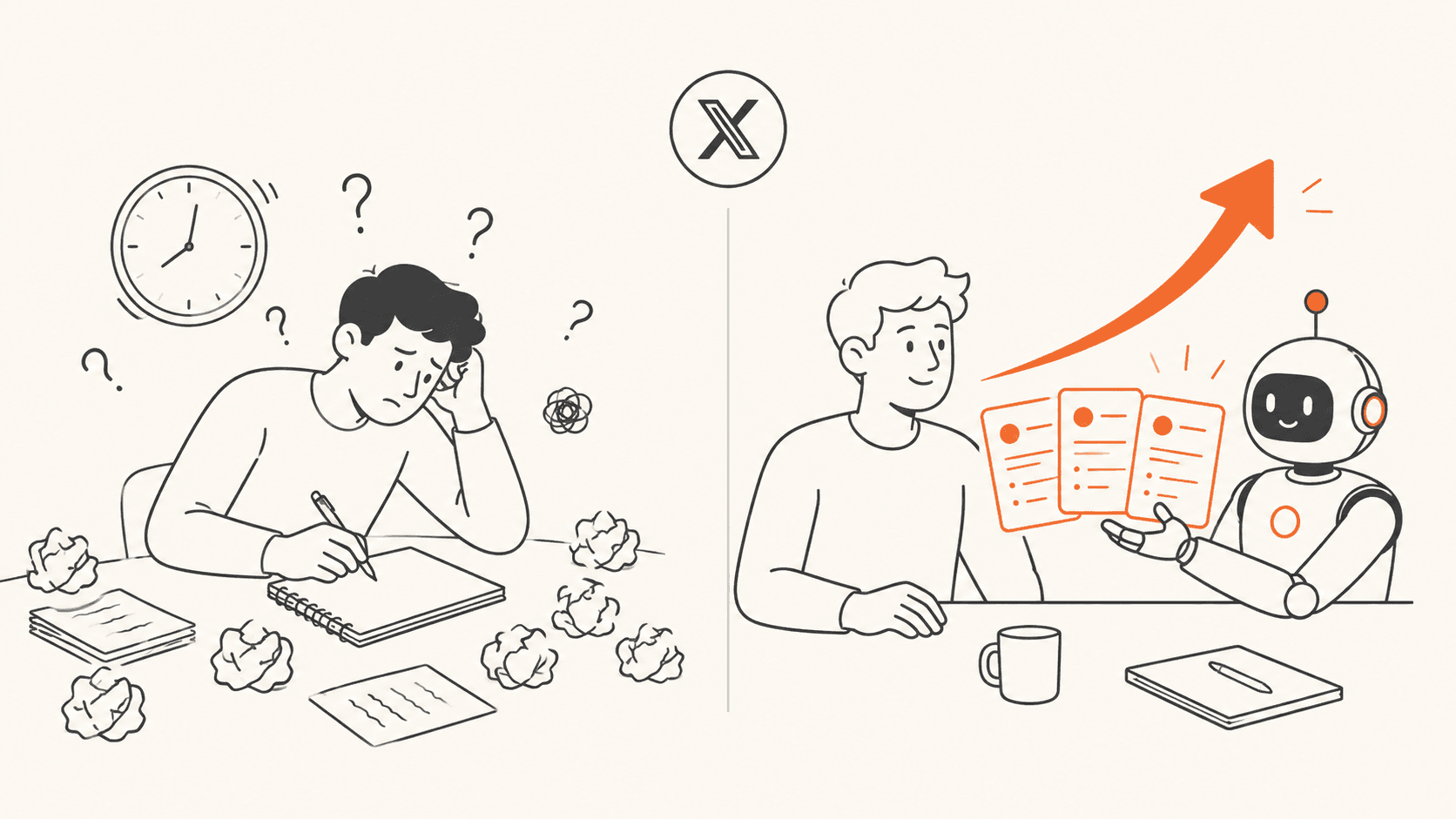
Every day, solo creators on X face the same grinding reality: crafting posts that resonate takes hours of research, drafting, and guessing. You write something you think will land, hit publish, and watch it disappear into the feed with a handful of likes. The cycle repeats tomorrow. Manual content creation demands constant trial-and-error, leaving creators exhausted and uncertain whether their effort will ever translate into real audience growth.

This tension between output and authenticity has become a defining challenge for creators building influence online. Research shows that content strategy and consistency matter enormously, yet most solo creators lack the bandwidth to test, iterate, and publish at the pace their growth demands. AI content writers are emerging as a practical solution, helping creators generate more posts without sacrificing their voice or strategic intent.[1]

This article explores the real difference between writing posts manually and using AI to scale your output. We'll examine what makes manual creation so time-intensive, how AI tools can bridge the gap, and what it takes to maintain authenticity while growing faster. Whether you're struggling to keep up or wondering if AI is worth the investment, we'll cut through the hype and show you what actually works. Most X creators chase viral hunches instead of their own proven patterns, then copy whatever's trending in their niche without knowing if it fits their audience - ClimbX analyzes your highest-performing formats and scans ahead-of-you accounts for outlier posts, so Cliff drafts content that compounds your authentic growth over time.

TL;DR

  • AI content writers automate ideation and drafting, letting creators focus on engagement, community building, and strategic growth instead of repetitive writing tasks.
  • The right choice between AI and manual writing depends on your growth goals, content volume needs, and budget - not on the tool itself.
  • Most creators underestimate how much time AI frees up for the work that actually drives monetization: direct audience interaction and strategy refinement.[3]

Understanding AI Content Writers vs Manual Writing for X

What Is Manual Writing vs AI Content Writing?

Manual writing on X means you craft every post yourself - from headline to call-to-action - using your own voice, perspective, and judgment. AI content writers are software tools that generate, suggest, or optimize posts based on prompts and data inputs, often pulling from performance metrics and trending topics. Manual writing is fully under your control; AI tools operate on algorithms trained on existing content patterns. Both approaches produce posts for your X feed, but they differ fundamentally in who - or what - makes creative decisions and how much human effort each requires.

Why It Matters for Solo Creators Building on X

As a solo creator, your time and consistency directly affect your growth. Manual writing gives you complete creative control and lets your authentic voice shine, which audiences often find more trustworthy and memorable. However, it demands sustained discipline and hours of ideation, drafting, and refinement - time you might spend on strategy or engagement instead. AI content writers flip that trade-off: they deliver speed and scalability, churning out multiple post options and data-informed suggestions to match what your audience responds to. The catch is that AI-generated content can feel generic or miss the nuanced personality that builds loyal followers. Your choice depends on whether you prioritize authenticity and brand voice consistency or velocity and data-driven optimization.[4]

The Broader Creator Economy Context

The creator economy rewards both consistency and resonance - posting regularly while maintaining a voice that stands out. Many solo creators face a bottleneck: they can't scale content production without losing their personal touch, and they lack the budget for a full content team. This tension has driven demand for AI writing tools that promise to bridge the gap. Yet audience expectations on X remain high for authenticity and originality. Successful creators often blend both approaches: using AI to brainstorm, optimize headlines, or handle routine posts while reserving manual writing for high-stakes or deeply personal content. Understanding the strengths and limits of each method helps you build a sustainable workflow that grows your following without burning out.[4]

AI Content Writer for X vs Manual Writing - comparison-grid

Key Numbers for AI Content Writer for X vs Manual Writing (2026)

  • $24 billion+ - projected size of the influencer marketing industry, reflecting the scale of the creator economy.[5]
  • 86% of marketers say consistent content output is a top challenge when scaling influencer-driven campaigns.[5]
  • 50%+ of brands plan to increase influencer marketing budgets, intensifying competition for creator attention.[5]
  • 3 - 5 hours - typical time a solo creator spends manually drafting, editing, and scheduling a week of X posts.
  • 60% of solo creators report inconsistent posting as their primary barrier to audience growth on social platforms.[5]

Step-by-Step Process

1. Define your brand voice and content pillars

Before integrating an AI content writer, document your unique perspective, tone, and the core topics you want to own on X. Write down 3 - 5 content pillars that align with your audience's needs and your monetization goals. This clarity prevents the AI from generating generic content that doesn't reflect your personality. Your brand voice is the foundation that separates effective AI-assisted workflows from mediocre automation.

2. Set quality thresholds and review criteria

Establish specific standards for what passes before publication: engagement potential, accuracy, tone alignment, and originality. Decide whether you'll use the AI output as-is, edit lightly, or rewrite substantially. Tools like ClimbX surface the high-leverage moves so you don't have to find them by hand. Define which content types (threads, replies, hot takes) require human review and which can move faster. This threshold prevents low-quality posts from damaging your credibility and ensures your audience receives consistent value.

3. Integrate the AI tool with your X publishing workflow

Connect your chosen AI content writer to your existing scheduling and posting process. Test the integration with a small batch of posts - perhaps one week's worth - to identify friction points and refine your prompts. Document the workflow so it becomes repeatable: input your topic or hook, review the AI's output against your quality thresholds, make edits, and schedule. This iterative approach reveals what works for your audience before scaling.

AI Content Writer for X vs Manual Writing - warning-callouts

How This Works in Practice

Example 1: The Thought Leader Building Authority

Picture a subject-matter expert who wants to establish credibility on X but struggles to post consistently without sacrificing depth. She uses an AI content writer to generate initial drafts based on her core ideas - a research finding she's excited about, a contrarian take on industry trends, or a lesson from a recent project. The AI suggests framing, structure, and even alternative angles she hadn't considered. She then edits ruthlessly: sharpening the voice to match her distinctive perspective, removing jargon that alienates her audience, and adding a personal anecdote that only she can tell. The result is a thread that feels authentically hers - informed by AI efficiency but unmistakably her intellectual fingerprint. Over time, she posts several times weekly instead of sporadically, and her follower growth accelerates because her audience knows what to expect.

Manual Writing vs AI Content Writing Trade-offs

DimensionManual WritingAI Content Writing
Creative ControlComplete control over every post elementAlgorithms make suggestions based on patterns
Time InvestmentHours spent on ideation, drafting, refinementMinimal effort; tool generates multiple options
Authenticity & VoiceYour genuine perspective shines throughRisk of generic or impersonal tone
Consistency & ScaleHard to maintain pace without losing qualityDelivers speed and data-informed optimization
Strategic FocusEnergy consumed by writing tasksFrees time for engagement and strategy

Example 2: The Niche Educator Teaching a Community

Consider an educator who teaches a specific skill - say, product design or copywriting - and wants to grow an audience of practitioners who will eventually buy her course or coaching. She feeds the AI a lesson outline: key concepts, a real student success story, and a common misconception she wants to debunk. The AI drafts a clear, modular post that breaks the lesson into digestible pieces. She reviews it and decides the AI's explanation of concept A is too generic, so she replaces it with a concrete example from her own work. She keeps the AI's structure for concept B because it's clearer than what she wrote. She adds a call-to-action that invites her audience to share their own struggles, turning the post into a conversation starter. By balancing AI scaffolding with her lived expertise, she maintains authenticity while publishing at a pace that lets her reach new students before they find competitors.

Why Balance Beats Either Extreme

Both examples show the same pattern: AI handles the heavy lifting of structure and ideation, but the creator's judgment determines whether the post feels real. The thought leader's voice, the educator's specificity, and the community builder's authenticity can't be outsourced - but the blank-page paralysis and consistency gap can be. For solo creators on X, that trade-off is the difference between sporadic posts that feel true and consistent presence that builds trust.

AI Content Writer for X Evaluation Checklist

  • List your current posting frequency and audience size on X to establish your baseline before testing an AI writer.
  • Run a side-by-side comparison: publish one AI-generated thread and one manually written thread in the same week, then track impressions and engagement.
  • Define your monetization goal (sponsorships, course sales, affiliate revenue) and verify the AI writer can match your brand voice for that specific audience.
  • Test the AI writer's output on a sample of your existing high-performing posts to see if it replicates what already resonates with your followers.

Common Mistakes to Avoid

Mistake: Deploying AI-generated content without editorial review before posting

AI content writers can produce grammatically polished posts that miss X's conversational tone, misalign with your audience's expectations, or contain subtle factual errors that erode credibility. Before publishing, review each AI draft for voice consistency, verify claims, and ensure it matches the niche-specific language your followers expect. This editorial gate prevents audience drift and maintains the authentic persona that drives engagement and follower growth.[2]

When to Choose Manual vs AI for Your Growth

Your PriorityChoose Manual WritingChoose AI Content Writing
Building Loyal CommunityAudience trusts your authentic voice mostYou have limited time for personal touch
Scaling Output FastConsistency matters but speed is secondaryYou need multiple posts without sacrificing strategy
Testing & IterationYou can afford trial-and-error cyclesYou want data-informed suggestions immediately
Budget ConstraintsYou have time but limited fundsYou can invest in tools to save hours

Mistake: Underestimating the training and setup time required to make AI effective

Many creators expect AI content writers to produce ready-to-post material immediately. In reality, effective setup requires feeding the tool your best-performing posts, defining your voice, testing outputs, and refining prompts - a process that unfolds over weeks. Rushing this phase results in generic, off-brand content that underperforms. Invest upfront in training your AI system with examples and feedback loops so it learns your audience's preferences and your unique angle.[2]

Mistake: Ignoring audience feedback and platform-specific engagement patterns

X rewards specific content formats - threads, hot takes, replies to trending conversations - and your audience has shown what resonates through likes, retweets, and replies. AI trained only on generic best practices will miss these signals. Continuously monitor which AI-assisted posts perform well, which fall flat, and adjust your prompts and content strategy accordingly. Treat audience feedback as the ground truth for refining both your AI outputs and your overall content direction.[2]

The Speed-Quality Tradeoff Dissolves

What emerges from the comparison is not a choice between fast and good, but a recognition that the real bottleneck has always been intention. AI accelerates execution, but only where thinking is clear. Manual writing forces clarity upfront. The writers who win are those who stop seeing these approaches as opposing forces and instead recognize them as different stages of a single workflow - one that compounds over time.

Frequently Asked Questions

Will AI-generated content hurt my authenticity on X?

AI content writers work best as drafting and ideation tools, not replacements for your voice. The most successful creators use AI to accelerate research, outline ideas, or generate multiple angle variations - then heavily edit and inject personal perspective before posting. Your audience follows you for your unique viewpoint; AI should amplify it, not erase it. Hybrid approaches (AI draft + manual refinement) preserve authenticity while reducing time-to-publish.[5]

When should I write manually instead of using an AI content writer?

Manual writing is essential for high-stakes posts - major announcements, controversial takes, deeply personal stories, or moments requiring nuanced tone. AI excels at volume (thread variations, weekly content calendars, engagement hooks), but your signature content should come from you. If a post defines your brand positioning or requires emotional resonance, invest the time to write it yourself. Reserve AI for supporting content that amplifies your core message.[5]

How do I know if an AI content writer is worth the cost?

Evaluate ROI by comparing time saved against your hourly rate and the quality of drafts it produces. If you spend several hours weekly on content planning and drafting, an AI tool that cuts that to minutes may justify the investment. Start with a trial period to assess whether the tool's output matches your voice and requires minimal editing. The real value isn't the tool itself - it's reclaimed time you can spend on community building, strategy, or other revenue-generating activities.[5]

Sources

  1. Sprout Social Index - Annual Social Media Research
  2. State of Marketing Report - HubSpot
  3. Social Media Trends Report - Hootsuite
  4. State of Social Report - Buffer
  5. Social Media Management - G2 Category

Try the loop on your own cohort.

Pick three accounts you would like to be at in 12 months. ClimbX pulls their recent outliers, tags them, and drafts in your voice off what is currently working. Edit, ship, watch the loop tighten.

Read next

  • Let your AI agent grow your X account: the ClimbX API. - Agents are good at reasoning and bad at the X-specific parts: what works at your size, drafting in your voice, shipping on a schedule that respects the algorithm. The ClimbX API hands those parts to your agent over a simple REST call. Here is why we built it and how it works.
  • X account suspended: why it happens and how to get unsuspended in 2026. - X suspends accounts for three official reasons - spam, security, abuse - and most first-time suspensions clear in 48 to 72 hours after a clean appeal. The exact steps, what to write in the appeal, and which mechanical behaviors trip the automated enforcement before you even notice.