Most creators on X publish consistently but have no clear picture of what actually drives their growth. You post daily, watch your follower count inch up, but struggle to connect the dots between specific content and real engagement gains. This guessing game costs time, energy, and missed opportunities to scale your audience when you don't know which posts move the needle.
Content scheduling and analytics tools promise to solve this problem, but many creators find themselves overwhelmed by dashboards that track vanity metrics without revealing what truly matters: which content actually builds an audience and drives monetization potential. The core challenge for solo creators is separating signal from noise, understanding not just how many people saw your post, but whether that post converted viewers into loyal followers and engagement.[4] This connects directly to Best Hypefury Alternatives for X (2026) - the two compound each other.
This review examines whether Hypefury delivers measurable value for creators focused on follower growth, impressions, and monetization. We'll walk through how the platform works, what analytics it provides, where it excels, and whether the investment makes sense for your specific growth goals and content strategy. Most X creators chase viral content formulas they've never tested against their own audience's actual response patterns, ClimbX analyzes your last 100 posts to isolate your highest-performing hooks and formats, then pairs that signal with outlier posts from ahead-of-you accounts to draft new content that compounds growth over time. The data behind Hypefury Pricing 2026: What You'll tells the same story.
TL;DR
- Hypefury connects content performance data to audience growth outcomes, helping solo creators move beyond vanity metrics to actionable insights.
- The platform delivers real value for solopreneurs actively building on X who need data-driven guidance on what content actually drives follower growth.
- Most creators fail because they optimize for engagement alone, Hypefury bridges that gap by showing which posts convert attention into audience expansion.[2]
Understanding Hypefury and Creator Growth Tools
What Is Hypefury?
Hypefury is a platform designed to streamline the content creation workflow for X creators. It combines content scheduling, performance analytics, and audience insights into a single interface, allowing creators to plan, publish, and measure their posts without switching between multiple tools. Rather than manually tracking engagement metrics or guessing which content resonates, creators can access real-time data on impressions, engagement, and follower growth directly within the platform. This consolidation reduces friction in the creation-to-analysis loop.[6]
Why Hypefury Matters for Solo Creators
For solopreneurs and independent creators, time is the scarcest resource. Hypefury addresses a specific pain point: the hours spent guessing about content strategy instead of actually creating high-impact posts. By automating scheduling and surfacing performance data upfront, the platform shifts creator focus from administrative overhead to strategic content decisions. This is particularly valuable for creators monetizing their influence, where consistent growth and engagement directly impact revenue. Understanding what the tool automates, and what still requires human judgment, is essential to evaluating whether it fits your workflow.
The Broader Creator Tool Landscape
Creator tools have evolved from simple schedulers into comprehensive growth platforms. Hypefury sits within this ecosystem as a specialized solution for X creators seeking integrated scheduling and analytics. The platform's value proposition hinges on reducing guesswork and increasing intentional creation time. However, it is not a replacement for original thinking, audience relationship-building, or content ideation, those remain the creator's responsibility. Evaluating Hypefury requires clarity on what it does automate and what it does not, so you can determine whether it aligns with your growth strategy and content workflow.
Step-by-Step Process
1. Connect Your X Account and Define Content Goals
Start by linking your X account to Hypefury and establishing clear content objectives. Determine what you want to achieve, whether that's growing followers, increasing impressions, or building authority in your niche. This foundational step ensures the platform's tools align with your audience-building strategy and helps you configure scheduling preferences that match your posting cadence and audience timezone.[3]
2. Build and Organize Your Content Calendar
Use Hypefury's calendar feature to plan and schedule your content in advance. Map out your posting strategy across multiple days or weeks, ensuring consistency and strategic spacing of your tweets. A structured calendar prevents last-minute scrambling and allows you to maintain a steady presence on X, which is essential for sustained audience growth and engagement.[3]
3. Monitor Your Analytics Dashboard for Engagement Patterns
Review Hypefury's analytics dashboard regularly to track how your content performs. Look for patterns in which tweets generate the most engagement, which topics resonate with your audience, and when your followers are most active. The platform guides you through interpreting this data, making it easier to spot what works without needing a data science background.[3]
4. Iterate Your Strategy Based on Performance Insights
Use the metrics you've gathered to refine your content approach. If certain themes, formats, or posting times consistently outperform others, double down on them. Adjust your calendar, experiment with new angles on high-performing topics, and gradually eliminate what isn't working. This continuous iteration cycle is how creators move from guessing to data-driven growth.[3]
How This Works in Practice
Example 1: The SaaS Solopreneur's Growth Loop
Picture a solopreneur building a SaaS tool who posts educational threads on X but struggles to know which topics actually move the needle. She's posting sporadically, sometimes twice a day, sometimes not for a week, and has no way to tell if her audience prefers content about product launches, technical deep-dives, or founder lessons. She uses Hypefury to schedule educational threads during peak engagement windows (typically early morning and evening on weekdays) and tracks which topics drive follower growth. Within weeks, the data becomes clear: her audience engages most with threads about common SaaS pitfalls and how she solved them. She doubles down on that angle, scheduling 5 posts a week at optimal times, and watches her follower count climb while she focuses her limited time on building the product itself rather than guessing at content strategy.
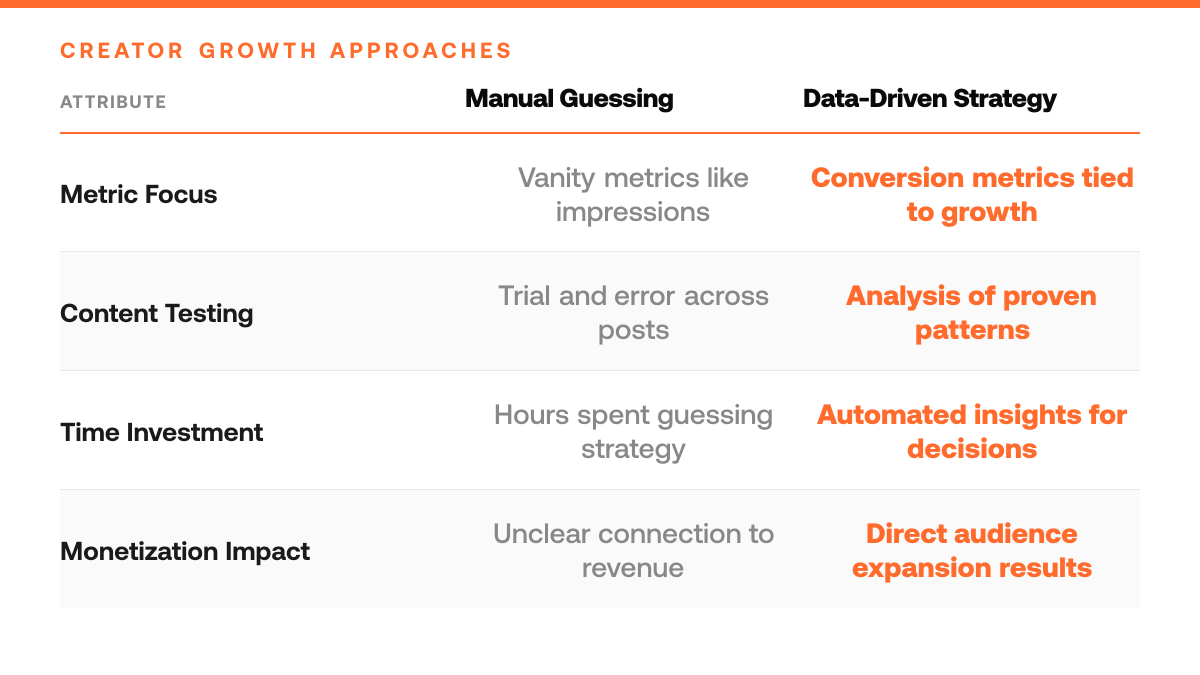
Creator Growth: Guessing vs Data-Driven Strategy
| Approach | Focus | Outcome |
|---|---|---|
| Guessing game | Post daily and watch follower count inch up | Struggle to connect content to real engagement gains |
| Data-driven with Hypefury | Analyze which posts convert viewers into loyal followers | Move beyond vanity metrics to actionable insights |
| Engagement-only optimization | Maximize likes and comments alone | Fail to drive audience expansion |
| Signal-based strategy | Isolate highest-performing hooks and formats | Compound growth over time with tested content |
Example 2: The Creator Monetizing Through Sponsorships
Imagine a creator who's been approached by brands interested in sponsorships but lacks proof of audience quality. Without concrete engagement metrics, she can't confidently pitch her rates or show sponsors why her followers are worth paying for. She leverages Hypefury's analytics to pull detailed engagement rates, audience demographics, and which posts consistently drive meaningful interactions. Armed with this data, she creates a one-page sponsorship deck showing potential brand partners not just her follower count but her average engagement rate and the types of audiences responding to her content. The analytics become her negotiating tool, sponsors see she's not just reaching people, but reaching the right people. She lands 3 brand deals within 2 months, each at rates significantly higher than her initial ask, because the data proves her audience's value.
Why Consistency Compounds
Both examples hinge on the same insight: solopreneurs and creators win when they remove the guesswork from posting and replace it with data-driven rhythm. Hypefury's scheduling and analytics eliminate the friction of manual posting and the anxiety of not knowing what works, freeing mental energy and calendar space for the work that actually builds the business, product development, sponsorship outreach, or audience relationship-building. When posting becomes predictable and measurable, growth stops feeling like luck.
Before You Commit to Hypefury Checklist
- Document your current content strategy and identify which post types drive the most engagement on your X account
- Set a realistic growth timeline for your audience based on your niche, posting frequency, and current follower count
- Commit to a consistent posting schedule you can maintain for at least several weeks while using Hypefury
- Review Hypefury's analytics dashboard features and confirm they align with the performance metrics you need to track
- Plan how you'll use performance data from Hypefury to refine your content strategy each week
Common Mistakes to Avoid
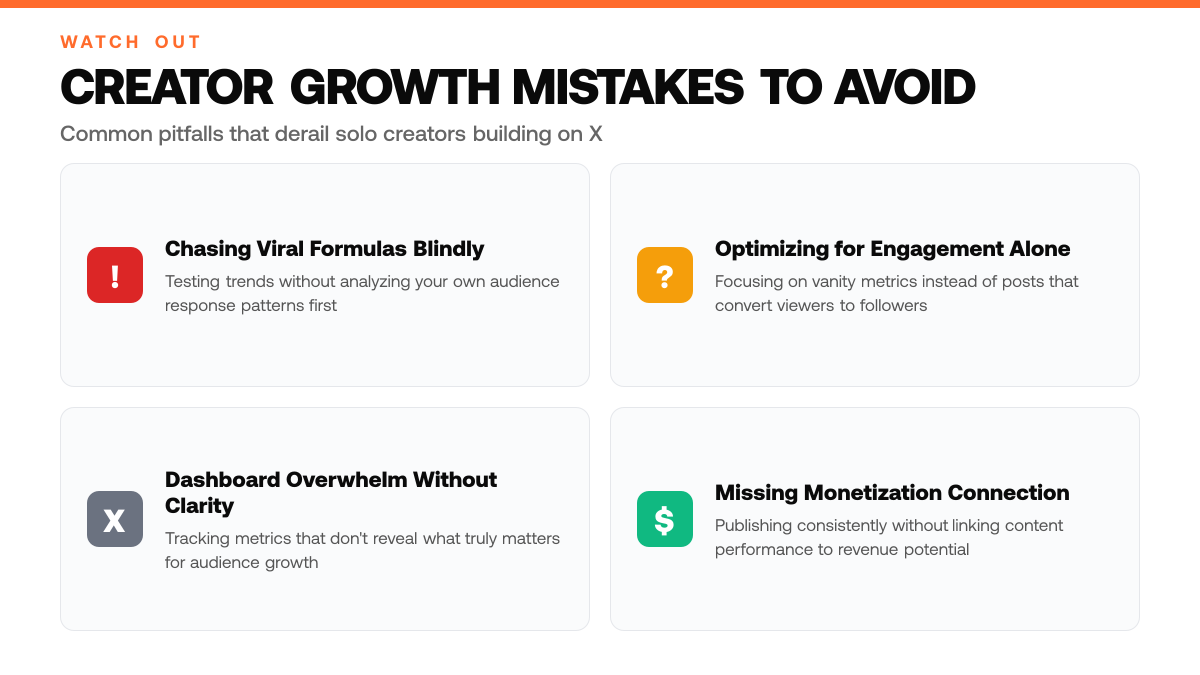
Mistake: Expecting Hypefury to guarantee viral content or follower growth without strategy
Many creators treat Hypefury as a magic tool that will automatically generate viral posts or deliver guaranteed follower spikes. In reality, the platform amplifies a thoughtful content strategy, it doesn't replace one. Without a clear understanding of what resonates with your audience, scheduling more posts won't move the needle. Fix this by defining your core message and audience first, then use Hypefury to distribute and optimize that strategy consistently.[1]
What Hypefury Automates vs What Remains Your Responsibility
| Function | Hypefury Handles | Creator Owns |
|---|---|---|
| Content planning | Schedule posts and surface performance data upfront | Original thinking and content ideation |
| Performance tracking | Real-time data on impressions and follower growth | Audience relationship-building |
| Administrative overhead | Consolidate scheduling and analytics into single interface | Strategic content decisions based on data |
| Guesswork reduction | Connect content performance to audience growth outcomes | Human judgment on what resonates with audience |
Mistake: Setting up Hypefury and ignoring the analytics dashboard
Creators often treat Hypefury as a scheduling tool only, uploading content and moving on without checking performance data. This wastes the platform's core strength, its growth intelligence. You miss insights into what content types drive impressions, which posting times work best, and where engagement gaps exist. Reverse this by checking your analytics dashboard weekly to identify patterns, then adjust your content calendar and posting strategy based on real performance data.[1]
Mistake: Not using Hypefury's content templates and frameworks to test different angles
Solo creators often stick to one content format or topic angle because they lack a system for rapid experimentation. Hypefury's built-in templates and scheduling features enable you to test multiple versions of the same idea across different days, but many users don't leverage this. Start by picking one core idea, then use Hypefury to schedule 3 - 4 variations with different hooks, tones, or angles to see which resonates most with your audience.[1]
Frequently Asked Questions
Is Hypefury right for creators building across multiple platforms?
No. Hypefury is built specifically for X-focused growth and analytics, not for creators managing equal presence across multiple platforms. According to Publora's comparison, Hypefury's strength lies in deep X-specific insights and audience growth strategies rather than multi-platform content distribution. If your monetization and audience-building strategy centers on X as your primary platform, Hypefury delivers focused value. If you're building equally across TikTok, Instagram, YouTube, and X simultaneously, you'll find the platform's toolset narrower than your needs.[5]
What makes Hypefury different from general social media management tools?
Hypefury prioritizes X-specific growth metrics and analytics over broad multi-platform scheduling. Rather than offering a catch-all dashboard for all networks, it concentrates on helping creators understand what content resonates on X, track audience engagement patterns, and optimize posting strategy for that single platform. This focused approach means less feature bloat and more precision for creators whose primary income and audience growth depend on X performance.
Who should actually use Hypefury?
Hypefury is most valuable for solo creators and solopreneurs whose core audience and monetization strategy centers on X. This includes writers building a newsletter subscriber base through X, course creators driving sales through X engagement, consultants using X for lead generation, and content creators monetizing through X's creator fund or sponsorships. If your business model relies on X as the primary growth engine, Hypefury's analytics and growth tools align with your priorities. Creators splitting effort equally across multiple platforms will find it less essential.
Sources
Try the loop on your own cohort.
Pick three accounts you would like to be at in 12 months. ClimbX pulls their recent outliers, tags them, and drafts in your voice off what is currently working. Edit, ship, watch the loop tighten.
Read next
- 5 X Premium Features Worth the Cost (Honest Review) - 5 X Premium Features Worth the Cost (Honest Review). A practical guide to what works, what to skip, and how to get started.
- X Engagement Pods vs Organic Growth: Which Wins? - A practical comparison of engagement pods and genuine audience development, including measurement risks and X platform-rule considerations.
- Is Tweet Hunter Worth It in 2026? An Honest Review - Is Tweet Hunter Worth It in 2026? An Honest Review. A practical guide to what works, what to skip, and how to get started.