You've built a following on X, but every time the algorithm shifts, your reach takes a hit. The followers you've earned can disappear overnight if the platform changes its rules or deprioritizes your content. This vulnerability is the core problem that drives many creators to look beyond social platforms for a more stable connection with their audience.
Email subscribers are different. They represent an owned audience asset that no algorithm can take away from you. Unlike X followers, email gives you a direct line to the people who care about your work, independent of platform changes or visibility fluctuations. This distinction matters because it opens a path to sustainable monetization and audience control. For a deeper look, see From Twitter Followers to First Sale: Revenue Roadmap. For a deeper look, see How to Turn X Drafts Into Published Posts.
This article covers how to convert your X followers into email subscribers, the specific strategies that work, and how building an email list creates a monetization channel that doesn't depend on social platform dynamics or algorithm favor. You'll learn the mechanics of moving your audience from a rented platform to owned ground. Most creators broadcast to Twitter followers who never see their email signup link because the content that grew the account doesn't match what drives conversions, ClimbX analyzes your highest-performing post formats and scans outlier content in your niche to surface the hooks that convert lurkers into subscribers.
TL;DR
- A clear lead magnet paired with a prominent call-to-action in your bio and pinned posts is the fastest path to convert X followers into email subscribers.
- This strategy works because it removes friction, followers see the offer immediately without scrolling, making it easy to take action.
- Most creators fail by burying their CTA deep in replies or using vague language; clarity and visibility are what drive conversions.[3]
Understanding Email Conversion From Social Media
What Is Email Conversion From Social?
Email conversion from social media is the process of turning your Twitter followers into active email subscribers. Unlike social platforms where engagement is often driven by entertainment or quick dopamine hits, email subscribers represent a different psychological contract. When someone joins your email list, they're explicitly opting in to receive value, whether that's insights, updates, or exclusive content delivered directly to their inbox. This shift from passive follower to active subscriber marks a fundamental change in how your audience relates to you. Email subscribers have taken a deliberate action, which means they're more invested in your message and more likely to take action when you ask.[1]
Why Email Subscribers Matter More Than Followers
Followers on Twitter can disappear overnight due to algorithm changes, account suspensions, or shifting platform priorities, you have no direct control over your reach. Email subscribers, by contrast, are an owned audience you can reach directly without relying on any platform's permission. This distinction is crucial for solopreneurs building sustainable income streams. Email subscribers are also more likely to convert into customers, attend your events, or engage with premium offerings because they've already demonstrated commitment by subscribing. The psychology of email is transactional in the best sense: subscribers expect you to deliver real value, not just entertainment, making them a far more valuable asset than a large but passive follower count.[1]
Building a Sustainable Subscriber Growth Strategy
Sustainable email growth starts with permission-based capture and audience segmentation. Rather than trying to convert every follower indiscriminately, successful creators use targeted lead magnets, clear value propositions, and strategic opt-in points to attract the right subscribers. Segmentation, grouping subscribers by interests, engagement level, or behavior, allows you to send relevant content that keeps people engaged and reduces unsubscribes. This approach respects your audience's attention while maximizing the quality of your subscriber list. Creators who invest in permission-based growth and segment their lists see higher open rates, better engagement, and ultimately stronger monetization opportunities than those who chase vanity metrics.[1]
Key Numbers for Email Marketing ROI & Subscriber Value (2026)
- Email marketing delivers $42 ROI for every $1 spent, significantly outperforming paid social and other channels.[3]
- Average email open rate across industries is 21.5%, with engaged subscribers opening at rates 2 - 3x higher.[4]
- Email click-through rates average 2.5%, compared to 0.5 - 1% for social media engagement on most platforms.[3]
- Email subscribers are 5x more likely to convert than passive social followers, justifying list-building effort.[4]
- Segmented email campaigns see 14 - 100% higher open and click rates than non-segmented sends.[3]
Step-by-Step Process
1. Define Your Lead Magnet Offer
Create a specific, valuable offer that solves a problem for your X audience, a checklist, template, guide, or resource that's immediately useful. Make it clear what followers will receive by subscribing. The offer should align with your expertise and the content you share on X, so it feels like a natural next step rather than a random ask. This foundation determines whether people will exchange their email address.
2. Build a Simple Landing Page
Create a dedicated landing page that showcases your lead magnet, explains its value in two to three sentences, and includes an email capture form. Keep the design clean and focused, one headline, one benefit statement, one call-to-action. The page should load quickly and work on mobile devices since most X users browse on phones. This is where the conversion happens, so remove distractions and make the email field the focal point.
3. Promote Your Landing Page on X
Share your landing page link consistently in your X posts, replies, and pinned tweet. Mention the lead magnet benefit directly, don't just drop a link. Use this tactic when sharing related content or answering questions your audience asks. The goal is to make it easy for engaged followers to find and click through. Repetition matters; most followers won't see every post, so promote across multiple tweets over time.
4. Nurture Subscribers and Optimize Results
Send your lead magnet immediately upon signup, then follow with a welcome email sequence that introduces your voice and value. Share exclusive insights, early access to content, or personal stories that deepen the relationship. Track which X posts drive the most signups, which landing page variations perform best, and which email subjects get opened. Use these insights to refine your offer, messaging, and promotion strategy over time.
How This Works in Practice
Example 1: The Niche Guide Creator's Conversion Bridge
Picture a creator in the productivity space who posts regularly on X but struggles to move followers into a dedicated email list. She notices her most-engaged tweets are educational threads that solve a specific problem, say, time-blocking strategies for solopreneurs. Rather than asking followers to "join my newsletter," she creates a free, downloadable guide that expands on one of her viral threads. She pins that guide offer to her profile and weaves it into related tweets over several days, making the guide the natural next step for someone who already trusts her insight. Within weeks, she's built a small but engaged email segment of people who explicitly chose to hear from her. The email list becomes her owned channel, no algorithm changes, no shadow-banning risk, and she can now test what topics convert best by tracking which guide downloads lead to repeat opens.
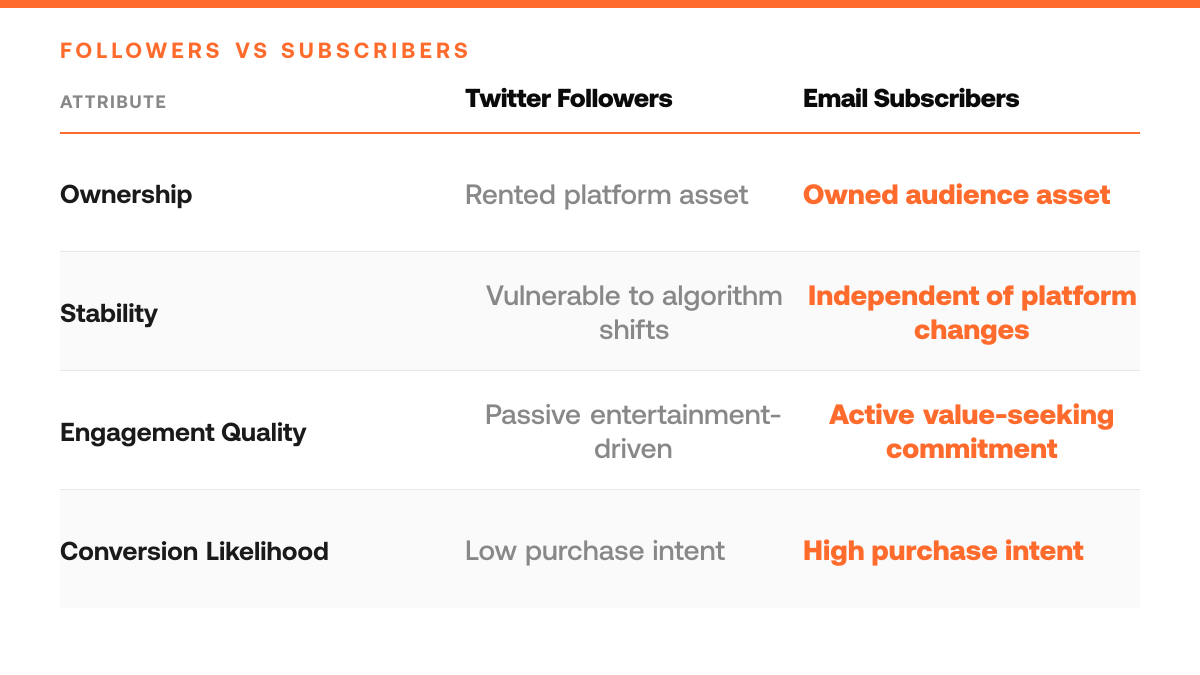
Followers vs Email Subscribers: Key Differences
| Attribute | X Followers | Email Subscribers |
|---|---|---|
| Ownership | Rented platform asset | Owned audience you control |
| Reach Stability | Vulnerable to algorithm shifts and platform changes | Direct access independent of platform dynamics |
| Audience Intent | Passive consumption, entertainment-driven | Active opt-in, explicit value expectation |
| Conversion Likelihood | Lower commitment, less likely to take action | Higher investment, more likely to become customers |
| Monetization Reliability | Dependent on algorithm favor and visibility | Sustainable income stream you can depend on |
Example 2: The Early-Access Strategist's Exclusivity Play
Consider a SaaS founder who wants to launch a new feature but needs genuine user feedback before the public release. She threads her vision on X, building anticipation, then offers early access exclusively to her email subscribers, new and existing. She pins a post that says "reply with your email to get in first" and runs a short, focused campaign over a few days, positioning the early access as a limited opportunity. Followers who care about her product self-select into her email list because they see concrete value: they'll get to use the feature weeks before everyone else. She captures not just email addresses but intent, these subscribers are pre-qualified because they chose to opt in for a specific, tangible benefit. Her email list now doubles as a beta-testing community and a retention lever for future launches.
Why Owned Channels Win
Both examples share a common thread: the email conversion works because it offers something real, a guide, early access, or insider status, rather than a generic newsletter pitch. Creators who lead with value, not urgency, build email lists that stay engaged and respond. The tactic shifts from \"grow followers\" to \"convert followers into subscribers who actually open your mail.\"
Twitter-to-Email Conversion Checklist
- Add a clickable link to your email signup page in your X bio and pin it to your profile header.
- Create a lead magnet (free guide, template, or resource) exclusive to your Twitter audience and promote it in replies to high-engagement posts.
- Include a clear call-to-action at the end of every tweet thread directing followers to join your email list for deeper insights.
- Test different signup incentives (checklists, case studies, early access) and track which ones convert most of your Twitter followers.
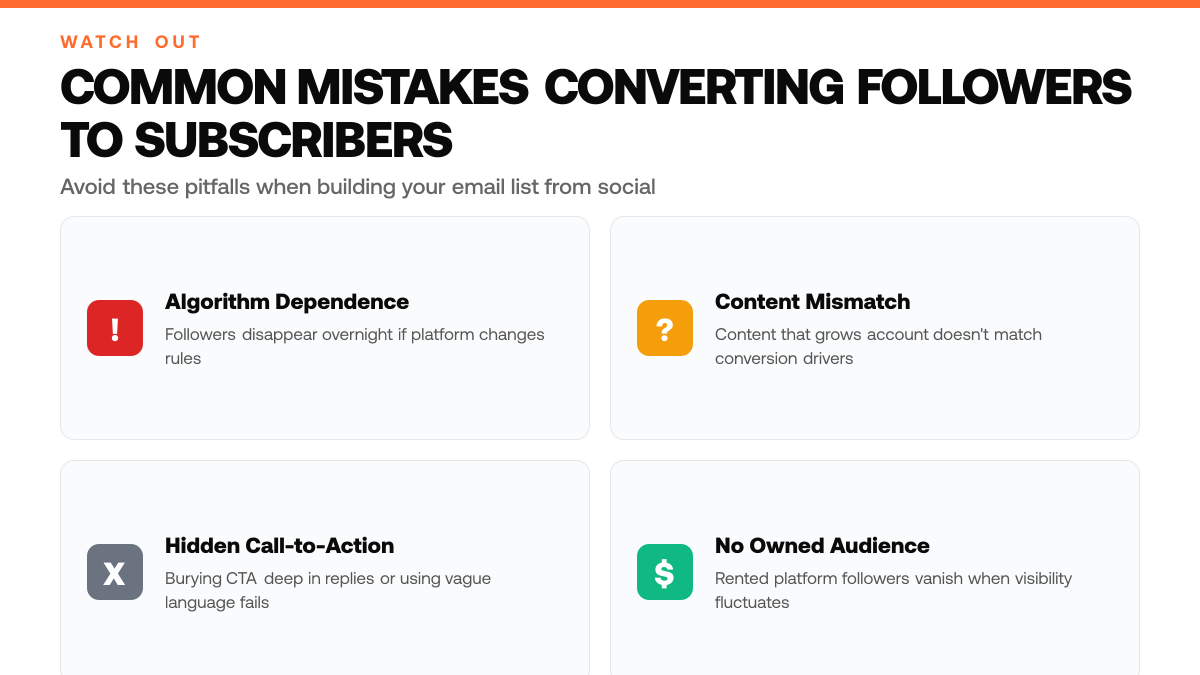
Common Mistakes to Avoid
Mistake: Posting conversion links without a clear value proposition
Solo creators often drop email signup links into tweets without explaining what subscribers actually get, a free guide, weekly tips, exclusive content, or early access. Without clarity, followers don't know why they should hand over their email. Fix this by leading with the benefit: 'Get my free Twitter growth playbook' or 'Join 5,000+ creators getting weekly monetization strategies.' Make the offer explicit in every CTA.[2]
Do's and Don'ts for X-to-Email Conversion
| Strategy | Do | Don't |
|---|---|---|
| Lead Magnet Clarity | Pair clear lead magnet with prominent CTA in bio and pinned posts | Bury CTA deep in replies or use vague language |
| Content Alignment | Match signup content to highest-performing post formats in your niche | Broadcast generic content that doesn't drive conversions |
| Friction Reduction | Make offer immediately visible so followers see it without scrolling | Require multiple steps or unclear navigation to subscribe |
| Audience Segmentation | Group subscribers by interests, engagement, or behavior for relevant content | Send indiscriminate messages to all subscribers equally |
Mistake: Neglecting email list hygiene and engagement
Building a large list means nothing if subscribers don't open or engage with your emails. Poor hygiene, inactive subscribers, unvalidated addresses, or lack of re-engagement campaigns, tanks your sender reputation and deliverability. Clean your list regularly by removing long-term non-openers, validate new signups, and send re-engagement campaigns to dormant subscribers before removing them. A smaller, engaged list converts better than a bloated, dead one.[2]
Mistake: Using weak or vague calls-to-action in your Twitter bio and pins
CTAs like 'Subscribe to my newsletter' or 'Join my list' don't tell followers why they should act now. Weak CTAs create friction and lower conversion. Instead, use specific, benefit-driven language: 'Get my free Twitter monetization guide' or 'Join 3,000+ creators earning from X.' Pin this CTA to your profile and repeat it in high-performing tweets so interested followers know exactly what they're signing up for and why it matters.[2]
Frequently Asked Questions
Why is email ownership critical for creators relying on social media?
Email gives you direct access to your audience independent of platform algorithm changes, account suspensions, or policy shifts. Social-only strategies leave creators vulnerable to platform risk, followers can disappear overnight if a network changes its rules or shuts down. Email also enables compliance with regulations like GDPR and CAN-SPAM, which protect both you and your subscribers legally. Building an owned list is non-negotiable for long-term creator sustainability.[4]
What's the difference between email marketing and social media for audience building?
Social media excels at discovery and reach, algorithms can amplify your content to new audiences quickly. Email, by contrast, deepens relationships with people who already know you and have opted in. Email subscribers are typically more engaged and loyal than social followers, making them more likely to purchase, support, or take action on your offers. The strongest strategy uses both: social to attract, email to convert and retain.[4]
How do I encourage Twitter followers to join my email list?
Offer clear value, a free guide, exclusive insights, early access to content, or a weekly digest followers can't get on social. Place your signup link prominently in your bio, mention it naturally in high-performing tweets, and use a dedicated landing page (not just a form) to explain what subscribers get. Make signup frictionless: ask for email only, not a lengthy form. Test different incentives to see what resonates with your audience.
Start your 7-day trial
Grow on X without sounding like everyone else. The right tool learns from your top posts and the leading voices in your niche, then drafts content in your voice. You edit, approve, and ship.
Start free trialSources
Read next
- Why You Need a Personal Brand in 2026 - A practical look at why personal branding matters in 2026, how it builds trust and distribution, and what founders and professionals should do first.
- How to Use AI for Personal Branding Without Sounding Like AI - Use AI to research, organize, and draft personal-brand content without losing your voice, judgment, or credibility.