The short version
To launch a SaaS on X with no audience, do not post one announcement into an empty feed. Spend 30 days finding your exact customer and joining their conversations. Get a small group of testers and collect honest proof. Post about the problem first. On launch day, share one clear post and a short demo. Message the people who already know you, and be there for support. Keep posting results and objections after. Judge the launch by conversations with real buyers, active trials and paying customers, not likes.
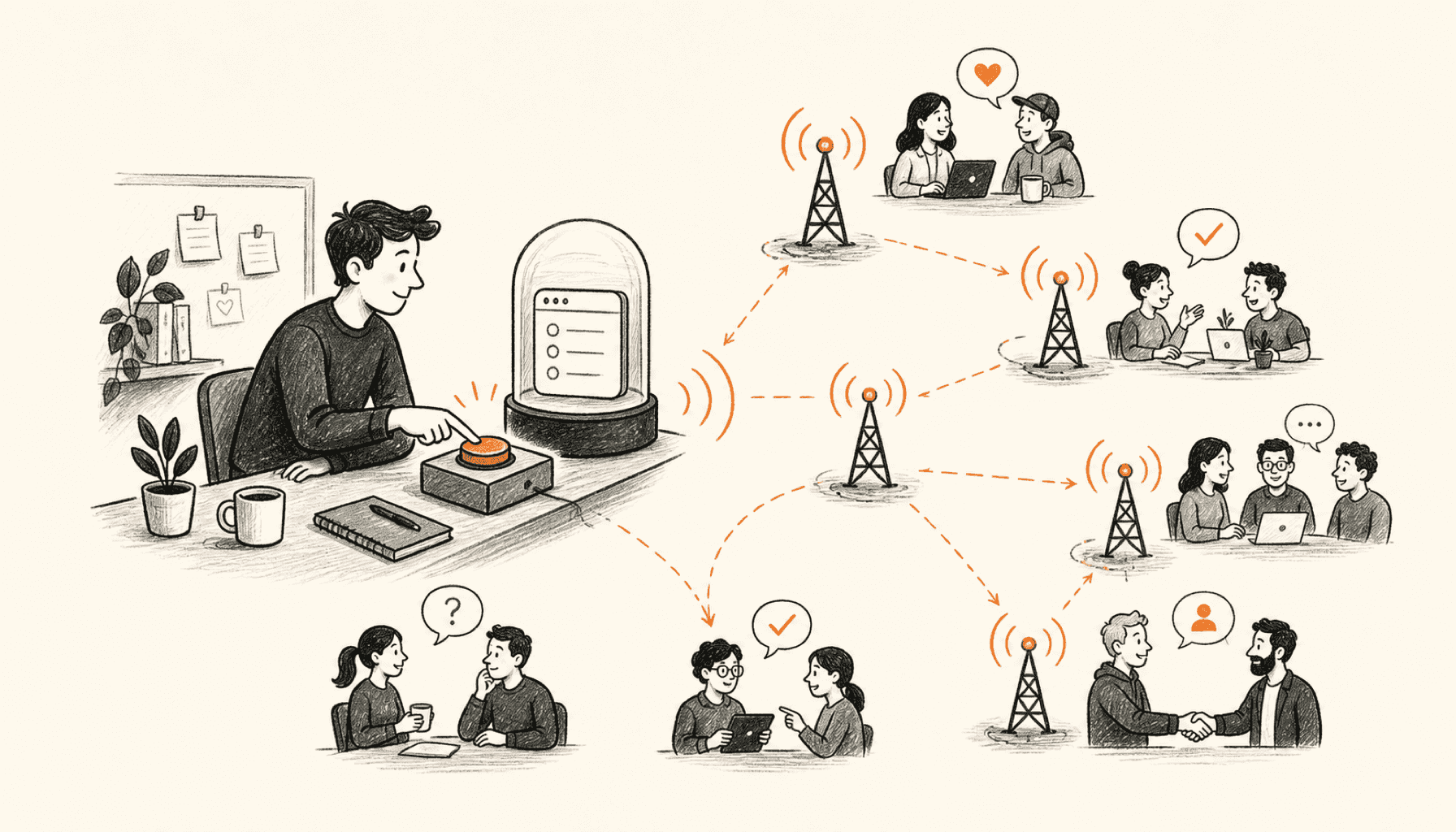
With no audience, launch day cannot create reach you never built. You do not have to wait for thousands of followers either. You get reach from other places: conversations, communities, partners, customers and useful things you share.
Do not aim to “go viral.” Aim for enough of the right attention to learn if the problem, product, message and offer click. A few good users who actually use the product teach you more than a wave of views from people who would never buy.
What changes when you launch with no audience
| Large existing audience | No existing audience |
|---|---|
| Can broadcast to known readers | Must enter existing conversations |
| Recognition exists before the launch | Trust must come from relevance and proof |
| Launch post can create initial traffic | Warm outreach and borrowed distribution create traffic |
| Many reactions, mixed qualification | Fewer reactions, easier manual qualification |
| Optimization often starts at conversion | Optimization starts at customer and problem clarity |
A small account has one advantage. You can see and answer every useful reply. Use that. Your first launch should feel like a few busy weeks talking to customers. It is not a press event.
Before the 30-day plan: define the launch promise
Write one sentence. Name the person, what they do today, what it costs them and the first result they get. If it needs words like revolutionary, all-in-one, powered or productivity, it is probably still too broad.
Launch promise
Then write down the limits. Who should not use it? What does it not do yet? What must the user already have? Honest limits make an early product easier to trust.
Days 1 to 7: build the customer map
- 1
Write the narrow customer hypothesis
Name the role, the company stage, what sets off the need, the current workaround, the pain and the first result they want. - 2
Find 50 relevant accounts
Include possible users, people who do the work, niche teachers, community hosts, tools that fit next to yours, and peers with the right audience. - 3
Create saved searches
Search the words people use for the problem, complaints about competitors, requests for tools, workarounds and moments that start the need. - 4
Fix the profile
Your bio says who you help. Your pinned post shows the problem or product. Your link goes to one page that fits. - 5
Start ten real conversations
Reply with something useful and ask clear questions. Learn how people describe the problem before you talk about the launch.
Use the process in getting your first SaaS customers from X to tell real buyers apart from people who are just curious.
Days 8 to 14: publish the problem before the product
Your first posts should help people see what the problem costs them, why it happens and what they can do about it. Then the product makes sense when it shows up. Your account does not turn into a string of teasers.
| Post | Purpose | Example angle |
|---|---|---|
| Problem observation | Recognition | The workaround that looks free but costs two hours weekly |
| Diagnostic checklist | Usefulness | Five signs the workflow has outgrown a spreadsheet |
| Decision post | Trust | Why the product solves one job instead of becoming all-in-one |
| Market comparison | Education | When manual, service, or software is the right choice |
| Focused question | Research | Which part of the workflow breaks first? |
Do not build fake mystery. Readers should learn something even if they never see the launch. Use the 50 practical founder post ideas to fill gaps while staying on the customer's problem.
Days 15 to 21: recruit proof, not applause
Invite a few people who match your customer guess. Say what task it helps with, how ready the product is, how much effort it takes and what they get. “Looking for beta users” is too broad.
Qualified tester invitation
I am looking for five [specific roles] who currently [painful workflow] at least [frequency].
The product helps with [first result]. It currently does [scope] and does not yet [limitation].
I will personally help set it up in exchange for direct feedback. Reply or DM [specific word] if that matches you.
- Watch them use it the first time, if you can.
- Note the moment they get why it is useful.
- Ask what nearly made them quit.
- Fix what stops people from getting started before you polish the launch.
- Ask permission before using a name, quote, screenshot, or result.
- Charge early when the product delivers a real outcome.
Days 22 to 26: assemble the launch package
One post is easy to miss. Make a few pieces that explain the same product in different ways. Each should make sense alone and point to the same next step.
| Asset | Job | Minimum requirement |
|---|---|---|
| Launch post | Create immediate understanding | Problem, product, audience, proof, CTA |
| Short demo | Show the first useful result | One workflow, readable at mobile size |
| Landing page | Answer buying questions | Outcome, proof, fit, price or next step |
| Pinned post | Convert profile visits | Evergreen explanation and clear link |
| FAQ or objection post | Reduce uncertainty | Honest answers to the top concerns |
| Direct follow-up list | Reach warm contacts | Only people with prior context or clear fit |
Days 27 to 29: prepare distribution without spamming
Tell testers, peers, partners and interested buyers when the launch is coming. Only ask for help when the product really fits their audience. Asking someone in a DM to just repost it rarely gets you much.
- Send testers the final product link and ask them to report broken steps.
- Give partners something useful they can share in their own words.
- Write a personal note to each person who asked to see the product.
- Schedule the follow-up posts, but keep time free for live replies and fixes.
- Check analytics, signup emails, billing, support and onboarding before people arrive.
Day 30: launch with clarity
No-audience SaaS launch post
[Specific audience] still spends [time or cost] on [broken workflow].
Today I am launching [product], which helps them [first useful outcome].
It includes: • [capability tied to the job] • [capability tied to the job] • [proof, demo, or honest limitation]
If you [fit condition], try it here: [link]. I will be here answering every question today.
Stay around. Answer questions with details. Fix broken onboarding. Invite good-fit people to a short demo. Write down objections and update the landing page. This live work after you post is often worth more than another hour on the wording.
The 72 hours after launch
- 1
Follow up with warm contacts
Send the launch to people who told you about the problem or asked for the product. Mention your earlier chat. - 2
Publish proof and objections separately
Turn your best demo moment, question, result and limit into short follow-up posts. - 3
Help every qualified signup activate
Helping early users by hand is research. Notice where they get confused or stuck in setup. - 4
Ask for the commitment
Once the value is clear, ask the user to move to a paid plan. Do not let the beta drag on. - 5
Write the postmortem
Write down where traffic came from, the conversations, active users, sales, objections, what failed and what you will try next.
Metrics that matter for a small launch
| Metric | Why it matters | Do not confuse it with |
|---|---|---|
| Qualified conversations | Shows problem and audience relevance | Reply count |
| Landing-page visits from target users | Shows message and distribution alignment | Total impressions |
| Activated trials | Shows the product reaches first value | Raw signups |
| Paid commitments | Tests willingness to pay | Compliments and waitlist entries |
| Retention or repeated use | Shows the job remains valuable | Launch-day activity |
| Reasons for no | Improves product, audience, and offer | Silence without follow-up |
What if the launch is quiet?
A quiet launch does not mean the product failed. Find the step where people dropped off. Did the right people see it? Did they recognize the problem? Did they get the result? Did they trust the proof? Could they take the next step? Did they start using it?
- The right people did not see it: go back to saved searches, replies, communities, partners and people who know you.
- Views but few clicks: rewrite the problem, fit, proof or CTA.
- Clicks but few signups: make the landing page clearer and less risky.
- Signups but no one uses it: watch users and fix the path to the first result.
- People use it but do not pay: look again at urgency, ongoing value, trust and price.
Keep selling after launch day. A small launch may mostly give you a clearer customer, better proof and a repeatable way to find users. Those make the next release easier.
Frequently asked questions
Can you launch a SaaS on X with no followers?
Yes. Talk with people instead of announcing to them. Make a short list of the right people and join their conversations. Find testers and collect proof. Prepare a few useful launch pieces. You do not need a big audience to reach your first users.
How long should I prepare before launching a SaaS on X?
For many early SaaS launches, 30 focused days is enough. Use the first three weeks to learn how customers talk, meet people, collect proof and get the product ready. Use the last week for launch posts and follow-up. Take longer if the product still needs testing.
What should a SaaS launch post include?
Open with the exact problem. Say what the product does and who it is for. Show it working or show proof. Name the key limits. End with one clear next step. People should get it without any hype.
When is the best time to launch on X?
Launch on a day you can be around for replies, demos, support and fixes. Your audience data may point to a good window. But a ready product and your own time matter more than any perfect day or hour.
Should I offer a launch discount?
Only offer a discount with a clear reason, like thanking early users for the risk or filling a small founder group. Give it an end date. Say what the normal price gets you. Avoid a low price forever, because it is hard to raise later.
What if the launch gets almost no engagement?
Message the people you already talked to. Reuse your best proof in smaller posts. Answer objections. Keep selling after launch day. A quiet launch tells you what to fix. It is not the end of the product.
Build a launch calendar from real customer signals.
ClimbX finds posts that work in your niche and drafts original posts in your voice for you to edit. Schedule your launch posts in order, then see which ones brought the right people.
Read next
- How to Get Your First SaaS Customers From X - Find real buying signals on X, start useful founder conversations, validate the problem, and turn relevant attention into your first paying SaaS customers.
- What to Post on X as a Startup Founder: 50 Practical Ideas - Fifty useful X post ideas for startup and SaaS founders, organized by proof, customer insight, product decisions, lessons, launches, and conversation goals.
- Why Your Build-in-Public Posts Get Likes but No Customers - Diagnose why X followers and build-in-public likes are not producing SaaS customers, then repair the audience, message, proof, offer, and conversion path.
Sources
- LaunchBuff: Launch a SaaS on X without a big following - a practical baseline for realistic follower expectations, build-up, launch-post structure, visuals, and founder presence
- OpenTweet: Twitter for SaaS Founders - a detailed founder baseline for problem-aware content, product-in-context posts, profile conversion, signups, and launch distribution