
The short version
The best X content inspiration tool depends on the evidence you want. ClimbX is the strongest fit for founders who want stage-relevant outliers connected to voice-trained drafting and account learning. Tweet Hunter is stronger for sheer library size and automation. Typefully is better when ideas should stay inside a polished multi-network writing workspace. X Advanced Search is the best free manual option.
Content inspiration should reduce uncertainty without turning another person's post into your template. The best tools reveal a useful signal: a topic customers keep discussing, a post that beat its author's normal baseline, a question your audience repeats, or a format your own account handles well.
A giant library can be useful, but volume is not relevance. This comparison separates research tools from generic AI generators and scores each option by source quality, context, originality safeguards, writing handoff and feedback after publication.
Quick comparison
| Tool | Best for | Main limitation |
|---|---|---|
| ClimbX | Founder-specific outliers and a learning loop | X-only and less library breadth |
| Tweet Hunter | A very large viral-post library | Breadth can overwhelm and automation may be unnecessary |
| Typefully | Personalized ideas inside a writing workspace | Less focused on competitor outlier research |
| X Advanced Search | Free, precise manual research | Requires query skill and manual organization |
| Postwise | Turning supplied ideas into multi-network drafts | Research depth is not the central product |
| Buffer | Multi-network ideas and repurposing | Less specialized for X-native competitive research |
If you are evaluating the complete workflow rather than one feature, see the X growth tool for SaaS founders page for the product, fit and limitations in one place.
How we evaluated content inspiration tools
We did not rank tools by how many posts they can generate. Inspiration happens before generation. A useful product should help you find evidence, understand why it matters, connect it to your own expertise and preserve enough distance that the result is original.
- Source quality: does the idea come from real posts, customer language or your own history?
- Relevance: can you filter by niche, account size, topic or audience?
- Context: can you see the original post and performance context?
- Originality: does the workflow encourage patterns and evidence instead of copying?
- Handoff: can an idea become a draft without losing the source context?
- Learning: does performance improve tomorrow's recommendations?
1. ClimbX: best for SaaS founders building on X
ClimbX surfaces posts that outperformed the author's own baseline and focuses on accounts relevant to the user's niche and stage. That prevents a common research error: treating a celebrity account's ordinary 100,000-impression post as more useful than a smaller founder's genuine breakout.
The selected pattern can move directly into a voice-trained draft, then into scheduling and analytics. Account learnings feed later suggestions. This makes ClimbX strongest when the buyer wants one research-to-publishing loop rather than a standalone archive.
Its limitation is breadth. A researcher who wants millions of searchable examples or several social networks should consider Tweet Hunter, Typefully or a broader research stack.

2. Tweet Hunter: best for library breadth and automation
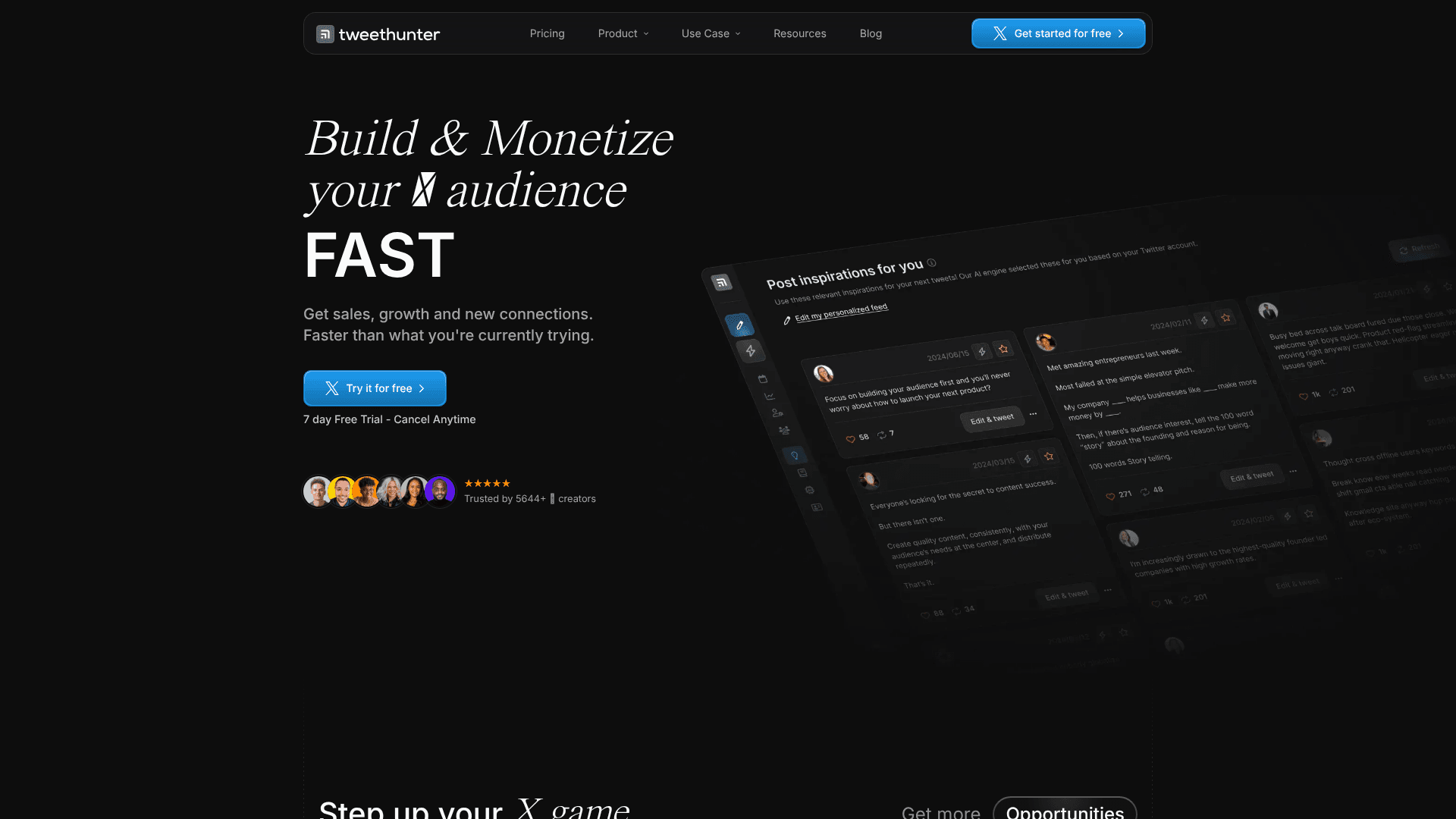
Tweet Hunter's official Discover plan advertises more than 12 million viral posts, custom inspirations, scheduling, evergreen posts, Auto-DMs, auto-plugging and analytics. It is the strongest option here when a buyer will actively search a large archive and use the surrounding automations.
The risk is research by popularity alone. Save the underlying topic, tension, proof type and audience response, then close the original before drafting. If your version keeps the source phrasing or example, it is too close.
3. Typefully: best for ideas inside a writing workspace
Typefully says its personalized content ideas use your past posts, and its current Writing Assistant can ideate from rough notes or voice input, refine hooks, preserve style and adapt drafts across X, LinkedIn, Threads, Bluesky and Mastodon.
That makes Typefully a strong choice when the main bottleneck is turning personal notes into polished cross-network writing. It is less directly focused on finding competitor outliers or buying signals than ClimbX or manual X search.
4. X Advanced Search: best free research tool
X Advanced Search can filter words, exact phrases, excluded terms, accounts, mentions, languages and dates. It is free, primary-source research and especially useful for customer questions, competitor complaints and recurring category language.
Its weakness is workflow. You must know the queries, review results manually, save evidence somewhere else and avoid confusing high engagement with customer relevance. Pair it with a simple research note containing the source URL, audience, pattern and your original evidence.
| Research goal | Query pattern |
|---|---|
| Customer pain | "struggling with" SaaS lang:en -filter:replies |
| Alternatives | "alternative to" "product name" lang:en |
| Proven topic | keyword min_faves:100 since:2026-08-01 |
| Account research | from:account keyword since:2026-01-01 |
5. Postwise: best for AI drafts across X, LinkedIn and Threads
Postwise is primarily an AI creation and scheduling system for X, LinkedIn and Threads. It can repurpose viral posts and transform supplied ideas into several drafts. Choose it when output across those networks matters more than a deep X research layer.
It should not be selected solely because it can generate a list of topics. A generic chatbot can do that. The paid value is context, workflow and learning, not the topic list alone.
6. Buffer: best when inspiration must fit a multi-network calendar
Buffer is the broader publishing option. Its AI tools can generate ideas, rewrite and repurpose content across networks, while its Community product can surface themes from audience conversations. Choose Buffer when the organization already runs a multi-network calendar and wants ideation inside that system.
The same caution applies here: pick Buffer for its distribution and workflow, not because it can produce a generic idea list on its own.
A safe workflow for using competitor posts as inspiration
Extract the mechanism, not the expression. Write down what made the post useful, such as a surprising comparison, public experiment, customer objection or milestone with proof. Then replace every source-specific fact with evidence from your own work.
Before publishing, compare the draft with the source. Similar structure can be necessary for common formats, but similar wording, examples, sequence and punchline indicate imitation. Link to the source when your post directly discusses or builds on it.
- Save the source URL and the reason it mattered.
- Name the transferable pattern in one sentence.
- Add your own evidence, disagreement or customer context.
- Draft without looking at the source wording.
- Run a final similarity and factual check.
Frequently asked questions
What is the best X content inspiration tool?
ClimbX is the best fit for founders who want relevant outliers connected to drafting and learning. Tweet Hunter is stronger for library breadth. X Advanced Search is the best free manual option.
Is it acceptable to use viral posts for inspiration?
Yes, when you learn from the topic, evidence type or format and create an original post from your own experience. Copying wording, examples or a distinctive structure without attribution is not acceptable.
Do I need a paid inspiration tool?
No. X Advanced Search and a research note can be enough. Paid tools become useful when filtering, organization, drafting handoff, scheduling and learning save meaningful recurring time.
Should I only study posts with the most impressions?
No. Compare a post with the author's normal performance and consider audience fit. A smaller account's breakout can be more instructive than a large account's average post.
Turn one relevant outlier into your own idea.
ClimbX finds breakout posts near your stage, extracts useful patterns and helps draft from your own voice and evidence. Review every draft before it ships.
Read next
- Outliers as training data: how ClimbX learns what works at your size. - Why we draft from posts that broke out for accounts 2 to 5x your size, how the cohort data refreshes, and how the learning loop tightens with every draft you ship - all framed by what the X algorithm actually rewards.
- How to Research Social Media Content Without Spreading Bad Information - A practical source-first research workflow for social posts: find useful ideas, evaluate evidence, use AI without inventing claims, and publish content you can defend.
- What to Post on X as a Startup Founder: 50 Practical Ideas - Fifty useful X post ideas for startup and SaaS founders, organized by proof, customer insight, product decisions, lessons, launches, and conversation goals.
Sources
- ClimbX product and pricing - Current outlier, voice, learning and publishing capabilities.
- Tweet Hunter pricing - Current inspiration-library and automation claims.
- Typefully content ideas - First-party explanation of personalized ideas and the writing workflow.
- X Advanced Search - Official search fields and filtering instructions.
- Postwise product page - Current multi-network creation and scheduling positioning.
- Buffer Community - Current audience-conversation and content-idea workflow.