The short version
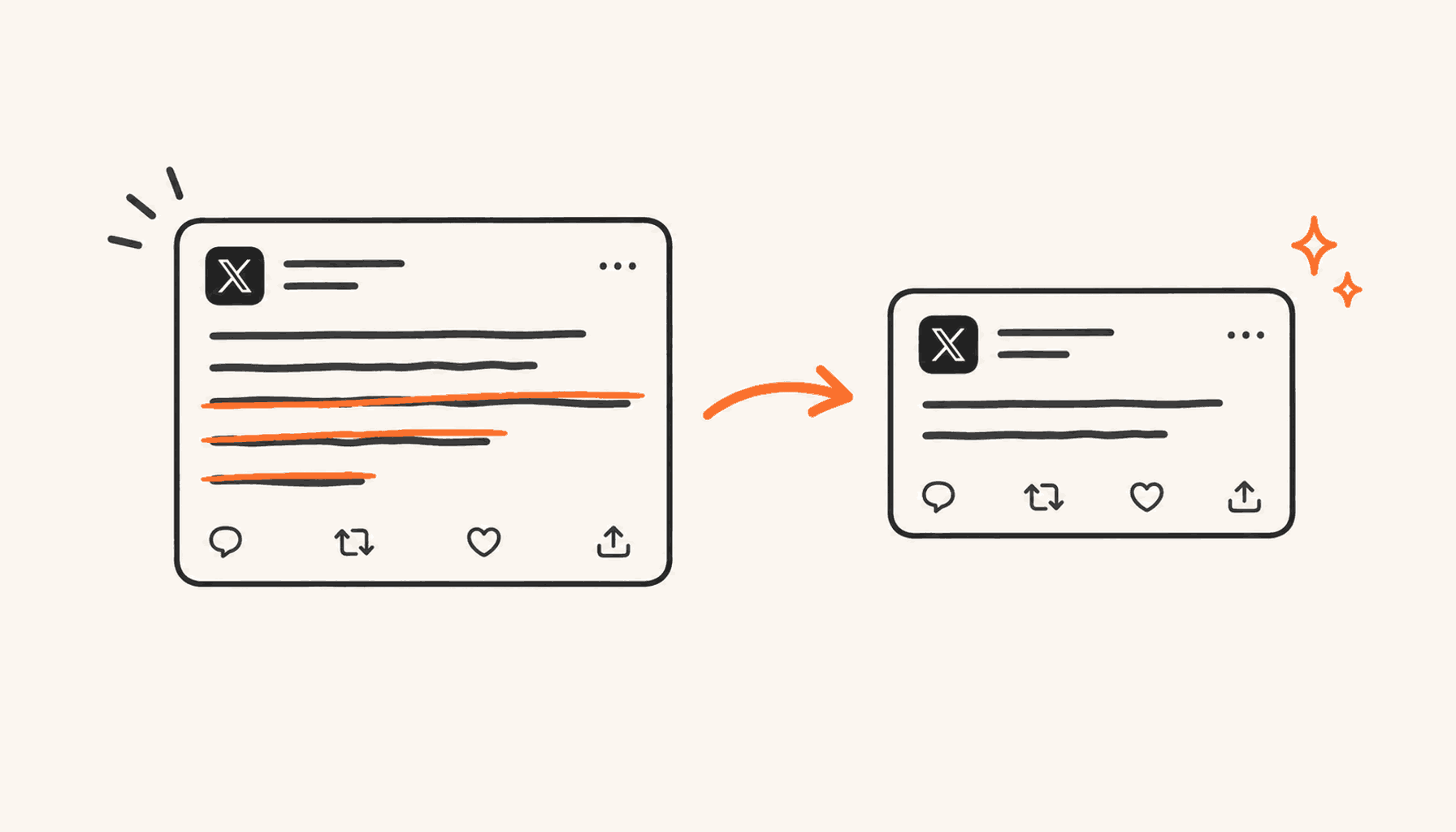
To write a good tweet, say one specific thing to a named audience. Keep it as short as the idea allows, and make it easy to answer. Use real numbers instead of claims. Keep links out of the post. Skip labels like “hot take:”. End on your point instead of “thoughts?”. Short won on my account, but longer posts did slightly better across 669 ClimbX users. So test length against your own median.
Most guides give you rules without numbers. This one shows nine rewrites. Each one shows one rule, with a number from my own posts behind it. I wrote the weak versions for this page. When the strong side is a real post of mine, I say so and link it.
Here, a “good” tweet is one that gets reach and replies. If you want leads or sales, a longer post about how you solve a problem can be the better tweet, even if it gets fewer quick replies. Also, short posts winning is true for my audience, not a rule. Across other users, longer posts did slightly better.
What makes a good tweet?
A good tweet gives the reader something to do in a few seconds. They can answer it, see themselves in it, or react to a number. I compared my top 500 posts with my bottom 200. I counted how often each trait showed up in each group. A ratio above 1 means the trait shows up more among winners. All of this comes from my 1,218 original posts from the last 180 days. The median post in my top 50 is just 10 words long.
- Community or connect call4.10
- Opens by naming the audience ("Founders,")4.00
- Quick-reply hook3.30
- Names a specific AI brand2.44
- Question1.54
- "hot take:" label0.53
- 26 words or more0.50
- Opinion0.34
- Expert advice0.17
- Playbook or how-to0.09
Posts that ask for a quick, personal reply sit at the top. Posts that lecture, like expert advice and playbooks, sit at the bottom, below 0.2. Advice can still work. It just needs a bigger audience first. In a separate study of 500 outlier posts from 181 creators, most expert and playbook winners came from big accounts, while 34 of 37 question winners came from small ones.
How to write a good tweet: 9 rewrites from weak to strong
Each pair shows one rule. Most rewrites change a few things at once, like length, audience and format. So read them as examples, not tests. The numbers in each section come from all my posts, not from these pairs.
1. Cut every word that does not earn its place
On my account, short won. Posts of 1 to 8 words reached 1.29x my median. 9 to 15 words reached 1.18x, and 26 to 45 words reached 0.80x. I also checked about 54,000 posts from 669 ClimbX users in the same 180 days. There, longer posts did a little better, with 46+ words at 1.14x. No one length works for everyone. Start short and see what your own audience does.
- Me: 1 to 8 words1.29x · my posts
- Me: 9 to 15 words1.18x · my posts
- Me: 26 to 45 words0.80x · my posts
- Me: 46+ words0.85x · my posts
- 669 users: 1 to 8 words0.92x · cross-user
- 669 users: 46+ words1.14x · cross-user
Weak
I've been thinking a lot lately about how most founders spend way too much time building features and not nearly enough time talking to the people who will actually use them, and honestly I made this mistake too.
Stronger
Built for 6 months. Talked to users for 6 days.
Guess which I regret.
Same idea, 14 words instead of 38. The numbers make the point. The reader works out the lesson.
2. Name the audience
Opening with the audience, like “Founders,”, had a win ratio of 4.0 in my posts. When a post is for everyone, nobody feels it is for them. When you name a group, they know you want their reply.
Weak
What's the hardest part of your job right now?
Stronger
Founders,
what's the hardest part of this week?
The reader asks one thing: am I a founder? If yes, the question is for them. The shorter time frame also makes it easier to answer.
3. Add a word limit to the question
Questions with a word limit gave the biggest lift I have found on my account. They reached 7.25x my median. The full breakdown is in how to get more replies on X. Without a limit, people have to stop and think. With one, anyone can answer while scrolling.
Weak
What do you think about the current state of your startup? Would love to hear what everyone is working on.
Stronger
sell me your startup
in two words max.
The stronger side is my real post: 51,998 impressions and 669 replies. See it on X. “Two words max” feels like a small game. People like to play.
4. Make it answerable from experience
Questions had a win ratio of 1.54 on my account. Opinions had 0.34. With a statement, people can only agree or not. With a question about their own life, they can answer.
Weak
AI is going to change every job. Most people are not ready.
Stronger
Name a career that AI can't replace, yet
Real post: 31,882 impressions, 475 replies. See it on X. Everyone has an answer. The “yet” gets people arguing.
In outlier posts from small accounts, questions got far more replies per view than playbooks. That chart and more ways to get answers are in the replies guide linked above.
5. Swap a generic claim for a specific number
I did an earlier study of 1,189 of my original posts. Milestone posts with a real number had a median of 3,767 impressions. Stories had 2,390. A number shows it happened. An adjective just asks people to believe you.
Weak
X has been so good to me lately, the hard work is finally paying off 🙏
Stronger
First X payout: $828.77 🤯🤯
Took me 81 days to get here from never using X before.
Real post: 62,326 impressions, 717 replies, 1,230 likes. See it on X. The exact amount and the 81 days show a real result.
6. Drop the link from the main post
86 of my 1,218 posts had a link. They reached 0.60x my median. Posts without one reached 1.03x. If you want to send people somewhere, make the post work on its own. Then put the link in the first reply.
Weak
New blog post: 7 lessons from launching my SaaS on X. Read it here: yoursite.com/launch
Stronger
Launched my SaaS on X with 400 followers.
31 signups in week one.
What worked: replying for an hour before every post.
(write-up in the reply)
Made-up numbers for this example. The weak version asks for a click. The stronger one gives the lesson in the post, so it gets reach on its own. Readers who want more find the link one tap away.
7. Remove “hot take:”
Posts labeled “hot take:” had a win ratio of 0.53 on my account. The label warns people before they even read the claim. If the take is good, it needs no warning.
Weak
hot take: most landing pages are too long
Stronger
Most landing pages would convert better at half the length.
Which section would you cut first?
The claim gets sharper: half the length, better conversion. The follow-up gives people something to answer. They do more than agree or disagree.
8. Lead with the surprising part
Quick-reply hooks had a win ratio of 3.3 in my posts. These are openers that make you want to reply before you finish reading. The fastest hook is a contradiction your reader already feels. Put it first. Cut the backstory.
Weak
I've been using AI tools every day for about a year now, and recently I noticed something strange: I'm working more hours than before.
Stronger
genuine question:
AI was supposed to make us work less
so why does it feel like everyone is working 10x more now?
Real post: 76,869 impressions, 511 replies. See it on X. The weak version spends 18 words on setup. The strong one opens with what everyone was promised and what everyone got. It also opens with “genuine question:”. The checklist below tells you to drop labels like that. I think it worked anyway, because that label sounds sincere instead of warning people about a spicy take. And the contradiction under it did the work. I would still test it without the label.
For more opening lines, see how to write hooks that stop the scroll.
9. End on the point, not “thoughts?”
Ending on a question made no real difference. It was 1.02x against 0.99x on my account, and 1.00x across the 669 ClimbX users. So adding “thoughts?” or “agree?” at the end does nothing. End on your sharpest line. Or make the whole post the question.
Weak
AI coding tools are making junior developers skip the fundamentals. Thoughts?
Stronger
AI writes the code now.
Who teaches juniors to read it?
The weak post makes a claim, then asks the reader to do the work. The stronger one is the question. It is specific, so people with a real answer want to reply.
One warning. When a post does well, reuse its format. Do not reuse its words. When I repeated my winners, they did far worse than the original. The numbers are in what is considered viral on Twitter.
How do you know what works for your audience?
Count it. After 30 days, sort your posts by impressions against your own median. Check which of the nine fixes the top ones share. My length result flipped for other users, so trust your numbers over mine. For more of what worked on my account, see my 10 biggest X posts, and for which post types to write in the first place, what to post on X to get followers.
ClimbX drafts posts in your voice from what already worked for accounts slightly ahead of you. So each draft starts from a format that has worked before. You edit every draft before it goes out. When an idea needs more than one post, use a thread instead of stretching a single tweet.
USA has ChatGPT USA has Grok USA has Claude USA has Gemini
China has DeepSeek China has Qwen China has Kimi China has MiniMax
Europe has?
My biggest post is 26 words, well past my usual length. It still follows most of the other rules. It names brands, has a contradiction people feel, and ends on a two-word question everyone in Europe could answer. Treat the rules as a starting point. You can break them.
A one-screen checklist before you post
Nine checks, under a minute
- As short as the idea allows. Cut any word you do not need.
- It names who it is for.
- If it is a question, it has a limit ("in 1 word", "two words max").
- A reader can answer from their own experience in seconds.
- Any claim has a real number instead of an adjective.
- No link in the post. Put it in the first reply.
- No "hot take:" or other warning labels.
- The surprising part is in the first line.
- It ends on the point, not on "thoughts?".
How these numbers were measured
My numbers: 1,218 original posts on @DanielSmidstrup, last 180 days, at least 3 days old. Lift is a post’s impressions divided by my own median. The win ratios compare my top 500 and bottom 200 original posts from the same 180 days. The 1,189-post study is an earlier snapshot of the same account. Cross-user: about 54,000 original posts from 669 ClimbX users, same window and age cutoff, authors with 20 or more posts, my account excluded, lift against each author’s own median. The outlier study is a separate set of 500 outlier posts from 181 creators. Queried October 3, 2026.
Common questions
How do you write a good tweet?
Say one thing to a named audience. Keep it as short as the idea allows, and make it easy to reply to. Use specific numbers instead of claims. Keep links out of the main post. Drop labels like "hot take:". Short posts won on my account, but longer posts did slightly better across 669 ClimbX users. So test length against your own median.
How long should a good tweet be?
No one length works for everyone. On my account (1,218 original posts, last 180 days), posts of 1 to 8 words reached 1.29x my median. Posts of 26 to 45 words reached 0.80x. Across about 54,000 posts from 669 ClimbX users in the same window, it was the other way round: 46+ words did 1.14x. Try both. After a month, compare against your own median.
How do you write a good Twitter post that gets replies?
Ask something people can answer from their own experience in a few seconds. Then limit the answer: "in 1 word", "two words max". Word-limit questions were my strongest reply format.
Should a tweet end with a question?
Only if the question is the point. Ending on a question made no difference to reach, in my 1,218 posts (1.02x vs 0.99x) or across about 54,000 posts from 669 ClimbX users (1.00x), both over the last 180 days. A generic "thoughts?" adds nothing. A specific question people can answer does.
Do links hurt a tweet?
In my posts, yes. 86 of my 1,218 original posts in the last 180 days had a link. They reached 0.60x my median. Posts without one reached 1.03x. Put the link in the first reply instead.
Start each day with drafts worth editing.
ClimbX drafts posts in your voice from the shapes that already worked for accounts slightly ahead of you. You edit every draft, so it still sounds like you.
Read next
- What to Post on X to Get Followers: 9 Post Types Ranked by Real Data - Nine post types from 1,189 real X posts, ranked by median reach and replies. What each one is good for, a weak and a strong example, and a weekly mix to copy.
- My 10 Biggest X Posts, and What They Taught Me - I ranked all 926 of my X posts in ClimbX. The top 10 generated 2,067,969 impressions and 11,052 replies. Here are the posts and the patterns I'd reuse.
- How to Write a Thread on X That People Finish - Write an X thread with a clear promise, useful sequence, credible evidence, readable pacing and a strong ending, plus structures, editing rules and examples.