
The short version
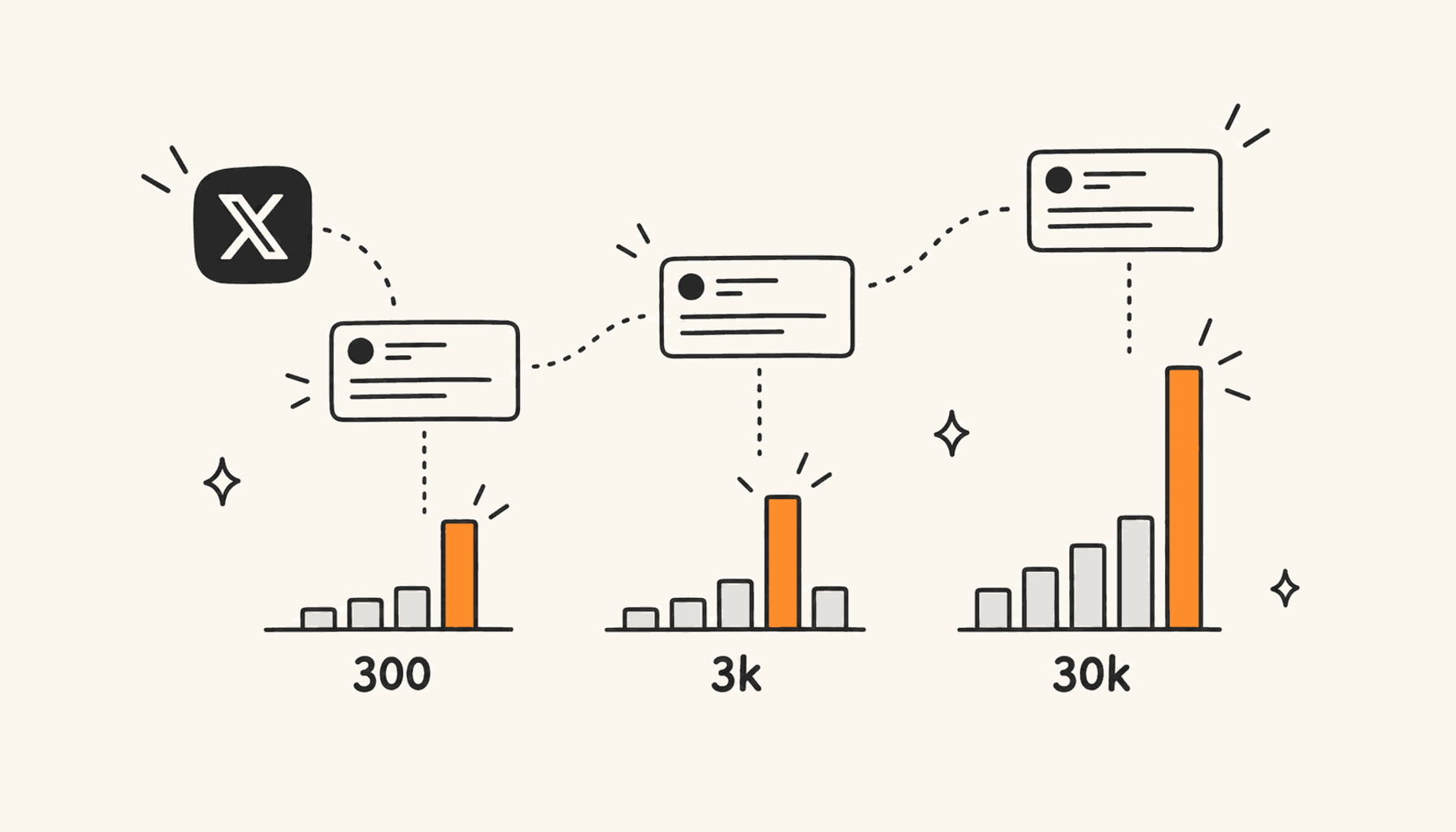
What is considered viral on Twitter depends on your size. Across 54,061 posts from 714 ClimbX users, a top-1% post reached about 3,400 impressions for accounts under 500 followers and about 18,000 for accounts with 1,000 to 5,000. A rule that fits any size: a post at about 10x your own median is viral for you. Only 1 in 29 posts gets there.
Most definitions of a viral tweet stop at “far more engagement than usual”. That is true, but it does not help until you know what usual is. So here are the real numbers, by follower count and by multiple of your own median.
What is considered viral on Twitter? The usual thresholds
The most common rule of thumb is 100,000 impressions. Almost no post from a small or mid-sized account gets there.
One 2026 guide puts it this way: most marketers consider a tweet viral above 100,000 impressions, or 50,000 for accounts under 5,000 followers (Conbersa, checked October 2026). In our data, 170 of 54,061 posts reached 100,000 impressions: 0.31%. For accounts under 500 followers it was 25 of 24,050 posts, or 0.10%.
With a fixed line, almost no small account’s best post ever counts. Meanwhile a big account can call an ordinary day viral. Size is what matters.
How many views is viral on Twitter for your follower count?
A top-1% post ranges from about 3,400 impressions under 500 followers to about 49,000 at 5,000 to 10,000 followers.
| Followers | Median post | Top 10% | Top 1% | Typical best post |
|---|---|---|---|---|
| Under 500 | 54 | 297 | 3,364 | 951 |
| 500 to 1k | 132 | 911 | 50,942 | 3,248 |
| 1k to 5k | 234 | 1,648 | 18,165 | 5,386 |
| 5k to 10k | 993 | 9,844 | 48,804 | 30,909 |
| 10k+ (low sample, 14 accounts) | 2,376 | 16,316 | 191,368 | 100,509 |
Impressions per original post, last 12 months. “Typical best post” is the median account’s single biggest post in that window. Accounts with 10,000 or more followers are shown for reference only. 14 accounts is too few to draw conclusions from.
The 500 to 1,000 band is the odd one. Its top 1% is higher than the next band up, because 13 of its 86 accounts made all of its top-1% posts. That is what going viral looks like up close. A few accounts at that size had posts spread far past their followers, and those few posts set the line. The median and top 10% rise steadily with size. Trust those more.
For small accounts, the most useful number is the last column. If you have 300 followers, the typical account your size has a best post of the year under 1,000 impressions. A post at 2,000 is not a failed viral post. It is a breakout.
How rare is a 3x, 10x or 50x post?
You get a 3x post about once every 8 posts, 10x once every 29 and 50x once every 121.
- 2x your median21.1% · 1 in 5 posts
- 3x your median12.6% · 1 in 8 posts
- 5x your median7.2% · 1 in 14 posts
- 10x your median3.45% · 1 in 29 posts
- 20x your median1.71% · 1 in 58 posts
- 50x your median0.83% · 1 in 121 posts
- 100x your median0.51% · 1 in 197 posts
Most accounts get there at least sometimes. In the 12 months, 94% of accounts had at least one 3x post, 67% had at least one 10x post and 29% at least one 50x post.
That gives you a rule you can use at any size. It is my rule, not an official X line or an industry standard. The 10x line is just a handy round number:
| Multiple of your median | How rare | What it means | What to do |
|---|---|---|---|
| 3x | 1 in 8 posts | An outlier | Note the format and hook; try the shape again |
| 10x | 1 in 29 posts | Viral for your account | Reply to everyone; pin it for a few days |
| 50x and up | 1 in 121 posts | Escaped your audience | Reply while it is live; write down why it traveled |
These are combined rates across 714 accounts, not a forecast for yours. Some accounts break out far more often than others. Breakouts tend to come in clusters. A quiet month is normal. Track your own rate over a few months before you read anything into it. Why some posts spread past your followers at all comes down to how the X algorithm ranks posts.
Why do raw view counts mislead?
Because the same number means opposite things at different sizes. About 3,400 impressions is a top-1% post under 500 followers. Above 10,000 followers it is an ordinary post: the median post in our small sample there reached about 2,400.
Raw views also make the wrong posts look good. My median post reaches about 2,900 impressions (1,189 original posts, last 180 days). My biggest post ever reached 1.36 million, about 466 times that: “USA has ChatGPT, USA has Grok ... Europe has?”, with 6,444 replies and 6,261 likes on 1,358,843 impressions.
If I judged my strategy by that post, I would write lists of countries forever. The lesson is more specific: a short list that sets up a gap, then a two-word question everyone can answer. I had about 2,600 followers when I posted it. So almost all of its reach came from people outside my audience. It says little about what my followers want. The posts worth studying are the 3x to 10x ones, because they happen often enough to repeat. A 466x post is a lottery ticket. A 4x post is a pattern you can learn from.
How do you spot an outlier worth learning from?
Check that the post won on its shape, not on media, news or fame. About half the outliers in our study won on those.
In a study of 500 outlier posts from 181 creators, 51% could not be copied. They won on a video, a breaking news story or a celebrity. The rest won on how they were written. The shapes that won for small accounts (questions, hooks and connect posts) are different from the ones that won for big accounts. The reply rates by shape are in how to get more replies on X.
Five checks before you learn from an outlier
- Measure it against that author’s own median, not against your account.
- Pick authors 2 to 5 times your follower count, not the biggest names in your niche.
- Skip it if the media, a news event or a famous name did the work.
- Name the shape in one line: the setup, the turn, and the job it gives the reader.
- Write your own version with your own evidence. Never reword their post.
By hand, this means scrolling several accounts and working out medians in your head. ClimbX does that for your niche. It drafts daily posts in your voice from what is working for accounts slightly ahead of you. You edit and approve each one. The method is explained in outliers as training data. If you are still choosing what to post about, the best niches to grow on X shows which topics break out most often.
What do viral tweets have in common?
On small accounts, viral posts are usually short. They give the reader an easy job: answer, pick, or say hi.
In the outlier study, nearly every question, hook and connect-call outlier came from an account under 25,000 followers (34 of 37 questions, 11 of 12 hooks, 9 of 9 connect posts). Expert takes, opinions and playbooks broke out mostly for big accounts that already had reach. On my own account, I compared my top 500 posts with my bottom 200. Community calls were 4.1 times more common at the top, and quick-reply hooks 3.3 times. Playbooks (0.09) and expert advice (0.17) sat at the bottom. My median top-50 post by replies was 10 words long.
Two common beliefs did not hold up. Timing: across about 54,000 posts from 669 ClimbX users, hour of day and weekday moved reach by only 0.95x to 1.05x. A better slot rarely turns an ordinary post into a viral one. Hot takes: posts labelled “hot take” scored 0.53 in my label study, below an ordinary post. The shapes that do work, with examples, are in how to get more replies on X and how to write a good tweet.
Can you go viral twice by repeating a winning post?
Not at the same scale. On my account, a repeated winner did 5 to 50 times worse.
That same 1.36 million post, 466x my median, landed at 9.5x when I posted a close repeat. That is still a strong post, just under the 10x line. But it is about 49 times smaller than the original. The people most likely to engage had probably seen the first one. What did carry over was the shape: short, a named audience, an easy answer. That shape suits my audience. Across other ClimbX users, longer posts did slightly better, so test it against your own median. My 10 biggest X posts share that shape with completely different topics.
The rule: repeat the reason a post worked, never the post. Give the same shape a new topic, a new audience name or a new number. Judge it against your median, not against the original.
How these numbers were measured
Cross-user data: 54,061 original posts from 714 ClimbX users, posted in the last 12 months and at least 3 days old, authors with 10 or more posts, my own account excluded. Follower band is each account’s current follower count. Bands under 20 accounts are shown for reference only. A post’s multiple is its impressions divided by its author’s own median. My own median comes from my 1,189 original posts over the last 180 days. The outlier study is a separate set of 500 outlier posts from 181 creators. The cross-user numbers were queried October 3, 2026.
Common questions
What is considered viral on Twitter?
There is no official line. A useful rule: a post is viral for you when it reaches about 10 times your own median impressions. Only 1 in 29 posts got there across 54,061 posts from 714 ClimbX users over 12 months. In raw numbers, a top-1% post reached about 3,400 impressions for accounts under 500 followers and about 18,000 for accounts with 1,000 to 5,000.
What is considered a viral tweet in views?
There is no official number. Marketing blogs often use 100,000 impressions. But only 0.31% of the 54,061 ClimbX-user posts in our data reached that, and 0.10% for accounts under 500 followers. Judge a post against your own median instead. 3x is an outlier, about 10x is viral for you, and 50x is rare at any size.
How many views is good on Twitter for a small account?
For accounts under 500 followers in our data (429 accounts, 12 months), the median post reached 54 impressions and the top 10% reached about 300. A post with 1,000 impressions is in the top few percent at that size. The typical small account’s best post of the year reached 951 impressions.
How many likes is considered viral on Twitter?
Likes grow with account size the way views do, so a fixed number does not work. Compare a post’s likes and replies to your own typical post. Some history: the ranking model X open-sourced in April 2023 weighted a predicted reply far above a predicted like. Those weights were never a points count, and they may have changed since.
Can you make a tweet go viral again by reposting it?
Rarely at the same scale. On my own account, a repeated winner did 5 to 50 times worse. A post that reached 466x my median landed at 9.5x when I posted it again. That is just under the 10x line and far below the original. Repeat the reason it worked, with a new angle.
Learn from the posts that beat their author's normal.
ClimbX drafts daily posts in your voice from what is working for accounts slightly ahead of you in your niche. Nothing posts until you approve it.
Read next
- Outliers as training data: how ClimbX learns what works at your size. - Why we draft from posts that broke out for accounts 2 to 5x your size, how the cohort data refreshes, and how the learning loop tightens with every draft you ship - all framed by what the X algorithm actually rewards.
- My 10 Biggest X Posts, and What They Taught Me - I ranked all 926 of my X posts in ClimbX. The top 10 generated 2,067,969 impressions and 11,052 replies. Here are the posts and the patterns I'd reuse.
- How the X algorithm actually works in 2026. - Replies beat reposts beat likes. The 30-minute window decides everything. What the For You algorithm rewards now, and what it quietly suppresses.
Sources
- Conbersa: How to Make a Viral Tweet in 2026 - Source of the common 100,000-impression rule of thumb (50,000 under 5,000 followers). Checked October 2026.
- X heavy ranker model weights (open source, 2023) - Historical weights on predicted probabilities, dated April 5, 2023 (reply 13.5, like 0.5, repost 1.0). The README says they can change. Checked October 2026.