The short version
For a solo SaaS founder, put most of your writing effort into the account whose perspective customers want to hear. That is often the founder account when you are explaining decisions and learning in public. Give the company account a clear job for product information and continuity. Run two active feeds only when you have distinct material and someone to maintain each.
A company logo gives a product a recognizable home. Your name gives readers someone to have a conversation with. Both can help a business, but maintaining them takes time that also belongs to building the product.
The useful decision is where your next month of writing should go. This guide uses illustrative founder situations to help you choose, define the second account’s role, and review the choice without abandoning an audience that already works.
Choose the primary writing account
| Situation | Start with |
|---|---|
| You are the expert and main customer contact | Founder account for explanations and conversations. |
| Customers already look for product updates | Company account for clear, dependable information. |
| Both accounts serve active, different audiences | Separate editorial jobs and a named owner for each. |
| You barely have enough material for one feed | One primary feed; a clear, maintained secondary profile. |
Separate identity from Professional account settings
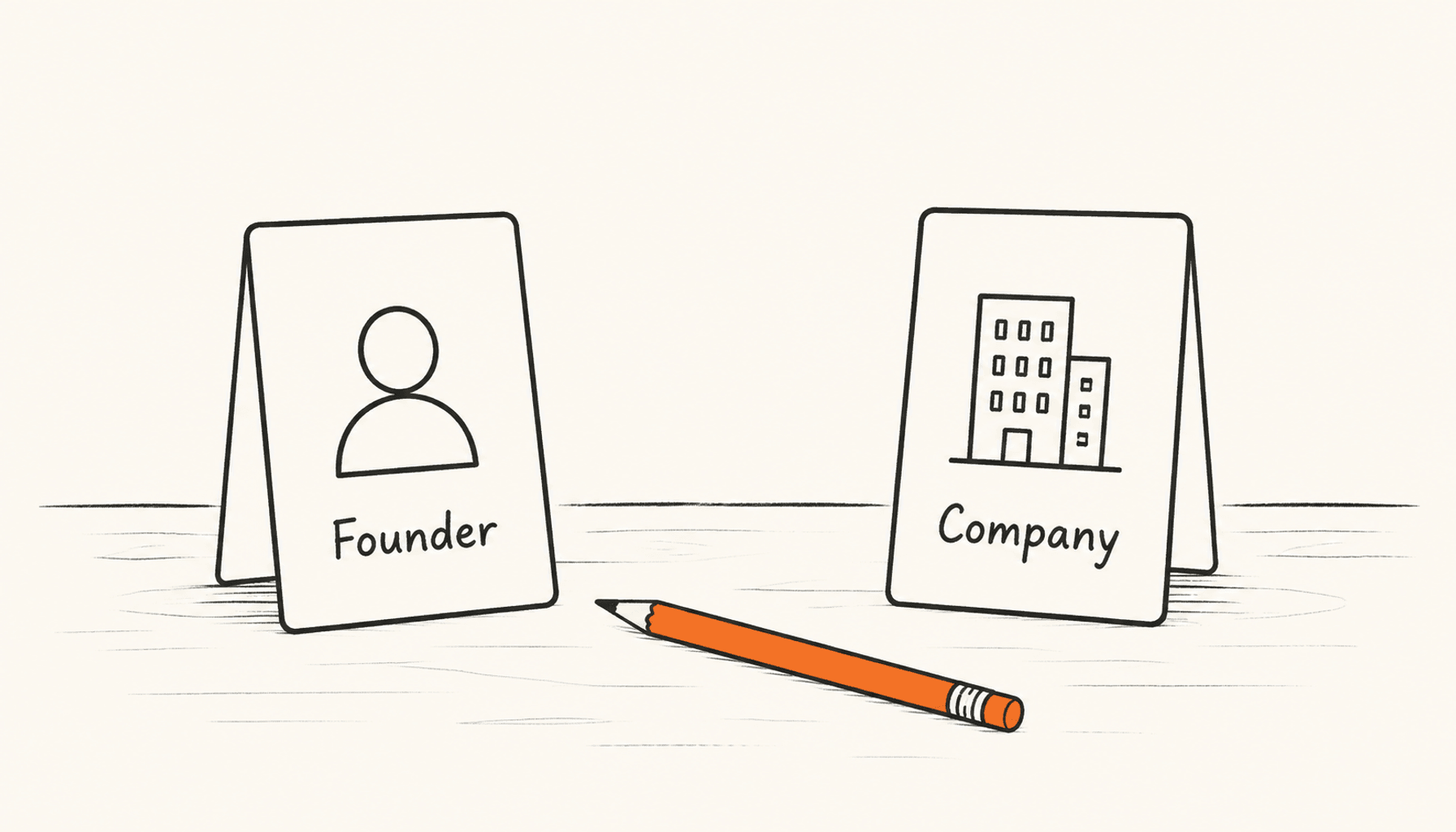
A founder account represents a person. A company account represents an organization or product. These are editorial identities. They are separate from choosing X’s Professional-account features or buying a subscription. A founder can discuss business under their own name; a company can write warmly and conversationally.
X’s Professional-account policy requires a complete profile, a clear authentic identity, and no history of repeated User Agreement violations. Its profile-label documentation also distinguishes a self-selected Professional category from a gold checkmark through Premium Business. None of those labels decides who should tell your product story.
Choose the founder account when the judgment is the story
A founder feed works well when the material depends on your experience: why you rejected a feature, what surprised you in a customer call, or how you solved a specific engineering problem. Readers can ask the person who made the decision a follow-up question.
Imagine a solo founder building invoicing software for small agencies. A useful post explains why they replaced a complicated billing setup with one default, including the tradeoff for agencies with unusual contracts. The founder can explain what they misunderstood and invite examples from agency owners. That is a reason to follow the person beyond the next release.
This is an editorial advantage, not evidence that X automatically distributes personal accounts more widely. A vague founder diary can still be less useful than a focused company tutorial. Keep the account anchored in problems your intended customers recognize.
Choose the company account when the product is the destination
A product feed has a different promise: readers can find dependable information about the thing they use. Release notes, short demonstrations, service updates, and explanations of supported workflows fit naturally here. Someone should be responsible for keeping those answers current.
Consider a small team whose customers already tag the product when they need help. Moving every announcement to the founder account would make information harder to find. Keep the company account useful and let the founder explain the reasoning behind selected changes. A founder does not need to become the public support inbox for every issue.
A company voice can use plain language, humor, and first-person explanations when the speaker is clear. A logo does not require stiff corporate copy. State what changed, who it helps, and where the reader should go next.
If you use both, give each a different assignment
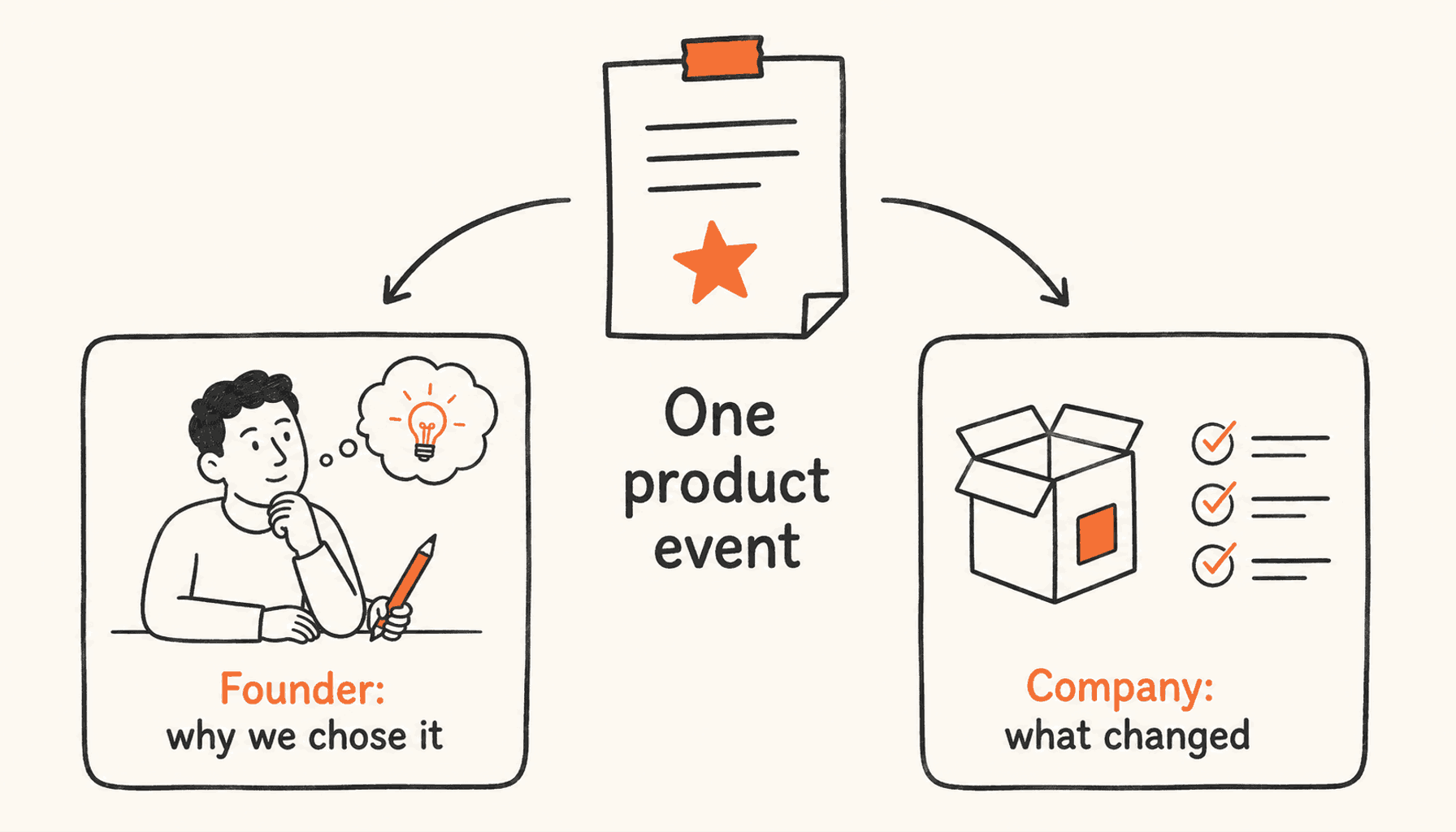
Two accounts become expensive when both need an original daily idea and both publish the same announcement. Start by separating the information readers need from the personal perspective that adds context. One product event can support both without identical posts.
- Give each feed a short audience promise and a responsible person.
- Use the founder bio to make the relationship to the product clear.
- Keep product availability and support instructions consistent across profiles.
- Share the other account’s post when it adds context; do not duplicate everything.
| Event | Founder angle | Company angle |
|---|---|---|
| A simpler onboarding flow ships | Explain the decision and the option you rejected. | Show the new flow and who can use it. |
| A customer asks a recurring question | Explain the underlying misconception without identifying the customer. | Link to the current answer or walkthrough. |
| A release is delayed | Describe a useful lesson if there is one. | Provide the confirmed availability update. |
Protect the audience and account continuity you already have
Before shifting your effort, inspect recent posts on both accounts. Look for relevant replies, people asking about the product, and visits that become trials or conversations. A small company feed with actual customer questions may be more valuable than a much larger founder feed serving unrelated interests.
Do not rename an established account just to fit this framework. A sudden switch from an individual to a product can confuse people who followed for the person. Try the new editorial balance first while preserving the identity and the useful material people already know.
Write down who maintains each account, who handles recovery, who checks scheduled posts, and what happens when a teammate stops managing the feed. Use access controls appropriate to your setup. The operational goal is that routine company communication can continue without depending on one person being available.
Run a small editorial trial before expanding
Choose a review window you can actually complete, such as the next four weeks. That is a planning suggestion, not a scientifically optimal test duration. Keep the product, intended customer, and offer reasonably stable while you learn whether the account’s promise is clear.
- Write one sentence describing who should follow the primary account and what they will learn.
- Select a few genuine customer questions or product decisions that support that promise.
- Give the secondary account a limited maintenance role, such as current product updates and contact information.
- Record what each post was intended to do and which useful responses it received.
- Review the effort alongside qualified conversations and product interest before adding a second full publishing routine.
Make the chosen account easier to write for
Once the account has a clear job, save a few examples of language you would genuinely use and collect source material from your work. ClimbX can help you research relevant posts, develop drafts in your voice, and organize scheduling. You still supply the actual experience and check the claims.
Start with one account and one real idea. Review the draft for a concrete reader benefit, an accurate connection to your product, and a natural next step. An account strategy becomes useful when it helps you publish something specific without inventing a new persona.
Frequently asked questions
Should a startup have both a founder and a company X account?
Both can be useful when they serve different jobs. A small team can focus original writing on one account while keeping the other profile accurate and useful for product information. Two active feeds need enough material and someone responsible for each.
Does a founder account get more reach than a company account?
This guide does not establish an automatic reach advantage. Compare the relevance of the content, the existing audience, useful responses, and the effort required on your own accounts.
Is a company account the same as an X Professional account?
No. Company account describes the identity represented by the profile. Professional account describes a set of X features with eligibility requirements. Decide the account’s audience and purpose separately.
Give your founder account a clear voice.
Bring one real product lesson to ClimbX. Research relevant conversations, draft in your voice, and review the post before adding it to your calendar.
Read next
- How to Sign Up for Twitter (X) and Set Up Your Account - Create an X account, complete verification, fix common signup problems, and make your first profile useful to the people you want to reach.
- What to Post on X as a Startup Founder: 50 Practical Ideas - Fifty useful X post ideas for startup and SaaS founders, organized by proof, customer insight, product decisions, lessons, launches, and conversation goals.
Sources
- X Professional account policy - Eligibility and the distinction between professional features and editorial identity.
- X profile labels - Official explanation of Professional category labels and checkmarks.