A solo creator posts consistently for three months, then disappears for two. Another publishes daily but sees no growth. The difference isn't talent, it's system. Without a repeatable process for ideation, writing, and publishing, even skilled creators drift into inconsistency. The creator economy has grown into a substantial market where solo creators can genuinely build sustainable income, yet most struggle with the operational side that separates success from burnout.[1]
The challenge isn't inspiration or platform access. It's strategy. Most solo creators lack the systems needed to maintain consistent output while staying true to their voice and audience. Content planning, batching, editing workflows, and performance tracking require deliberate structure. Without these foundations, creators either burn out chasing trends or fade into irrelevance as algorithms reward consistency and authenticity.
This guide walks through the complete framework for building a sustainable content studio, from workspace setup and content calendars to batching workflows and analytics review. You'll learn how to establish systems that work with your schedule, not against it, so you can publish reliably without the guesswork.
TL;DR
- Successful content creation in your studio is built on three core elements: a repeatable process, a clear understanding of your audience, and the right tools.
- Solo creators who systematize their workflow, rather than creating on impulse, produce more consistent content and build audiences faster.
- The most common trap: focusing on output volume before nailing the process, which leads to burnout and inconsistent quality.[4]
Understanding Content Strategy for Creators
What Is a Content Strategy?
A content strategy is a deliberate plan that guides what you create, when you publish, and how your content aligns with your audience's needs and platform dynamics. Rather than posting whenever inspiration strikes, a content strategy maps your core topics, called content pillars, and ensures each post serves a specific purpose: building authority, driving engagement, or moving followers toward monetization. This framework transforms content creation from a guessing game into a repeatable system that compounds over time.[5]
Why Content Strategy Matters for Creator Growth
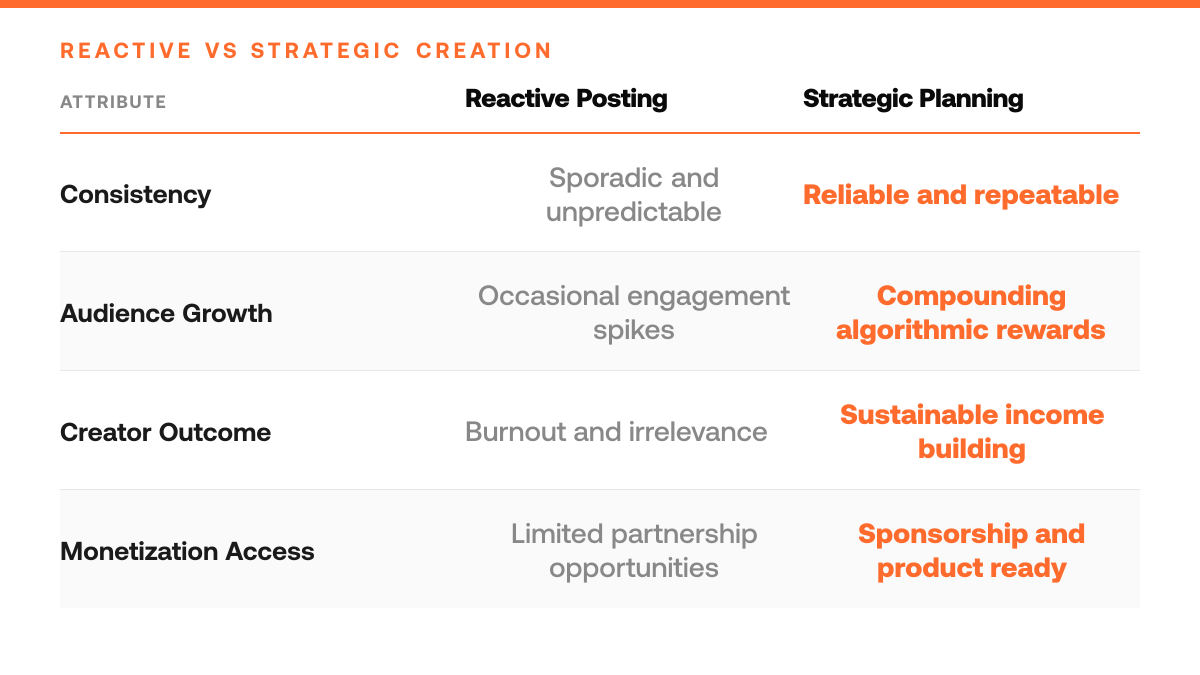
The difference between reactive posting and strategic planning directly impacts both your follower growth and monetization potential. Creators who post randomly may generate occasional engagement, but they miss the algorithmic rewards that come from consistency, audience psychology, and platform-specific tactics. A strategy accounts for how your audience thinks, what keeps them coming back, and how platform algorithms surface content to new users. This intentionality compounds: stronger engagement signals lead to wider reach, which attracts sponsorships and partnership opportunities that reactive creators simply cannot access.[5]
The Creator Economy Landscape
Solo creators and solopreneurs now operate in a competitive but opportunity-rich environment where audience-building is the foundation for income. Success no longer depends on luck or viral moments, it depends on understanding your niche, serving your audience consistently, and positioning yourself as a reliable source of value. Creators who combine audience psychology with platform knowledge and clear content pillars build sustainable followings that support sponsorships, digital products, and other revenue streams. The creators winning today are those who treat content creation as a strategic business, not a hobby.
Key Numbers for The Complete Guide to Creating Content in Your Studio (2026)
- $252.33 billion creator economy market size in 2025, with projected 23.3% compound annual growth through 2033.[4]
- 207 million active content creators worldwide, with 162 million in the United States alone.[4]
- Only 4% of creators earn more than $100K annually, highlighting the need for strategic content systems.[4]
- YouTube pays $3 - $30 per 1,000 views; TikTok Creator Rewards Program pays $0.40 - $1.00 per 1,000 views.[4]
Step-by-Step Process
1. Plan Your Content Calendar Around Core Topics
Start by identifying three to five core themes that align with your expertise and audience interests. Map these themes across a monthly calendar, assigning specific topics to each week. This planning phase ensures you're not creating content randomly, every post builds toward a coherent narrative that keeps followers engaged and returning for more. Document your themes in a simple spreadsheet or planning tool so you can reference them consistently as you move to production.[2]
2. Create Content in Batches During Dedicated Studio Sessions
Set aside focused time blocks, ideally several hours, to produce multiple pieces of content at once. Write captions, record videos, or design graphics in batches rather than one at a time. This workflow reduces context-switching, improves consistency in tone and quality, and lets you build momentum. Batch creation also means you're not scrambling for content daily; instead, you're working strategically in concentrated sessions that feed your distribution schedule for weeks ahead.
3. Edit and Optimize Each Piece for Your Platform
Review every post for clarity, engagement hooks, and platform-specific formatting before it goes live. On X, this means checking your thread structure, verifying links work, and ensuring your hook lands in the first line. Optimize hashtags, mention relevant accounts where genuine, and test different call-to-action styles. This step transforms raw content into polished assets that perform better and reflect your professional brand.
4. Schedule and Distribute on a Consistent Cadence
Use a scheduling tool to queue your optimized content across your chosen posting times. Consistency matters more than frequency, posting three times weekly at predictable times builds audience habit better than sporadic bursts. Monitor which posts gain traction, note the patterns, and adjust your next batch accordingly. This final step closes the loop: distribution data informs your next planning cycle, making your entire workflow measurable and scalable.
How This Works in Practice
Example 1: The Niche Educator Building Authority
Picture a solo creator teaching digital marketing fundamentals who posts educational threads 3 - 4 times weekly but struggles to move beyond a modest following. They experiment with the studio content system by identifying which lesson formats, breakdowns of real case studies, step-by-step guides, and contrarian takes on industry trends, generate the most replies and retweets. Within weeks, they notice that their audience gravitates toward actionable, behind-the-scenes content that reveals their thinking process rather than polished, generic advice. By doubling down on these resonant themes and varying the format (short-form threads, image carousels, video clips), they attract followers who genuinely engage rather than passively scroll. The creator's impression count climbs, and sponsorship inquiries begin arriving from tools and services aligned with their niche, turning audience growth into a monetization pathway.
Example 2: The Personal Brand Builder Scaling Influence
Consider a solopreneur offering consulting services who recognizes that generic motivational content underperforms on X but personal stories and tactical advice resonate deeply. They apply the studio system to test different content pillars: client wins, lessons from failures, and quick productivity tips. They notice that vulnerability, sharing a challenge they overcame, consistently outperforms polished success stories, and they adjust their posting rhythm to capitalize on these insights. By mixing formats (long-form reflections, quick tips, and reply-to-trending-topics), they build a reputation as both approachable and knowledgeable. Over time, their follower base expands with people genuinely interested in their perspective, leading to higher-quality inbound inquiries for their services and opportunities to collaborate with complementary creators.
Reactive vs. Strategic Content Creation
| Reactive Posting | Strategic Planning |
|---|---|
| Posts whenever inspiration strikes | Maps core topics and content pillars in advance |
| Occasional engagement with no algorithmic rewards | Consistent output that compounds reach over time |
| Misses audience psychology and platform dynamics | Accounts for how audience thinks and what keeps them returning |
| Cannot access sponsorships or partnership opportunities | Attracts sponsorships and partnerships through reliable value delivery |
Why Authenticity and Format Diversity Matter
Both examples reveal a common truth: audiences on X reward creators who blend authentic insight with strategic format variation. The studio content system works because it removes guesswork, you identify what genuinely resonates with your specific audience, then amplify those themes across multiple formats. Whether you're building authority in a niche or scaling a personal brand into a revenue stream, the foundation is the same: test, measure, refine, and stay consistent. This iterative approach transforms X from a broadcast channel into a direct feedback loop that guides your content strategy and accelerates growth.
Studio Content Creation Checklist
- Map your content pillars and confirm each aligns with your audience's growth goals on X before drafting.
- Set up a pre-launch review template to verify headlines, hooks, and calls-to-action are tested and ready.
- Schedule weekly content audits to track which posts drive impressions and engagement on your account.
- Document your studio workflow steps so nothing critical, from research to posting, gets skipped.
- Test each content format (threads, posts, videos) in your studio setup and log what resonates with followers.
Common Mistakes to Avoid
Mistake: Skipping audience research and posting without data-driven insights
Solo creators often assume they know what their audience wants, leading to content that misses the mark and fails to gain traction. Without analyzing engagement metrics, follower demographics, and topic performance, you're essentially guessing. Fix this by auditing your analytics before creating, identify which topics, formats, and posting times drive the most impressions and engagement, then build your content calendar around those patterns.[3]
Common Creator Pitfalls vs. Sustainable Practices
| Pitfall | Sustainable Practice |
|---|---|
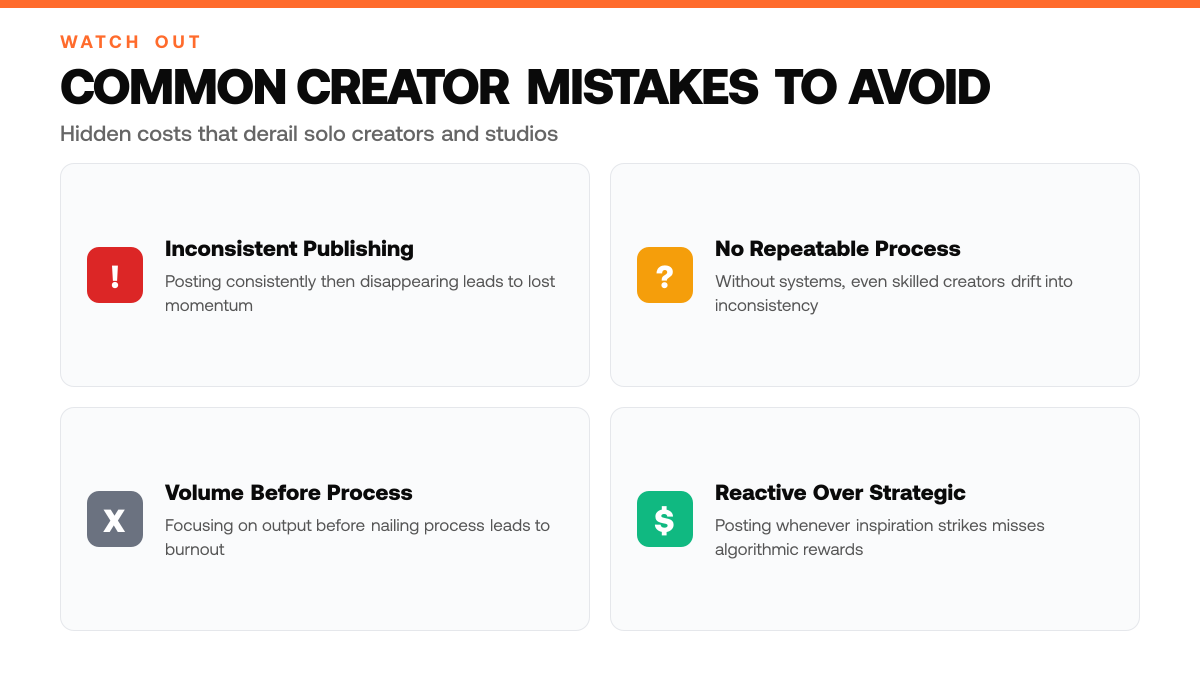
| Focusing on output volume before nailing process | Establish repeatable systems before scaling content |
| Publishing inconsistently over months | Maintain consistent schedule aligned with capacity |
| Creating without clear audience understanding | Develop deliberate strategy guided by audience needs |
| Treating content creation as a hobby | Operate as a strategic business with documented workflows |
Mistake: Creating content sporadically instead of batching and maintaining a consistent schedule
Inconsistent posting kills momentum and makes it harder for your audience to develop a habit of consuming your work. When you batch-create content in focused sessions, you build a reliable publishing rhythm that signals reliability to both your audience and the algorithm. Dedicate specific days to creating multiple pieces at once, then schedule them across the week, this removes the pressure of daily creation and ensures you never miss a posting window.[3]
Mistake: Treating your studio setup as separate from your content strategy
Many solo creators invest in equipment and space but fail to optimize how they actually use it for efficient production. Your studio should be designed to support batching and consistency, from lighting and audio quality to file organization and editing workflows. Audit your setup for bottlenecks: unclear file naming, poor lighting that requires reshoots, or an editing process that takes twice as long as it should. Streamline these systems so your studio accelerates output, not slows it down.
Frequently Asked Questions
What studio setup do I actually need to start creating content?
You don't need much to begin. A smartphone, basic lighting (even a desk lamp works), and a quiet space are enough to produce quality content. As your audience grows, invest incrementally, a microphone or ring light when audio or video clarity becomes a bottleneck, not before. The creator economy has lowered barriers to entry significantly; focus first on consistency and message clarity rather than equipment. Upgrade tools only when your current setup limits your output or audience experience.[4]
How do I balance content creation with running other parts of my business?
Batch-create content in dedicated blocks rather than daily. Spend a few hours once or twice weekly recording, writing, or planning multiple posts at once, then schedule them across the week. This rhythm frees mental energy for sales, client work, or product development on other days. Treat content creation as a scheduled business function, not a constant task. Many solo creators find that batching reduces decision fatigue and improves consistency without consuming every hour.
What tools should I use to manage content across my studio workflow?
Start with a simple content calendar (Google Sheets or Notion) to plan topics and posting dates, a notes app for ideas, and native platform scheduling tools. As you scale, a dedicated content management platform can centralize drafting, scheduling, and analytics. The goal is reducing friction between creation and publication, choose tools that integrate with your actual workflow, not the most popular ones. Switching tools frequently wastes time; pick one that covers planning, scheduling, and basic analytics, then stick with it.
Start your 7-day trial
Grow on X without sounding like everyone else. The right tool learns from your top posts and the leading voices in your niche, then drafts content in your voice. You edit, approve, and ship.
Start free trialSources
Read next
- The Complete Guide to Finding Content Ideas That Actually Convert - The Complete Guide to Finding Content Ideas That Actually Convert. A practical guide to what works, what to skip, and how to get started.
- 5 X Premium Features Worth the Cost (Honest Review) - 5 X Premium Features Worth the Cost (Honest Review). A practical guide to what works, what to skip, and how to get started.
- Why You Need a Personal Brand in 2026 - A practical look at why personal branding matters in 2026, how it builds trust and distribution, and what founders and professionals should do first.