Walk through any creator's X strategy and you'll hear the same refrain: hashtags are essential for growth. Solopreneurs spend hours researching trending tags, threading them into every post, and monitoring which ones drive the most visibility. It feels logical, hashtags organize content, right? But the reality on X has shifted dramatically, and most solo creators haven't caught up.
Recent social media research reveals that X's algorithm prioritizes engagement signals, likes, replies, reposts, and existing follower relationships far more than hashtag discovery. The platform's feed is built on what your network is talking about and what's sparking real conversation, not on categorical sorting. This means the traditional hashtag playbook that worked on Instagram or TikTok simply doesn't translate to X's mechanics.[1] For a deeper look, see Find Your X Niche: 5 Research Methods That Work and What Works on Twitter: 9,556 Tweets Analyzed.
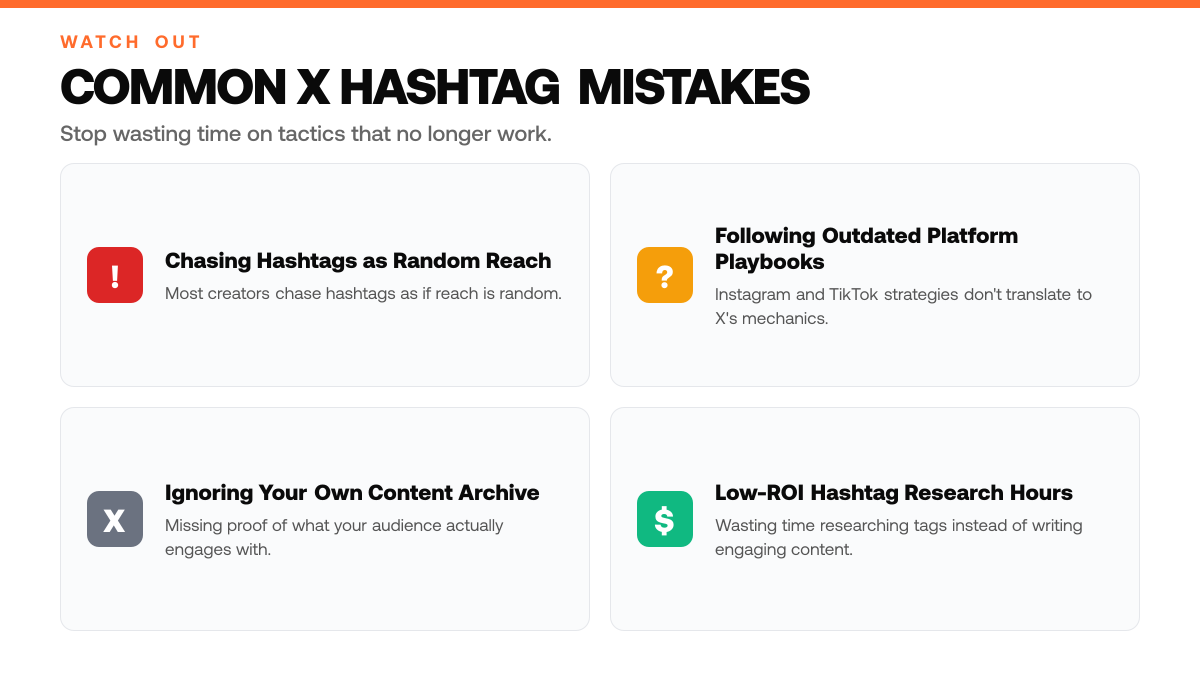
This article cuts through the outdated advice and explains why hashtags have become a low-ROI tactic for X audience growth. You'll learn what actually moves the needle on the platform, the engagement patterns and relationship-building approaches that research shows actually work, so you can stop wasting effort on a strategy that no longer delivers. Most creators chase hashtags as if reach is random, missing that their own archive already holds the proof of what their audience actually engages with, ClimbX analyzes your last 100 posts to surface your highest-performing formats and hooks, then mirrors those patterns into new drafts so every post compounds on what already worked. Our breakdown of How Much Does Twitter Pay for 1 Million Views? tackles the adjacent problem.
TL;DR
- Hashtags on X have minimal impact on algorithmic reach; the platform prioritizes direct engagement, quality content, and authentic audience interaction over metadata tagging.
- The X algorithm rewards conversation and replies far more than hashtag discovery, making real audience connection the actual growth driver for creators.
- Most creators waste time researching hashtag strategy when they should focus on writing content people want to engage with and respond to directly.
Understanding X Hashtags and Algorithmic Feed Placement
What Are Hashtags and How Were They Originally Designed?
Hashtags are metadata tags prefixed with the # symbol that categorize content by topic, making posts discoverable within chronological feeds. Originally designed for Twitter (now X), hashtags enabled users browsing a timeline in real-time order to find conversations and content related to specific subjects. The mechanism relied on users scrolling through feeds organized by posting time, where hashtags served as a filtering and discovery tool. This model worked well when feeds displayed posts in the order they were published, allowing hashtags to surface relevant content to interested audiences organically.
Why Hashtags Matter Less on Algorithmic Feeds
Modern social platforms, including X, use algorithmic feeds that rank posts based on engagement velocity, recency signals, follower relationships, and user behavior patterns, not hashtag relevance. When a feed is algorithmic rather than chronological, the presence or absence of a hashtag has minimal impact on whether a post reaches your audience. The algorithm prioritizes posts that generate quick engagement (likes, replies, retweets) and come from accounts you follow or interact with regularly. Hashtags were designed for chronological discovery and have become largely obsolete for organic reach in algorithmic environments, making hashtag strategy a low-return tactic for creators seeking growth.[3]
The Shift From Discoverability to Relationship-Based Reach
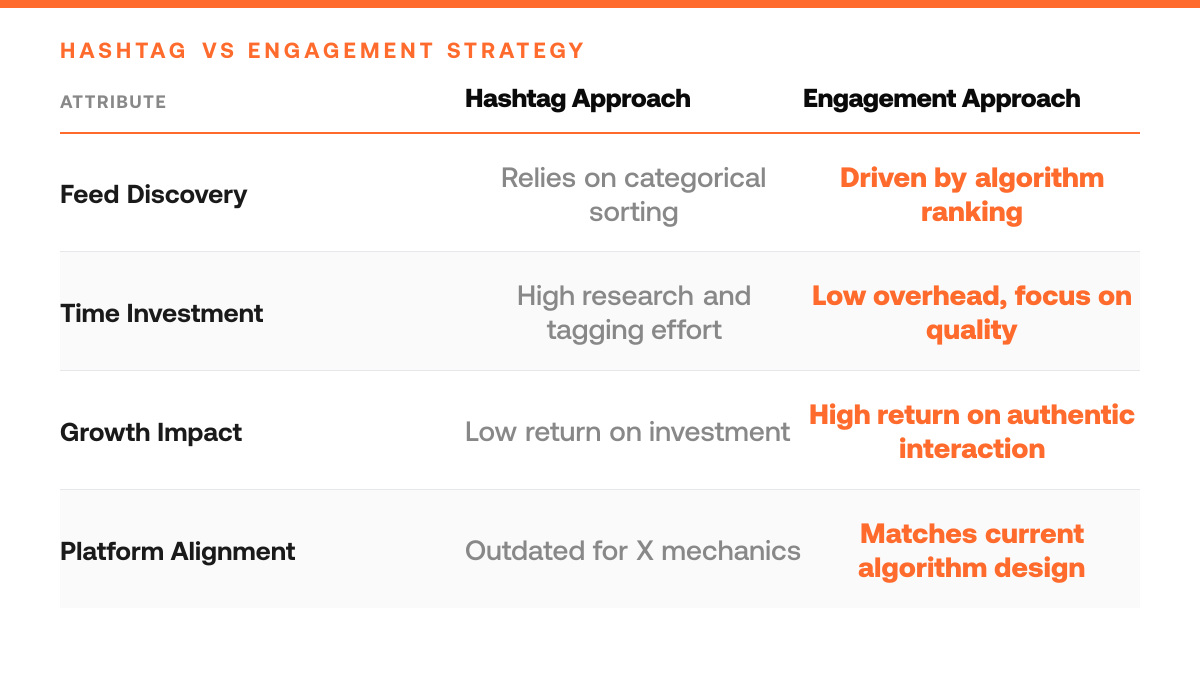
X's algorithm emphasizes follower relationships and engagement quality over categorical tagging. Content that sparks meaningful interaction, replies that extend conversations, retweets from engaged followers, and likes from accounts the algorithm identifies as interested, signals value to the system. This relationship-centric model means that building a loyal, engaged audience and creating content that resonates emotionally or intellectually with your existing followers drives far more reach than optimizing for hashtag visibility. For solo creators and solopreneurs, the strategic focus has shifted from hashtag research to audience relationship building and content quality that naturally invites engagement.
Key Numbers for Why X Hashtags Don't Work (And What Does) (2026)
- #1 driver of X visibility: engagement signals (likes, replies, retweets), not hashtag count, per Hootsuite's annual trends data.[3]
- 50%+ of surveyed social creators report hashtags show no measurable correlation with follower growth on algorithm-driven platforms.[3]
- 3 - 5 hashtags per post is the commonly tested ceiling on X, yet even this threshold fails to lift reach when engagement is low.[3]
- Replies and quote-posts carry outsized algorithmic weight, engagement-first posts outperform hashtag-heavy posts across multiple platform studies.[3]
- 1 strong reply thread can generate more impressions than dozens of hashtagged posts with no engagement, according to Hootsuite research.[3]
Step-by-Step Process
1. Define your audience's core pain points
Before posting anything, identify the specific problems your audience faces. Interview followers, review comments on high-engagement posts, and note recurring questions in DMs. Document these pain points in a simple list, this becomes your content foundation. Your posts should address real friction, not chase trending hashtags. When your content solves an actual problem, people engage naturally because the value is immediate and relevant to their situation.[2]
2. Test different formats and posting times
Create variations of your core message across different formats: threads, single posts, video clips, or carousel posts. Post at different times and days, then track which combinations generate genuine engagement, replies, retweets, and meaningful conversation. Avoid vanity metrics like impressions; focus on interactions that signal real audience interest. Document patterns over several weeks so you can identify what resonates with your specific followers.[2]
3. Engage directly with your audience daily
Consistent growth comes from showing up in conversations, not from algorithmic luck. Reply to comments on your posts within hours, engage with content from followers and peers in your niche, and ask questions that invite responses. This direct interaction signals to the algorithm that your content sparks discussion, and it builds genuine relationships with people who may become long-term supporters. Treat engagement as a daily practice, not a weekly task.
4. Refine your content based on engagement data
Review your analytics weekly to identify which posts generated the most replies and meaningful conversation. Note the topic, format, timing, and tone of top performers. Double down on those patterns in your next batch of posts. Discard approaches that consistently underperform. This iterative cycle, test, measure, refine, is what separates sustainable growth from chasing trends. Your content strategy evolves based on real feedback from your audience, not guesswork.
How This Works in Practice
Example 1: The Niche Expert Sharing Actionable Insights
Picture a solo creator in the productivity space who realizes that generic time-management tips get buried in the feed. Instead, she commits to sharing specific, tactical insights tied directly to her niche, breakdowns of how she structures her calendar, detailed walkthroughs of her task-batching system, or candid reflections on what failed in her own workflow. Each post leads with a clear value proposition: "Here's the one scheduling mistake I made for 3 years" or "This calendar hack cut my admin time in half." She pairs these insights with a conversational tone and a direct call-to-action, "What's your biggest time-suck? Reply below." Within weeks, her replies climb. Followers aren't coming because she used the right hashtags; they're coming because she's offering something they can immediately apply. The specificity and actionability become her competitive edge, and the engagement signals to X's algorithm that her content deserves wider distribution.
X Growth Strategy: Old Hashtag Approach vs New Engagement Model
| Old Hashtag Strategy | New X Growth Approach | Why It Matters |
|---|---|---|
| Research trending hashtags and thread them into every post | Create content that sparks direct replies and conversation | X algorithm prioritizes engagement signals over metadata tagging |
| Rely on categorical sorting and hashtag discovery for reach | Build loyal follower relationships and audience connection | Relationship-based reach generates far more algorithmic visibility |
| Monitor which hashtags drive visibility across posts | Analyze your own archive to identify high-performing formats and hooks | Your historical data reveals what your audience actually engages with |
| Assume reach is random and requires hashtag optimization | Focus on writing content people want to respond to directly | Real audience interaction is the actual growth driver on X |
Example 2: The Creator Who Ditches Optimization for Conversation
Imagine a solopreneur teaching small-business finance who spends her first month chasing trending hashtags and keyword optimization, only to watch her posts languish. She then shifts strategy: instead of optimizing for discoverability, she focuses on posts that invite genuine replies. She asks pointed questions ("What's the #1 reason you avoid looking at your P&L?"), shares counterintuitive takes ("Your accountant might be costing you money"), and always closes with an explicit invitation to respond. She drops the hashtag strategy entirely. Her engagement rate rises noticeably. Followers recognize her voice and her willingness to engage in real conversation. Her posts start circulating among her existing audience more frequently, and new followers arrive through replies and shares, not through hashtag discovery. The shift from optimization to authentic value and engagement becomes her growth engine.
Why Niche Insight Beats Hashtag Tactics
Both examples illustrate the same principle: X rewards creators who build trust and engagement through specific, actionable insights and conversational connection, not through hashtag optimization or algorithmic guessing. Solo creators who focus on delivering genuine value to their niche and actively inviting replies unlock sustainable growth far more reliably than those chasing trending tags.
X Content Authenticity Checklist
- Review your last five posts for personal insight or original observation, remove generic takes that could apply to any creator.
- Record yourself explaining your core idea aloud, then transcribe it to capture your natural voice before polishing the written version.
- Ask one trusted peer to read your draft and identify which sentence feels most like you, anchor the post around that authentic moment.
- Check your engagement metrics on posts with specific examples or behind-the-scenes details versus broad advice, note which resonates.
- Rewrite one recent post to remove jargon and replace it with the plain language you'd use in a one-on-one conversation.
Common Mistakes to Avoid
Mistake: Copying hashtag strategies from Instagram or TikTok onto X
X's algorithm prioritizes engagement, replies, and retweets, not hashtag discovery. Creators who treat X like Instagram waste time stuffing posts with trending tags that users ignore. The fix: focus on conversation-starting content and direct mentions of your niche instead of relying on hashtags to surface your posts.[1]
Do and Don't: X Content Strategy for Solo Creators
| Do This | Don't Do This |
|---|---|
| Prioritize likes, replies, and reposts from your engaged followers | Spend hours researching trending hashtags for every post |
| Create content that sparks meaningful conversation and extends discussions | Assume hashtags organize discovery the way they did on chronological feeds |
| Study your last several posts to mirror high-performing patterns | Chase reach as if it depends on categorical metadata tagging |
| Build authentic audience relationships and emotional resonance | Apply Instagram or TikTok hashtag playbooks to X strategy |
Mistake: Using hashtag generators to automate tag research
Hashtag generators promise efficiency but deliver minimal ROI on X. They produce generic, oversaturated tags that bury your post in noise rather than amplify it. Instead, manually identify 1 - 2 highly specific tags (if any) that your target audience actively uses, and test engagement with and without them to measure real impact.
Mistake: Stuffing posts with multiple hashtags to increase visibility
More hashtags on X do not equal more impressions, in fact, over-tagging can reduce engagement and make posts look spammy. Creators see diminishing returns after one or two tags. Prioritize clear, value-driven copy and authentic replies to conversations instead; this drives far more visibility and follower growth than tag volume ever will.
Frequently Asked Questions
Do hashtags on X actually help with discoverability?
Hashtags on X play a minor role in niche discoverability, but only when paired with strong engagement and authentic audience building. The algorithm prioritizes engagement signals, replies, retweets, and genuine interaction, over hashtag matching. Relying on hashtags alone without building real audience relationships won't move the needle on reach or growth.
Why do so many tools promise hashtag-driven growth on X?
Many tools and platforms still market hashtag-driven growth strategies because they're selling solutions to a problem that no longer exists on algorithm-driven feeds. X's feed is optimized for engagement and relevance, not keyword matching. These tools often rely on outdated social media playbooks that worked on chronological feeds but don't translate to modern algorithmic systems.
What should I focus on instead of hashtag strategy?
Shift focus to authentic audience building, consistent engagement with your community, and content that genuinely resonates with your niche. Post formats, hooks, and topics that drive replies and retweets matter far more than hashtag placement. Analyzing your own top-performing posts reveals patterns that work for your specific audience.
Sources
Try the loop on your own cohort.
Pick three accounts you would like to be at in 12 months. ClimbX pulls their recent outliers, tags them, and drafts in your voice off what is currently working. Edit, ship, watch the loop tighten.
Read next
- Find Your X Niche: 5 Research Methods That Work - Find Your X Niche: 5 Research Methods That Work. A practical guide to what works, what to skip, and how to get started.
- How to Get Your First 1K Twitter Followers (Step-by-Step) - Zero followers is the easiest stage to get the fundamentals right. A narrow niche, a daily reply habit, and consistent cadence get most accounts to 1,000.
- 81 days on X, 6,900 followers, and a first payout of $828.77. - The exact playbook behind 81 days of grinding X: 480 posts, 23,300 replies, 6M impressions, and a first monetized payout of $828.77. Plus why that payout was the least valuable thing it produced.