
The short version
If you want to buy Twitter followers, I get it. A bigger number makes a new X account look established. Follower packages sell that number. They cannot make the people behind it care about your work. Before you pay, look at what you actually get, the risk to your account, and what the same effort could build instead.
An empty-looking profile feels like a handicap. You have a useful product and something to say. But a small follower count makes you wonder if anyone will take you seriously. A seller offers to fix the number overnight.
The number is not the real problem. If readers do not care about your posts yet, more accounts on a list will not make the posts better. If it is unclear what you do, a bigger number will not explain it. This guide covers the rules, the stats traps, and a better place to spend your time and money.
What are you actually buying?
A follower package sells a set bump in your follower count. The accounts behind it may be bots, dead accounts, people paid to follow, or just people with no interest in your topic. Words like real, active or premium do not prove those people care about what you post.
Paying to reach an audience is one thing. Paying to fake one is another. A reader who sees your ad and follows chose you. An account delivered to fill an order did not. Neither one guarantees a sale. They are just very different kinds of interest.
| Purchase or activity | What to evaluate | Our recommendation |
|---|---|---|
| A fixed follower package | Count delivery is not evidence of interest | Avoid |
| Paid likes or engagement bundles | Manufactured activity obscures genuine response | Avoid |
| Advertising your useful content | Audience fit, rules, cost, and voluntary response | Evaluate on actual outcomes |
| Research and writing assistance | Whether it helps you produce more useful work | Useful with review |
| Relevant conversations and original posts | Whether the right people choose to engage | Build around this |
Does X allow buying followers?
X's authenticity policy bans paying others to pump up your numbers, follows included. It also bans using services that sell this. Its following FAQs warn against apps that promise lots of followers. They say using them can get you suspended.
We cannot predict what happens after one specific purchase. We have no measured ban rate for follower sellers. And an account that has not been caught yet is not proof that X is fine with it.
Keep the rules apart from the sales pitch. A seller may promise slow delivery, real-looking accounts or no password needed. None of that shows buying followers is a good way to grow.
Why bought followers do not solve the growth problem
Why someone follows you matters. An interested reader saw a reason to come back. A bought follow only tells you an order was filled. Those two follows mean very different things.
Say you are a consultant who helps small shops plan their stock. A bundle of random accounts does not bring you more shop owners asking about stockouts or reading your examples. It does not bring you clients. A useful stock teardown at least gives the right reader something to look at.
Not every organic post does well. But posts like that can make people understand and want what you sell. A follower package skips that part. It only makes your dashboard look busier.
It also eats your time. You compare sellers, check delivery, chase follows that vanish and decide whether to buy more. That time could go into a clearer pinned post, a better example, or a chat with someone who has the problem your product solves.
The engagement-rate trap: the denominator changes
Bought followers make any stat based on follower count harder to read. The math is simple. No algorithm theory needed.
Say an account has 500 followers and a post gets 20 engagements. Engagements divided by followers is 4%. Add 4,500 followers, keep the same 20 engagements, and it drops to 0.4%. The post did not get worse. Only the number you divide by changed.
This is an example, not a forecast for any account. Not every analytics tool counts engagement rate this way either. A rate based on impressions divides by something else. So buying followers does not move that rate in the same way.
A falling ratio does not mean X is secretly punishing every post. The numbers alone cannot tell you that. Look at replies from the right people, impressions, profile visits, site visits and customers before you decide what happened.
Can bought followers damage credibility?
They can. Your profile looks popular, but almost nobody talks to you. A future customer or partner may notice that gap. Still, weak engagement alone does not prove someone bought followers. An old audience, a new topic or patchy posting can do the same.
So build proof you can explain. A useful public answer, a detailed case study or a good customer conversation gives people more to look at than the number by your name.
If a sponsor asks about your audience, show the data you actually have and how you got it. Do not pass off bought followers as real interest. Do not repeat a seller's promises as your own claims.
Why can the followers disappear later?
Bought followers do not stay forever. X says in its following FAQs that locked accounts are removed from follower counts. People can also just unfollow. A drop alone does not tell you which one happened.
A seller's refill promise only tops up the number. It does not bring the right people, trust or demand. You can end up paying again and again just to keep the number up.
What if you already bought followers?
- Stop repeat orders and auto refills. Keep the receipts so you know which service you used and what it promised.
- If you connected an app, check its access and remove it. If you shared your login, change your password and check your sessions. X explains how in its third-party access guide.
- Check suspicious followers one by one. X's following FAQs show how to remove a follower on the web. Do not trust a bulk cleaner just because it promises to undo what another service did. How to remove followers on X, including bots covers the steps for web and the app.
- Start tracking what matters: real conversations, useful replies, site visits and signups. Do not trust your follower count for the period the purchase affected.
- If X has restricted the account, follow the notice and the official recovery steps. Removing the followers does not promise X will lift the penalty.
Your account is not ruined for good. But stop using the pumped-up number as proof that people want what you post.
A better alternative: earn interest you can learn from
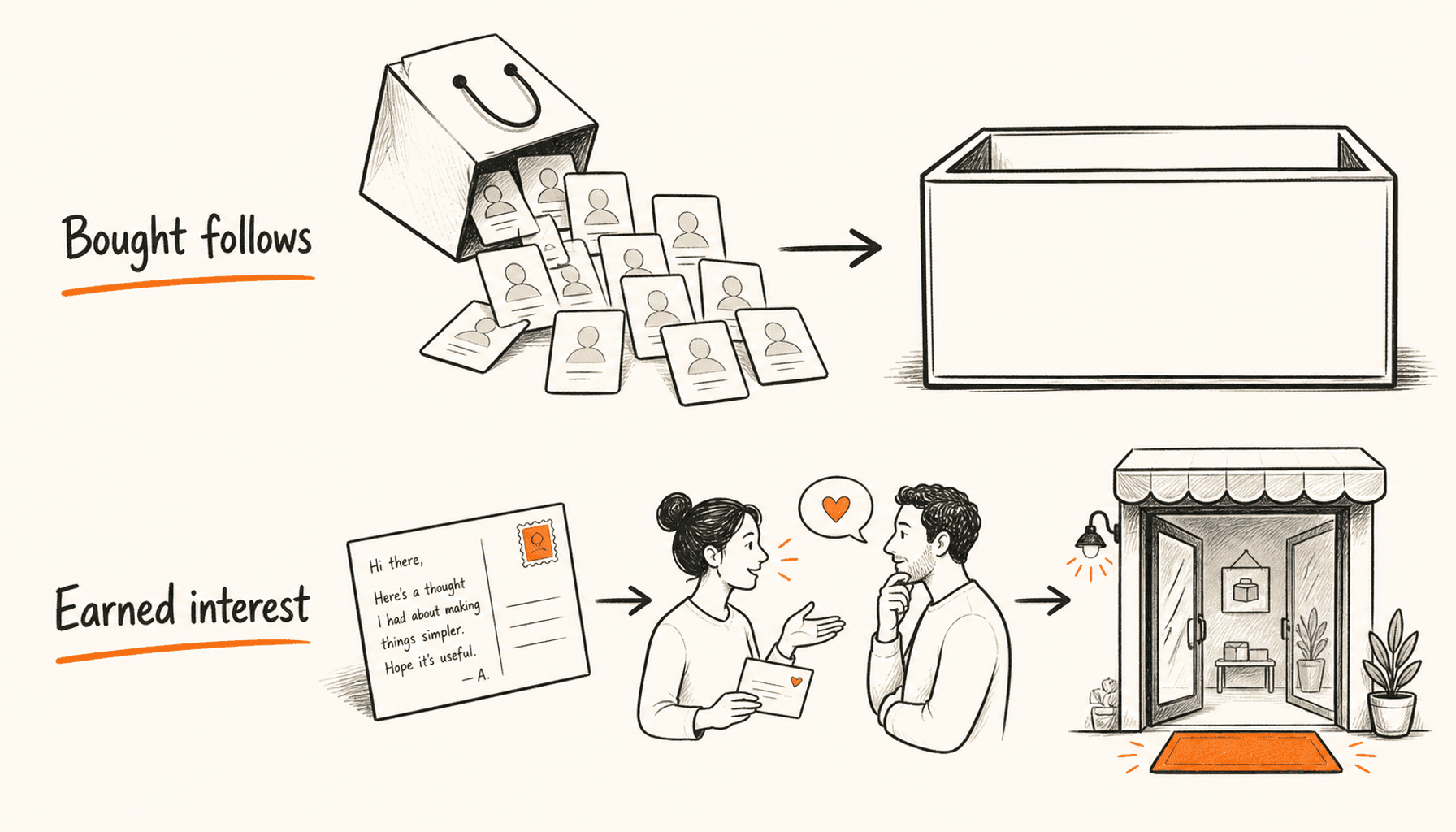
Start by naming the reader you want and the problem they know they have. An invoicing tool, an analytics product and a design agency should not all post the same generic productivity tips just because they get likes.
Pick a few topics where you have real proof to share. Write about a decision, a trade-off, an example or a mistake you know well. Make the post useful before you ask anyone to visit your product.
Find conversations where people already talk about those topics. Read enough to get the context. Reply when you can add something. You do not have to comment on every post that looks relevant. One thoughtful reply teaches you more than a pile of "great post" replies.
Post at a pace you can keep up, and check how people respond. If the right people read but do not click, try a clearer offer. If few of the right people see the post, try a more specific topic or find better places to show up. Buying followers fixes neither.
For a step-by-step starting point, read our guide to getting your first 100 followers on X.
Where ClimbX fits in that alternative
ClimbX helps with the work that makes people choose to follow you. Inspiration shows you post patterns that work in your niche. Studio turns your ideas into drafts in your voice. Engage finds conversations worth joining. Scheduling sends out the posts you approved.
Use them in a small routine you can repeat. Pick an idea a future customer would care about. Add your own proof. Edit the draft and schedule it. Then check the replies and results to decide what to post next. ClimbX helps with the work. It does not sell followers, and it cannot make people care about an unclear offer.
Judge the results by attention from the right people and by business results. More activity is not progress on its own. ClimbX does not guarantee followers, customers or safety from X's penalties. It gives you a simple way to research, write and post steadily, while you make the calls.
See the ClimbX workflow for founders, or try the free AI tweet generator to start with an idea you can check before you post.
Give people a reason to follow you.
ClimbX helps you find ideas, turn your experience into drafts and post steadily. Write useful posts for real people. Skip the follower package.
Frequently asked questions
Can buying real followers be different from buying bots?
The accounts may differ. But a seller calling them real does not prove they care about your posts. Look at how the followers are delivered and what X's rules say. Ignore the word on the package.
Will buying followers guarantee a suspension?
No. We found no reliable source showing every purchase leads to suspension. But it breaks X's written rules, and that is reason enough not to do it. We do not make up ban odds.
Is paying for ads the same as buying followers?
No. An ad shows your posts to people, and they decide whether to follow. A follower package just adds to a number. Ads still have to follow X's rules. They also have to bring in enough real response to be worth the money.
Do I need a large follower count before promoting my product?
No. You need an offer that fits the reader and a reason to trust it. A big audience helps more people see it. It does not make the offer fit. You can post a useful example and a clear next step while your account is small.
Should I buy followers first and use ClimbX afterward?
No. Start with the audience you have. Use ClimbX to find ideas, draft posts you review, schedule them and learn from the replies. You do not need to buy a big number first.
Read next
- Auto Follow Bot for Twitter (X): How It Works and Alternatives - Looking for an auto follow bot for Twitter or X? See how follow-back tools work, what to check before connecting one, and an alternative for relevant growth.
- Twitter (X) Automation: Tools, Rules, and Better Workflows - Compare Twitter automation workflows: scheduled posts, AI drafts, automated replies, and follow bots. Learn what X permits and where human review matters.
- Buy Twitter (X) Likes: What to Know Before You Pay - Considering buying Twitter or X likes? Learn what like packages deliver, how they affect your feedback, and alternatives for reaching relevant readers.
- Twitter (X) Engagement Pods: How They Work and Alternatives - Considering a Twitter engagement pod? Learn how reaction groups work, how they differ from peer feedback, and what to check before joining.
- Copy Viral Tweets: What Works and What to Do Instead - Want to copy a viral tweet to grow on X? Learn which structures you can study, why copied posts disappoint, and how to create an original version.
- How to Grow on X in 2026: The Complete Playbook - An evidence-backed guide to growing on X in 2026: profile, content, replies, cadence, analytics, the algorithm, and a 30-day plan.
Sources
- Authenticity policy - Official documentation checked September 5, 2026.
- Following FAQs and follower counts - Official documentation checked September 5, 2026.
- Third-party app access and sessions - Official documentation checked September 5, 2026.