
The short version
Twitter automation tools can save you time on research, drafts, scheduling and account activity. The real question is which decisions the tool makes for you. Posting something you approved is fine. Picking strangers to follow or sending replies you never read is a different story. This guide covers the main workflows, what X allows today, and where ClimbX says a person should stay in control.
Scheduling a post you already reviewed is fine. X allows some automated posting. The mistake is reading that as a green light to let a bot run your whole account.
This guide keeps what X says apart from what we recommend. X says some actions can get you restricted or suspended. X does not publish a ban rate for any tool. We will not make one up.
What does fully automated X growth mean?
Here it means a tool that picks topics, writes claims, posts and talks to other accounts with nobody checking. A dashboard may let you set a niche or tone once. That is not the same as reading each reply in the conversation it lands in.
A simple test: what can the tool do while you sleep? Can it promise a product feature? Answer a complaint? Follow people you would not pick? Repeat something it got wrong? If yes, the risk is bigger than a clumsy post.
| Workflow | Who makes the consequential decision? | Our position |
|---|---|---|
| Research assistance | You choose which findings to trust | Useful with source checks |
| AI draft suggestions | You approve the meaning and wording | Useful with review |
| Scheduling approved posts | You choose the post and publishing time | Reasonable with a queue you can pause |
| Unattended posts and replies | A system speaks before you review it | We do not recommend it |
| Automated follower or engagement growth | A system selects relationship actions | We do not recommend it |
Which automation behaviors does X restrict?
X's automation rules ban automated likes and automated replies nobody asked for. Allowed reply automation has to meet specific conditions. The rules also say that connecting an app through OAuth is not enough consent for automated actions. Using the official API does not make every workflow OK. The API itself no longer allows follows, likes or replies nobody summoned. Costs and limits: X API limits.
Its authenticity policy covers faked engagement, bulk spam and misleading account behavior. It looks at what your account does. It does not care much which tool wrote the text.
| What you automate | X automation rules (April 2026) |
|---|---|
| Scheduling your own posts | Allowed, if the posts are not spam or duplicates |
| Automated reposts | Allowed in moderation; bulk or aggressive reposting is not |
| Replies to people who opted in (replied to you, messaged you) | Allowed: one per interaction, with an easy opt-out |
| Replies found by keyword search | Not allowed |
| AI reply bots | Only with prior written approval from X |
| Automated likes | Not allowed |
| Bulk follow or unfollow | Not allowed; apps that promise more followers are banned outright |
| Scripting the X website instead of the API | Not allowed; can mean permanent suspension |
| Unsolicited automated DMs | Not allowed |
The pattern: automation that publishes what you wrote is fine. Automation that pretends to be you talking to other people (likes, replies, follows, DMs) is where accounts get flagged.
For follow-specific examples, see our companion article on auto-follow risks. Thinking about a new tool? Write down what it actually does. Check each action against the rules above. A "safe" label on the website does not replace that check.
Can automation get your account banned?
Yes. X states that violating its automation rules can result in account suspension. Its suspended-account guidance also lists spam, security issues and abuse as reasons for suspension. A restriction on its own does not prove AI writing caused it.
Keep this in mind when tool makers share stories. One bot running for months without trouble does not prove it follows the rules. One suspended account does not prove every scheduled post is dangerous.
What we can say is simpler. A tool that keeps doing banned things puts your account at risk of the penalties X lists. If your network and reach live on that account, that is a bad trade for a bit of saved time. That is our judgment. It is not a measured prediction.
Why unattended publishing is risky even without a suspension
A post is something you said. A reply is something you said to someone. Both need context that a general prompt can miss.
Say you tell an assistant you are looking into a new integration. A bot posts that the integration is live. The post reads well, but it is wrong. A quick review catches that before readers act on it.
Now say a customer posts about a lost invoice. A cheerful generic reply can look like you do not care. A good reply might mean checking their account, saying you are not sure yet, or moving it to support. Matching your tone does not tell a bot which one to do.
You also stop learning. If you never read the conversations your account starts, you miss the objections, words and examples that would make your product and your next post better. Handing every conversation to a bot can take away much of the reason you joined X.
These examples show why we recommend review. They do not mean every AI draft fails. A human check does not guarantee a good result either.
Scheduled posts are not the same as an unattended account
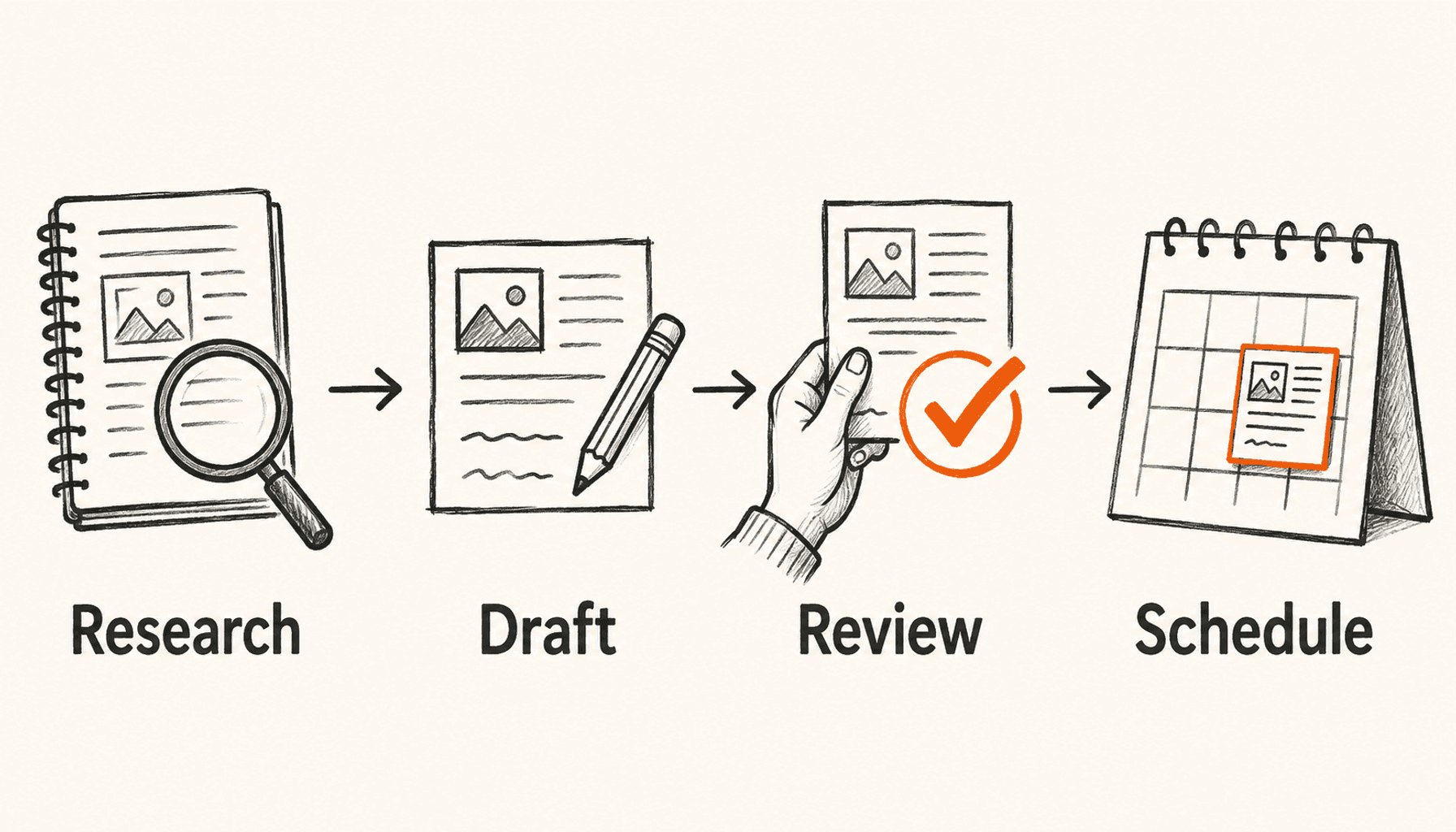
A scheduler holds a post you picked and sends it at a time you picked. X's automation rules allow that. You do not need to press Publish yourself at that exact minute.
Your job does not end when you approve it, though. A promo post can look bad if your service goes down that day. A timely claim can go stale. Keep your queue where you can see it. Know how to pause it. Check posts again when things change.
Before you approve a post, ask four questions:
- Is it true, and do I know where it came from?
- Is this what I actually think or went through?
- Does the post make sense at its scheduled time?
- Would I stand behind it if the person mentioned read it now?
For delivery mechanics, see how to schedule posts and threads on X.
How to reduce your exposure if you already use a bot
First, list everything that can act on your account: the app dashboard, scheduled jobs, browser extensions and any agent connected through an API. Pausing one of them can leave another one running.
Pause any bot posting and engagement. Read what is in the queue before you turn approved posts back on. X's third-party app guide shows how to see which apps are connected and remove their access. It also shows how to check your active logins.
Got a warning? Do what it says. Got suspended? Use the official appeal. Write down what happened. Do not count on a fixed recovery time, and do not assume deleting posts undoes a penalty. Ouraccount suspension guide is a good place to start.
What ClimbX recommends instead
Use automation where the output is still a draft or a suggestion. Let it gather research, pull up examples, suggest other openings and sum up your results. Then you decide what goes public.
Pick your replies on purpose. Read the post and the replies under it. Add something you can back up. If you have nothing useful to add, move on. Not every conversation needs your reply.
ClimbX helps with research, drafts and scheduling. AI drafts posts and replies. You edit and approve what goes out. ClimbX never likes, follows or DMs for you, and never replies to other people for you. That holds whether you use the app, the API or an AI agent. We do not recommend fully automated growth, auto-follow loops or making banned activity look human.
Permission to post is not the same as payout eligibility
X's Original Content Rewards guidance says content made or posted by automated means does not qualify for payouts. That is a payout rule. It does not mean all scheduled posting breaks X's general automation rules.
Want to earn money from X? Check the current program rules before you decide how to write and send your posts. Approving each post is a good habit. It does not guarantee an AI-assisted or scheduled post qualifies for payouts. Only X decides that, not ClimbX.
A practical ClimbX routine with review built in
Start with something real: a customer question, something you learned while building, or a pattern from Inspiration. Use Studio to try a few ways of saying it. Check the facts. Rewrite anything that does not sound like you. Then schedule it.
Next, open the conversations you want to join. Engage helps you find them. Read the thread before you decide to reply. Make your reply about that person and that topic. If you have nothing to add, skip it.
Last, look at what you posted. Let the responses guide your next topic. Do not just tell an agent to make more of whatever got the most engagement. One real customer question can be worth more than a busy thread that has nothing to do with your business.
See the ClimbX workflow for founders. If you are still exploring the writing process, the free AI tweet generator lets you work on a draft before you connect anything. The goal is to prepare better and post more steadily, with you making the calls.
Let ClimbX help with the preparation. Keep the final say.
Find ideas, shape drafts in your voice and schedule the posts you approve. Build a writing routine you can repeat, without handing your account to a bot.
Frequently asked questions
Is AI-written content automatically against X's rules?
No. What matters is the content and how you use it. A draft you reviewed is one thing. A bot sending replies nobody asked for is another. Using AI does not make a post safe, and it does not make it a violation either.
Can a tool guarantee that my account will not be suspended?
No. Only X decides who gets suspended. A tool you can trust tells you what it does and where its limits are. It does not promise you are safe.
What about useful bots and opted-in automated responses?
Some automation is allowed under X's rules. A bot account with one clear job is fine. A founder handing their voice and relationships to a bot is a different call. We advise against that. We do not claim every bot is banned.
Does human approval make every action safe?
No. You still need to check what it says, who it goes to and what it does. Approving keeps you responsible and catches mistakes. It does not put you above X's rules.
Does ClimbX recommend fully automating an X account?
No. Get help with research and drafts. Approve what gets scheduled. Stay in your own conversations. Saving time is great, as long as you still know and stand behind what your account does.
Read next
- Auto Follow Bot for Twitter (X): How It Works and Alternatives - Looking for an auto follow bot for Twitter or X? See how follow-back tools work, what to check before connecting one, and an alternative for relevant growth.
- Buy Twitter (X) Followers: What to Know Before You Pay - Thinking about buying Twitter or X followers? Understand what follower packages deliver, account risks, and alternatives for attracting people who care.
- Buy Twitter (X) Likes: What to Know Before You Pay - Considering buying Twitter or X likes? Learn what like packages deliver, how they affect your feedback, and alternatives for reaching relevant readers.
- Twitter (X) Engagement Pods: How They Work and Alternatives - Considering a Twitter engagement pod? Learn how reaction groups work, how they differ from peer feedback, and what to check before joining.
- Copy Viral Tweets: What Works and What to Do Instead - Want to copy a viral tweet to grow on X? Learn which structures you can study, why copied posts disappoint, and how to create an original version.
- How to Grow on X in 2026: The Complete Playbook - An evidence-backed guide to growing on X in 2026: profile, content, replies, cadence, analytics, the algorithm, and a 30-day plan.
Sources
- Automation rules - Official documentation checked September 5, 2026.
- Original Content Rewards - Official documentation checked September 5, 2026.
- Authenticity policy - Official documentation checked September 5, 2026.
- Suspended-account guidance - Official documentation checked September 5, 2026.
- Third-party app access and sessions - Official documentation checked September 5, 2026.