
The short version
Copying a viral tweet looks like a quick way to borrow a format that already attracted attention. But its words are only one part of its success: the author, evidence, audience, and timing matter too. This guide explains what you can learn from a strong post, where copying stops being useful, and how to turn a pattern into your own contribution.
ClimbX publishes this guide and offers a paid research and writing service. Policy sources checked September 5, 2026.
A viral post looks like an answer key. The opening worked, the replies are visible, and the structure seems simple enough to reuse. When your own page is quiet, reproducing it can feel less risky than writing from scratch.
But the visible text is only part of the situation. The author, audience, evidence, timing, and prior relationships all shape how a post is received. This guide explains what you can learn from a strong example and where imitation stops being useful.
Why the same words can produce a different result
A product founder announcing a lesson after years of public work brings context that a new account does not inherit. Readers may know the product, remember the earlier decision, or trust the author's history. Copying the announcement does not copy those relationships.
The same applies to a claim supported by a distinctive example. If the example is what makes the post valuable, changing the opening while keeping someone else's story does not supply your own evidence. It may leave you unable to answer the follow-up questions the post attracts.
Treat performance as a reason to inspect an example, not proof that its sentences are universally effective. Ask what made it worth reading and which part you can honestly reproduce through your own work.
| What you notice | A useful thing to learn | What to avoid |
|---|---|---|
| A clear opening | How quickly it establishes the problem | Reusing a distinctive sentence as your own |
| A concrete example | What evidence makes the point credible | Claiming the author's experience |
| A before-and-after structure | How the change is explained | Swapping a few words around copied facts |
| A strong discussion | Which questions readers care about | Assuming the reply count transfers to you |
| A concise conclusion | How it connects the example to a lesson | Presenting a borrowed lesson as a personal result |
What X's rules say about copied content
X's search guidance warns that repeatedly publishing duplicate or near-duplicate content can affect search visibility. That is different from saying every familiar sentence or common format automatically receives a penalty.
X's Original Content Rewards guidance also excludes copied and minimally changed work from its definition of original content. That is a monetization rule, not a guarantee about how every post will rank. Attribution and originality are separate questions; naming a source does not turn a near-copy into your own contribution.
This article is about an editorial decision, not a legal determination about a particular post. If you want to reuse someone else's work, consider the necessary permission and the platform's rules separately from whether it might get engagement.
Inspiration, quotation, and copying are different jobs
If you want people to see another creator's post, use the platform's sharing features. X documents Reposts and Quote posts, which preserve a connection to the original instead of making the content appear to originate from you.
If you want to analyze the post, make your contribution explicit. Explain what you agree with, what the example leaves out, or how the idea applies in a different situation. The contribution needs to be substantive enough that the reader understands why your post exists.
If you are using it as private inspiration, reduce it to a structural note. For example: specific problem, unexpected decision, evidence, lesson. Then close the source and write from a real problem you understand. That helps separate the mechanism from the sentences.
Why changing a few words is not a strategy
A paraphrase can retain the source's central idea, sequence, example, and conclusion even when individual words change. Asking an AI to make it sound different does not necessarily create a new contribution.
The practical weakness is dependence. If you cannot explain why the claim is true or where the example came from, the draft is not ready to carry your name. A polished voice can conceal that weakness from you until someone asks a specific question.
A better prompt begins with your material. Give the assistant your notes, the actual result, the limitation, and the reader's problem. Ask it to organize those inputs or propose alternative openings. Inspect the result for claims it added without support.
Turn a pattern into an original post
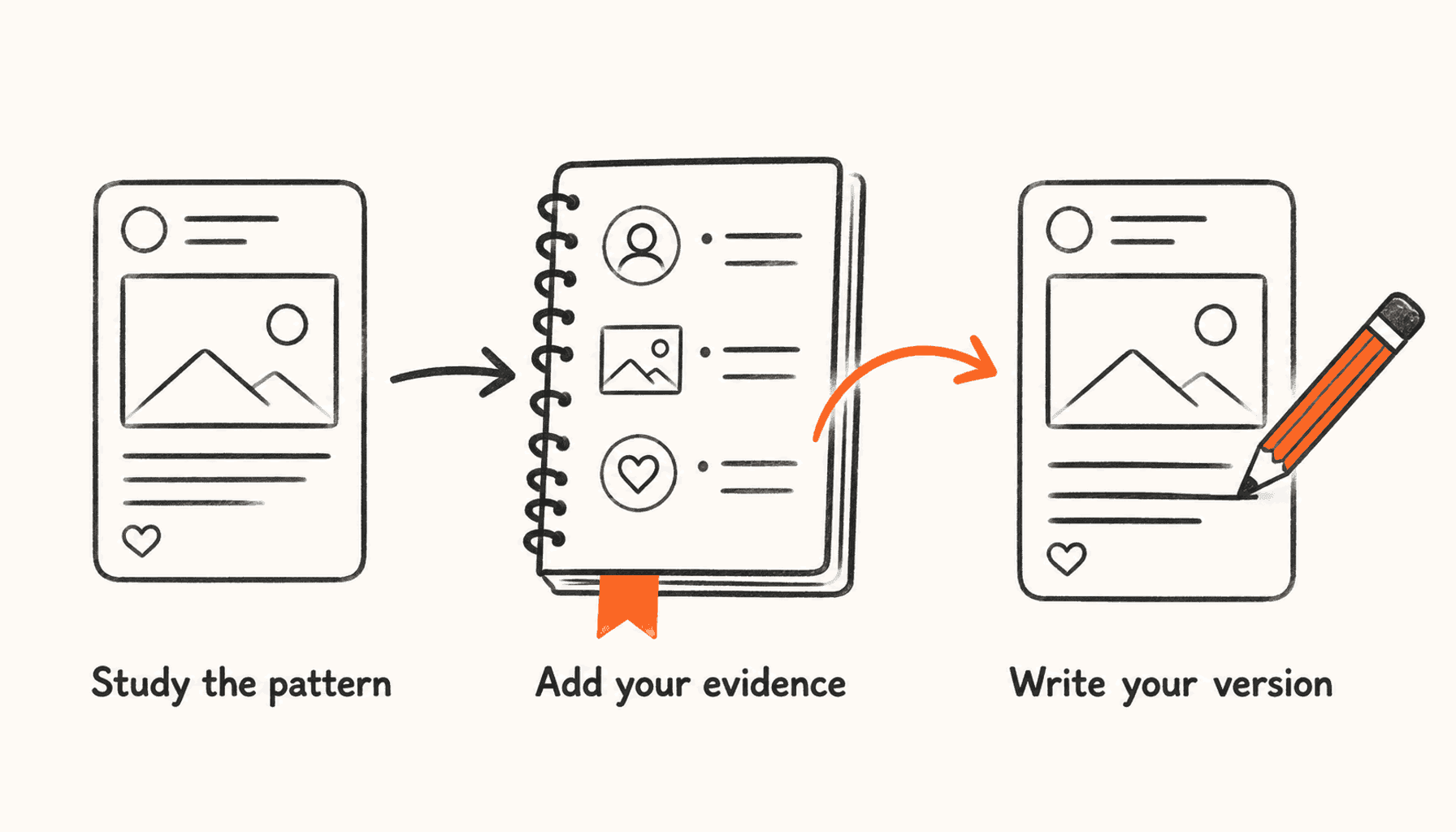
Start with a hypothetical reference pattern: a creator explains an unpopular product decision, gives evidence, and shows what changed. The reusable element is the explanation structure. The creator's decision and result belong to their story.
For your version, choose a decision you actually made. Perhaps you removed a confusing onboarding step after watching users hesitate. Describe what you observed and what you changed. If you have not measured the effect yet, say that rather than borrowing a conversion improvement from another post.
The draft can still be interesting without a dramatic number. A specific observation and an honest unresolved question often give readers more to discuss than a borrowed success claim. What matters is that you can account for every part of it.
- Identify the structural pattern in plain words, without copying the original sentences.
- Choose your own event, observation, or evidence that fits the problem.
- State what you know and what remains uncertain.
- Write the explanation for a reader who lacks your background context.
- Check the result against the source for borrowed wording or examples you did not intend to reuse.
Use content research to understand readers
The best research question is not which post you can reproduce next. It is which problem keeps producing useful discussion among the people you want to reach.
Read the replies as well as the post. Look for confusion, disagreement, and requests for examples. Those can suggest an original follow-up based on your experience. Do not assume that a highly visible author's audience is identical to your own.
Keep a small idea library with the source, the general pattern, and your potential contribution in separate fields. That distinction makes it easier to credit a source where appropriate and to reject an idea when you do not have anything to add.
For a broader research process, read how to research social media content.
How to use ClimbX without copying creators
Inspiration is a starting point for analysis. Inspect a relevant example, identify the pattern, and decide whether you have your own material that belongs in that format. A large engagement count does not make a post a script you should reuse.
In Studio, supply the actual example you want to explain. Ask for drafts that organize that material in your voice, then verify the facts and edit the phrasing. Reject drafts that invent experience, borrow a distinctive story, or claim results you did not achieve.
Schedule the version you have reviewed. After publication, read the questions and use them to decide what to explain next. The workflow becomes more valuable when it helps you express your own knowledge consistently, rather than making you a faster imitator.
See the ClimbX workflow for founders, or work on an original idea with the free AI tweet generator. ClimbX cannot transfer another account's reputation or guarantee its results. It can help you prepare and publish work you can stand behind.
A final check before you publish
Read the draft without the reference beside it. Can you explain where every claim came from? Would the post still be useful without the borrowed example? Is your contribution clear to a reader who also knows the original?
If the answers are weak, return to the material. You may need to collect a better example, ask a real question, or share the original with commentary instead. Choosing not to publish a thin imitation is a useful editorial decision.
Turn inspiration into something only you could write.
Bring your own examples and evidence to ClimbX. Explore drafts, refine your voice, and schedule the version you are ready to stand behind.
Frequently asked questions
Can I use the same format as a viral tweet?
You can learn from broad structures such as a before-and-after explanation or a practical checklist. Supply your own wording, evidence, and point of view rather than treating the source's story as interchangeable content.
Does crediting the author make copied text original?
No. Attribution identifies a source; it does not create a new contribution by itself. Use appropriate sharing, quotation, or permission and make the purpose of your own post clear.
Can AI turn someone else's post into my original content?
Changing the wording is not enough. Start with your own notes and evidence, then use AI to help organize or refine them. You remain responsible for what the draft says.
Does ClimbX recommend copying high-performing posts?
No. Use performance to find examples worth studying. Then identify a useful pattern and write something grounded in your own experience and the reader's problem.
Read next
- Auto Follow Bot for Twitter (X): How It Works and Alternatives - Looking for an auto follow bot for Twitter or X? See how follow-back tools work, what to check before connecting one, and an alternative for relevant growth.
- Twitter (X) Automation: Tools, Rules, and Better Workflows - Compare Twitter automation workflows: scheduled posts, AI drafts, automated replies, and follow bots. Learn what X permits and where human review matters.
- Buy Twitter (X) Followers: What to Know Before You Pay - Thinking about buying Twitter or X followers? Understand what follower packages deliver, account risks, and alternatives for attracting people who care.
- Buy Twitter (X) Likes: What to Know Before You Pay - Considering buying Twitter or X likes? Learn what like packages deliver, how they affect your feedback, and alternatives for reaching relevant readers.
- Twitter (X) Engagement Pods: How They Work and Alternatives - Considering a Twitter engagement pod? Learn how reaction groups work, how they differ from peer feedback, and what to check before joining.
- How to Grow on X in 2026: The Complete Playbook - An evidence-backed guide to growing on X in 2026: profile, content, replies, cadence, analytics, the algorithm, and a 30-day plan.
Sources
- X search rules and restrictions - Official documentation checked September 5, 2026.
- X Original Content Rewards - Official documentation checked September 5, 2026.
- X Reposts and Quote posts - Official documentation checked September 5, 2026.