The short version
Paste the full destination URL into the X composer, add a reason to open it, and review the post before publishing. X wraps links through t.co and counts a URL as 23 characters. Sharing a post link and editing your profile website are separate actions.
The link has two jobs: take the reader to the right page and set an honest expectation about what they will find. This guide covers the mechanics, then a short launch check you can use before sending people to a tutorial, feature page, or signup flow.
Choose the next step
| Your task | Start here |
|---|---|
| Share a website | Paste its URL into a post and explain the destination. |
| Share an existing post | Use the post’s Share control and copy its link. |
| Share your profile | Use the profile address for your current handle. |
| Add your business website | Edit the website field in your profile. |
Post a link with a clear reason to click
Copy the destination address from the actual page, paste it into the composer, and write the useful part of the message around it. X’s automatic t.co handling means a long URL is counted as 23 characters in a post. You do not need another shortener just to reduce that count.
Say what is behind the link. “The checklist we use before releasing a pricing change” gives a reader a decision. “Check this out” makes the reader do the work of guessing whether it matters.
Copy the right post or profile URL
For an existing post, use its Share control and copy the post link. This preserves the reference to that specific conversation. A profile link points to the account and is a poor substitute when someone needs the exact explanation you are discussing.
Check your current handle before sharing a profile address. If you recently changed it, update website footers, email signatures, and launch documents that still point to the old identity.
| Link type | What it points to | Typical mistake |
|---|---|---|
| Website URL | The page you want readers to use. | Linking to the homepage when the post promises a specific guide. |
| Post URL | One particular X post and its conversation. | Sharing the author’s profile instead of the post. |
| Profile URL | The account identified by its current handle. | Keeping an old handle in a website footer. |
| Profile website field | The external destination chosen in your profile. | Leaving an expired campaign or private preview link. |
Check a link preview as a separate part of the post
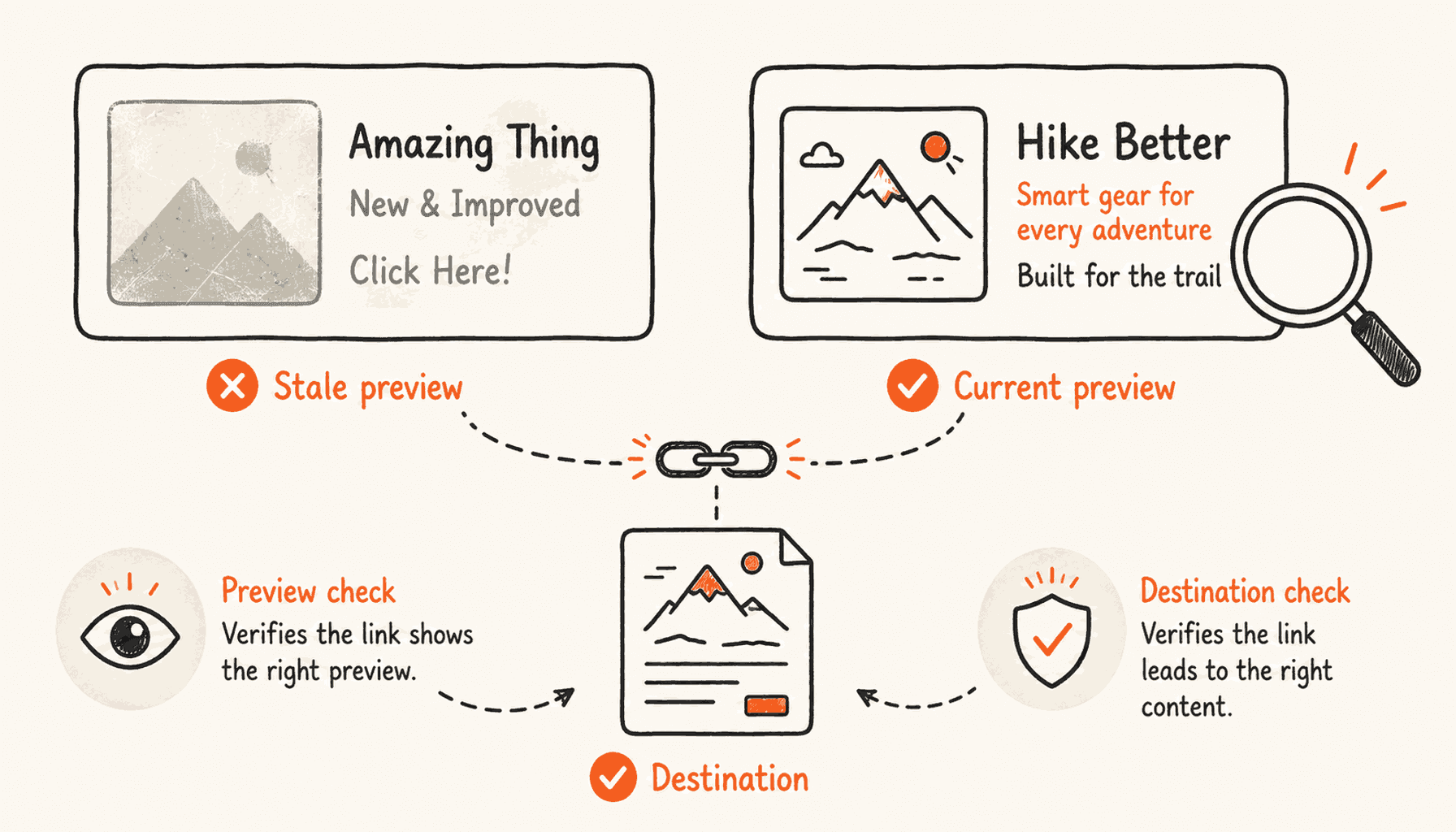
Before publishing an important announcement, inspect the preview if one appears. Does its headline describe the page you are sending readers to? Does the image still show an old product name or price?
If the card is missing or stale, first open the destination directly and check that the page loads. If you own the website, inspect its title, description, and social-card metadata. Preview behavior can involve caching; repeatedly changing the post wording is not a reliable fix for a website metadata problem.
Make the written post understandable even without the card. A link preview is a useful supplement, but the message should still explain the destination if a client renders it differently.
If the preview looks wrong, isolate the problem
Separate destination access from card appearance. If the URL opens the wrong page, fix that before debugging the image. If the destination is correct but the card is stale, inspect the website’s social metadata and any recent page changes.
For example, a launch post might link to a new feature page while its preview still advertises last month’s offer. The text and destination can both be correct while the preview misleads the reader. Make the website metadata consistent, then check the final result; do not assume editing the caption updates a cached card.
If you do not control the destination, you may not be able to fix its preview. Write a self-contained explanation of the resource and avoid claiming a particular card will appear for every reader. The useful outcome is a clear, working reference.
| What failed | Where to investigate |
|---|---|
| Wrong destination | The exact URL and redirects. |
| Works only for you | The page’s login and sharing permissions. |
| Wrong headline or image | The destination’s metadata and cached preview. |
| Readers do not understand the offer | The promise in the post and the landing page’s first screen. |
Run a small destination check before a launch
Open the final URL in a private browser window and on a phone. This catches a common mistake: linking to something that works only because you are already logged into your own account.
If the page deliberately requires login, say so when that affects the reader’s decision. Also check that redirects preserve the destination you intended. A working homepage is not necessarily the right landing page for a specific feature announcement.
- Does the page answer the promise made in the post?
- Can the intended reader access it?
- Does the primary action work at phone size?
- Are any tracking parameters free of personal or confidential data?
Measure the result you actually wanted
Choose a result before deciding whether to put the link in the main post or in a reply. For a tutorial, useful reading and follow-up questions may matter. For a signup page, completed relevant signups are a stronger signal than impressions alone.
Try a few comparable posts and keep notes about the topic, audience, and destination. Do not interpret one unusually successful post as proof of a universal rule about external links. Content, timing, and audience all changed alongside the placement.
A t.co link is not access control. X’s shortener does not make a document private; set the destination’s permissions appropriately before sharing it.
For a founder sharing a setup guide, keep a simple chain of evidence: the post promised a particular task, the page explained that task, and the reader either completed the next step or left. Use consistent, non-personal campaign labels if you track the link. Separate a visit from a trial start and a trial start from someone actually using the product.
Compare similar topics over a reasonable window. If one post linked to a tutorial and another linked to a generic signup page, the link placement is not the only thing that changed. Write down that difference before choosing a rule for the next batch.
Frequently asked questions
How many characters does a URL use on X?
X says URLs count as 23 characters, regardless of their original length.
Do I need a third-party URL shortener?
Not to reduce the X character count. X shortens links automatically through t.co.
Does a short link make a private document safe to share?
No. Access depends on the destination’s permissions, not on how short its URL looks.
Write a post that gives the link a reason to exist
Use ClimbX to develop the observation, evidence, and reader takeaway before adding the destination. Review the finished draft and schedule it as part of a consistent founder publishing routine.
Read next
- How to Write a Thread on X That People Finish - Write an X thread with a clear promise, useful sequence, credible evidence, readable pacing and a strong ending, plus structures, editing rules and examples.
- Why Your Build-in-Public Posts Get Likes but No Customers - Diagnose why X followers and build-in-public likes are not producing SaaS customers, then repair the audience, message, proof, offer, and conversion path.
Sources
- How to post a link - Posting URLs and their character count.
- X’s URL shortener - Automatic t.co handling and destination access.
- Find a post URL - Copying a link to an individual post.